

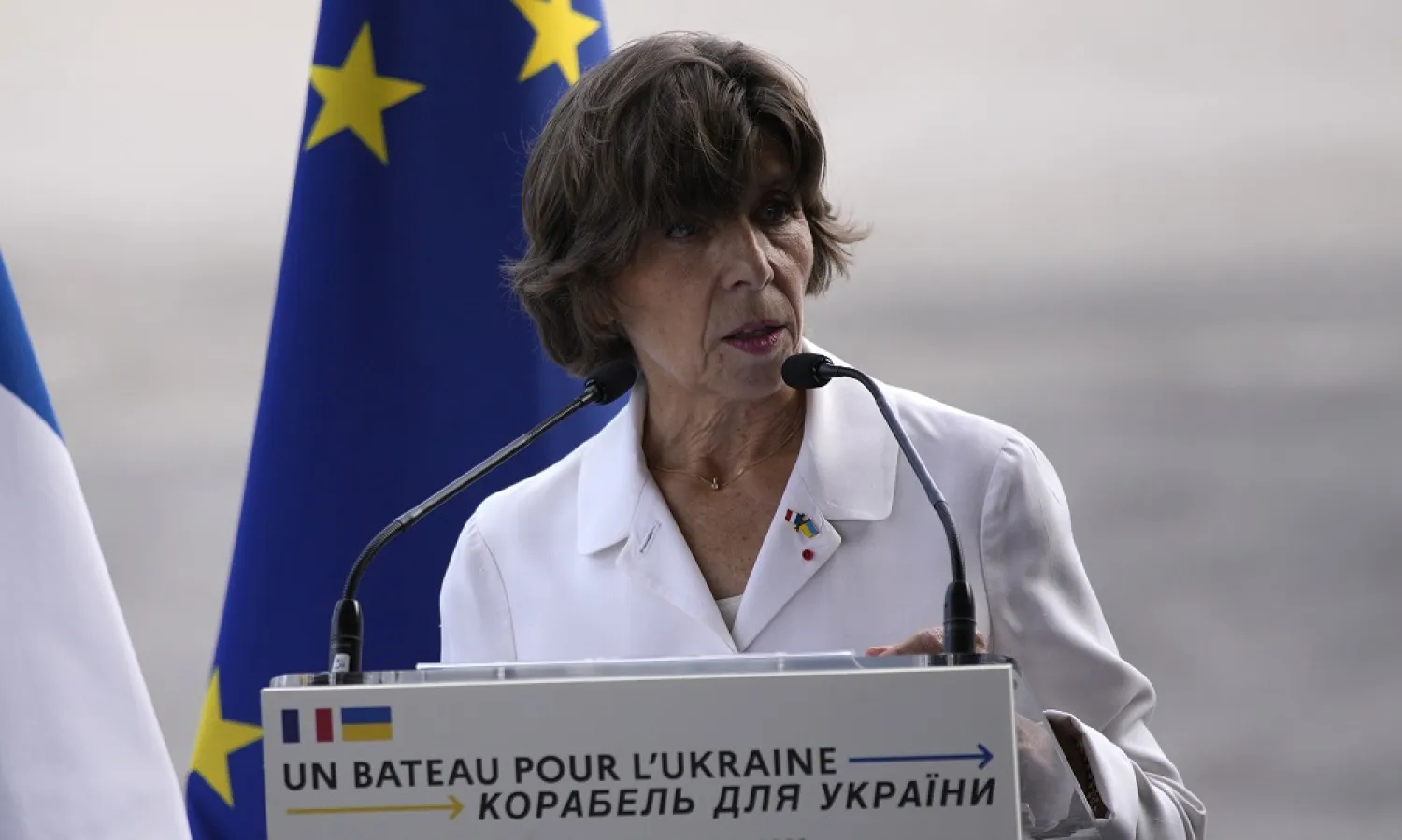

EU to Target Iranian Officials with Travel Bans, Asset Freezes, Says France

French Foreign Minister Catherine Colonna speaks after visiting the cargo ship for Ukraine Wednesday, Sept. 28, 2022 in the port of Marseille, southern France. (AP)
TT

EU to Target Iranian Officials with Travel Bans, Asset Freezes, Says France

French Foreign Minister Catherine Colonna speaks after visiting the cargo ship for Ukraine Wednesday, Sept. 28, 2022 in the port of Marseille, southern France. (AP)

France's foreign minister said on Tuesday that the European Union was looking to impose asset freezes and travel bans on a number of Iranian officials involved in the crackdown on protesters.

"France's action at heart of EU ... (is) to target those responsible for the crackdown by holding them responsible for their acts," Catherine Colonna told lawmakers in parliament, adding that the EU was looking at asset freezes and travel bans.

The bloc last agreed human rights sanctions on Tehran in 2021. No Iranians had been added to that list since 2013, however, as the bloc has shied away such measures in the hope of reviving a nuclear accord with Iran after the United States withdrew in 2018. Those talks have now stalled.

It currently has an array of sanctions on about 90 Iranian individuals which have been renewed annually every April.

Colonna suggested the new measures could target repressive regime figures who send their children to live in Western countries. Diplomats say the measures are expected to be rubber-stamped at an EU foreign ministers meeting on Oct. 17.

The United States and Canada have already imposed sanctions on Iran's morality police over allegations of abuse of Iranian women, saying they held the unit responsible for the death of a 22-year-old Mahsa Amini in police custody.

Amini, a Kurdish woman, was arrested by the morality police in Tehran for wearing "unsuitable attire" and fell into a coma while in detention. The authorities have said they would investigate the cause of her death.

Iran's supreme leader on Monday gave his full backing to security forces confronting protests ignited by the death of Amini, comments that could herald a harsher crackdown to quell unrest more than two weeks since she died.

Iran Human Rights, a Norway-based group, has said more than 100 people have been killed. Iranian authorities have not given a death toll, while saying many members of the security forces have been killed by "rioters and thugs backed by foreign foes".



Türkiye and Armenia Agree to Simplify Visa Procedures to Normalize Ties

Türkiye’s President Recep Tayyip Erdogan, right, and Armenia's Prime Minister Nikol Pashinyan shake hands before a meeting at Prague Castle in Prague, Czech Republic, Thursday, Oct. 6, 2022. (Turkish Presidency via AP, File)
TT

Türkiye and Armenia Agree to Simplify Visa Procedures to Normalize Ties

Türkiye’s President Recep Tayyip Erdogan, right, and Armenia's Prime Minister Nikol Pashinyan shake hands before a meeting at Prague Castle in Prague, Czech Republic, Thursday, Oct. 6, 2022. (Turkish Presidency via AP, File)

Türkiye and Armenia have agreed to simplify visa procedures as part of efforts to normalize ties, Türkiye’s Foreign Ministry announced Monday, making it easier for their citizens to travel between the two countries.

Relations between Türkiye and Armenia have long been strained by historic grievances and Türkiye’s alliance with Azerbaijan. The two neighboring countries have no formal diplomatic ties and their joint border has remained closed since the 1990s.

The two countries, however, agreed to work toward normalization in 2021, appointing special envoys to explore steps toward reconciliation and reopening the frontier. Those talks have progressed in parallel with efforts to ease tensions between Armenia and Azerbaijan.

Türkiye supported Azerbaijan during its 2020 conflict with Armenia for control of the Karabakh region, known internationally as Nagorno-Karabakh, a territorial dispute that had lasted nearly four decades.

The Turkish Foreign Ministry said in a statement posted on social platform X that Ankara and Yerevan agreed that holders of diplomatic, special and service passports from both countries would be able to obtain electronic visas free of charge as of Jan. 1.

“On this occasion, Türkiye and Armenia reaffirm once again their commitment to continue the normalization process between the two countries with the goal of achieving full normalization without any preconditions,” the ministry said.

Türkiye and Armenia also have a more than century-old dispute over the deaths of an estimated 1.5 million Armenians in massacres, deportations and forced marches that began in 1915 in Ottoman Türkiye. Historians widely view the event as genocide.

Türkiye denies the deaths constituted genocide, saying the toll has been inflated and those killed were victims of civil war and unrest. It has lobbied to prevent countries from officially recognizing the massacres as genocide.


Russia Says Ukraine Tried to Attack Putin's Residence so Moscow's Negotiating Stance under Review

Russian President Vladimir Putin chairs a meeting on the "special military operation" amid the ongoing Russia-Ukraine conflict in Moscow, Russia, December 29, 2025. Sputnik/Mikhail Metzel/Pool via REUTERS
TT

Russia Says Ukraine Tried to Attack Putin's Residence so Moscow's Negotiating Stance under Review

Russian President Vladimir Putin chairs a meeting on the "special military operation" amid the ongoing Russia-Ukraine conflict in Moscow, Russia, December 29, 2025. Sputnik/Mikhail Metzel/Pool via REUTERS

Russian Foreign Minister Sergei Lavrov said on Monday that Ukraine had tried to attack President Vladimir Putin's residence ‌in the Novgorod ‌region and so ‌Moscow's ⁠negotiating ​position ‌would be reviewed.

Lavrov said that on Dec. 28-29, Ukraine had attacked the Russian president's state residence in the Novgorod region with 91 long-range drones which were all ⁠destroyed by Russian air defenses.

"Such reckless actions will ‌not go unanswered," ‍Lavrov said, adding ‍that the attack amounted to "state ‍terrorism."

He said that targets had already been selected for retaliatory strikes by Russia's armed forces, Reuters reported.

Lavrov noted that the ​attack took place during negotiations about a possible Ukrainian peace ⁠deal and that while Russia would not leave the negotiations, Moscow's position will be reviewed.

Ukrainian President Volodymyr Zelenskiy said the accusation was a lie, adding that Moscow was preparing the ground to strike government buildings in Kyiv.

It was not immediately clear if Putin ‌was in the residence at the time.


Paris Metro Stabbing Suspect is French, Says Ministry

The attacks happened on a central line of Paris's metro, seen here in a file picture © JULIEN DE ROSA / AFP/File
TT

Paris Metro Stabbing Suspect is French, Says Ministry

The attacks happened on a central line of Paris's metro, seen here in a file picture © JULIEN DE ROSA / AFP/File

The suspect in the stabbing of three women in the Paris metro last week is French, the interior ministry said Monday, after previously saying he was an undocumented Malian ordered to leave the country.

A source with knowledge of the case, requesting anonymity because not allowed to speak to the press, said he had held a French passport since 2018, AFP reported.

The 25-year-old man was arrested on suspicion of having stabbed and injured three women along the Paris metro's Line 3 on Friday, then admitted to a psychiatric hospital the next day.

"The investigation uncovered a French passport belonging to the suspect," the ministry said, adding that he had not once mentioned his French nationality during previous run-ins with police.

The ministry said on Friday the man was a Malian citizen imprisoned in January last year for aggravated theft and sexual assault, and required to leave France after being released in July.

The man had been placed in an administrative detention centre, but failure to obtain a consular travel document required for his deportation meant he was released after 90 days as required by law, it said.

Interior Minister Laurent Nunez last week called for "maximum vigilance" during the festive season in France.