


In Mexico, Locals Try to Save Traditional ‘Mexican Caviar’

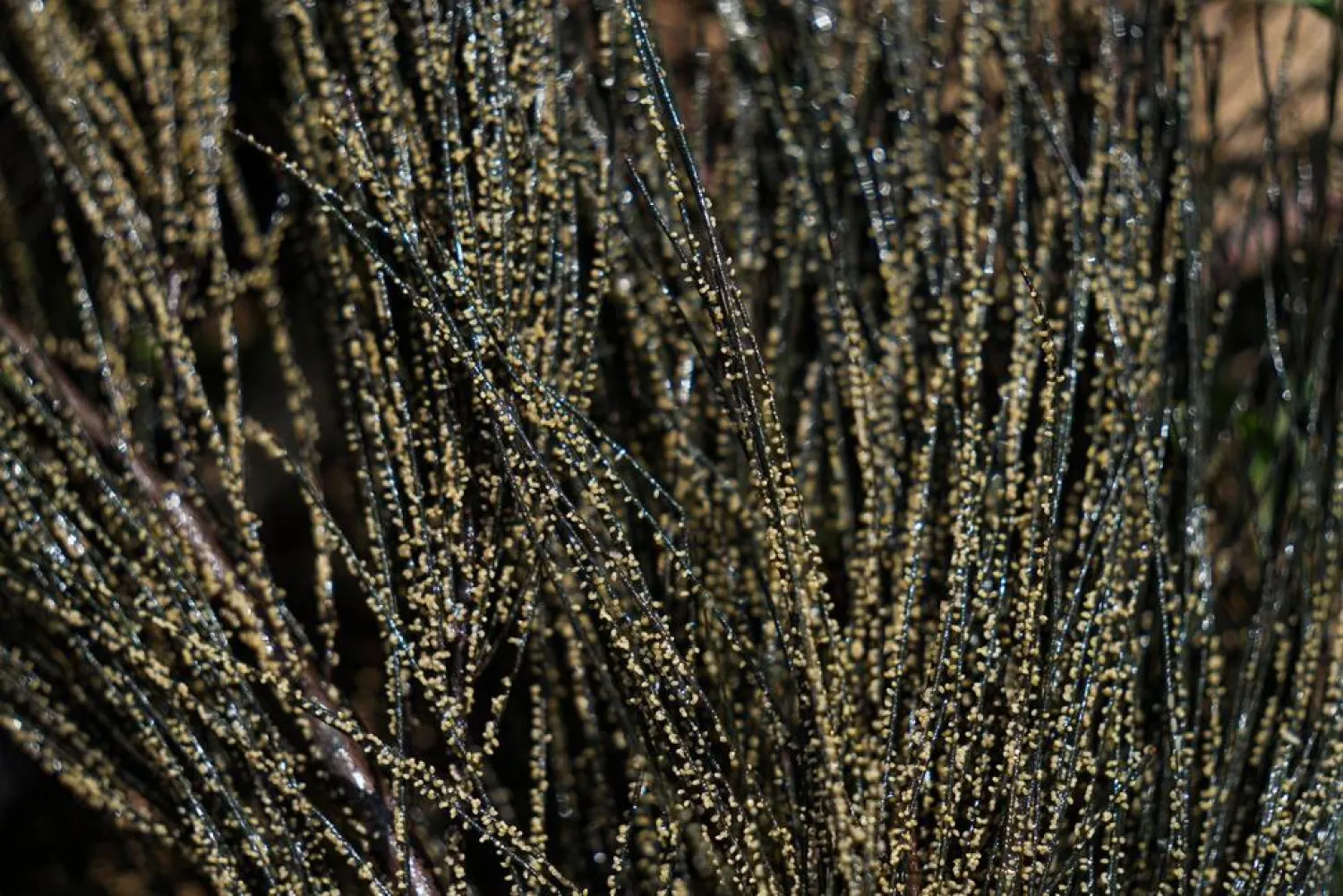
Ahuautle, the eggs of the axayacatl, a type of an aquatic insect, are seen attached to pine needles before being harvested at Lake Texcoco, near to Mexico City, Tuesday, Sept. 20, 2022. (AP)
TT

In Mexico, Locals Try to Save Traditional ‘Mexican Caviar’

Ahuautle, the eggs of the axayacatl, a type of an aquatic insect, are seen attached to pine needles before being harvested at Lake Texcoco, near to Mexico City, Tuesday, Sept. 20, 2022. (AP)

In a shallow lake on the outskirts of Mexico City, a handful of farmers still harvest the eggs of an evasive, fingertip-size water bug in a bid to keep alive a culinary tradition dating at least to the Aztec empire.

Caviar is typically associated sturgeons swimming the Caspian Sea, but the Mexican version is made from the tiny eggs of an aquatic insect of the corixidae family, also known as the “bird fly,” because birds like to eat it. Similar bugs are often known as “water boatmen” in English, because of the way they seem to row in ponds and streams.

The bug, which only occasionally surfaces before diving again in a trail of bubbles, would not look like food to most, but it was once important to the people of the Valley of Mexico.

For Juan Hernández, a farmer from San Cristóbal Nezquipayac, cultivating and collecting the tiny insect eggs known as “ahuautle” -- meaning water amaranth in Nahua -- is a way of life.

“For me, more than anything, it means tradition,” said the 59-year-old Hernández. He is one of only six people known to still harvest ahuautle, at least in the Texcoco area, they fear they may be the last.

The painstaking collection of “Mexican caviar,” known for its intense but delicate flavor, is threatened by the drying out of Lake Texcoco, development around the lakeshore and waning interest in the ingredient among younger generations, said Jorge Ocampo, agrarian history coordinator at the Center for Economic, Social and Technological Research on Agribusiness and World Agriculture in Mexico State.

Ocampo called the dish's survival an example of “community resistance,” similar to the way in which inhabitants around Lake Texcoco — a shallow, saline lake that once covered most of the eastern half of the Mexico City valley — have managed to preserve other traditions, festivals and ceremonies.

For Hernández, it's hard, dirty work that few are willing to do anymore.

Dressed in a hat, long-sleeved shirt, shorts and rubber boots, Hernández wades through the calf-high waters of Nabor Carrillo — a smallish lake formed from the remnants of Texcoco — to collect pine branches he had poked into the muddy lakebed the week before.

The branches serve as an anchor for the bird-fly bugs to deposit their eggs.

Under a blazing sun and accompanied by the calls of hundreds of herons, plovers and other migratory birds that stop at the lakes, Hernández gathers dozens of egg-coated sticks and lays them on a raft of styrofoam.

“We look for them along the edges of the lake, where the flies are more active,” Hernández said. He started as a young man, after a period of joblessness, joining about four dozen other local residents who used to work the lakes during the ahuautle season — the rainy period from June through September.

After about two hours, Hernández has gathered a heap of sticks covered with thousands of bird-fly eggs.

He returns to the edge of the lake to lay the sticks out to dry in the sun, which can take several hours or days, depending on the weather.

“Cleaning is a process that takes a lot of work,” said Hernández, as he rubs his hand over the sticks to remove the eggs, which he then places on a piece of cloth.

Later, he takes the eggs home and runs them through a sieve to remove any bits of pine bark or mud. Then he packs them in bags he offers for sale.

While Hernández takes care of collecting the eggs, restaurant owner Gustavo Guerrero serves them to customers at his eatery in the east-side borough of Iztapalapa.

One of Guerrero's favorite recipes is to mix the ahuautle with breadcrumbs and bind them with eggs to form a croquette, which he then fries and serves with green tomatillo sauce, nopal cactus and squash flowers — all pre-Hispanic ingredients.

“Eating this is like revisiting the past,” said Guerrero, 61. He says the flavor of the ahuautle reminds him of his childhood, when his mother cooked the dish according to a recipe she learned from her grandmother.

But Guerrero acknowledges that “Mexican caviar” is at risk of disappearing because younger generations aren't familiar with the dish, and ever-fewer people harvest it in the scarce remaining lakes where it is found.

Ahuautle is also at risk of becoming only a gourmet dish for the rich: A kilogram of the eggs can sell for the equivalent of $50 (roughly $25 a pound).

Insects, their eggs and larvae have been a part of Mexico's cuisine for hundreds or thousands of years. Edday Farfán, an entomologist at Mexico's National Autonomous University, said there are more than 430 species of edible insects in Mexico.

Farfán has been studying bird flies since 2016, and even has one tattooed on his arm.

Farfán said indigenous peoples living around the lakes adopted the insect eggs as a source of protein because prior to the Spanish conquest of 1521, they had few domesticated animals or livestock.

But now, Farfán said, the dish “is associated with the countryside, perhaps with poverty, as if it were an undesirable protein.”

Even those still familiar with ahuautle often consider the insects that produce it to be feed for chickens or turkeys, and may think of it literally as “for the birds.”

With the odds stacked against it, there is no guarantee that Mexican caviar will even be a choice for future generations.

“There are a lot of kids, young people who don't eat it anymore, they don't like it,” Hernández admits.

“Now we are just keeping ahuautle alive,” he said. “I hope it doesn't disappear, because it is a source in income for those of us who live off the land.”


Al-Qatif Street Food Festival Celebrates Saudi Culinary Arts

The event features six pavilions that allow visitors to explore a wide variety of foods and beverages made from local ingredients, reflecting the Kingdom’s diverse environments and regional flavors - SPA
TT

Al-Qatif Street Food Festival Celebrates Saudi Culinary Arts

The event features six pavilions that allow visitors to explore a wide variety of foods and beverages made from local ingredients, reflecting the Kingdom’s diverse environments and regional flavors - SPA

The Culinary Arts Commission launched Al-Qatif Street Food Festival, which runs until December 30, 2025, offering visitors a rich cultural experience that highlights Saudi culinary arts in a setting that reflects the authenticity and diversity of the Kingdom’s national cuisine, while reinforcing the presence of heritage within the contemporary cultural landscape.

The festival showcases Saudi food culture as a vital component of national identity through live cooking stations where traditional dishes are prepared and presented by culinary experts, SPA reported.

The event features six pavilions that allow visitors to explore a wide variety of foods and beverages made from local ingredients, reflecting the Kingdom’s diverse environments and regional flavors.

In addition to the culinary offerings, the festival presents a range of accompanying cultural experiences designed to enrich the visitor journey and encourage engagement with food as both an artistic and knowledge-based experience.

These include a dedicated children’s pavilion, interactive tasting spaces for dishes, and innovative beverage experiences inspired by Saudi agricultural products.


Want to Read More in 2026? Here's How to Revive Your Love of Books

A woman reads a book in the afternoon sun on a bench outside South Station in Boston, on Friday, May 31, 2024. (AP Photo/David Goldman, File)
TT

Want to Read More in 2026? Here's How to Revive Your Love of Books

A woman reads a book in the afternoon sun on a bench outside South Station in Boston, on Friday, May 31, 2024. (AP Photo/David Goldman, File)

People stop reading in adulthood for lots of reasons. But it’s never too late to turn the page on old habits and start again.

Curling up with a good book can reduce stress, increase creativity and boost empathy. A recent analysis of US government data found that the percentage of Americans who read for pleasure during an average day has fallen to 16% in 2023 from 28% in 2004. That includes not just books but audiobooks, e-books and periodicals like magazines, The AP news reported.

Some people say they're fatigued from years of assigned reading in school. Others don't have the time or would rather zone out by doom-scrolling on social media. And many just got out of the habit.

“It’s difficult for people who are really tired and busy to think about getting into reading if it’s not something they’re used to,” said Jacqueline Rammer, director of Menomonee Falls Public Library in Wisconsin.

For those looking to set reading goals or resolutions in 2026, here's how to get back into the habit.

Choose the right book When picking your next book, avoid dense nonfiction or a 500-page doorstop.

“Your first book should be something that you think will be joyful,” said Jocelyn Luizzi, a software engineer from Chicago who blogs about books.

Everyone's taste is different, so get recommendations from a variety of places including friends, booksellers and online communities like BookTok.

Rammer and her staff ask library visitors: What was the last book, TV show or movie that you really enjoyed? Then, they look for similar genres or themes.

Many libraries offer access to a service called NoveList which suggests “read-alikes” for various books and authors.

Set a reading routine To create a habit that sticks, “start by scheduling reading into your day,” said Gloria Mark, an attention span expert with the University of California, Irvine. Read five pages during a lunch break or right before bed.

If you're reading a physical book, Mark said to avoid distractions by keeping phones and laptops out of sight.

But experimenting with other formats can make reading more convenient. E-books are portable and audiobooks are a good candidate to accompany chores or the morning commute. You can likely access both for free by downloading an app called Libby and signing in with a library card.

Try to read in a quiet setting, but don't be afraid to make it a social activity. Many cities in the US and around the world host silent book clubs where people read their own books together in coffee shops and libraries.

Setting a reading goal for the year or joining a local library's winter reading challenge can help with motivation — but if it feels like added pressure, don't do it.

Shannon Whitehead Smith, a book blogger from the Atlanta area who also works in marketing, says scrolling through lists of other people's reads on social media and trackers like StoryGraph encourages her to keep the habit.

“Seeing all these other people reading motivates me to put my phone down and pick up this book that’s sitting beside me,” she said.

Feel free to skip a read if a book feels particularly sluggish, it's OK to put it down and start another. Reading “shouldn't feel like a burden,” said Jess Bone with University College London, who analyzed the survey data about American adults reading for pleasure.

Routine readers say the habit helps them stay curious and release the stress of the day. Rammer, the library director, reads mysteries rife with twists and turns, and romances that cycle through roller coasters of emotions.

Most of all, she likes books that end with a “happily ever after.”

“I think the guarantee of knowing that things are going to end up OK is really reassuring,” Rammer said.


Saudi Architecture and Design Commission Launches Graphic Design Association in Riyadh

The association aims to unify graphic design practitioners
TT

Saudi Architecture and Design Commission Launches Graphic Design Association in Riyadh

The association aims to unify graphic design practitioners

The Graphic Design Association has been launched in Riyadh under the patronage of the Saudi Architecture and Design Commission.

Sunday’s event, attended by officials and culture experts, marks a significant step in empowering graphic design talents.

The ceremony included a presentation outlining the association’s vision and operational plans for developing the graphic design sector. Key goals include supporting designers and enhancing their professional presence locally and internationally.

The association aims to unify graphic design practitioners, providing a framework that fosters skill development, stimulates innovation, and creates opportunities in the cultural sector.

Acting CEO of the Architecture and Design Commission Prince Nawaf bin Abdulaziz bin Ayyaf stressed that the association is vital for organizing the sector and improving professional practices, thereby enhancing its role in the cultural ecosystem.

The Graphic Design Association is one of the professional associations established under the Saudi Ministry of Culture, aimed at building an integrated system of organizations to empower practitioners across various cultural fields.
