NASA Kicked Asteroid Off Course in Test to Save Earth

The massive Vehicle Assembly Building where NASA’s powerful new 322-foot-tall moon rocket has been assembled for the unpiloted Artemis 1 mission, is reflected after a hard rain at the Kennedy Space Center in Cape Canaveral, Florida, US October 28, 2021. REUTERS/Thom Baur/Files
TT

NASA Kicked Asteroid Off Course in Test to Save Earth

The massive Vehicle Assembly Building where NASA’s powerful new 322-foot-tall moon rocket has been assembled for the unpiloted Artemis 1 mission, is reflected after a hard rain at the Kennedy Space Center in Cape Canaveral, Florida, US October 28, 2021. REUTERS/Thom Baur/Files

NASA on Tuesday celebrated exceeding expectations during a mission to deflect a distant asteroid, in a sci-fi like test of humanity's ability to stop an incoming cosmic object from devastating life on Earth.

The fridge-sized Double Asteroid Redirection Test (DART) impactor deliberately smashed into the moonlet asteroid Dimorphos on September 26, pushing it into a smaller, faster orbit around its big brother Didymos, NASA chief Bill Nelson announced.

That changed its orbital period by four percent, or 32 minutes -- from 11 hour 55 minutes to 11 hours 23 minutes, bettering an expectation of 10 minutes.

"At some point in the future, if we find an asteroid that is threatening to hit Earth, and would be large enough to really do some damage, thank goodness that we will have had this successful test," Nelson told AFP.

The asteroid pair loop together around our Sun every 2.1 years, and pose no threat to our planet.

But they are ideal for studying the "kinetic impact" method of planetary defense.

DART's success as a proof-of-concept has made a reality what was once science fiction -- notably films such as "Armageddon," "Deep Impact," and "Don't Look Up."

Never actually photographed before, Dimorphos, which is 530 feet (160 meters) in diameter or roughly the size of a big Egyptian pyramid, appeared as a speck of light around an hour before impact.

Its egg-like shape and craggy, boulder-dotted surface finally came into clear view in the last few moments, as DART raced toward it at roughly 14,500 miles (23,500 kilometers) per hour.

In the days that followed, astronomers rejoiced in stunning images of matter spreading out thousands of miles -- pictures collected by Earth and space telescopes, as well as a tiny companion satellite that traveled to the zone with DART.

Thanks to its temporary new tail, Dimorphos has turned into a man-made comet.

But quantifying just how well the test worked required an analysis of light patterns from ground telescopes, which took a few weeks to become apparent.

The binary asteroid system, which was around 6.8 million miles (11 million kilometers) from Earth at impact, is visible only as a single dot from the ground.

The dot's brightness changes as Dimorphos passes in front of Didymos, which is significantly bigger at half-a-mile wide.

Four optical telescopes were involved in measuring the orbital period -- all in Chile and South Africa -- while two US based radar telescopes helped confirm the finding, said NASA planetary scientist Nancy Chabot.

The test also showed scientists that the asteroid is less like a solid rock, and more like a "rubbish pile" of boulders bound by mutual gravity.

If an asteroid is more solid, the momentum imparted by a spaceship will be limited. But if significant mass is pushed at high velocity in the opposite direction to impact, there will be an additional boost.

"It looks like the recoil from the ejecta blast off the surface was a substantial contributor to the overall push given to the asteroid," said NASA scientist Tom Statler at a briefing.

The test will serve as an "anchor point" for simulations and calculations about the outcome of future impacts, he added.

No known asteroid larger than 140 meters (460 feet) in size -- big enough to devastate a city -- has a significant chance to hit Earth for the next 100 years, according to NASA.

But wait long enough, and it will happen.

The geological record shows, for example, that a six-mile wide asteroid struck Earth 66 million years ago, plunging the world into a long winter that led to the mass extinction of the dinosaurs along with 75 percent of all species.

The agency plans to launch in 2026 a telescope called the Near-Earth Object (NEO) Surveyor to better characterize potentially hazardous 140-meter asteroids and comets that come within 30 million miles.

So far, less than half of the estimated 25,000 NEOs of 140 meters have been discovered.

Kinetic impact with a spaceship is just one way to defend the planet, albeit the only method possible with current technology.

Should an approaching object be detected early, a spaceship could be sent to fly alongside it for long enough to divert its path via using the ship's gravitational pull, creating a so-called gravity tractor.

Another option would be launching nuclear explosives to redirect or destroy an asteroid.

NASA believes the best way to deploy such weapons would be at a distance, to impart force without blowing the asteroid to smithereens, which could further imperil Earth.


Saudi Reef: Coffee Production Reaches 7,400 Tons in 2026

The program also provides specialized training in organic farming, pest control, modern irrigation, and coffee cultivation - SPA
TT

Saudi Reef: Coffee Production Reaches 7,400 Tons in 2026

The program also provides specialized training in organic farming, pest control, modern irrigation, and coffee cultivation - SPA

The Sustainable Agricultural Rural Development Program (Saudi Reef) reported that Saudi coffee production rose from 800 tons annually in 2020 to approximately 7,400 tons in 2026, an increase of more than 825%, supporting Saudi Vision 2030 objectives.

Saudi Reef spokesperson Majed Al-Buraikan said the number of beneficiaries in the coffee sector exceeded 6,200 in 2026, up 207% from 2021, while total support surpassed SAR 185 million, SPA reported.

The funding supports small-scale producers, agricultural investment, and coffee value chains.

Al-Buraikan said approximately 4.4 million coffee seedlings are expected to raise production to more than 20,000 tons at full capacity.

The program also provides specialized training in organic farming, pest control, modern irrigation, and coffee cultivation.

Development efforts included producing 1,000 improved cuttings to enhance varieties and productivity, agricultural projects involving 8,000 coffee seedlings, and cultivation trials at 12 sites to expand cultivation and improve yields, quality, and sustainability.

The program’s 2026 targets included increasing annual production to 7,000 tons and raising self-sufficiency from 0.5% to 4.4%. Actual production exceeded the target, reaching 7,400 tons.


KAUST Unveils Landmark Coral Facility on Red Sea, Advancing Saudi Scientific Expertise and Marine Conservation

KCRI is designed to restore the Red Sea reefscape and offer a framework that coral restoration programs worldwide can adopt. (SPA)
TT

KAUST Unveils Landmark Coral Facility on Red Sea, Advancing Saudi Scientific Expertise and Marine Conservation

KCRI is designed to restore the Red Sea reefscape and offer a framework that coral restoration programs worldwide can adopt. (SPA)

The King Abdullah University of Science and Technology (KAUST) launched the KAUST Coral Restoration Initiative’s large-scale coral facility, restoring and advancing one of Saudi Arabia’s most precious natural assets, reported the Saudi Press Agency on Wednesday.

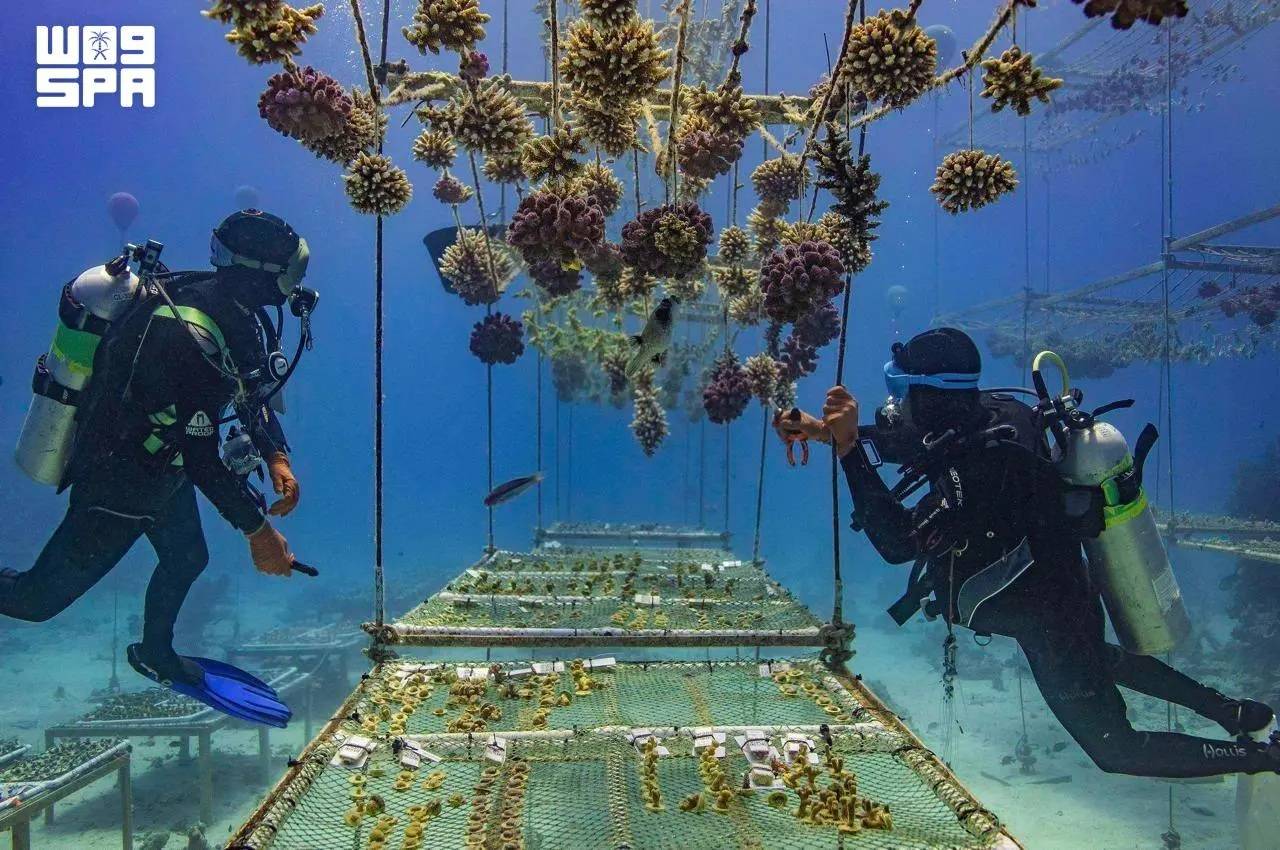
On Saudi Arabia’s Red Sea coast, the KAUST Coral Restoration Initiative (KCRI) land-based nursery and research campus is now growing corals at scale. It is designed to produce up to 360,000 corals a year, to outplant more than two million corals across 100 hectares of reef at Shushah Island by 2030, and to establish a resilient reef ecosystem by 2040.

This opening of the world’s largest coral restoration facility, announced at COP31 in Antalya, arrives at a moment of acute urgency for the world’s reefs. The fourth global coral bleaching event, confirmed by NOAA as the most severe in recorded history, affected more than 84% of the world’s reef area between 2023 and 2025.

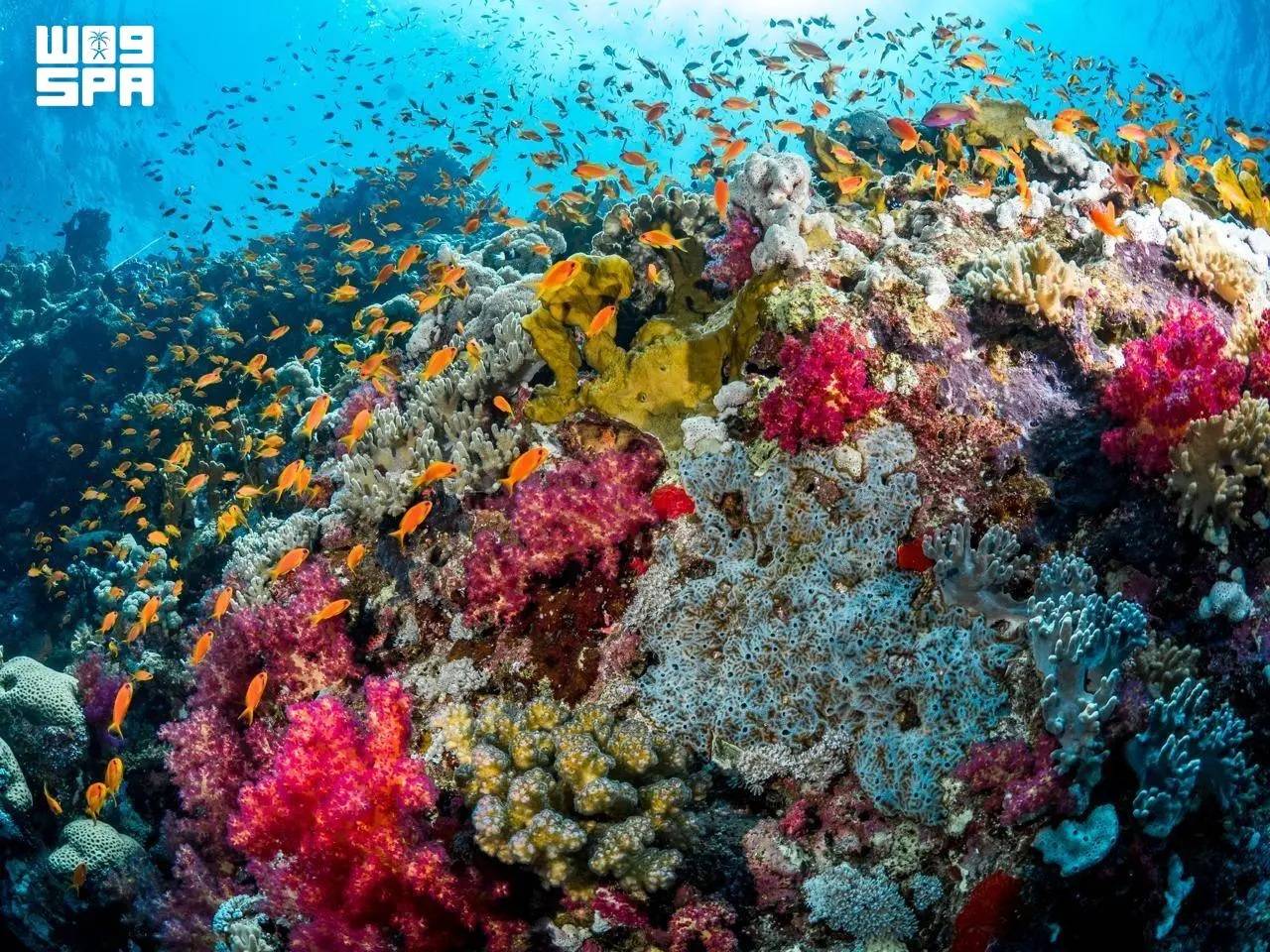
Coral reefs support around a quarter of all marine species, protect coastlines from storms and sustain the livelihoods of more than 500 million people. (SPA)

The Red Sea is the right place to start. Its corals live in some of the warmest, saltiest waters on Earth, and they hold lessons about resilience that reefs everywhere will need. KCRI combines the Red Sea’s unique corals with KAUST’s world-class marine science to learn how corals can be grown at scale and conditioned to withstand warmer water before they return to the reef.

The initiative also draws on the expertise of the Coral Research and Development Accelerator Platform (CORDAP), which works internationally to accelerate scientific and technological solutions for coral reef conservation and restoration.

KCRI brings four components together in a single restoration system, including a large-scale land-based coral nursery, sea-based nurseries, more than 50 research programs spanning coral probiotics, heat-resilient corals, robotics and AI-driven modelling and eCoral, an AI-driven digital twin of the reefscape that guides where and how every coral is planted and monitored.

Saudi scientists, divers and aquarists are playing an important role in KCRI’s restoration efforts, developing specialist expertise in coral cultivation, marine science and reef restoration. (SPA)

Saudi scientists, divers and aquarists are playing an important role in KCRI’s restoration efforts, developing specialist expertise in coral cultivation, marine science and reef restoration. Beyond its restoration activities, KCRI represents a long-term investment in Saudi Arabia’s marine science capabilities.

Coral reefs support around a quarter of all marine species, protect coastlines from storms and sustain the livelihoods of more than 500 million people. KCRI is designed to restore the Red Sea reefscape and offer a framework that coral restoration programs worldwide can adopt.

KAUST is also working with international partners on how coral diversity can be safeguarded for future generations.


Portugal Closes All Schools and Non-Essential Services Ahead of a Major Atlantic Storm

Heavy machinery clears the debris from a landslide along the Marocos road in Machico municipality, on the Portuguese island of Madeira, due to severe weather caused by the passage of Storm Charles, 11 November 2026. (EPA)
TT

Portugal Closes All Schools and Non-Essential Services Ahead of a Major Atlantic Storm

Heavy machinery clears the debris from a landslide along the Marocos road in Machico municipality, on the Portuguese island of Madeira, due to severe weather caused by the passage of Storm Charles, 11 November 2026. (EPA)

Portugal closed all schools and shuttered non-essential public services on Wednesday as a major Atlantic storm headed for the country's mainland.

Streets remained largely deserted ahead of the arrival of Storm Charles after the government told people to stay at home as heavy rain and rough seas were expected to batter the Portuguese coast, with wind gusts of up to 140 kph (85 mph).

It was the first time in living memory that Portugal’s roughly 8,000 schools had canceled classes nationwide over a storm forecast.

Buses without passengers drove through the country's capital, Lisbon, where some streets flooded due to clogged drains. A national supermarket chain closed its stores, while an international technology conference in Lisbon attended by around 70,000 people called off the day's events.

In January, the country's center-right government faced harsh criticism for its weak response when Storm Kristin hit central Portugal, felling thousands of trees and causing widespread property damage that is still being repaired.

The brunt of Storm Charles was expected to hit the Atlantic coast on Wednesday afternoon and evening, coming from the southwest after it had struck the Portuguese island of Madeira on Tuesday with 130 kph (81 mph) winds.