

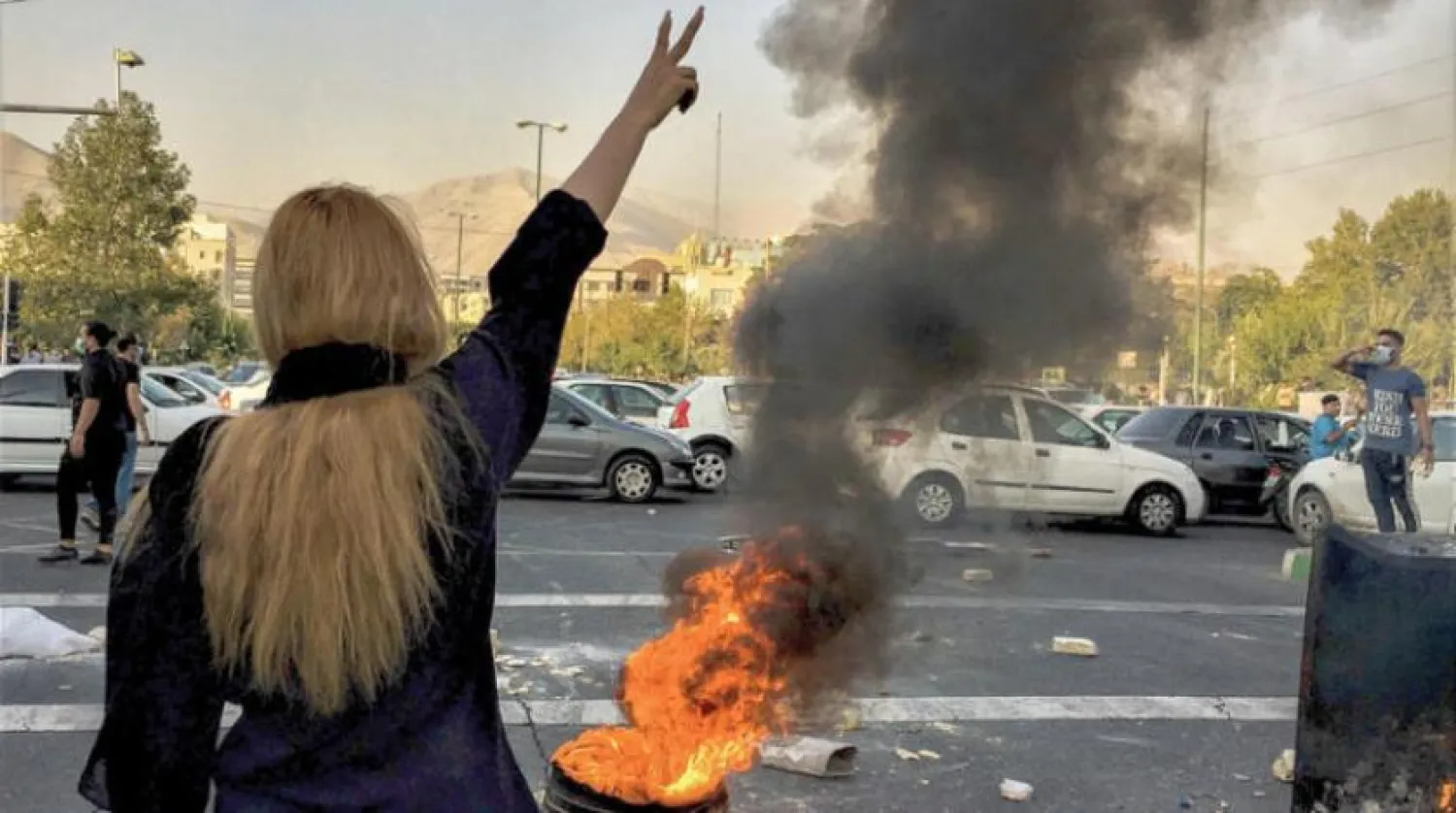

Iran Accuses Persian-Language Media Outlets Abroad of Inciting Protests

A new picture of the protests in Tehran (AP)
TT

Iran Accuses Persian-Language Media Outlets Abroad of Inciting Protests

A new picture of the protests in Tehran (AP)

Iran’s Supreme Leader Ali Khamenei responded for the first time on Wednesday to reports of Iranian drones being used by Russia in Ukraine.

“A few years ago, when photos of Iranian advanced missiles and drones were published, they said it was Photoshop,” said Khamenei, adding that the same parties who questioned the weapons were now looking to punish Iran for selling or giving them to others.

Speaking to a gathering of elites and top scientific talents at the Imam Khomeini Hussainia, Khamenei admitted that Iran was seeking to develop its nuclear industry but denied that it was seeking to acquire a nuclear weapon.

“We do not seek to have a nuclear weapon, but the development of the nuclear industry is important to us, and we have made good achievements in this field,” said Khamenei.

Khamenei’s speech came at a time when anti-regime protests have been sweeping Iran for the second month in a row. Demonstrators are taking to the streets against the deteriorating living conditions in Iran. They are also protesting oppression, tyranny, and the lack of freedoms.

Dozens of students protested at a university in Iran’s capital on Tuesday as a government official visited, state media reported.

On Tuesday, around 90 students gathered outside the law faculty at Tehran’s Allameh Tabatabai University, chanting “inappropriate and immoral slogans” while government spokesman Ali Bahadori-Jahromi was addressing a conference inside, state news agency IRNA said.

It did not elaborate on the reasons for the demonstration but said Bahadori-Jahromi later “appeared among the protesting students… and talked with them.”

Officials have accused the country’s “enemies,” mainly the US, of inciting “riots.”

Bahadori-Jahromi said Persian-language media outlets and platforms based outside Iran were being used to “put pressure” on Tehran.

“Countries are willing to pay from their own pockets to start Persian-language media, while they do not know Persian at all and want to put pressure on us,” IRNA quoted him as saying.



French, Japanese Ships Cross Strait of Hormuz in First Since War

A cargo ship in the Gulf, near the Strait of Hormuz, as seen from northern Ras al-Khaimah, near the border with Oman’s Musandam governance, amid the US-Israeli conflict with Iran, in United Arab Emirates, March 11, 2026. (Reuters)
TT

French, Japanese Ships Cross Strait of Hormuz in First Since War

A cargo ship in the Gulf, near the Strait of Hormuz, as seen from northern Ras al-Khaimah, near the border with Oman’s Musandam governance, amid the US-Israeli conflict with Iran, in United Arab Emirates, March 11, 2026. (Reuters)

One French- and another Japanese-owned vessel are among a handful of vessels to have crossed the war-torn Strait of Hormuz, maritime tracking data showed Friday.

The passage, a vital maritime route for oil and liquified natural gas, has been virtually blocked by Iran since the start of the war, said AFP.

But both ships made the crossing on Thursday, according to ship tracking company Marine Traffic's website.

The Maltese-flagged Kribi belonging to the French maritime transport group CMA CGM crossed the waterway to leave the Gulf on Thursday afternoon, Marine Traffic's data showed.

By early Friday, it was off Muscat, Oman, still broadcasting the message "owner France" on its transponder system in the field usually used to give the destination.

The vessel's navigation data showed it had crossed via an Iranian-approved route through its waters, dubbed the "Tehran Toll Booth" by leading shipping journal Lloyd's List.

- Southern route -

In addition, three tankers -- including one co-owned by a Japanese company -- crossed the Strait of Hormuz on Thursday by taking an alternative, southern route.

They hugged close to the shore of Oman's Musandam Peninsula -- a first in nearly three weeks according to Lloyd's List.

Before the war, which started more than a month ago, about a fifth of global oil and liquefied natural gas (LNG) passed through the Strait.

All three ships signaled they were an "OMANI SHIP" in the message broadcast by their transponder as they crossed the strait.

The Sohar LNG, which was empty when crossing, is co-owned by Japanese shipping company Mitsui O.S.K.

That makes it the first Japanese vessel to exit the Gulf since the start of the war, according to a company statement quoted by Japanese media.

The Hong-Kong flagged New Vision, which crossed the strait on March 1 right after the war started, is expected in the French port of Le Havre on Saturday evening.

Since the conflict started however, that has dwindled to a trickle as Iran selectively attacks ships and energy facilities throughout the Gulf in retaliation for US and Israeli attacks.

A few commercial ships crossing the Strait of Hormuz recently have passed through the Iranian-approved route in the north of the waterway.

- Down to a trickle -

Just 221 commodities vessels have crossed the Strait of Hormuz since March 1, some more than once, according to Kpler data up to Friday morning.

In peacetime, the same waterway handles around 120 daily transits, according to Lloyd's List.

Of the vessels that made the crossing, 60 percent either came from Iran or were heading there.

It was not clear from the data how many had been cleared to make the crossing by Tehran.

But it did show that, among the 118 crossings by ships carrying cargo, 37 had left the Gulf carrying crude oil.

Most of those oil tankers -- 30 of them -- came from Iran or sailed under the Iranian flag. And most ships carrying Iranian oil did not specify their destination on their transponder.

Of those who did, all but one reported they were heading to China.

In the early days of the war, transponder data showed dozens of ships broadcasting messages such as "Chinese crew" or "Chinese owner" in the field usually used for their destination.

This appeared to be an attempt by the ships to avoid being targeted by Iran.


Iran Executes Two Linked to Opposition Group

Executions in Iran have surged in recent years - AFP
TT

Iran Executes Two Linked to Opposition Group

Executions in Iran have surged in recent years - AFP

Iran on Saturday executed two men it said were convicted of links to an opposition group, the People's Mojahedin Organization of ‌Iran, and ‌of carrying out armed ‌attacks, ⁠domestic media reported.

The ⁠executions were the latest in recent days of individuals with PMOI links.

The PMOI confirmed ⁠Saturday's executions, saying ‌in ‌a statement that Iran was "trying ‌to hide its ‌weakness by executing political prisoners, especially PMOI members and supporters." Four PMOI ‌members were executed earlier this week, ⁠it ⁠said.

The group said the two men executed on Saturday were arrested in January 2024 and had their death sentences upheld in December 2025.


Earthquake Kills 8 Members of Same Family near Afghan Capital

Previous earthquake in Afghanistan (Archive-Reuters)
TT

Earthquake Kills 8 Members of Same Family near Afghan Capital

Previous earthquake in Afghanistan (Archive-Reuters)

An earthquake that struck Afghanistan overnight killed eight members of the same family in Kabul province, the health ministry said on Saturday.

The 5.8-magnitude quake struck at 8.42 pm (1612 GMT) on Friday at a depth of 186 kilometers (115 miles) at the epicenter in northeastern Badakhshan province, according to the US Geological Survey (USGS).

Shaking was felt in multiple parts of the country, including the capital Kabul, according to AFP journalists.

"In the Gosfand Dara area of Kabul Province, eight members of a family died as a result of the earthquake," Health Ministry spokesman Sharafat Zaman said in a message to media.

He added that a child aged around two years old was the only survivor from the household and the country's disaster management agency said the boy had been injured in the tremor.

Afghanistan is frequently jolted by earthquakes, particularly along the Hindu Kush mountain range near where the Eurasian and Indian tectonic plates meet.

In August, a shallow magnitude 6 earthquake wiped out mountainside villages and killed more than 2,200 people in eastern Afghanistan, making it the deadliest tremor in the country's recent history.