Algeria Expects Record Attendance of Arab Leaders in Upcoming Summit https://english.aawsat.com/home/article/3943326/algeria-expects-record-attendance-arab-leaders-upcoming-summit
Algeria Expects Record Attendance of Arab Leaders in Upcoming Summit
Algiers completes logistical and security preparations to host the Arab summit. (Asharq Al-Awsat)
Seventeen Arab leaders are expected to participate in the upcoming 31st Arab Summit, which will be held in Algiers on Nov. 1-2, according to Algerian media.
All About Algeria e-newspaper underlined the attendance of Morocco’s King Mohammed VI and his son Crown Prince Moulay Hassan, in light of the unprecedented diplomatic tension between the two countries.
Algeria severed ties with Morocco in August 2021, accusing Rabat of supporting two organizations it described as “terrorist” and of “hostile acts,” a move which Morocco said was “completely unjustified.”
All eyes are expected to focus on the King’s agenda during his stay in Algiers, who will be at his reception at the airport and whether he will meet with Algerian President Abdelmadjid Tebboune.
The newspaper said Egypt’s President Abdel Fattah al-Sisi and Emir of Qatar Tamim bin Hamad Al Thani are among the distinguished guests.
In addition to the Arab leaders, other attendees include Senegal’s President Macky Sall and Azerbaijan’s President Ilham Aliyev, in his capacity as the Head of the Non-Aligned Movement.
The United Nations Secretary-General Antonio Guterres and Secretary-General of the Organization of Islamic Cooperation (OIC) Hissein Brahim Taha will also attend the upcoming event.
The Algerian media affirmed that prominent figures will take part in the summit for the first time in many years.
In this regard, Arab League Secretary-General Ahmed Aboul Gheit confirmed in an interview with Algerian state radio that the Arab summit “will see a remarkable presence of a large number of Arab leaders.”
He pointed out that a “consultation group” will be formed among the Arab leaders, to discuss various issues that benefit “unification.”
In remarks about the Summit’s agenda and the prioritized subjects, Aboul Gheit said, without elaborating, that talks will focus on rescuing the Arab countries that are facing foreign interventions, settling regional disputes and resolving several outstanding matters.
He stressed that the preparations are going according to the plan, pointing to the great efforts to make the summit a success.
Baghdad Fears Armed Factions Could Join Potential US-Iran War
Two Iraqi security personnel flash victory signs in Baghdad on September 30 to mark the withdrawal of US forces (EPA)
Iraq's push to bring armed factions under state control faces a critical test as fears mount of renewed war between the United States and Iran, raising the prospect of militia involvement that could drag Baghdad into a regional conflict it is determined to avoid.
The concerns come amid US and Israeli reports of plans to resume strikes on Iran after the November 3 US midterm elections, with efforts to cement a ceasefire at an impasse.
The prospect leaves Prime Minister Ali al-Zaidi's government facing a delicate balancing act: keeping Iraq out of another war while preserving ties with Washington, even as armed factions retain military capabilities and the freedom to act independently of Baghdad, observers say.
Al-Zaidi outlined a phased disarmament plan in a September interview with The New York Times during a visit to New York, setting June 30, 2027, as the new deadline for bringing all weapons under state control. The previous deadline was September 30, 2026.
The plan begins with a 90-day period during which factions would halt attacks on US interests and neighboring countries in return for US forces refraining from targeting them. A gradual handover of weapons would follow over the next six months.
But setting a deadline has done little to settle disputes over how the plan would work. Powerful factions remain unwilling to disarm, with some insisting that foreign troops must leave first. Nor do public pledges to accept state control necessarily amount to binding commitments to surrender heavy weapons, missiles or drones.
Risks of escalation
Talib Mohammed Karim, a political science professor at Mustansiriyah University, said the scale of any US strike and Israel's role in it would largely determine how far Iraqi factions become involved.
Direct Israeli strikes on Iran, he told Asharq Al-Awsat, would make it "more serious" for some factions to shift from attacking US interests and bases in the region to striking deep inside Israel, potentially setting off retaliatory attacks and widening the conflict.
Karim said Baghdad's responsibility went beyond restraining armed factions. It must also prevent Iraqi territory from being drawn into the war and safeguard the country's sovereignty and national interests under the constitution.
Factions tied to Iran's supreme leader
Ghalib al-Daami, a media professor at Mustansiriyah University, expects any initial involvement by Iraqi factions to be indirect, most likely through attacks on US interests.
The factions have already declared their readiness to fight alongside Iran if war resumes, Daami told Asharq Al-Awsat. But openly entering the conflict could leave them in a "predicament," he said.
Abdulrahman al-Jubouri, a specialist in US affairs, said the factions do not necessarily share Baghdad's priorities, pointing to Kataib Hezbollah, whose ideology is directly tied to Iran's supreme leader.
"Al-Zaidi's position is not binding on these groups. Some say they remain committed to the truce, but they have not changed their view of the United States as an enemy," Jubouri said.
No united front among factions
Basil Hussein, head of the Kluadha Center for Political Studies, does not expect Iraqi factions to respond in unison to another US-Iran war.
Groups most closely aligned with Iran's Revolutionary Guards, particularly Kataib Hezbollah and the Nujaba Movement, could follow Tehran's calculations and expand their attacks to US interests and energy facilities across the region, Hussein told Asharq Al-Awsat.
Others, including Asaib Ahl al-Haq and Kataib al-Imam Ali, which have declared their support for bringing weapons under state control, are more likely to stay out of the fighting. But those declarations offer no guarantee of how they would respond if the war spreads, he said.
For al-Zaidi's government, Hussein said, the stakes are especially high. Renewed fighting could hand factions resisting disarmament another reason to keep their weapons while exposing Iraq to US and regional retaliation.
Researcher and academic Abbas Abboud outlined two paths for the factions: honor an agreement with the government to place weapons first under the commander-in-chief of the armed forces and then surrender them in stages, or join attacks on US interests inside or outside Iraq.
The second path could unravel the government's central program, Abboud warned.
If the factions join Iran in a war against the United States, he said, Baghdad could face severe political and security fallout, with Iraq dragged into the fighting "against its will and political decision."
Economic strain and sovereignty
Political researcher Hani Ashour said al-Zaidi's insistence that weapons remain under state control and decisions on war and peace rest with constitutional institutions reflects Baghdad's official determination to avoid another regional conflict.
A renewed US-Iran war could upend the regional landscape, Ashour told Asharq Al-Awsat, as Iraq struggles to shield itself from the fallout while grappling with difficult economic conditions.
Ashour believes the government will not allow factions to join the fighting under any pretext, noting that several have already pledged to place their weapons under state control.
Whether Baghdad can enforce that position, however, depends on turning political pledges into action. Factions remain divided over disarmament, with the timing and terms of any handover still in dispute.
Political researcher Falah al-Mishal said government warnings against those promoting weapons outside state control were in line with al-Zaidi's government program. Under existing laws, he noted, penalties for incitement or terrorist acts can extend to the death penalty.
Aden Governor After Escaping Airport Missile Attack: Hostilities Will Not Deter People of Yemenhttps://english.aawsat.com/arab-world/5332849-aden-governor-after-escaping-airport-missile-attack-hostilities-will-not-deter
Aden Governor After Escaping Airport Missile Attack: Hostilities Will Not Deter People of Yemen
Aden Governor Abdulrahman Sheikh tours Aden airport before the Houthi militia attack. (Saba)
Aden Governor Abdulrahman Sheikh narrowly escaped a ballistic missile strike on Wednesday when it landed near the city's international airport shortly after he left the facility during a routine inspection tour.
Sheikh, who also serves as Yemen's minister of state, had visited Aden International Airport to inspect runway rehabilitation work before continuing to other sites across the city. Shortly after his departure, he learned of the attempt to target him.
Speaking to Asharq Al-Awsat, Sheikh said he had been inspecting the third phase of the airport's rehabilitation project, carried out by the Saudi Development and Reconstruction Program for Yemen. Work on the runway was between 70% and 80% complete, he said.
The attack did not interrupt his schedule.
Sheikh continued his tour, inspecting public service projects and visiting various security departments.
Such threats have become part of daily life for officials in the interim capital, Aden, since the war in 2015 and the Houthi coup, forcing authorities to weigh security risks against the need to maintain services and advance reconstruction.
Sheikh said local authorities take precautions against Houthi drone and ballistic missile attacks, including avoiding prolonged stays at inspection sites and keeping official movements unannounced.
He revealed that security agencies had busted several Houthi sleeper cells in Aden and other provinces as part of efforts to protect the city and its vital facilities.
The governor insisted that attacks would not deter Yemenis from performing their duties or halt efforts to improve conditions in Aden.
Beyond security threats, Aden faces mounting pressure to provide essential services, with shortages of cooking gas, strains on electricity supplies and continued demand for medicines and medical equipment.
Sheikh described the overall situation as reassuring despite difficulties securing some basic necessities.
He attributed the cooking gas shortage to disrupted supplies from Marib province, which have been affected by the war, and rising demand that has outpaced available quantities.
Electricity remains another major challenge, with exceptional circumstances placing further pressure on the sector and threatening services that residents depend on.
Healthcare facilities also require regular deliveries of medicines and medical supplies to sustain operations and meet patients' needs.
Sheikh praised support from the Saudi Development and Reconstruction Program for Yemen, the Joint Forces and the King Salman Humanitarian Aid and Relief Center, highlighting their contributions to the regular supply of medicines and medical equipment.
He said local authorities would continue to oversee development projects and maintain essential services despite security and economic challenges.
For Aden, the missile strike underscored the risks confronting a city struggling to rebuild amid persistent threats.
The attack came moments after the governor left the airport, but his inspection tour went ahead, reflecting the authorities' determination to keep reconstruction and public services moving despite the obstacles posed by the Houthis, stressed Sheikh.
Emboldened Israeli Settlers Lead a Surge of Attacks on Palestinians’ Olive Harvesthttps://english.aawsat.com/arab-world/5332827-emboldened-israeli-settlers-lead-surge-attacks-palestinians%E2%80%99-olive-harvest
A Palestinian woman picks olives during the harvest season in a Palestinian-owned olive grove in the village of Turmus Ayya, northeast of Ramallah in the Israeli-occupied West Bank, on October 20, 2026. (AFP)
TT
TT
Emboldened Israeli Settlers Lead a Surge of Attacks on Palestinians’ Olive Harvest
A Palestinian woman picks olives during the harvest season in a Palestinian-owned olive grove in the village of Turmus Ayya, northeast of Ramallah in the Israeli-occupied West Bank, on October 20, 2026. (AFP)
Attacks by Jewish settlers have surged this year during the Palestinians’ annual olive harvest in the occupied West Bank.
Scenes of Palestinians, journalists and diplomats beaten by masked men spotlight how settlers have been establishing themselves deeper in Palestinian communities, emboldened by Prime Minister Benjamin Netanyahu ’s government. At least four Palestinians have been killed this season, whether by settlers or Israeli soldiers.
The violence has brought new international criticism at a time when Netanyahu faces a razor-thin race in next Tuesday's legislative elections. But the prime minister is doubling down. After a West Bank shooting attack blamed on Palestinian gunmen that killed two Israeli soldiers on Friday, Netanyahu praised settlers as “heroic” and vowed to “destroy the terror infrastructure and establish more and more settlements.”
Here’s a look at the olive harvest and the tensions around it:
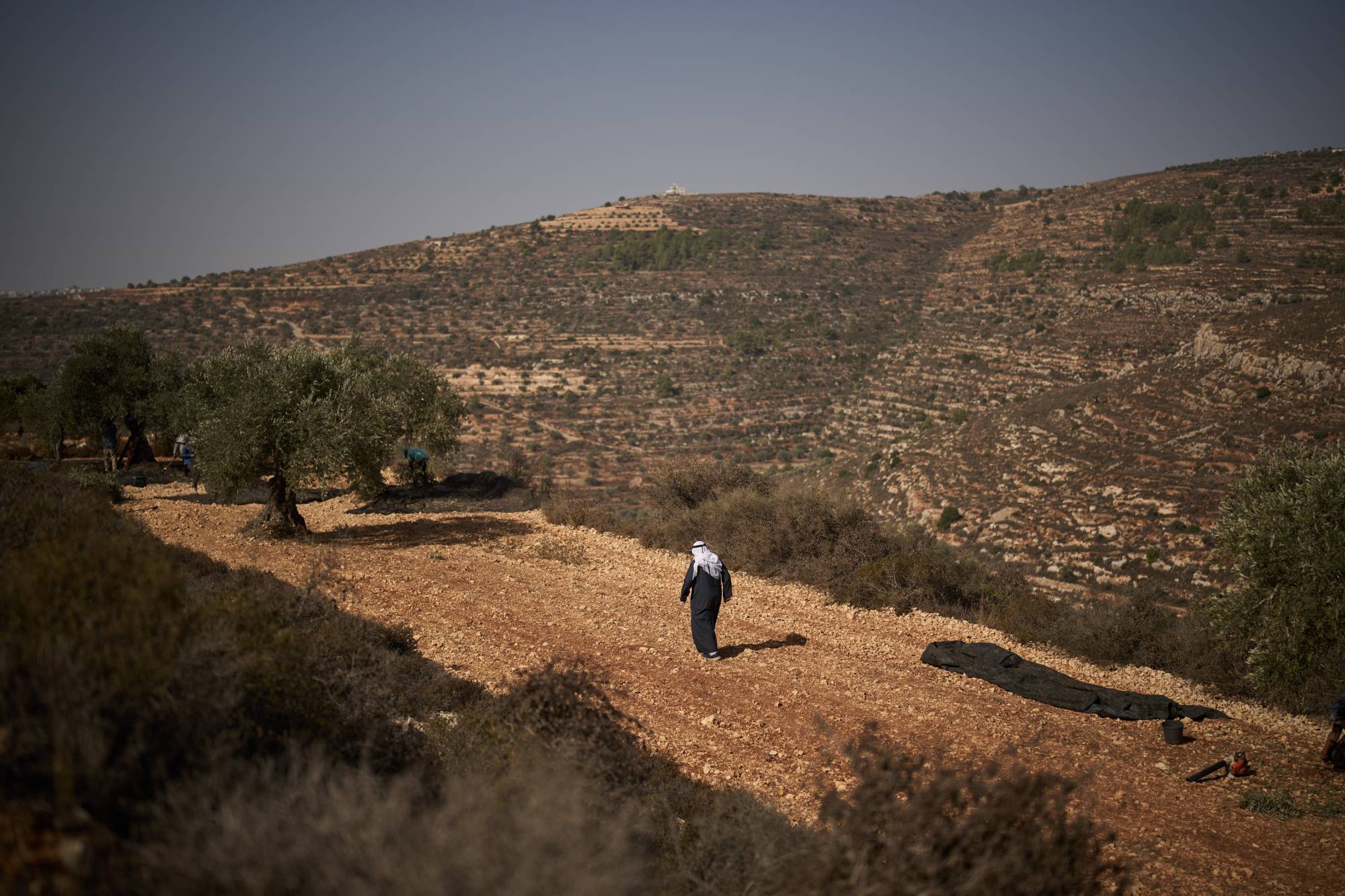
Palestinian Kamal Haloum walks in an olive grove during the olive harvest in the West Bank village of Al-Mazraa al-Sharqiya, Friday, Oct. 23, 2026. (AP)
Palestinians’ ties to the land are challenged
Olive groves across the West Bank represent both heritage and needed income. The harvest traditionally has been a joyous occasion for Palestinians to gather and be thankful for another year.
“In the past, harvesters would enjoy a month of singing and fixing tea and coffee in their groves. Now the journey is full of pain and risk,” said Abbas Milhem of the Palestinian Farmers’ Union.
But the harvest has become a time of friction as Palestinians spread out and, simply by picking olives, assert their ties to the land that many Israeli settlers say should belong to Israel instead.
Olive trees have been destroyed and olives stolen in over 325 incidents of settler violence this harvest season, which began in late September, Israeli rights group Yesh Din says. Over 130 of those incidents involved physical assaults on harvesters.
Yesh Din and the farmers’ union call this harvest the most violent in recent history.
One Palestinian, Abel Atif Bazaari, said last week outside the village of Burqa near Nablus that olives are more than just a crop. He ran his fingers along a branch. “Protected, respected. I think in all religions, olives are respected,” he said. “This is the identity of the Palestinians.”
His cousin, a security guard, was killed when responding to an attack on the family's land this season. Bazaari was hurt. A bandage covered his temple near his blackened left eye. They have paused the harvest, he said. The land has been in the family for over a century.
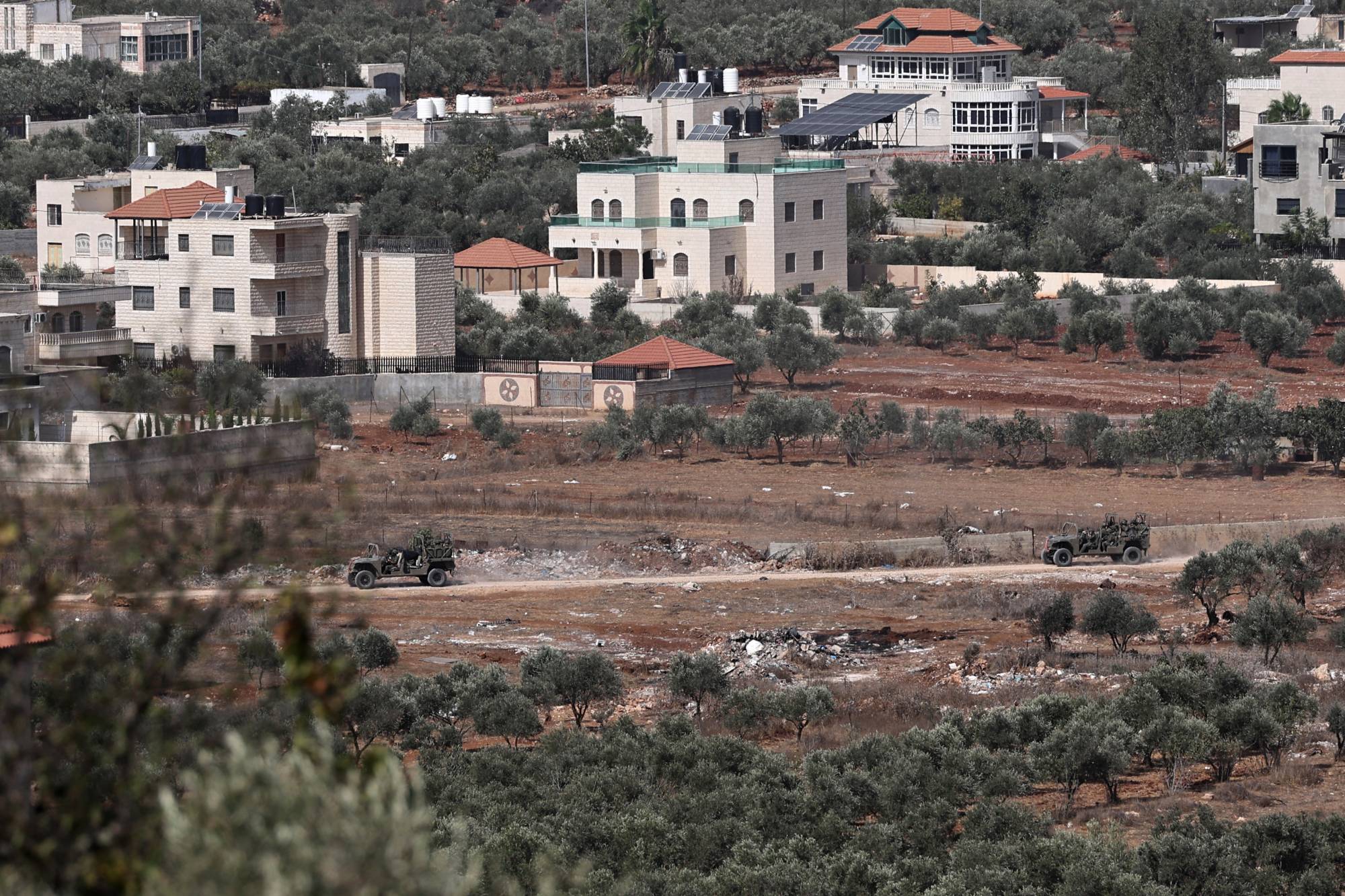
Israeli military vehicles patrol an area during the olive harvest in the town of Turmus Ayya, in the West Bank, 23 October 2026. (EPA)
West Bank outposts have surged under Netanyahu
Since 2023, Israeli settlers have erected more than 180 new outposts in the West Bank, most of them close to Palestinian communities and often on their farmland, according to Peace Now, a watchdog group. Settlers from those outposts have largely been behind intensifying attacks on Palestinians since the war in Gaza began with the Hamas-led assault on Israel on Oct. 7, 2023.
On Wednesday, a joint statement by activists and rabbis from the United States, Israel and the West Bank called the attacks on the harvest and Palestinian farmers part of “ethnic cleansing” in the territory. Israel has denied allegations, previously made by Britain as well, of ethnic cleansing.
The outposts — often made up of a few mobile homes — are not authorized, but the military rarely takes action against them. Palestinians trying to fend off the settlers have been accused of throwing rocks or chunks of concrete.
Netanyahu’s government relies on the support of far-right parties and has dramatically expanded settlements as a way to strengthen Israel’s grip on the West Bank and prevent any potential Palestinian state. Far-right Finance Minister Bezalel Smotrich, a settler leader who is in charge of settlement policy, has sought to steer funding to unauthorized outposts.
Most of the international community views all settlements as illegal and an obstacle to peace. “The clear goal is to drive communities off their land,” UN Secretary-General Antonio Guterres said Thursday of settler attacks.
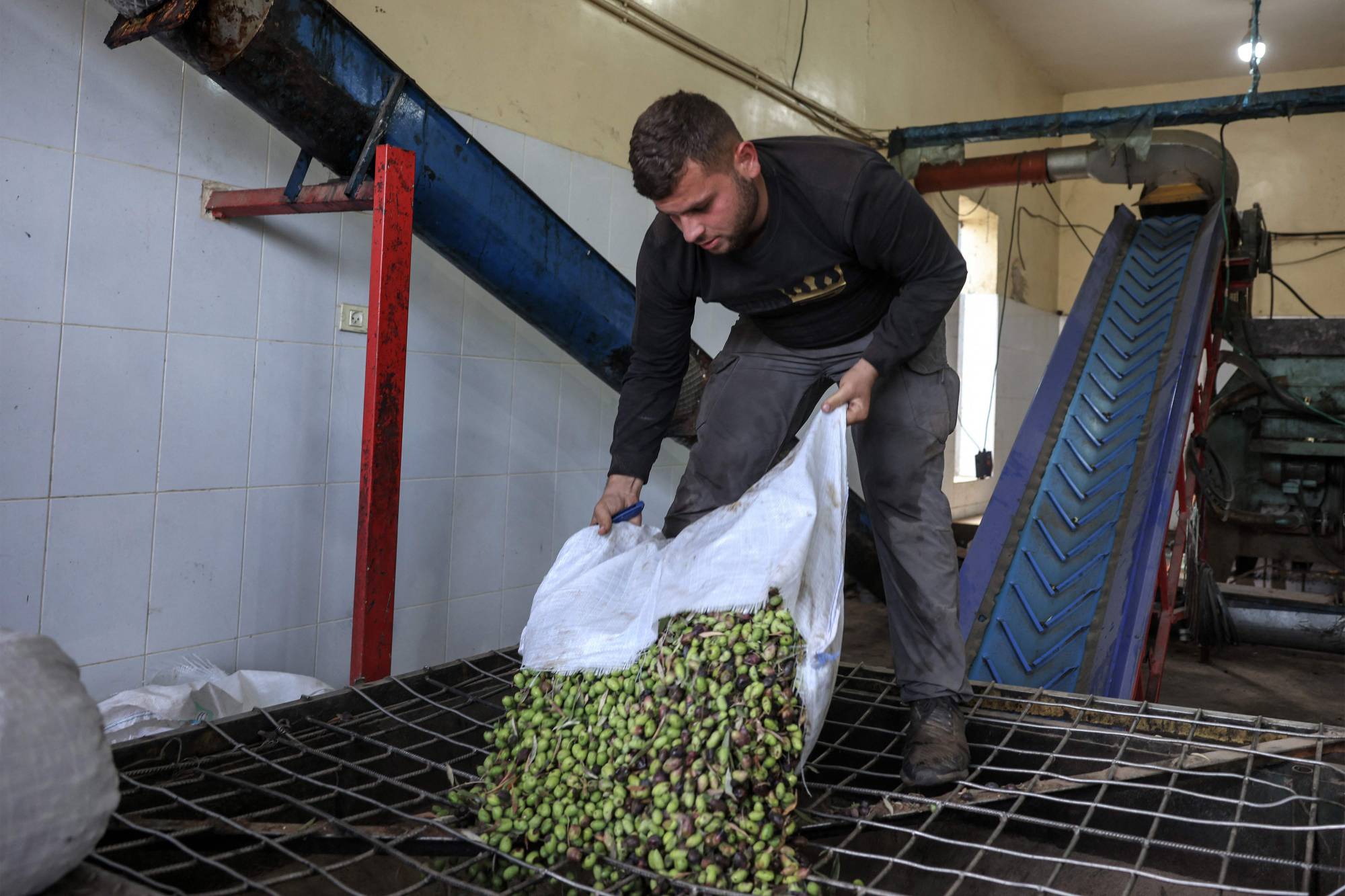
A Palestinian worker unloads freshly harvested olives for processing at an olive press in Turmus Ayya, northeast of Ramallah in the Israeli-occupied West Bank, on October 20, 2026. (AFP)
Outsiders visit in solidarity and are attacked
The olive harvest draws activists, diplomats, rabbis, journalists and others who seek to show solidarity with Palestinians and document attacks and intimidation.
Sometimes they are attacked, too.
A photographer for The Washington Post, Heidi Levine, is recovering after settlers last Friday beat her so badly that several vertebrae were broken and a finger was nearly detached. The following day, masked settlers wielding metal bars attacked a French mayor among a group of diplomats from France, Belgium and Poland at another harvest.
On Wednesday, a US congressional candidate from New York, Brad Lander, was among a group of American rabbis and others detained by Israeli troops at a harvest before being released hours later.
Rights groups say settlers are rarely punished, though several were arrested after last week’s high-profile attacks. Police said most were later released as investigations continue.
It’s becoming harder for Palestinians to reach their land. Peace Now says they have been required to coordinate with Israel’s military to access more of their privately owned farmland than previously. The West Bank is a patchwork of areas under varying levels of Palestinian civil and Israeli military control.
Some of those who coordinate with the military are still attacked, Milhem with the farmers’ union said. He estimated that roughly 110,000 Palestinian families depend on privately owned groves for income that reaches into the millions of dollars in all.
“Palestinian farmers do not — and should not — need permits to harvest their own olive fields,” Lander said Thursday on X, adding that Wednesday’s visit was meant to “call attention to the horrors of the occupation.”
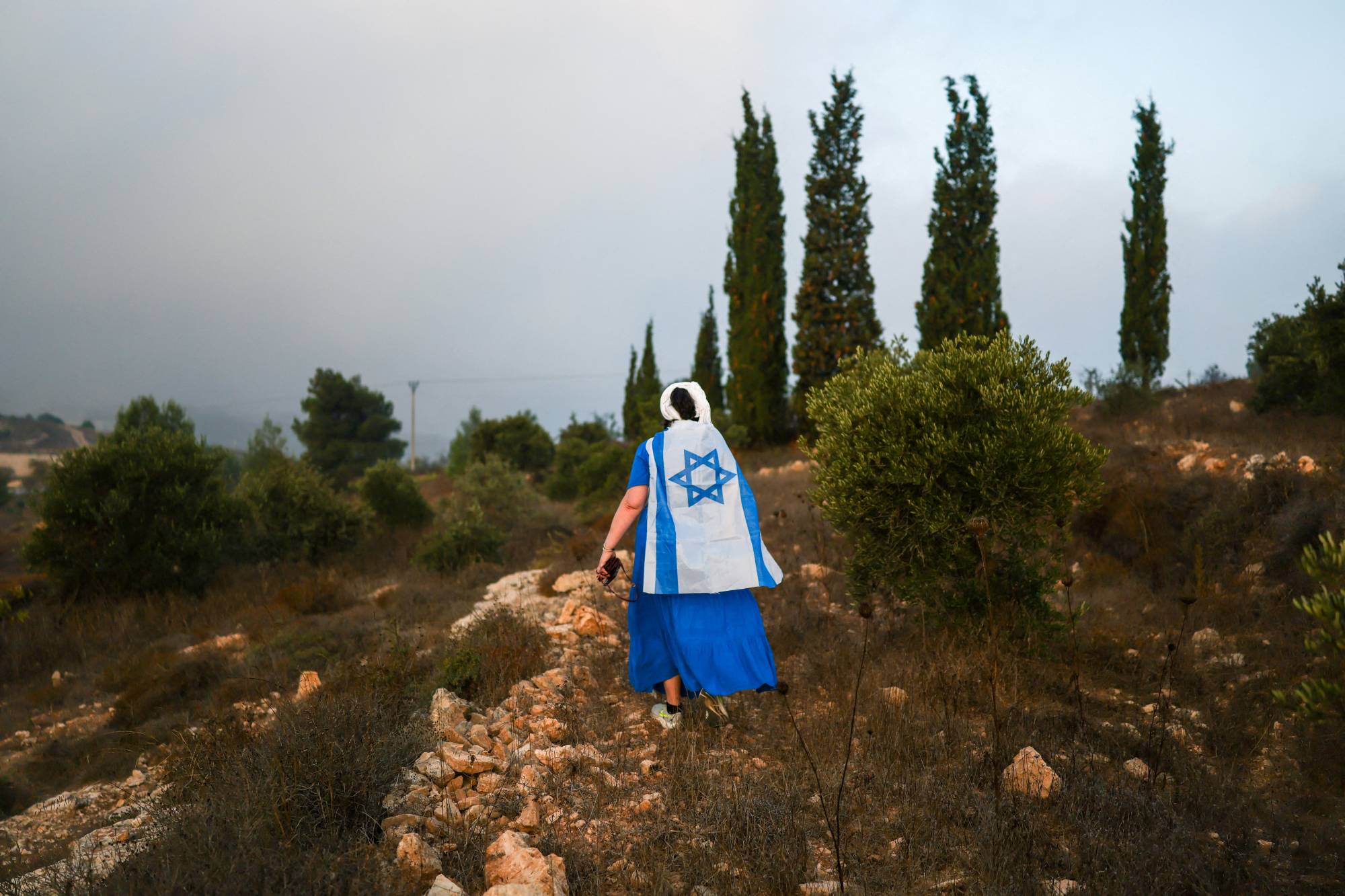
A Jewish settler walks towards olive trees owned by Palestinians due to be harvested, near the Israeli settlement Neve Daniel, in the Israeli-occupied West Bank, October 12, 2026. (Reuters)
‘Handful of criminals’
Settler attacks on Palestinians rarely bring an outcry in Israel, but some Israeli senior politicians and officials have spoken out after Levine was beaten.
Netanyahu’s main rival in the elections, Gadi Eisenkot, said on X that “a handful of criminals is burning up the last shreds of legitimacy left to the state of Israel.” Eisenkot has backed settlement building in the West Bank but says he would shut down the unauthorized outposts.
Levine told the AP that Israeli President Isaac Herzog told her “he’s ashamed for what happened: ‘These people are a stain on Israeli society.’” Herzog has denounced settler attacks against Palestinians in the past.
Netanyahu, meanwhile, has questioned the circumstances around some attacks on the olive harvest and alleged a “coordinated campaign to smear Israel” following the weekend attack on diplomats.
He has blamed overall attacks in the West Bank on a small number of troublemakers.
لم تشترك بعد
انشئ حساباً خاصاً بك لتحصل على أخبار مخصصة لك ولتتمتع بخاصية حفظ المقالات وتتلقى نشراتنا البريدية المتنوعة