Chinese Leader Xi Jinping’s Rise and Rule

Chinese President Xi Jinping speaks at an event to introduce new members of the Politburo Standing Committee at the Great Hall of the People in Beijing, Sunday, Oct. 23, 2022. (AP)
TT

Chinese Leader Xi Jinping’s Rise and Rule

Chinese President Xi Jinping speaks at an event to introduce new members of the Politburo Standing Committee at the Great Hall of the People in Beijing, Sunday, Oct. 23, 2022. (AP)

Chinese President Xi Jinping, the son of a communist revolutionary leader, was a victim of the Cultural Revolution and a provincial chief who promoted economic growth before ascending to the very top a decade ago.

On Sunday, China's 69-year-old leader secured a widely expected third term as general secretary of the ruling Communist Party, paving the way for him to remain in power for at least five more years — and possibly longer.

In his first decade in power, he tightened state control over the economy and society and promoted a more muscular foreign and defense policy, all while establishing himself as one of the most powerful leaders in China's modern history.

Early years

June 15, 1953: Born in Beijing, the son of Xi Zhongxun, a senior Communist Party official and former guerrilla commander in the civil war that brought the communists to power in 1949.

1969-75: At the age of 15, Xi is among many educated urban youths sent to live and work in poor rural villages during the Cultural Revolution, a period of social upheaval launched by then-leader Mao Zedong.

1975-79: Returns to Beijing to study chemical engineering at prestigious Tsinghua University.

1979-82: Joins military as aide in Central Military Commission and Defense Ministry.

Regional leader

1982-85: Assigned as deputy and then leader of the Communist Party in Zhengding county, south of Beijing in Hebei province.

1985: Begins 17-year stint in coastal Fujian province, a manufacturing hub, as vice mayor of the city of Xiamen.

1987: Marries Peng Liyuan, a popular singer in the People’s Liberation Army’s song and dance troupe. They have one daughter. An earlier marriage for Xi fell apart after three years.

2000-2002: Governor of Fujian province.

2002: Transferred to neighboring Zhejiang province, where he is appointed party chief, a post that outranks governor in the Chinese system.

March 2007: Appointed party chief of Shanghai but stays only a few months.

October 2007: Joins national leadership as one of nine members of the Politburo Standing Committee, the top leadership of the Communist Party.

March 2008: Named vice president of China.

August 2011: Xi hosts then-Vice President Joe Biden on the latter's visit to China, nearly a decade before Biden becomes US president.

National leader

November 2012: Replaces Chinese President Hu Jintao as general secretary of the Communist Party, the top party position.

March 2013: Starts first five-year term as president of China.

2013-2014: China begins reclaiming land in the South China Sea to build islands, some with runways and other infrastructure, pushing its territorial claims to disputed areas in the vital waterway.

2017: China launches a harsh crackdown on the Uyghur and other predominantly Muslim ethnic groups in the Xinjiang region after extremist attacks. Mass detentions and human rights abuses draw international condemnation and accusations of genocide.

October 2017: The party enshrines his ideology, known as “Xi Jinping Thought,” in its constitution as he starts a second five-year term as leader. This symbolically elevates him to Mao's level as a leader whose ideology is identified by his name.

March 2018: China's legislature abolishes a two-term limit on the presidency, signaling Xi's desire to stay in power for more than 10 years.

July 2018: The United States, under President Donald Trump, imposes tariffs on Chinese imports, starting a trade war. China retaliates with tariffs on US goods.

June-November 2019: Massive protests demanding greater democracy paralyze Hong Kong. Xi's government responds by imposing a national security law in mid-2020 that quashes dissent in the city.

January 2020: China locks down the city of Wuhan as a new virus sparks what will become the COVID-19 pandemic.

September 2020: Xi announces in a video speech to the UN General Assembly that China aims to peak carbon dioxide emissions before 2030 and achieve carbon neutrality before 2060.

December 2020: Authorities announce an anti-monopoly investigation into e-commerce giant Alibaba, the start of a crackdown on China's high-flying tech companies.

August 2022: China launches missiles and deploys warships and fighter jets in major military exercises around Taiwan following the visit of a senior US lawmaker, House Speaker Nancy Pelosi, to the self-governing island that China claims as its territory.

October 2022: Xi starts a third five-year term as Communist Party leader, breaking with recent precedent that limited leaders to two terms.


West Bank’s Displaced Palestinians Hold Little Hope for Post-Netanyahu Era

A general view shows extensive demolitions in a neighborhood of Tulkarem refugee camp, near the city of Tulkarem in the Israeli-occupied West Bank, on November 11, 2026. (AFP)
TT

West Bank’s Displaced Palestinians Hold Little Hope for Post-Netanyahu Era

A general view shows extensive demolitions in a neighborhood of Tulkarem refugee camp, near the city of Tulkarem in the Israeli-occupied West Bank, on November 11, 2026. (AFP)

After Israeli forces pushed him and thousands of others out of the West Bank refugee camp of Tulkarem last year, Adel Darsieh held onto his hope of returning home, but it is fading fast.

Prime Minister Benjamin Netanyahu has vowed no return for the displaced people from the camp near the northern city of Jenin.

He is now fighting for his political life after his party lost seats in Israel's general election last month and former general Gadi Eisenkot was tasked with trying to form a new government.

But even the prospect of an end to Netanyahu's rule is not enough to lift Darsieh's hopes.

"Whether it's this government or a new one, what does it change?" said the 64-year-old. "They're two sides of the same coin."

The Israeli military carried out a major operation in the north of the occupied Palestinian territory in early 2025, during a temporary ceasefire in Hamas-ruled Gaza, having vowed to root out extremists.

Shortly before the election, Netanyahu announced that no one removed from Tulkarem would be allowed back.

For Palestinian families, it is a second form of displacement. The Tulkarem camp was set up in 1950 for refugees who fled or were forced out during the creation of the state of Israel two years earlier. The West Bank has been occupied by Israel since 1967.

"Successive generations have lived through displacement without being able to return to their homes. If our grandparents and parents couldn't return, how can we believe that our return will be possible?" Darsieh said.

According to UN figures, the Israeli operation launched last year displaced 12,100 people from the Tulkarem camp.

- 'Empty stomachs' -

With the Israeli military keeping up periodic operations around the region, Darsieh is living near the camp in a modest, makeshift home with a sheet metal roof. His wife uses a wheelchair.

He went to receive trays of mansaf, a dish of rice, meat and fermented yoghurt, prepared by Fazaa Kitchen, a solidarity group that serves food to the displaced.

Working from the building of the Wadi al-Hawarith charity, volunteers in orange jackets fill, seal and package portions of food in an assembly line.

The group prepares and distributes some 1,200 meals to 400 families.

"If we weren't cooking, families would be going to bed with empty stomachs," said the organization's head, Hussein al-Sheikh Ali, 60, who himself is displaced.

He described Israel's actions in the West Bank since the Gaza war -- a conflict launched in response to the unprecedented attack on Israel by Hamas on October 7, 2023 -- as "collective punishment".

Netanyahu's now-caretaker government, which includes far-right figures, rapidly expanded Israeli settlements in the West Bank which are considered illegal under international law.

"Some Palestinians hope that a new Israeli government might emerge with a less extremist, more moderate tone," Ali said.

"Yet the fear remains that the same policies towards the Palestinians will persist, even if the political figures themselves change."

Faisal Salama, who heads Tulkarem camp's popular committee, which represents residents, called Netanyahu's decision to stop residents returning illegal.

But he held out guarded hope for an end to military operations. He pointed to how Israel, soon after the election, ended an operation in Hebron that displaced 3,000 Palestinians, which was launched after gunmen shot dead two Israeli soldiers.

- 'Scale of suffering' -

Even if residents could return, much of the camp has been destroyed. Houses have been razed, buildings emptied and businesses burnt down.

Eisenkot, who commanded forces in the West Bank during the second Intifada, a Palestinian uprising from 2000 to 2005, has sought to appeal to a broad spectrum including liberals but has only taken some distance from Netanyahu on security.

Eisenkot backs the existence of the major settlements but has also spoken out forcefully against extremist settlers who have attacked Palestinians with virtual impunity.

Beth Oppenheim, a policy fellow at the European Council on Foreign Relations, said a consensus has emerged among Jewish Israelis on key policies on the West Bank, including opposition to the creation of a Palestinian state.

Still, she said that Eisenkot as prime minister could be more flexible on allowing a return to Tulkarem.

"I think that given the political atmosphere in Israel today, this will be done through a security pretext," she said.

"They would make the case that this is necessary to stabilize the situation in the West Bank and that having people displaced could create the conditions for unrest," she said.

For Asia Assaf, 44, a Fazaa Kitchen volunteer whose home was destroyed in March 2025, political debates are far away from her daily concerns.

"One cannot truly grasp the scale of suffering until one has experienced it firsthand," she said.


Spy Scandal and Midterm Defeat Heat Up Trump’s Asia Visit

US President Donald Trump waves as he attends a midterm campaign rally at Salina Regional Airport in Salina, Kansas, US, November 1, 2026. (Reuters)
TT

Spy Scandal and Midterm Defeat Heat Up Trump’s Asia Visit

US President Donald Trump waves as he attends a midterm campaign rally at Salina Regional Airport in Salina, Kansas, US, November 1, 2026. (Reuters)

US President Donald Trump heads to Asia this week, reeling from a midterm election drubbing and Chinese spy allegations that have raised the stakes for his latest face-to-face with Beijing's powerful leader, Xi Jinping.

Trump will first visit Manila for meetings with Southeast Asian and other regional leaders on Tuesday before jetting to Shenzhen for the Asia-Pacific Economic Cooperation (APEC) forum, where he will meet the Chinese president and hold three-way discussions with Xi and Russia's Vladimir Putin.

With a fragile trade-war truce between the US and China extended to early next year, and more Trump-Xi talks due in December at the G20 in Miami, some analysts had initially billed the Shenzhen meeting as a low-stakes summit.

But a backlash against Trump's Republican Party in this month's midterms and criticism that his administration failed to act on intelligence that Nvidia CEO Jensen Huang, who has close ties to Trump, had an affair with a suspected Chinese spy, have muddied those expectations.

"With less reason to worry about market reactions or electoral fallout, (Trump) may be more willing to consider disruptive measures," said Ruby Osman, a senior policy adviser on China at the Tony Blair Institute, a London-based think tank.

Washington has already signaled such willingness ahead of the meeting, urging China to live up to its commitments ‌made under the truce ‌agreed between Trump and Xi a year ago.

Chinese analysts say they are particularly concerned that the Nvidia saga, including ‌allegations that ⁠restricted semiconductors were ⁠diverted to Chinese customers, will now harden US attitudes towards China.

US House Speaker Mike Johnson said last week there was growing consensus in Congress on further limiting Chinese access to advanced chips after the scandal, and Democrats are expected to press hard on the issue when they take over the House and Senate majorities in January.

China has said the United States has fabricated the spy narrative to justify a technological blockade.

Zhu Feng, director of the Institute of International Studies at Nanjing University, said the spat could also speed up "the decoupling of AI" between the world's two superpowers even as they try to cooperate on mitigating the technology's risks.

Trump is not expected to directly raise the spy allegations with Xi, one senior US administration said on condition of anonymity, adding that the Nvidia situation "should not really have any bearing on the trip".

TRUMP'S LEGACY

Rather than picking fresh fights with China, Trump may want to ⁠focus on legacy-building endeavors such as denuclearization agreements with Beijing and Moscow, or securing another meeting with North Korea's secretive ‌leader, Kim Jong Un.

Trump sees the unprecedented summit with Xi and Putin as possibly providing movement towards ‌an agreement on nuclear arms control. But that is a non-starter for China, which has far fewer warheads than the others, Chinese analysts said.

Trump may also seek to enlist Putin ‌and Xi's support in setting up a future meeting with Kim, who has close ties to the Chinese and Russian leaders.

The president will be focused on "building his ‌legacy," said Victor Cha at the Center for Strategic and International Studies, a US think tank. A big part of that is his North Korea diplomacy, which he has devoted a lot of time to over his two terms, Cha added.

The proposed three-way meeting has drawn comparisons, particularly in Russia, with the 1945 Yalta Conference between the US, Britain and the Soviet Union that formalized spheres of influence, set the stage for the post-World War Two order and became shorthand for great-power deals imposed on smaller countries.

Such a framing is particularly worrisome for Ukraine, engaged in a ‌four-year war with Russia. Trump is not expected to raise Ukraine at the meeting, the senior US official said.

'A LOT TO LOSE'

Xi could also seek to take advantage of Trump's political weakness after his election humbling, analysts ⁠say.

Top of Beijing's wish list is ensuring ⁠that the US president doesn't approve a $14 billion arms package to Taiwan, which China claims as its own. Trump has said he is holding the arms back as a "negotiating chip" with China.

But with China's export engine humming, simply buying time may be enough for Beijing, said Jonathan Czin, a foreign policy analyst at the Brookings Institution, a US-based think tank.

"Xi just needs Trump to remain reluctant to revert toward a more competitive posture toward China for as long as possible. China will take whatever time it can get to fortify itself for the next round in the contest," said Czin, who formerly worked at the Central Intelligence Agency and as director for China at the US National Security Council.

Beijing will be acutely aware that whoever succeeds Trump when his term ends in two years time, may be less accommodating, said Czin and Osman.

Trump's Democratic predecessor, Joe Biden, repeatedly angered China with comments over human rights issues and a pledge that the US would defend Taiwan if Beijing attacked. Many of Trump's potential Republican successors, such as Secretary of State Marco Rubio, are also seen as more hawkish on China.

Both leaders will also be wary of reigniting a trade row that threatened to tank the global economy and financial markets last year, said Kurt Tong, a former senior State Department official now with the Asia Group think tank.

Despite the frustration the US has voiced on Chinese implementation of the terms of the truce, Tong expects it will be further extended beyond its January 10 expiration.

"The two sides are quite incentivized to maintain this fragile stability ... despite also having some disagreements," added senior China analyst Chim Lee at the Economist Intelligence Unit.

"They both have quite a lot to lose."


‘A Moral Red Line’? World on Cusp of Autonomous Weapons Revolution

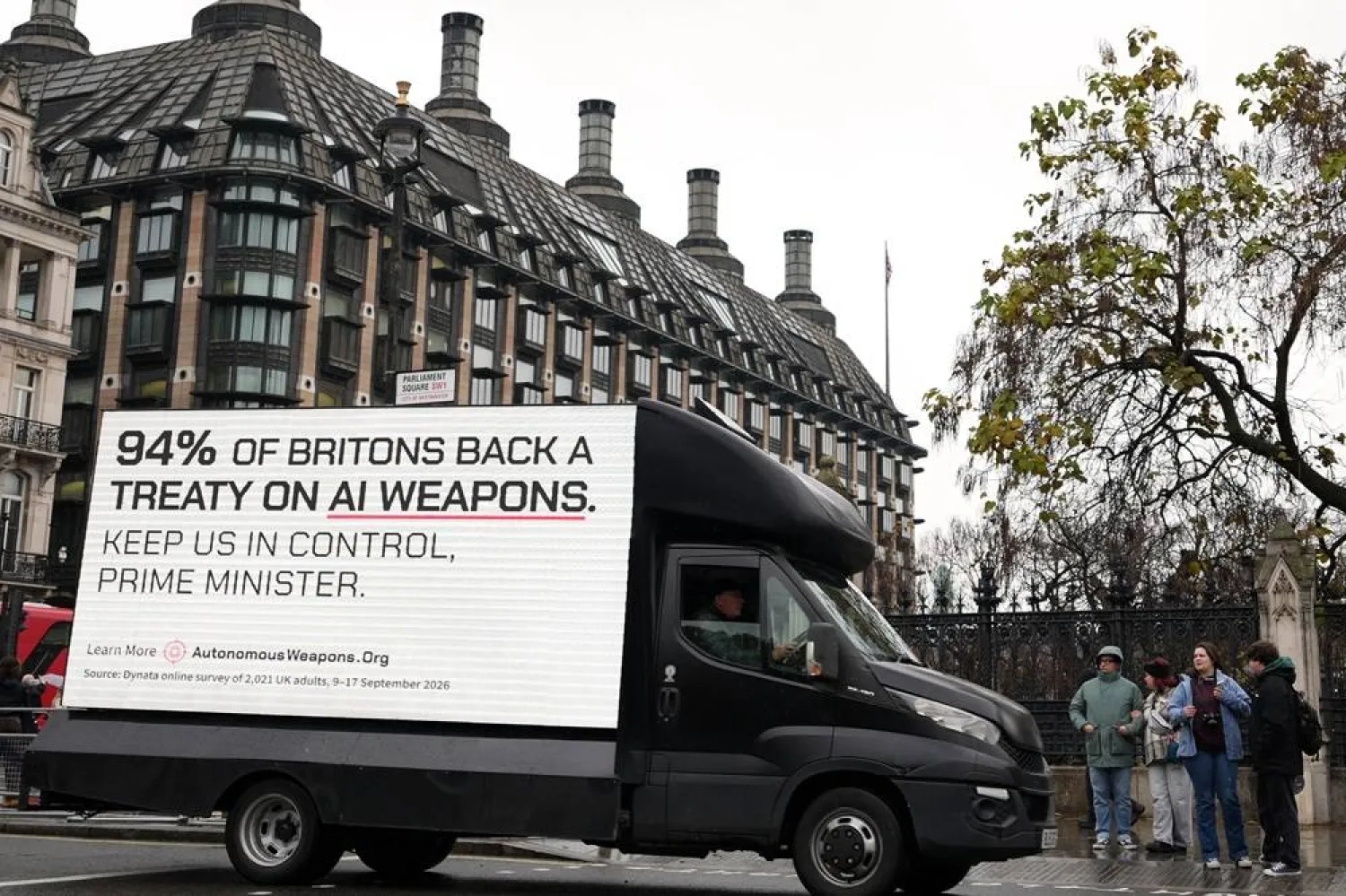
Pedestrians look on as a van, displaying a screen asking for a Treaty on AI Weapons, drives through Westminster in London, Wednesday, Nov. 11, 2026. (AP)
TT

‘A Moral Red Line’? World on Cusp of Autonomous Weapons Revolution

Pedestrians look on as a van, displaying a screen asking for a Treaty on AI Weapons, drives through Westminster in London, Wednesday, Nov. 11, 2026. (AP)

Lethal autonomous weapons powered by artificial intelligence are set to revolutionize warfare but there is no proper regulatory or legal framework governing the new technology.

A conference starting Monday at the United Nations in Geneva will discuss how to establish curbs and prohibitions on such weapons, called killer robots by some.

But some analysts doubt the discussions at the Convention on Certain Conventional Weapons (CCW) will keep pace with the fast-changing weapons.

AFP looks at three key questions ahead of the conference.

- What are LAWS? -

Lethal Autonomous Weapons Systems (LAWS) "can identify, select, and engage a target without the intervention of a human operator in the execution of these tasks," said Jean-Marc Rickli, head of global and emerging risks at the Geneva Centre for Security Policy.

Autonomous weapons have long existed. An anti-personnel mine "is an autonomous weapon in the sense that it explodes when someone steps on it," said Laure de Roucy-Rochegonde of the Centre for Geopolitics of Technology at the French Institute of International Relations (IFRI).

But with the proliferation of AI-enhanced drones, such weapons are now "capable of selecting and engaging a target that was not predetermined, adapting to their environment without human intervention," said Rickli.

So the critical issue for potential regulators lies in determining the level of human control over the decision to employ such a weapon.

The United States refers to an "appropriate levels of human judgement" in the use of autonomous weapons.

France maintains that a human must remain in the decision-making loop and bans "lethal autonomous weapons systems" (LAWS) but permits "partially autonomous" systems known as PLAWS.

"The human role is always ensured through what is termed 'appropriate control' by a military commander -- a concept that varies in scope depending on the system's criticality and the operational context," said Rear Admiral Vincent Sebastien, deputy director of the French defense ministry's Agency for Defense Artificial Intelligence (AMIAD).

- The ethical issues?

"We are now dangerously close to crossing a moral red line: the autonomous targeting of humans by machines," UN Secretary General Antonio Guterres, and International Committee of the Red Cross president Mirjana Spoljaric warned in a joint statement in August.

But analysts said the Geneva discussions, while important, will touch only part of the issue.

Today, the diminishing role of humans is being driven by the growing use of AI in analysis and targeting.

Rickli said the scope of the agenda in Geneva is "very narrow".

"It fails to encompass the full range of issues surrounding AI on the battlefield" -- an area where its use is expanding, particularly in target generation.

He said this was seen in the US-Israeli war against Iran this year "where the Americans engaged as many as 1,000 targets per day" inside Iran.

"There are a host of problems and unacceptable risks associated with targeting and decision-support systems," added de Roucy-Rochegonde. "Part of this debate concerns systems that are already widely deployed on the battlefield."

"What kind of human supervision is required to ensure that the operator is genuinely exercising their own judgement rather than simply providing a rubber stamp for the machine's recommendations?" she asked.

- How quickly is the situation changing?

The autonomous weapons to be discussed in Geneva are not yet in widespread use, although analysts have noted that they have been deployed by Russia in its invasion of Ukraine, as well as US attacks in Iran.

But the spread is inevitable.

"Autonomy will very quickly become a reality on the battlefield," warned rear admiral Sebastien.

"Autonomous weapon systems are not part of a distant future -- a race towards greater autonomy in weapons systems is already well underway," Guterres and Spoljaric said in their statement.

Yet significant doubts and dangers remain, Dario Amodei, head of the AI giant Anthropic, warned this year: "Today, frontier AI systems are simply not reliable enough to power fully autonomous weapons."

But ultimately, the incentive for major powers is too strong.

Swarms of autonomous drones -- which "aim to neutralize an adversary through saturation" -- would be highly effective, and some states view them as a crucial strategic advantage, said Rickli.

In January, the Chinese defense ministry described swarms of autonomous drones as the "new face of warfare."

"In an era of sharp military competition, the first state to normalize fully autonomous lethal strikes will reset expectations for everyone else," said Gerald Mako, a research affiliate of Cambridge University in the Small Wars Journal.