


Russia Builds Defensive Lines to Stem Ukraine’s Advance

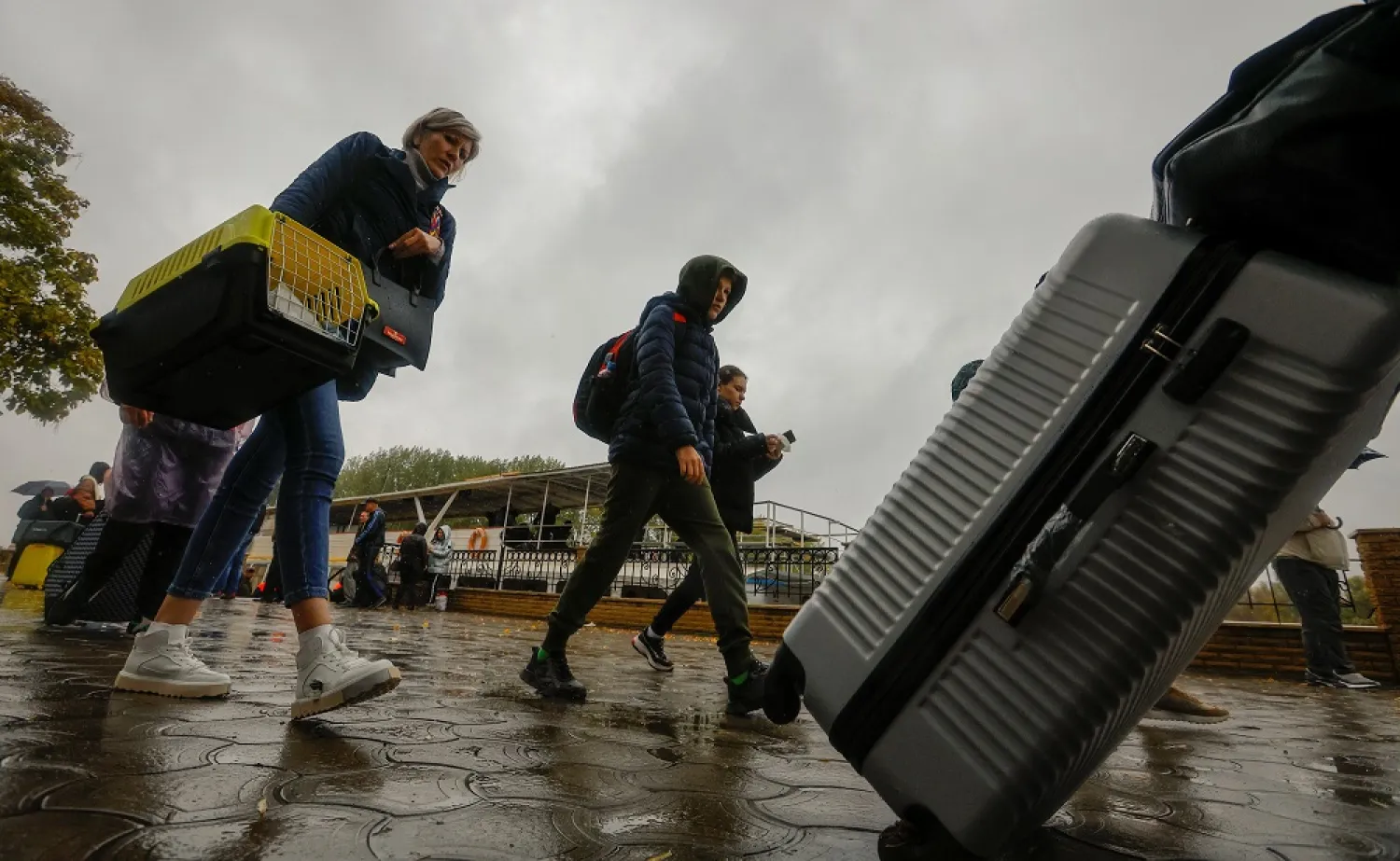
Civilians evacuated from the Russian-controlled city of Kherson walk from a ferry to board a bus heading to Crimea, in the town of Oleshky, Kherson region, Russian-controlled Ukraine October 23, 2022. (Reuters)
TT

Russia Builds Defensive Lines to Stem Ukraine’s Advance

Civilians evacuated from the Russian-controlled city of Kherson walk from a ferry to board a bus heading to Crimea, in the town of Oleshky, Kherson region, Russian-controlled Ukraine October 23, 2022. (Reuters)

Russian authorities are building defensive positions in occupied areas of Ukraine and border regions of Russia, reflecting fears that Ukrainian forces may attack along new sections of the 1,000-kilometer (620-mile) front line of a war nearing its ninth month.

In recent weeks, Ukraine has focused its counteroffensive mostly on the Kherson region. Their relentless artillery strikes cut the main crossings across the Dnieper River, which bisects the southern region, leaving Russian troops on the west bank short of supplies and vulnerable to encirclement.

Kirill Stremousov, the deputy head of the Russian-installed regional administration in Kherson, said Sunday in a radio interview that Russian defensive lines “have been reinforced and the situation has remained stable” since local officials strongly encouraged all residents of the region's capital and nearby areas Saturday to evacuate by ferry to the river's east bank.

The region is one of four that Russian President Vladimir Putin illegally annexed last month and put under Russian martial law on Thursday. Kherson city has been in Russian hands since the early days of the war, but Ukraine's forces have made advances toward reclaiming it.

About 20,000 Kherson residents have moved to places on the east bank of the Dnieper River, the Kremlin-backed regional administration reported. The Ukrainian military said Sunday that Russia's military also withdrew its officers from areas on the west bank, leaving newly mobilized, inexperienced forces.

The Ukrainian claim could not be independently verified.

As Ukraine presses south after liberating the Kharkiv region in the north last month, authorities in the western Russian provinces bordering northeastern Ukraine appeared jittery.

The governor of Russia's Kursk region, Roman Starovoit, said Sunday that two defensive lines have been built and a third one would be finished by Nov. 5.

Defensive lines were also established in the Belgorod region, Gov. Vyacheslav Gladkov said. He posted pictures Saturday of lines of pyramid-shaped concrete blocks to block the movement of armored vehicles.

More defensive positions are being built in the Luhansk region of eastern Ukraine, according to an announcement by Yevgeny Prigozhin, a millionaire Russian businessman dubbed “Putin's chef.” Prigozhin owns the Wagner Group, a mercenary military company that has played a prominent role in the war.

He said his company was constructing a “Wagner line” in the Luhansk region, another of the Ukrainian provinces Putin illegally annexed last month. Prigozhin posted images Wednesday showing a section of newly built defenses and trench systems southeast of the town of Kreminna.

The British Defense Ministry said Sunday that “the project suggests Russia is making a significant effort to prepare defenses in depth behind the current front line, likely to deter any rapid Ukrainian counteroffensives.”

Russia’s forces captured Luhansk several months ago. Pro-Moscow separatists declared independent republics in the region and neighboring Donetsk eight years ago, and Putin made controlling all of both provinces a goal at the war’s outset.

The Institute for the Study of War, a think tank in Washington, said Sunday that Russia’s latest strategy of targeting power plants appeared aimed at diminishing Ukrainians’ will to fight and forcing the government in Kyiv to devote more resources to protecting civilians and energy infrastructure.

It said the effort was unlikely to damage Ukrainian morale but would have significant economic impacts.

Nine regions across Ukraine, from Odesa in the southwest to Kharkiv in the northeast, saw more attacks targeting energy and other critical infrastructure over the past day, the Ukrainian army's general staff said. It reported a total of 25 Russian air strikes and more than 100 missile and artillery strikes around Ukraine.

The Russian attacks forced the emergency suspension of fertilizer production at a major chemical plant in northwestern Ukraine. The company that operates the plant, Rivneazot, said Sunday the suspension did not pose an environmental risk.

Russian S-300 missile strikes overnight hit a residential neighborhood in the city of Mykolaiv, injuring three people, according to the Ukrainian military’s southern command. Two apartment buildings, a playground and a warehouse were damaged or destroyed, it said in a Facebook post.

Images posted on Telegram by local media and officials showed an apartment building with one side sheared off, and piles of rubble amid puddles on the adjacent ground.

Ukrainian counteroffensive forces in the Kherson and Zaporizhzhia regions, meanwhile, targeted Russian-held facilities, notably in the town of Nova Kakhovka, and carried out 17 air strikes in the overall campaign, according to the Ukrainian army's general staff.

In a Telegram post Sunday, the Ukrainian military claimed to have destroyed 14 Iranian-made Russian drones over the past day.

The mayor of Enerhodar, home to the Zaporizhzhia Nuclear Power Plant, reported an attack on a hotel used by Russian occupying forces and people who collaborate with them. It was unclear if anyone was hurt.

Elsewhere, Ukraine’s security service said Sunday it had detained the longtime chief of a major aircraft engine factory, accusing him of collaborating with Russia by supplying military equipment for Russian attack aircraft.

Viacheslav Bohuslaiev, president of the Motor Sich plant in Zaporizhzhia, and another top factory official were charged with collaboration and “assisting the aggressor state.”

Ukrainian security service SBU said in a statement that the two were accused of colluding with a Russian arms maker close to the Kremlin to supply Ukrainian-made engines and spare parts to Russian forces. The SBU described a complex scheme using intermediaries in three countries to evade sanctions against Russia.

Motor Sich is one of Ukraine’s leading manufacturers and has been a key maker of aircraft engines since Soviet times. Its facilities have been repeatedly targeted by Russian strikes during the war.



Pope Leo Summons World's Cardinals for Key Assembly to Help him Govern the Church

A handout picture provided by the Vatican Media shows Pope Leo XIV presiding over the Jubilee Audience in St. Peter's Square, Vatican City, 20 December 2025.  EPA/VATICAN MEDIA HANDOUT
A handout picture provided by the Vatican Media shows Pope Leo XIV presiding over the Jubilee Audience in St. Peter's Square, Vatican City, 20 December 2025. EPA/VATICAN MEDIA HANDOUT
TT

Pope Leo Summons World's Cardinals for Key Assembly to Help him Govern the Church

A handout picture provided by the Vatican Media shows Pope Leo XIV presiding over the Jubilee Audience in St. Peter's Square, Vatican City, 20 December 2025.  EPA/VATICAN MEDIA HANDOUT
A handout picture provided by the Vatican Media shows Pope Leo XIV presiding over the Jubilee Audience in St. Peter's Square, Vatican City, 20 December 2025. EPA/VATICAN MEDIA HANDOUT

Pope Leo XIV has summoned the world’s cardinals for two days of meetings to help him govern the church, the Vatican said Saturday, in the clearest sign yet that the new year will signal the unofficial start of his pontificate.

The consistory, as such gatherings are called, will be held Jan. 7-8, immediately following the Jan. 6 conclusion of the 2025 Holy Year, a once-every-quarter century celebration of Christianity.

Leo’s first few months as pope have been dominated by fulfilling the weekly Holy Year obligations of meeting with pilgrimage groups and celebrating special Jubilee audiences and Masses. Additionally, much of his time has been spent wrapping up the outstanding matters of Pope Francis' pontificate.

As a result, the January consistory in many ways will mark the first time that Leo can look ahead to his own agenda following his May 8 election as the first American pope. It is significant that he has summoned all the world’s cardinals to Rome, The Associated Press reported.

Francis had largely eschewed the consistory tradition as a means of governance. He had instead relied on a small group of eight or nine hand-picked cardinal advisers to help him govern and make key decisions.

The Vatican said Saturday that Leo’s first consistory “will be oriented toward fostering common discernment and offering support and advice to the Holy Father in the exercise of his high and grave responsibility in the government of the universal Church.”

Other types of consistories include the formal installation of new cardinals. But no new cardinals will be made at this meeting, which is purely consultative.


Iran, UK Foreign Ministers in Rare Direct Contact

Iranian Foreign Minister Abbas Araghchi gestures during a joint news conference with Russian Foreign Minister Sergei Lavrov at Zinaida Morozova's Mansion in Moscow, Wednesday, Dec. 17, 2025. (Ramil Sitdikov/Pool Photo via AP)
TT

Iran, UK Foreign Ministers in Rare Direct Contact

Iranian Foreign Minister Abbas Araghchi gestures during a joint news conference with Russian Foreign Minister Sergei Lavrov at Zinaida Morozova's Mansion in Moscow, Wednesday, Dec. 17, 2025. (Ramil Sitdikov/Pool Photo via AP)

Iran's Foreign Minister Abbas Araghchi has spoken by phone with his British counterpart Yvette Cooper, an Iranian foreign ministry statement said on Saturday, in a rare case of direct contact between the two countries.

The ministry said that in Friday's call the ministers "stressed the need to continue consultations at various levels to strengthen mutual understanding and pursue issues of mutual interest."

According to AFP, a UK government source said Cooper "emphasized the need for a diplomatic solution on Iran's nuclear program and raised a number of other issues."

The source in London said Cooper raised the case of Lindsay and Craig Foreman, a British couple detained in Iran for nearly a year on suspicion of espionage.

The Iranian ministry statement did not mention the case of the two Britons.

It said Araghchi criticized "the irresponsible approach of the three European countries towards the Iranian nuclear issue", referring to Britain, France and Germany.

The three countries at the end of September initiated the reinstatement of UN sanctions against Iran because of its nuclear program.

The Foremans, both in their early fifties, were seized in January as they passed through Kerman, in central Iran, while on a round-the-world motorbike trip.

Iran accuses the couple of entering the country pretending to be tourists so as to gather information for foreign intelligence services, an allegation the couple's family rejects.

Before Friday's call, the last exchange between the two ministers was in October.


Netanyahu Plans to Brief Trump on Possible New Iran Strikes, NBC News Reports

Israeli Prime Minister Benjamin Netanyahu speaks at the plenum of the Knesset, Israel's parliament, in Jerusalem, November 10, 2025. REUTERS/Ronen Zvulun/File Photo
TT

Netanyahu Plans to Brief Trump on Possible New Iran Strikes, NBC News Reports

Israeli Prime Minister Benjamin Netanyahu speaks at the plenum of the Knesset, Israel's parliament, in Jerusalem, November 10, 2025. REUTERS/Ronen Zvulun/File Photo

US President Donald Trump is ​set to be briefed by Israel's Prime Minister Benjamin Netanyahu that any expansion ‌of ‌Iran's ‌ballistic ⁠missile ​program ‌poses a threat that could necessitate swift action, NBC News reported on Saturday.

Israeli ⁠officials are ‌concerned that Iran ‍is ‍reconstituting nuclear enrichment ‍sites the US bombed in June, and ​are preparing to brief Trump for options ⁠on attacking the missile program again, the NBC report added.

Reuters could not verify the report.

New satellite imagery shows recent activity at the Natanz nuclear facility that was damaged during June's 12-day war with Israel, according to the US-based Institute for Science and International Security (ISIS).

During the June conflict, the IAEA confirmed Israeli strikes hit Iran's Natanz underground enrichment plant.

The think tank said the satellite imagery from December 13 show panels placed on top of the remaining anti-drone structure at the Pilot Fuel Enrichment Plant (PFEP), providing cover for the damaged facility.

It suggested the new covering allows Iran to examine or retrieve materials from the rubble while limiting external observation.

The Natanz uranium enrichment facility, located some 250 km south of the Iranian capital Tehran, is one of Iran's most important and most controversial nuclear facilities in the Middle East.