

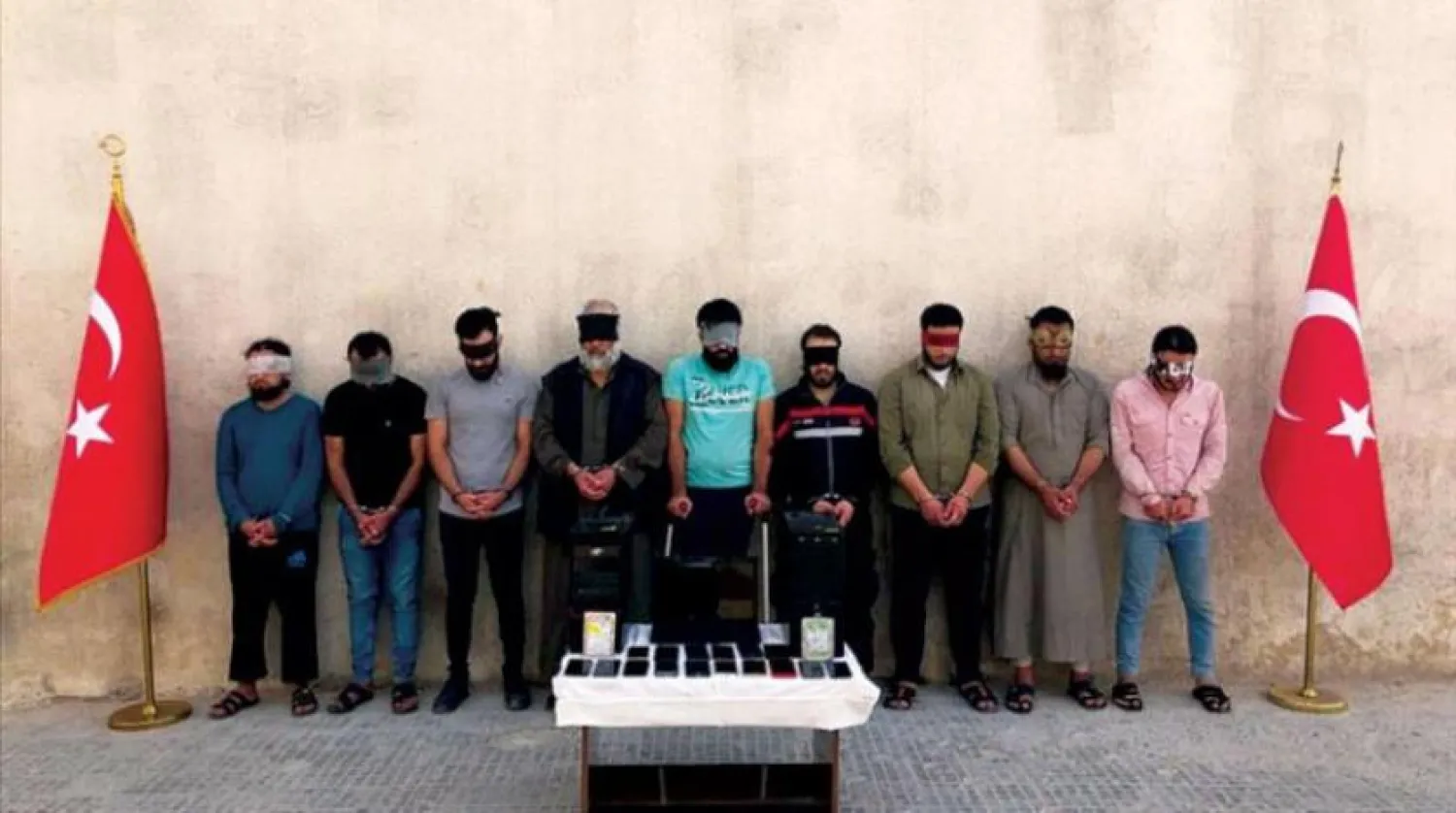

Türkiye Renews Call for Reconciliation in Syria

A photo distributed by the Turkish Interior Ministry of ISIS fighters who were arrested in the city of Al-Bab, Syria (Asharq Al-Awsat)
TT

Türkiye Renews Call for Reconciliation in Syria

A photo distributed by the Turkish Interior Ministry of ISIS fighters who were arrested in the city of Al-Bab, Syria (Asharq Al-Awsat)

Türkiye has renewed its call for reconciliation between the regime in Damascus and opposition factions in Syria.

Turkish Foreign Minister Mevlut Cavusoglu has reaffirmed his country’s support for Syria remaining unified and undivided. The top diplomat stressed the need for finding a political solution to the crisis in Syria and urged more communication between Damascus and opposition factions.

“Within the framework of the UN Security Council resolution, the regime and the opposition must agree on a roadmap including a constitution and then an election process,” Cavusoglu said, speaking to representatives of non-government organizations (NGOs) and businesspeople in southern Hatay province.

“Unity in Syria can only be achieved if the moderate opposition and the regime [Syrian authorities] agree on a roadmap,” he added.

Cavusoglu added that this is the only way to establish unity and cohesion in Syria, and this would also contribute to enabling displaced Syrians to return securely to their country.

“We will provide the necessary support for fair and transparent elections in Syria under the auspices of the UN,” noted the minister.

Cavusoglu pointed out that the Constitutional Committee, after nine rounds of talks, has not yet achieved any results.

“We will continue to work with the guarantor countries of the Astana process (Russia, Türkiye, and Iran) to achieve results in the upcoming rounds,” he said.

Addressing those who said they were disturbed by this proposal, he said, "Tell us if there is another solution. Do you accept that this civil war continues for another 50 years?"

Cavusoglu pointed out that Syria should not be allowed to "turn into a den of terrorism directed against Turkey," saying that Turkey is aware of the support provided by the West to separatist groups in Syria such as the Kurdistan Workers' Party (PKK) and the Kurdish People's Protection Units (YPG).



Somali President to Asharq Al-Awsat: Working with Saudi-led Partners to Void Israel’s Somaliland Recognition

Prince Mohammed bin Salman, Crown Prince and Prime Minister meets with Somali President Hassan Sheikh Mohamud Makkah. (SPA file)
TT

Somali President to Asharq Al-Awsat: Working with Saudi-led Partners to Void Israel’s Somaliland Recognition

Prince Mohammed bin Salman, Crown Prince and Prime Minister meets with Somali President Hassan Sheikh Mohamud Makkah. (SPA file)

Somali President Hassan Sheikh Mohamud unveiled a three-pronged political and legal strategy to nullify what he described as Israeli recognition of the breakaway region of Somaliland, warning that such a move threatens Somalia’s sovereignty and regional stability.

Speaking to Asharq Al-Awsat, Mohamud said his government is acting in close coordination with partners led by Saudi Arabia to safeguard stability and shield the Horn of Africa from what he called “reckless escalation.”

Without naming specific countries, the Somali leader said some regional states may see the Israeli recognition as an opportunity to pursue “narrow, short-term interests at the expense of Somalia’s unity and regional stability.”

“I do not wish to name any particular country or countries,” he said. “But it is clear that some may view this recognition as a chance to achieve limited gains.”

He stressed that Somalia’s unity is a “red line,” adding that Mogadishu has taken firm positions to protect national sovereignty. “We warn against being misled by reckless Israeli adventurism,” he said.

Three parallel steps

Mohamud was referring to recognition announced by Israeli Prime Minister Benjamin Netanyahu of the self-declared Republic of Somaliland as an independent state.

“I affirm with the utmost clarity and firmness that any recognition of Somaliland as an independent state constitutes a blatant violation of the sovereignty and unity of the Federal Republic of Somalia,” he said.

He described the move as a grave breach of international law, the UN Charter, and African Union resolutions that uphold respect for inherited African borders.

On that basis, Somalia has adopted and will continue to pursue three parallel measures, he revealed.

The first involves immediate diplomatic action through the UN, African Union, and Organization of Islamic Cooperation to reject and legally and politically invalidate the recognition.

Mohamud said Somalia called for and secured a formal session at the UN Security Council to address what he termed a “flagrant Israeli violation” of Somalia’s sovereignty and territorial integrity.

The session, he said, marked a significant diplomatic victory for Mogadishu, particularly given Somalia’s current membership on the council.

He expressed “deep appreciation” for statements of solidarity and condemnation issued by the African Union, Arab League, OIC, Gulf Cooperation Council, Intergovernmental Authority on Development (IGAD), and the EU, among others.

The second step centers on coordinating a unified Arab, Islamic, and African position. Mohamud praised Saudi Arabia for being among the first to issue a clear statement rejecting any infringement on Somalia’s unity.

He said the Saudi position reflects the Kingdom’s longstanding commitment to state sovereignty and territorial integrity, reinforced by the Saudi cabinet’s “firm and principled” support for Somalia during what he described as a delicate moment.

The third step focuses on strengthening internal national dialogue to address political issues within the framework of a single Somali state, free from external interference or dictates.

Regional security

Mohamud warned that if left unchecked, the recognition could set a “dangerous precedent and undermine regional and international peace and security.”

He said it could embolden separatist movements not only in the Horn of Africa but across Africa and the Arab world, citing developments in countries such as Sudan and Yemen as evidence of the high cost of state fragmentation.

“This concerns a vital global shipping artery and core Arab national security,” he said, referring to the Red Sea.

“Any political or security tension along Somalia’s coast will directly affect international trade and energy security.”

He added that instability would impact Red Sea littoral states, particularly Saudi Arabia, Egypt, Sudan, Eritrea, Yemen, and Jordan. “Preserving Somalia’s unity is a cornerstone of collective Red Sea security,” he said.

Strategic foothold

Mohamud argued that Israel’s objective goes beyond political recognition.

“We believe the goal extends beyond a political gesture,” he told Asharq Al-Awsat. “It includes seeking a strategic foothold in the Horn of Africa near the Red Sea, enabling influence over the Bab al-Mandeb Strait and threatening the national security of Red Sea states.”

He described the move as a test of Somali, Arab, and African resolve on issues of sovereignty and territorial unity, emphasizing that Somalia’s opposition to secession is a principled and enduring national stance supported widely in the Arab and African worlds, “foremost by Saudi Arabia.”

He rejected any attempt to turn Somalia into a battleground for regional or international rivalries. “We will not allow Somalia to become an arena for settling conflicts that do not serve our people’s interests or our region’s security,” he declared.

Saudi ties

Regarding Saudi-Somali relations, Mohamud described the partnership as “deep-rooted and strategic, rooted in shared history, religion, and a common destiny.” Saudi Arabia, he said, “remains a central partner in supporting Somalia’s stability, reconstruction, development, and Red Sea security.”

He voiced admiration for Saudi Arabia’s Vision 2030 and the economic and development gains achieved under the leadership of Custodian of the Two Holy Mosques King Salman bin Abdulaziz and Prince Mohammed bin Salman, Crown Prince and Prime Minister.

Asked about the recent Saudi Cabinet decision rejecting any attempt to divide Somalia, Mohamud said the federal government received it with “great appreciation and relief.”

He said the position extends the Kingdom’s historic support for Somalia’s territorial unity and sovereignty, reinforces regional stability, and sends an important message to the international community on the need to respect state sovereignty and refrain from interference in internal affairs.


RSF Drone Strike on Mosque Kills 2 Children in Sudan’s Kordofan Region

Displaced Sudanese gather near a food distribution point at the Abu al-Naga displacement camp in the Gedaref State, some 420km east of the capital Khartoum on February 6, 2026. (AFP)
TT

RSF Drone Strike on Mosque Kills 2 Children in Sudan’s Kordofan Region

Displaced Sudanese gather near a food distribution point at the Abu al-Naga displacement camp in the Gedaref State, some 420km east of the capital Khartoum on February 6, 2026. (AFP)

A drone strike at a mosque killed two children and injured 13 others in Sudan ’s central region of Kordofan early Wednesday, a local doctors group said, as the country's civil war continues. 

The Sudan Doctors Network, which monitors the conflict, said the paramilitary Rapid Support Forces, which are fighting the army, carried out the strike in al-Rahad city in North Kordofan. 

Network spokesperson Mohamed Elsheikh told The Associated Press that the children had been attending a Quran lesson at dawn. 

Targeting children inside mosques "represents a dangerous escalation in the pattern of repeated violations against civilians,” the network added. 

There was no immediate RSF comment. 

The war between the RSF and the military began in 2023, when tensions erupted between the two former allies that were meant to oversee a democratic transition after a 2019 uprising. The World Health Organization says the fighting has killed at least 40,000 people and displaced 12 million. 

Aid groups say the true death toll could be many times higher, as the fighting in vast and remote areas impedes access. 

The Sudan Doctors Network called attacks on places of worship part of a “systematic pattern” that undermines the sanctity of religious sites. 

More than 15 mosques have been damaged, burned or bombed partially or completely and over 165 churches have been destroyed or closed throughout the war, according to figures reported last year. 

Drone attacks have been common. 

On Saturday, a drone attack by the RSF hit a vehicle carrying displaced families in central Sudan, killing at least 24 people, including eight children, according to the Sudan Doctors Network. 

The United Nations High Commissioner for Human Rights has said the Kordofan region remains “volatile and a focus of hostilities” as the warring parties vie for control of strategic areas. 


Türkiye Signals May Launch ‘Simple’ Military Operation Against PKK in Iraq

PKK fighters in the Qandil Mountains of northern Iraq. (Reuters)
TT

Türkiye Signals May Launch ‘Simple’ Military Operation Against PKK in Iraq

PKK fighters in the Qandil Mountains of northern Iraq. (Reuters)

Türkiye has indicated it may launch a limited military operation against the Kurdistan Workers’ Party (PKK) in the Sinjar region of northern Iraq, while stressing its readiness to work with any government that assumes power in Baghdad.

Turkish Foreign Minister Hakan Fidan said the PKK is set to become a major issue for Iraq, noting that the group does not control any territory inside Türkiye, but “occupies large areas in Iraq”.

“How can a sovereign state allow this?” he asked, adding that “changes could soon take place” in several areas, including Iraq’s Sinjar, Makhmour and the Qandil Mountains.

Fidan outlined what he described as the PKK’s current deployment, saying Makhmour, south of Erbil near the Nineveh province, hosts the group’s civilian structures, while Sinjar, northwest of Mosul near the Syrian border, hosts its armed elements.

He said the leadership and command structures are based in the Qandil Mountains, with other strongholds near Duhok lying outside the area covered by Türkiye’s ongoing Claw Operation.

In a televised interview late Monday, Fidan stated that Sinjar is surrounded by Iraq’s Popular Mobilization Forces (PMF), revealing that Ankara has held around 20 meetings with PMF leader Faleh al-Fayyad to address the issue.

On possible military action against the PKK, he described it as “a simple military operation,” in which PMF forces would advance on the ground while Türkiye conducts air operations, estimating it would take two or three days.

Since 2024, Türkiye has pursued negotiations with imprisoned PKK leader Abdullah Ocalan, which led to his call on February 27, 2025, for the group to dissolve and lay down its arms.

The PKK subsequently announced a ceasefire, declared its dissolution on May 12, 2025, and held symbolic weapons-burning ceremonies in the Qandil Mountains in July. In October, it announced the withdrawal of its fighters from Türkiye to areas in Qandil.

On Baghdad’s position, Fidan said the Iraqi government would be forced to demonstrate genuine political will toward the PKK, insisting that the group cannot remain in Sinjar.

Iraq began addressing the issue during the tenure of former prime minister Mustafa al-Kadhimi and that, under current Prime Minister Mohammed Shia al-Sudani, the PKK has sought to expand its presence in Baghdad, he remarked.

Baghdad is in the process of forming a new government, months after holding parliamentary elections.

Over the past two years, Ankara and Baghdad have established a high-level security coordination mechanism to confront the PKK, holding five meetings in both capitals. The latest took place in April. Following Turkish President Recep Tayyip Erdogan’s visit to Iraq in April 2024, Iraq’s National Security Council formally designated the PKK a banned organization.

Fidan also said the Kurdish issue in Syria has direct implications for Iraq, hoping that Baghdad would draw lessons from recent developments in Syria, including the integration of Kurdish forces into the Syrian army, and take “prudent decisions to ease Iraq’s own transition”.