


China’s Economic Growth Accelerates but Weak amid Shutdowns

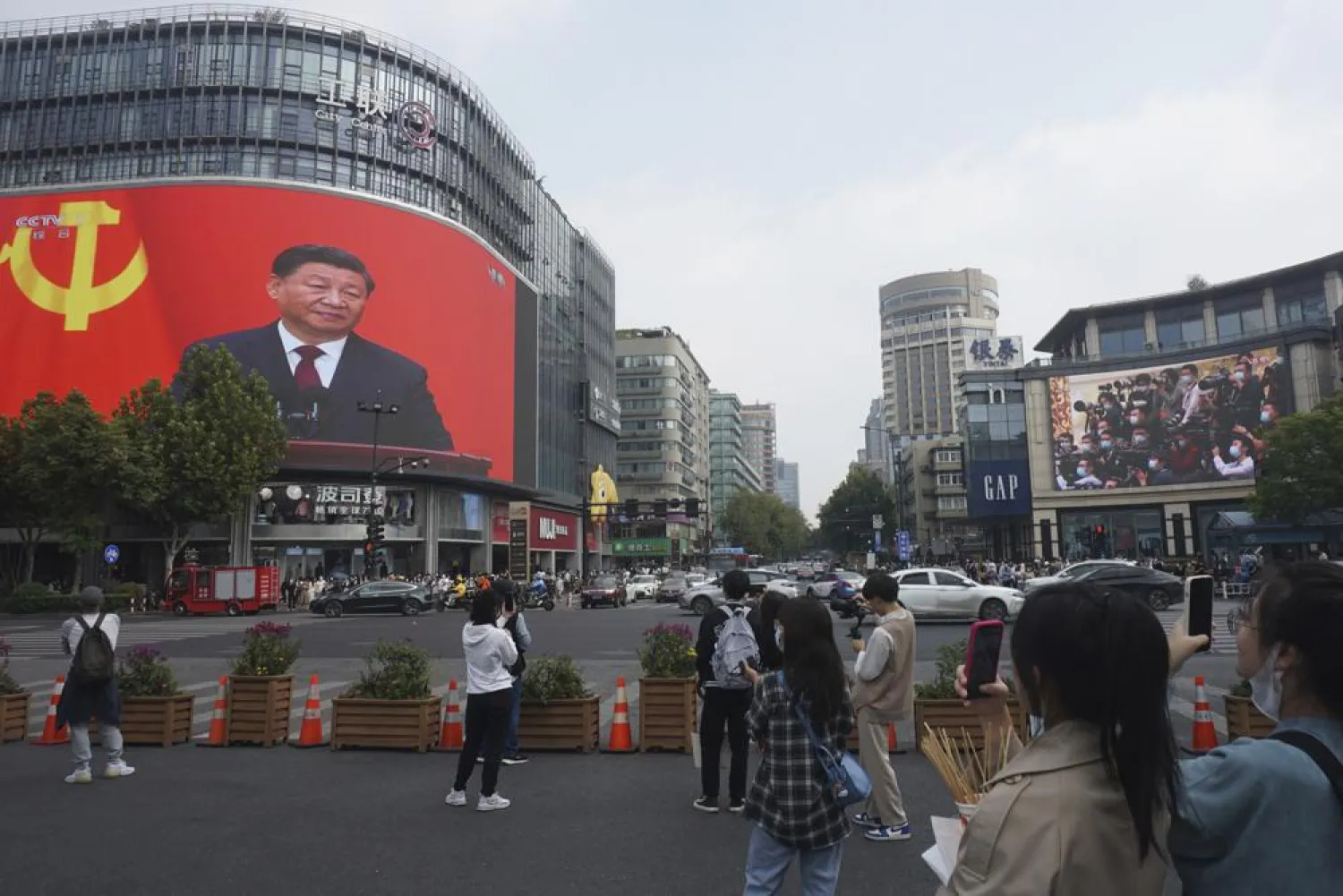
Chinese President Xi Jinping is seen at the end of the Chinese Communist Party's 20th Party Congress on a giant screen a commercial district of Hangzhou in eastern China's Zhejiang province on Sunday, Oct 23, 2022. (AP)
TT

China’s Economic Growth Accelerates but Weak amid Shutdowns

Chinese President Xi Jinping is seen at the end of the Chinese Communist Party's 20th Party Congress on a giant screen a commercial district of Hangzhou in eastern China's Zhejiang province on Sunday, Oct 23, 2022. (AP)

China's economic growth picked up in the latest quarter but still was among the weakest in decades as the ruling Communist Party tries to reverse a slump while enforcing anti-virus controls and a crackdown on debt in its vast real estate industry.

The world's second-largest economy grew by 3.9% over a year earlier in the three months ending in September, up from the previous quarter's 0.4%, official data showed Monday.

The announcement was planned for last week but postponed while the ruling Communist Party met to award President Xi Jinping a new term as leader.

Xi, the most powerful leader in decades, wants a bigger party role in business and technology development. That has prompted warnings tighter control of entrepreneurs who generate jobs and wealth will depress growth that already was in long-term decline.

The party gave Xi a free hand by installing a seven-member ruling Standing Committee made up of his allies. Supporters of free enterprise including Premier Li Keqiang, the party's No. 2 until last week, were dropped from the leadership.

The International Monetary Fund and private sector forecasters say the economy will expand by as little as 3% this year. That would be the second weakest since the 1980s after 2020, when growth plunged to 2.4% at the start of the coronavirus pandemic.

Investors and the public watched the congress for initiatives to stimulate the economy or reduce the impact of “Zero COVID” controls that shut down cities and disrupt business, but none were announced.

The latest slide in growth that began in mid-2021 hurts China’s trading partners by depressing demand for imported oil, food and consumer goods.

The improvement is “mainly a result of more flexible” anti-virus controls that isolate individual buildings or neighborhoods instead of cities, said Iris Pang of ING in a report. But she said more lockdowns are “still a big uncertainty.”

“This uncertainty means the effectiveness of pro-growth policy would be undermined,” Pang said.

Growth slid after controls on debt that regulators worry is dangerously high caused a slump in real estate sales and construction, one of China's biggest economic engines. Economic growth fell to 4% over a year earlier in the final quarter.

Beijing has eased mortgage lending and local governments have taken over some unfinished projects to make sure buyers get apartments. But regulators are sticking to debt limits have forced small developers into bankruptcy and caused some bigger competitors to miss payments to bondholders.

The ruling party is enforcing “Zero COVID" despite rising costs and public frustration after Shanghai and other industrial centers were temporarily shut down. That has boiled over into protests in some areas at a time when other countries are easing anti-virus controls.

For the first nine months of 2022, growth was 3% over a year earlier, up from 2.5% in the first six months but barely half the ruling party's official 5.5% target. Leaders have stopped talking about that goal but promised easier lending and other measures to boost growth.

Growth is “highly uneven” and supported by government spending on building roads and other public works while consumer spending is weakening, said Larry Hu and Yuxiao Zhang of Macquarie in a report.

In September, retail sales growth fell to 2.5% over a year earlier from the previous month’s 5.4%. Growth in factory output accelerated to 6.3% from 4.2%.

Also Monday, trade data showed export growth declined to 5.7% compared with a year earlier in September from the previous month's 7%. Imports crept up 0.3%.

“Most of the economy lost momentum last month,” said Julian Evans-Pritchard of Capital Economics in a report. “The situation looks to have worsened in October.”

Investment in infrastructure, mostly government money, rose 16% in September compared with the previous month's 15%.

Repeated shutdowns and uncertainty about business conditions have devastated entrepreneurs. Small retailers and restaurants have closed. Others say they are struggling to stay afloat.

Beijing is using cautious, targeted stimulus instead of across-the-board spending, a strategy that will take longer to show results, economists say. Chinese leaders worry too much spending might push up politically sensitive housing costs or corporate debt.



Iraq Exports 2.6 million bpd from Southern Ports

An oil field in the Dibs area on the outskirts of Kirkuk, Iraq (Reuters)
TT

Iraq Exports 2.6 million bpd from Southern Ports

An oil field in the Dibs area on the outskirts of Kirkuk, Iraq (Reuters)

Iraq is exporting around 2.6 million barrels of oil per day from its southern ports so far in September and producing more than 3 million bpd from its southern oilfields, Bassem Abdul Karim, head of Iraq's Basra Oil Company, said on Thursday.

Abdul Karim, speaking at an energy conference in Basra, added that Iraq is transporting around 250,000 bpd of Basra crude to Kirkuk for exports via Ceyhan in Türkiye.

On September 16, Iraq launched a pilot operation to transport crude oil by road from its southern oilfields to a Kirkuk storage facility in an effort to boost supplies to the northern export system and potentially increase shipments through Türkiye's Ceyhan port.

The initiative forms part of broader Iraqi efforts to increase flows through the northern export route after the US-Israeli war on Iran disrupted Iraq's shipments through the Strait of Hormuz, its main export route.


Oil Gains on Little Sign of Progress in US-Iran Talks

Gas prices at a Shell gas station above $6 a gallon for regular gasoline and $8 a gallon for diesel are displayed across from a US flag outside of the Marathon Petroleum Corp. (Photo by Patrick T. Fallon / AFP)
TT

Oil Gains on Little Sign of Progress in US-Iran Talks

Gas prices at a Shell gas station above $6 a gallon for regular gasoline and $8 a gallon for diesel are displayed across from a US flag outside of the Marathon Petroleum Corp. (Photo by Patrick T. Fallon / AFP)

Oil prices rose more than 1% on Thursday as diplomatic talks between the US and Iran showed little sign of progress, while investors focused on uncertainty about a potential US ban on diesel exports.

Brent crude futures were up $1.63, or 1.58%, at $104.71 a barrel at 1200 GMT, while West Texas Intermediate futures were up $1.34, or 1.49%, at $93.53 a barrel.

Brent rose to as high as $106.50 earlier in the day, following reports suggesting Iran gave the US one week to meet its publicly stated demands, such as lifting the US naval blockade, Reuters reported.

Iran and the US remain divided over how to end their conflict, but diplomacy must continue, a senior Iranian official told Reuters on Wednesday, after Iran's president told the UN General Assembly that Tehran would never surrender to US pressure.

The official said Tehran was reviewing Washington's response to its peace proposals, which prioritise lifting the US naval blockade on Iranian ports and reopening the Strait of Hormuz.

European diesel futures came off all-time highs on Thursday amid uncertainty about a potential US ban on diesel exports. A White House official on Wednesday denied a report that said the US is preparing a 90-day ban of diesel exports.

A European Commission spokesperson said on Thursday that the EU was concerned about the reported US plans, as such a move would risk a negative impact on both sides.

Analysts and market watchers have warned a US diesel export ban would do little to ease high energy prices and could worsen global supplies and further disrupt economies.

The physical market for oil is nowhere near a fully normalised situation, said Priyanka Sachdeva, head of market insights at Phillip Nova.

"Brent retains a larger geopolitical and sea-route premium because international crude is more directly exposed to Middle East and Hormuz disruption, while WTI benefits more from relatively insulated US supply," Sachdeva added.

US distillate stockpiles, including diesel and heating oil, fell 428,000 barrels to 107.4 million barrels last week, Energy Information Administration data showed.

Meanwhile, US crude inventories rose 3 million barrels to 426.4 million barrels last week, though analysts polled by Reuters had expected a 641,000-barrel draw.


Saudi Aramco Chief: Any Interruption Can be Fixed 'Within Days'

Aramco President and CEO Amin Nasser speaks during a press conference. Reuters file photo
TT

Saudi Aramco Chief: Any Interruption Can be Fixed 'Within Days'

Aramco President and CEO Amin Nasser speaks during a press conference. Reuters file photo

Saudi Aramco can restore disrupted operations within days and is looking at building alternative oil export routes, its President and CEO Amin Nasser said.

Nasser told Nikkei Asia in Tokyo on Thursday that Aramco was studying "a fourth and a fifth route" for crude oil exports in addition to its three primary routes.

Nasser added that the company is considering expanding overseas storage capacity, including in Japan, to strengthen its ability to withstand disruptions.

He stated that Aramco's operations are built with abundant flexibilities in place to continue serving its customers even during disruptions.

He added that observers often assumed Aramco had only two major export pathways, through the Strait of Hormuz or the Bab el-Mandeb Strait at the southern entrance to the Red Sea after using the East-West pipeline. In reality, Nasser said, the company could also access the 320km Sumed pipeline, which carries crude from the Red Sea to the Mediterranean through Egypt.

"People think about interruptions in Hormuz, interruptions in Bab-el Mandeb, [but] we never stopped. We continue to supply our customers," he said. "The only thing you do [is] shift more vessels, one way or the other. ... We do have this multiple optionality that allows us to meet our customers' demand."

The chief executive said that the company was also keen to add more optionality in its oil supplies, including building up additional storage capacities abroad to meet short-term disruptions, as well as "a fourth and a fifth route" for exporting crude.

The company was in discussions with the relevant ministry and its partners in Japan on expanding its storage capacity in the country, as well as "doing the engineering and the feasibility and all of the work that is required" for the additional export routes, Nasser said.