


Saudi Arabia Supports UNRWA with $27 Million

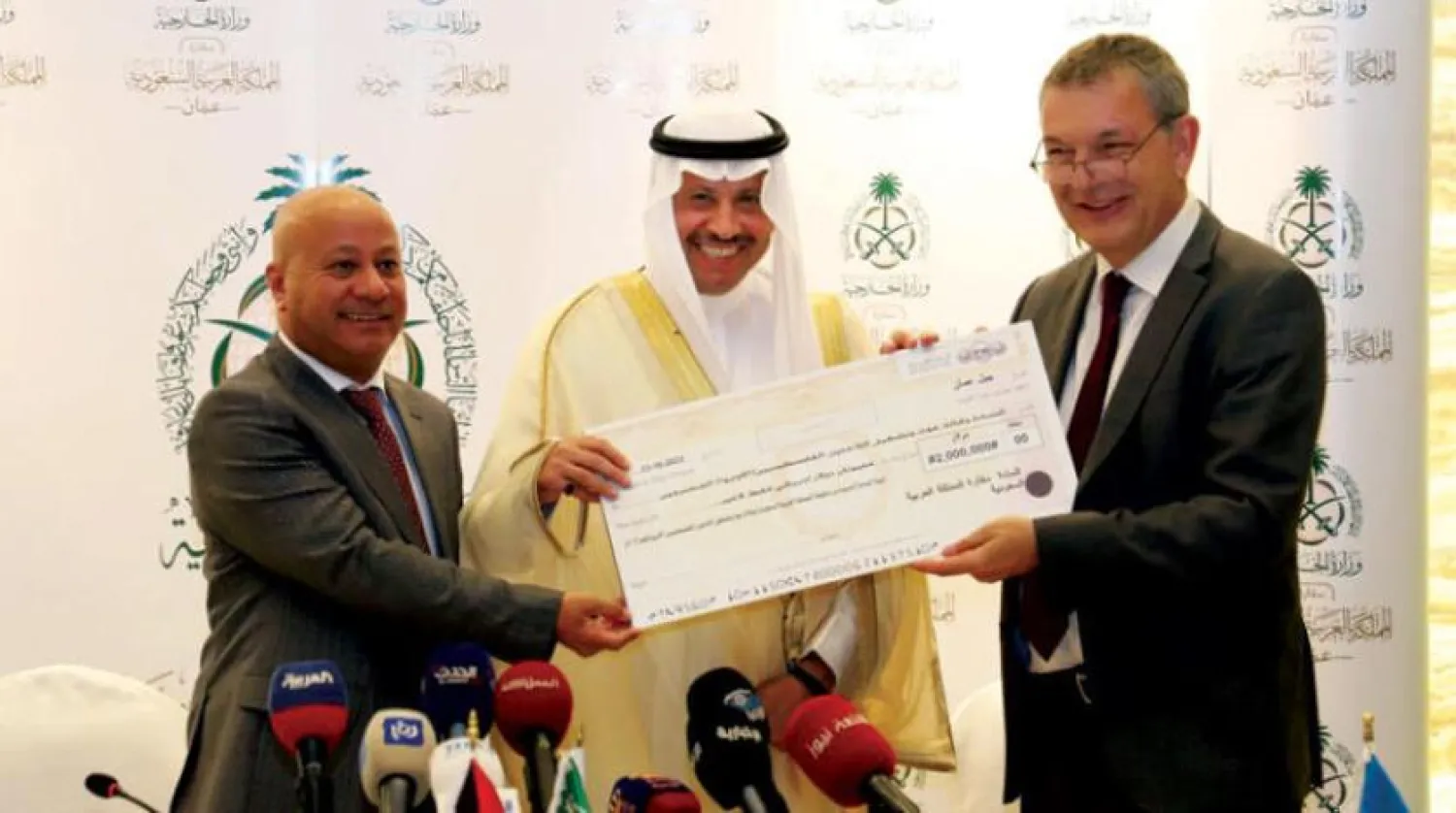
Saudi Ambassador to Jordan Nayef Al-Sudairy handed the Commissioner-General of UNRWA, Philippe Lazzarini, a check in support of UNRWA’s programs and operations in the region. (Asharq Al-Awsat)
TT

Saudi Arabia Supports UNRWA with $27 Million

Saudi Ambassador to Jordan Nayef Al-Sudairy handed the Commissioner-General of UNRWA, Philippe Lazzarini, a check in support of UNRWA’s programs and operations in the region. (Asharq Al-Awsat)

Saudi Arabia has announced a contribution of $27 million to the United Nations Relief and Works Agency for Palestine Refugees in the Near East (UNRWA), during a press conference held in Amman on Sunday.

Saudi Ambassador to Jordan Nayef Al-Sudairy handed the Commissioner-General of UNRWA, Philippe Lazzarini, a check for UNRWA’s budget, in support of the agency’s programs and operations in the region.

In remarks on the occasion, Al-Sudairy said: “The Kingdom of Saudi Arabia has historically been devoted to providing political and socio-economic support to the Palestinian cause. This includes supporting the rights of the Palestinian people in United Nations and humanitarian organizations and the historic cooperation with UNRWA through continuous support for the services it provides.”

The ambassador noted that the total Saudi support for Palestine exceeded $5.2 billion since 1999, including funding for the budgets of the Palestinian National Authority, direct support for a number of sectors related to infrastructure, health, education, food and agricultural security, as well as government, Palestinian civil society, water and environmental reform.

Al-Sudairy stressed that the security and stability of the Middle East region required a just and comprehensive solution to the Palestinian cause, in accordance with international resolutions and the Arab Peace Initiative, as well as the establishment of an independent Palestinian state on the 1967 borders with East Jerusalem as its capital.

He added that Riyadh “condemns all unilateral measures that undermine the two-state solution and calls for their immediate and complete halt.”

Sunday’s press conference, which was organized by the Saudi embassy in Amman, was attended by the head of the refugee affairs department in the Palestine Liberation Organization, Ahmed Abu Houli, the head of the Palestine Committee in the Jordanian Senate, Nayef Al-Kadi, and a number of deputies and politicians.

“Generous commitment”

“We are delighted to receive this generous contribution from the Kingdom of Saudi Arabia” said Philippe Lazzarini, UNRWA Commissioner General.

“This renewed commitment to the work of UNRWA is in line with the Kingdom’s longstanding generosity towards Palestine refugees and in solidarity with them,” he added.

Lazzarini continued: “There are few sources of stability in the lives of Palestine refugees. Access to basic services like education and primary health care are among them. Following decades of partnership with the Kingdom of Saudi Arabia, UNRWA looks forward to further deepening it to promote a dignified life, especially in the face of growing needs and deteriorating conditions in the Palestinian camps across the region.”

Palestinian demands

Abu Houli, for his part, called on the donor countries to follow the Saudi example and fulfill their obligations and pledges, noting that the financial donations would contribute to helping the agency overcome its financial crisis.

He also praised the Saudi support and its “stance and actions at all Arab, regional and international levels to mobilize political and financial support to the United Nations Relief and Works Agency for Palestine Refugees (UNRWA).”

Jordan - in cooperation with UNRWA, Sweden, Japan and Turkey – is expected to organize a conference in support of the international agency on the sidelines of the United Nations General Assembly meetings this month.

Abu Houli called on the international community and the United Nations to assume their responsibilities and move quickly to protect the agency as an international institution, and to save its financial situation “before it is too late.”

Historical Evidence

Saudi support for the Palestinian cause on all political, economic and social levels dates back to the era of King Abdulaziz bin Abdul Rahman, at the London Conference in 1935.

Riyadh was also present at conferences and meetings on the Palestinian issue, including King Fahd’s peace initiative at the Fez Summit in 1982, the Madrid Conference, and the Arab Peace Initiative, which was proposed by then Saudi Crown Prince, King Abdullah bin Abdulaziz and adopted as a unified Arab project at the Beirut Summit in March 2002.

Observers emphasize that the Palestinian issue has always been at the forefront of Saudi Arabia’s priorities. The Kingdom has called on Israel to abide by the relevant international legitimacy resolutions, which stipulate the complete withdrawal from all Arab lands occupied since 1967. It has also repeatedly urged the international community to intervene urgently to stop the Israeli attacks against the Palestinian people.

Riyadh also condemned the Israeli occupation’s construction of a separation wall, and submitted a protest note in this regard to the International Court of Justice in The Hague, in a move that ended with the court’s decision that the apartheid wall was illegal and demanded its removal.

Over the past decades, Riyadh has provided many initiatives and projects, including the King Fahd Peace Project, or the Arab Peace Project, announced during the Arab Summit held in the Moroccan city of Fez in 1982.

The project was approved by the Arab countries, and became the basis for the Madrid peace conference in 1991.

The project included a number of items, starting with Israel’s withdrawal from all the Arab lands occupied in 1967, including Jerusalem, and the removal of Israeli settlements in the occupied lands after the aforementioned year, in addition to affirming the Palestinians’ right to return to their homeland.



US Affirms Partnership with Riyadh is at its Strongest Level

Alison Dilworth, Charge d’Affaires ad interim to Saudi Arabia, shakes hands with a participant from the United States at the exhibition (Asharq Al-Awsat)
TT

US Affirms Partnership with Riyadh is at its Strongest Level

Alison Dilworth, Charge d’Affaires ad interim to Saudi Arabia, shakes hands with a participant from the United States at the exhibition (Asharq Al-Awsat)

US Charge d’Affaires ad interim to Saudi Arabia, Alison Dilworth, said Sunday that the World Defense Show currently being held in Riyadh reflects the strongest manifestation of the bilateral partnership between the United States and the Kingdom, affirming that relations between the two countries “have never been stronger than they are today.”

In remarks to Asharq Al-Awsat on the sidelines of the Show, Dilworth said the strong US participation in the exhibition clearly demonstrates the strength of cooperation between Washington and Riyadh. She pointed out that the partnership has witnessed sustained and strengthening growth in recent years.

Dilworth added that the Show brings together major global names in defense and aviation, such as Boeing and Lockheed Martin, alongside small and medium-sized US companies working in artificial intelligence, cybersecurity, and advanced defense systems, reflecting the diversity of American participation and the broad scope of technical and industrial cooperation.

She highlighted that US companies aim to grow with Saudi partners, supporting the Kingdom’s security and prosperity in line with Vision 2030.

On the Saudi-US political momentum that has strengthened bilateral relations in recent years, Dilworth said that 2025 saw what she described as a “historic” visit by US President Donald Trump to the Kingdom, followed by a visit by the Saudi Crown Prince to Washington in November.

The two visits resulted in the signing of 23 agreements which she described as “pivotal achievements” in the trajectory of US-Saudi cooperation.

Regarding the military displays at the exhibition, the diplomat highlighted that the F-35 and the scheduled aerial demonstrations underscore the US commitment as a long-term partner to Saudi Arabia.


World Defense Show in Riyadh Witnesses Signing of Important Agreements

Saudi Minister of Defense Prince Khalid bin Salman bin Abdulaziz signs an agreement with his Slovakian counterpart. SPA
TT

World Defense Show in Riyadh Witnesses Signing of Important Agreements

Saudi Minister of Defense Prince Khalid bin Salman bin Abdulaziz signs an agreement with his Slovakian counterpart. SPA

Saudi Minister of Defense and Vice Chairman of the Board of Directors of the General Authority for Military Industries (GAMI) Prince Khalid bin Salman bin Abdulaziz inaugurated in Riyadh the third edition of the World Defense Show, organized by GAMI until February 12.

At the Saudi Arabian Military Industries (SAMI) Group pavilion, the Defense Minister launched on Sunday SAMI Land Company, SAMI Autonomous Company, SAMI Land Industrial Complex, and the HEET Program.

He also unveiled the SAMI Local Content Program (RUKN), the group's flagship supply chain program.

Prince Khalid and his South Korean counterpart witnessed the signing of a memorandum of understanding between the Saudi General Authority for Defense Development and the Korean Agency for Defense Development.

The agreement focuses on defense research, development, and innovation in advanced military technologies and systems.

The Saudi Defense Minister also signed three defense cooperation agreements with Slovakia, Malaysia, and Somalia.

Furthermore, the National Industrial Development Center signed a cooperation memorandum with European aerospace corporation Airbus to explore opportunities for developing and localizing the aviation and helicopter industry in Saudi Arabia.

Under the memorandum, the two sides aim to strengthen collaboration to establish an integrated aviation industrial base in the Kingdom. They will study the creation of an engineering center to develop national capabilities in manufacturing, assembly, maintenance, and repair, alongside a supporting logistics network.

The agreement also covers technology and knowledge transfer, encouraging global suppliers to invest in Saudi Arabia, and developing Saudi talent through educational and training partnerships with domestic institutions. It includes coordination with relevant authorities to examine procurement options, support the shift toward exports, and explore incentives and financing mechanisms to enhance project readiness and competitiveness.

GE Aerospace and the Middle East Propulsion Company Ltd. (MEPC) announced signing three new agreements to enhance operational readiness for the Royal Saudi Air Force (RSAF) F110 fleet and build in-country capabilities.

Leveraging their decade-old partnership, are focused on the RSAF’s F110-129 engines and will also support F110-129 customers across the broader region.

These agreements represent Phase 3 of a long-term initiative, building on the success of similar Phase 1 and 2 agreements, which saw GE Aerospace providing repair and overhaul services support to MEPC.

The agreements seek to ensure sustained material supply and comprehensive maintenance and repair services support for the RSAF F110 Engine Structural Integrity Program (ENSIP).

They highlight the shared vision of both companies to advance the safety, efficiency, and operational excellence of defense aircraft in the wider Middle East.

MEPC Managing Director Mohammed Alnawkhani said: “These agreements represent the next phase of our strategic partnership with GE Aerospace and a major step forward in enhancing readiness for the RSAF F110 fleet.”

“Together, we are expanding in-Kingdom F110-129 sustainment capabilities, ensuring long-term material availability, and delivering the high standards of safety and performance required by our customers in the Kingdom and across the region.”

“This milestone also strengthens localization efforts in support of Saudi Vision 2030, contributing to national industrial development and building sovereign aerospace sustainment capabilities,” he added.

Salim Mousallam, Vice President, Defense & Systems for the Middle East, Africa, and Türkiye at GE Aerospace said that the enduring partnership with MEPC is a testament to the company’s shared vision of enhancing in-country capabilities and ensuring peak operational readiness through maximized availability for its customers.

“These agreements will significantly increase engine availability, streamline MRO processes, and directly support the RSAF’s critical missions. As a trusted partner to the Kingdom, we are proud to provide high-quality services to MEPC, reducing maintenance burden and service disruptions for their mission-critical F110 fleet,” he said.

Under the F110-129 Material Support Agreement, GE Aerospace will provide essential ENSIP Kits (F110-129 parts) to support MEPC in performing the necessary overhaul of RSAF F110-129 engines within the Kingdom.

The F110-129 repair and overhaul agreement further solidifies the provision of comprehensive repair and overhaul services specifically for the Royal Saudi Air Force fleet. GE Aerospace also signed a new F110-129 services agreement to extend critical repair and overhaul capabilities to support other F110 customers across the region.


Kuwait Includes 8 Lebanese Hospitals on 'Terror' List

Kuwait indicated that it had listed eight hospitals in Lebanon as part of regulations related to "combating terrorism.” KUNA
TT

Kuwait Includes 8 Lebanese Hospitals on 'Terror' List

Kuwait indicated that it had listed eight hospitals in Lebanon as part of regulations related to "combating terrorism.” KUNA

Kuwait's foreign ministry issued on Sunday a circular indicating that it had listed eight hospitals in Lebanon as part of regulations related to "combating terrorism.”

Lebanon's health ministry expressed surprise and said it would seek clarification.

It said it received the Kuwaiti statement "with great surprise", adding it had not been provided with "any information or notification from any Kuwaiti entity about this matter.”

"The hospitals mentioned in the statement are registered with the syndicate of private hospitals in Lebanon and carry out their role in providing treatment and health services to all Lebanese without exception," the ministry statement said.

It called the facilities "an essential part of the Lebanese health system,” and said it would contact the relevant authorities to request clarification and "protect Lebanon's health system.”

It noted that "Kuwait has numerous joint projects with the ministry... and has been among the most prominent countries that have stood by the health system during the successive crises that Lebanon has faced.”

The latest move was "unprecedented and inconsistent" with the Gulf country's usual approach, it added.