


Iran: Criticism Mounts over Brutal Crackdown... Khamenei Points to ‘Clear American Role’

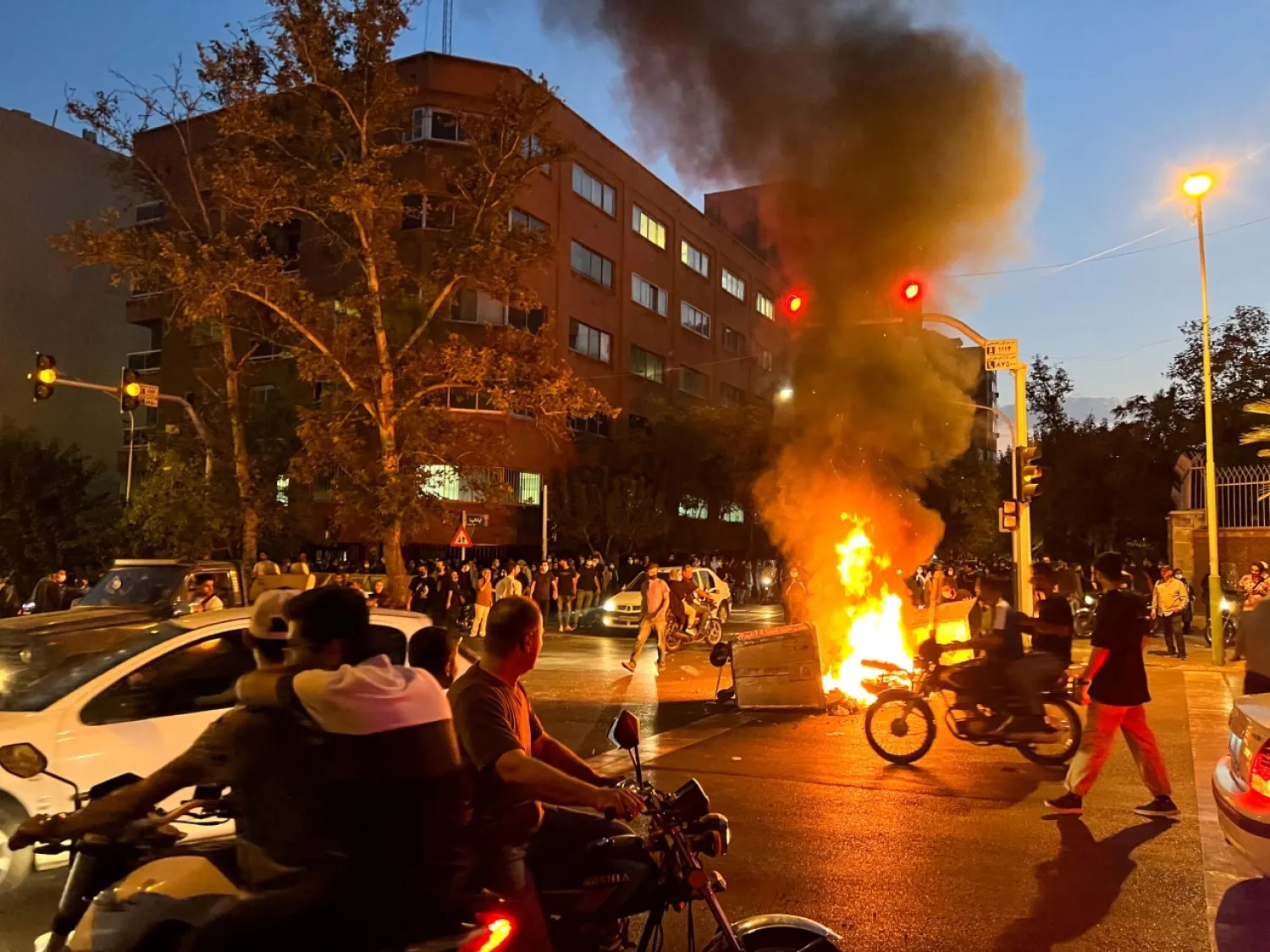
A police motorcycle burns during a protest over the death of Mahsa Amini, in Tehran, Iran September 19, 2022. WANA (West Asia News Agency) via REUTERS
TT

Iran: Criticism Mounts over Brutal Crackdown... Khamenei Points to ‘Clear American Role’

A police motorcycle burns during a protest over the death of Mahsa Amini, in Tehran, Iran September 19, 2022. WANA (West Asia News Agency) via REUTERS

Iran’s spiritual leader, Ali Khamenei, played down the school students’ protests, saying that their movement was manipulated by “the owners of plans and agendas,” while demonstrations continued across Iranian universities.

Videos on social media showing Iranian security forces severely beating protesters have gone viral as anger grows at a widening crackdown with arrests of prominent figures from rappers to economists and lawyers aimed at ending seven weeks of unrest.

Anti-regime rallies have swept the country since the death of Mahsa Amini in the custody of the morality police seven weeks ago, after she was arrested for an alleged breach of the country’s strict dress code for women.

The protests constitute one of the most difficult challenges facing Iran’s clerical leaders in decades. The country’s authorities have tried to accuse Iran’s enemies abroad and their agents of fueling the protest movement, a narrative that few Iranians believe.

Khamenei accused the United States, Israel, some “malignant European powers” and some groups of waging a "combined war". He said that they “used all their energies to harm the Iranian people.”

His comments came after the Intelligence Ministry and the IRGC issued a joint statement on Friday, accusing the US Central Intelligence Agency (CIA) and the Israeli Mossad of being behind the protests. The statement accused two female journalists, who were arrested by the authorities, of being “agents” to these bodies.

Khamenei expressed his satisfaction with the security services’ reports, saying that they have proven that the “enemy planned riots in Tehran and major and small cities.”

Reuters quoted Khamenei as saying on Wednesday that US officials who support protests are “shameless”.

“Those who think the US is an untouchable power are wrong,” Khamenei said. “It is completely vulnerable as seen with current events.”

He continued: “America’s fingerprints can be seen in most of the anti-Iranian events”, stressing that the Iranian people had managed to “thwart enemy plots.”

“We will not forget some incidents, and we will fulfill our promise regarding (...) Soleimani at the appropriate time,” he warned, referring to the US forces’ killing of IRGC General Qassem Soleimani in Iraq in January 2020.

Khamanei’s comments came as Iran prepares to celebrate Student’s Day next Saturday, the anniversary of the storming of the US Embassy by students supporting the first Iranian leader (Khomeini) in 1979, and taking 53 diplomats hostage for 444 days.

The state-run Mehr news agency reported that Iranian President Ebrahim Raisi would address the annual demonstration, which mobilizes government agencies every year.

Defying a harsh warning by the chief of the widely feared Revolutionary Guards, Iranians have risked their lives and arrest by remaining in the street despite a bloody crackdown.

Student strikes were renewed across the country. Students of Balochistan University resisted the deployment of security forces, chanting slogans and warning against suppressing their movement, according to a video recording published by the account of the Coordinating Committee of Iranian University Students’ Unions.

In the province of Kurdistan, students crowded into Mariwan University. In Shiraz, in the south of the country, students organized a protest rally to demand the release of detainees. The Khawaja Naseer Industrial University in Tehran and Rasht University issued separate statements, condemning the arrest of students, and calling on the authorities to respect the right to protest. Earlier this week, student unions have published similar statements at many universities.
 
Crackdown on protests

A video that went viral on social media showed a dozen riot police beating a man at night on a street in southern Tehran. One of the officers on a motorbike ran him over then another shot him at close range.

“This shocking video sent from Tehran today is another horrific reminder that the cruelty of Iran’s security forces knows no bounds,” Amnesty International said on Twitter about the video.

“Amid a crisis of impunity, they’re given free rein to brutally beat & shoot protesters. @UN_HRC must urgently investigate these crimes.”

Iran’s police said in a communique on Tuesday that a special order was issued to examine the details of a video showing police officers beating a citizen, without giving any detail on the video in question.

“The police does not approve of harsh and unconventional treatment, the offending police officers will certainly be dealt with according to the law,” the statement read, according to Tasnim news agency.

The activist HRANA news agency said around 300 people had been killed in the unrest, including 46 minors. Iran said at least 36 members of the security forces were also killed.

Some 14,160 people have been arrested, including about 300 students, in protests in 133 cities and towns, and 129 universities, it said.

On Monday night, security forces went to the house of prominent economist Davoud Souri and arrested him. The officers took his laptop and mobile phone with them, and after his arrest, they informed his family that he was at Evin prison, according to a social media post that Reuters could not verify.

Iranian media published on Wednesday a video of the arrest of famous Iranian rapper Toomaj Salehi, showing him blindfolded and saying he did not mean what he had said in previous comments critical of the authorities.

He was detained following his release of several rap clips in support of the protests.


Police Warn Sydney Protesters ahead of Israeli President’s Visit

 01 February 2026, Australia, Sydney: A protester holds a poster during a Free Palestine rally protesting the invitation of Isaac Herzog to Australia at the State Library of Victoria in Melbourne. (Jay Kogler/AAP/dpa)
01 February 2026, Australia, Sydney: A protester holds a poster during a Free Palestine rally protesting the invitation of Isaac Herzog to Australia at the State Library of Victoria in Melbourne. (Jay Kogler/AAP/dpa)
TT

Police Warn Sydney Protesters ahead of Israeli President’s Visit

 01 February 2026, Australia, Sydney: A protester holds a poster during a Free Palestine rally protesting the invitation of Isaac Herzog to Australia at the State Library of Victoria in Melbourne. (Jay Kogler/AAP/dpa)
01 February 2026, Australia, Sydney: A protester holds a poster during a Free Palestine rally protesting the invitation of Isaac Herzog to Australia at the State Library of Victoria in Melbourne. (Jay Kogler/AAP/dpa)

Australian authorities warned protesters to avoid violence in Sydney's streets when Israeli President Isaac Herzog visits on Monday to honor victims of the Bondi Beach mass shooting.

Police say they will deploy in large numbers for the Israeli head of state's visit following the December 14 attack on a Jewish Hanukkah celebration that killed 15 people.

"It's really important that there's no clashes or violence on the streets in Sydney," New South Wales Premier Chris Minns told reporters on Saturday.

"Our clear message is in an unambiguous way that we're hoping that people can remain calm and respectful during that presidential visit."

The state premier promised a "massive policing presence" in Sydney on Monday afternoon.

State police declared the Sydney visit to be a "major event", a designation that allows them to separate different groups to reduce the risk of confrontation.

Herzog has said he will "express solidarity and offer strength" to the Jewish community in Australia during his four-day visit, which starts Monday.

The trip has been welcomed by many Jewish Australians.

"His visit will lift the spirits of a pained community," said Alex Ryvchin, co-chief executive of the Executive Council of Australian Jewry, the community's peak body.

Pro-Palestinian activists have called for protests nationwide, however, including in parts of central Sydney where police have refused to authorize demonstrations under new powers granted after the Bondi Beach attack.

- 'Full immunity' -

Amnesty International Australia has also urged supporters to rally for an end to "genocide" against Palestinians, and urged Herzog be investigated for alleged war crimes.

High-profile Australian human rights lawyer Chris Sidoti -- a member of a UN-established inquiry into rights abuses in Israel and the Palestinian territories -- called this week for Herzog's invitation to be withdrawn, or for his arrest on arrival.

The UN's Independent International Commission of Inquiry found in 2025 that Herzog "incited the commission of genocide" by saying all Palestinians -- "an entire nation" -- were responsible for the Hamas attack on October 7, 2023.

Australia's federal police have ruled out an arrest, with senior officials telling lawmakers this week that they received legal advice Herzog had "full immunity" covering civil and criminal matters, including genocide.

Critics have accused Prime Minister Anthony Albanese's center-left government of moving too slowly to protect Jewish Australians ahead of the Bondi Beach shooting despite a rise in antisemitic attacks since 2023.

Alleged Bondi Beach gunman Sajid Akram, 50, was shot and killed by police during the attack.

An Indian national, he entered Australia on a visa in 1998.

His 24-year-old son Naveed, an Australian-born citizen who remains in prison, has been charged with terrorism and 15 murders.


Cuba to Protect Essential Services as US Moves to Cut Off Oil Supply

 People wait for transportation as Cubans brace for fuel scarcity measures after US tightens oil supply blockade, in Havana, Cuba, February 6, 2026. (Reuters)
People wait for transportation as Cubans brace for fuel scarcity measures after US tightens oil supply blockade, in Havana, Cuba, February 6, 2026. (Reuters)
TT

Cuba to Protect Essential Services as US Moves to Cut Off Oil Supply

 People wait for transportation as Cubans brace for fuel scarcity measures after US tightens oil supply blockade, in Havana, Cuba, February 6, 2026. (Reuters)
People wait for transportation as Cubans brace for fuel scarcity measures after US tightens oil supply blockade, in Havana, Cuba, February 6, 2026. (Reuters)

Cuba detailed a wide-ranging plan on Friday to protect essential services and ration fuel as the communist-run government dug in its heels in defiance of a US effort to cut off oil supply to the Caribbean island.

The rationing measures are the first to be announced since President Donald Trump threatened to slap tariffs on the US-bound products of any country exporting fuel to Cuba and suggested hard times ahead for Cubans already suffering severe shortages of food, fuel ‌and medicine.

Government ‌ministers said the measures would guarantee ‌fuel supply ⁠for key sectors, ‌including agricultural production, education, water supply, healthcare and defense.

Commerce Minister Oscar Perez-Oliva struck a defiant tone as he laid out details of the government plan.

"This is an opportunity and a challenge that we have no doubt we will overcome," Perez-Oliva told a television news program. "We are not going to collapse."

The government will supply fuel to the ⁠tourism and export sectors, including for the production of Cuba's world-famous cigars, to ensure ‌the foreign exchange necessary to fund other basic ‍programs, Perez-Oliva said, adding, "If we ‍don't have income, then we will not overcome this situation."

Domestic ‍and international air travel will not be immediately affected by the fuel rationing, although drivers will see cutbacks at the pump until supply normalizes, he said.

The government said it would protect ports and ensure fuel for domestic transportation in a bid to protect the island nation's import and export sectors.

Perez-Oliva also announced an ambitious ⁠plan to plant 200,000 hectares (500,000 acres) of rice to guarantee "an important part of our demand," but acknowledged fuel shortfalls would push the country to depend more on renewable energy for irrigation needs and animal-power for tilling fields.

Education Minister Naima Ariatne, appearing on the same program, said infant-care centers and primary schools would remain open and in person, but secondary schools and higher education would implement a hybrid system that would require more "flexibility" and vary by institution and region.

"As a priority, we want to leave (open) our primary schools," Ariatne said.

Top officials said ‌health care would also be prioritized, with special emphasis on emergency services, maternity wards and cancer programs.


Trump Signs Order Preparing for Tariffs on Iran’s Trade Partners

A man walks past a mural depicting the US Statue of Liberty with the torch-bearing arm broken, painted on the outer walls of the former US embassy, in Tehran on February 6, 2026. (AFP)
TT

Trump Signs Order Preparing for Tariffs on Iran’s Trade Partners

A man walks past a mural depicting the US Statue of Liberty with the torch-bearing arm broken, painted on the outer walls of the former US embassy, in Tehran on February 6, 2026. (AFP)

US President Donald Trump on Friday signed an executive order threatening tariffs on Iran's trade partners, after he pledged a further round of talks with Tehran next week.

The order, effective from Saturday, called for a fresh "imposition of tariffs" on countries still doing business with Iran.

It comes amid heightened tensions between Washington and Tehran, with an American naval group led by an aircraft carrier in Middle Eastern waters and indirect talks held on Tehran's nuclear program in Oman on Friday.

The levies "may be imposed on goods imported into the United States that are products of any country that directly or indirectly purchases, imports, or otherwise acquires any goods or services from Iran", the order said.

Trump issued a threat of 25 percent tariffs on any country trading with Iran last month.

This order establishes a process for his administration to impose tariffs on goods from those countries.

The rate is to be determined by Secretary of State Marco Rubio, although the order specifies that it could be "for example" 25 percent, the level first mentioned by the US president in mid-January.

Tariffs would affect trade with a number of countries including Russia, Germany, Türkiye and the United Arab Emirates.

More than a quarter of Iran's trade is with China, with $18 billion in imports and $14.5 billion in exports in 2024, according to World Trade Organization data.

The talks on Friday in Muscat, mediated by Oman, were the first between the two foes since the United States joined Israel's war with Iran in June with strikes on nuclear sites.

"We likewise had very good talks on Iran," Trump told reporters on board Air Force One en route to his Mar-a-Lago resort in Florida, adding, "we're going to meet again early next week."

Diplomatic relations between Iran and the US broke down with the 1979 revolution that brought the current government into power after hostages were taken at the US embassy in Tehran for 444 days.

Direct engagement has been rare in the decades since.

Iran remains under an internet blackout amid a harsh government crackdown on economic protests that began in December across the country.

The US-based Human Rights Activists News Agency (HRANA) said Friday it has confirmed 6,505 protesters were killed, as well as 214 members of the security forces and 61 bystanders.
