

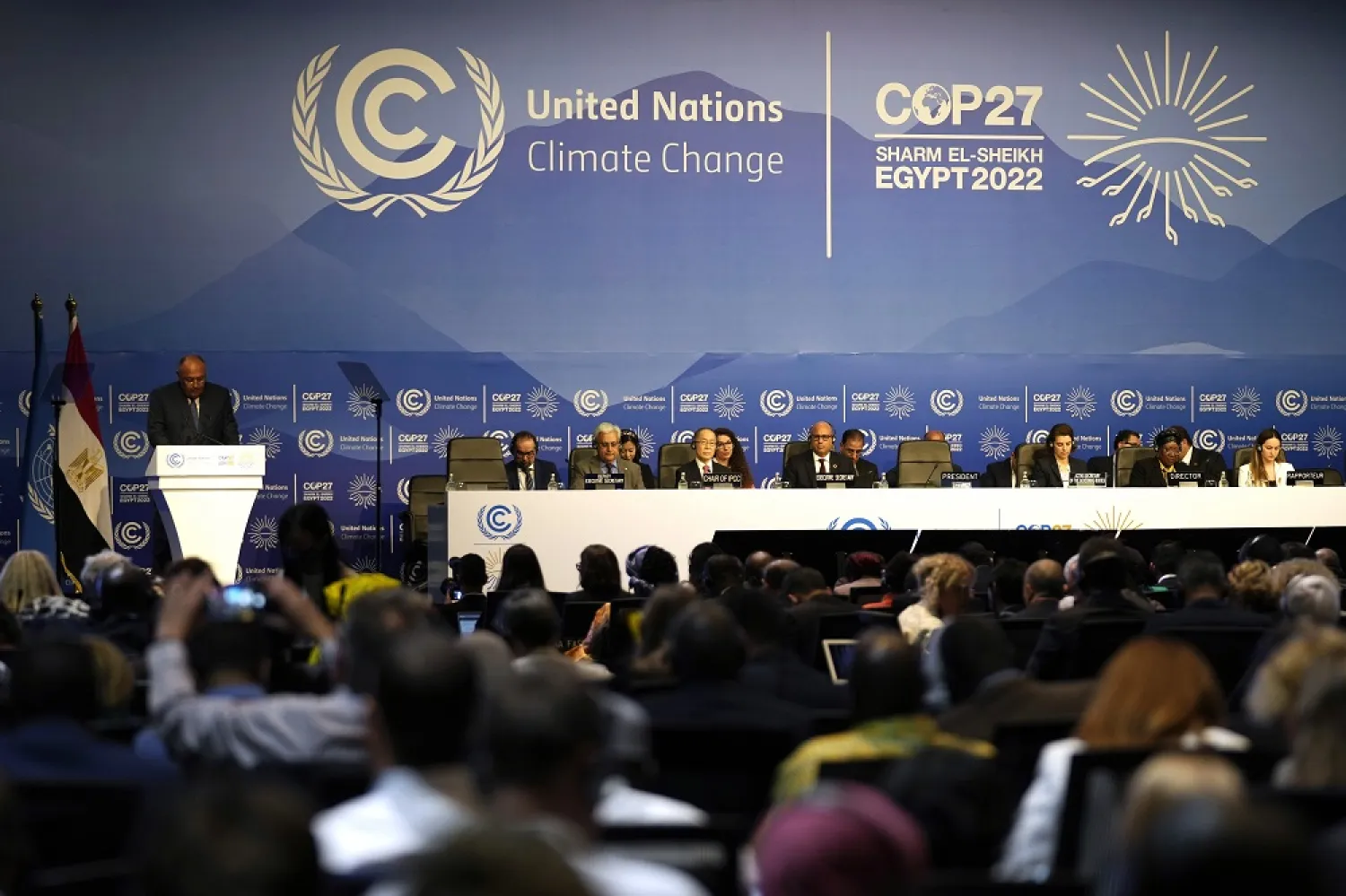

COP27... A Climate Summit with an Economic Spirit

Sameh Shoukry, president of the COP27 climate summit, left speaks during an opening session at the COP27 UN Climate Summit, Sunday, Nov. 6, 2022, in Sharm el-Sheikh, Egypt. (AP)
TT

COP27... A Climate Summit with an Economic Spirit

Sameh Shoukry, president of the COP27 climate summit, left speaks during an opening session at the COP27 UN Climate Summit, Sunday, Nov. 6, 2022, in Sharm el-Sheikh, Egypt. (AP)

The economy appears to be at the heart of problems and solutions to the world’s climate crisis as the COP27 UN Climate Change Conference got underway in Egypt’s Sharm el-Sheikh on Sunday.

As the world rushed towards industrialization at the onset of the 20th century, it drove unwanted gases into the atmosphere and harvested millions of trees, forests, and green spaces. This resulted in hundreds of billions of greenhouse gas emissions threatening the very existence of humans on the planet.

When taking a closer look, it becomes clear that a transition towards a green economy is needed now more than ever. For that reason, renowned economic figures have led many of the previous COP summits.

In the same fashion, Mahmoud Mohieldin was announced as the UN Climate Change High-Level Champion for Egypt during its presidency of COP27. Besides being a prominent economist and a climate pioneer, Mohieldin is the UN Special Envoy on Financing 2030 Sustainable Development Agenda.

Previously, Mohieldin served as Egypt’s investment minister. He also was the World Bank’s Senior Vice President for the 2030 Development Agenda.

Speaking in several media interviews, he stressed the strong link between climate issues and the economy.

“There is great importance for good spending on climate action,” he said.

Developed countries pledged in 2009 to provide $100 billion annually by 2020 to protect the climate in poor countries. This pledge has largely not been fulfilled.

At the beginning of COP27, Egyptian President Abdel Fattah al-Sisi called for the development of a “roadmap” that would protect the world from the impact of climate change.

“The current session of the Climate Summit (COP27) comes at a very sensitive time, in which our world is exposed to existential threats and unprecedented challenges, affecting the very survival of our planet and our ability to live on it,” said Sisi.

“There is no doubt that these dangers and challenges require quick action by all countries to develop a roadmap to rescue, protect the world from the effects of climate change,” he added.

“Egypt is looking forward to the conference to go from the pledges stage to the implementation with concrete measures, building on the foregoing, especially the outcomes of the Glasgow Summit and the Paris Agreement,” affirmed the president.

In a positive step, COP27 will discuss the sensitive issue of “loss and damage” funding, according to the agenda unanimously adopted on Sunday.

Egyptian Foreign Minister and COP27 President Sameh Shoukry stressed that his country will spare no effort in contributing to the success of this important summit.

“We have become more aware of the danger that surrounds us, and what we have to do to ward off this danger. Egypt is determined to continue this path, and we have a lot of effort before us to move seriously towards implementation and multilateral collective action in the face of the greatest challenge facing our societies,” said Shoukry.

He stressed the need to possess a political will to address climate change, and to move from negotiations and pledges to implementation.

“It comes as no surprise to anyone that the COP is being held this year in a world which is witnessing political turmoil that cast a long shadow on all our nations and has resulted in energy and food crises,” noted Shoukry.

“However, these challenges should be no reason for delaying our collective effort to fight climate change. It is inherent on us all in Sharm el-Sheikh to demonstrate our recognition of the magnitude of the challenges we face and our steadfast resolve to overcome them,” he stated.

Several days ago, IMF Managing Director Kristalina Georgieva warned of an increase in climate disasters in the event of failure to act quickly to confront climate change.

“If we act now, not only can we avoid the worst, but we can also choose a better future. Done right, the green transformation will deliver a cleaner planet, with less pollution, more resilient economies, and healthier people,” said Georgieva.

“While the world’s larger economies contribute the most and must deliver the lion’s share of cuts to global greenhouse gases, smaller economies pay the biggest costs and face the biggest bill for adaptation,” she added.

“In fact, for around 50 low-income and developing economies, the IMF estimates annual adaption costs will exceed 1 percent of GDP for the next 10 years,” revealed Georgieva.

Lebanon PM Pledges Reconstruction on Visit to Ruined Border Towns

This handout picture released by the Lebanese Government Press Office shows Lebanon's Prime Minister Nawaf Salam being showered with confetti as he is received by locals during a tour in the heavily-damaged southern village of Dhayra near the border with Israel on February 7, 2026. (Lebanese Government Press Office / AFP)
TT

Lebanon PM Pledges Reconstruction on Visit to Ruined Border Towns

This handout picture released by the Lebanese Government Press Office shows Lebanon's Prime Minister Nawaf Salam being showered with confetti as he is received by locals during a tour in the heavily-damaged southern village of Dhayra near the border with Israel on February 7, 2026. (Lebanese Government Press Office / AFP)

Lebanese Prime Minister Nawaf Salam visited heavily damaged towns near the Israeli border on Saturday, pledging reconstruction.

It was his first trip to the southern border area since the army said it finished disarming Hezbollah there, in January.

Swathes of south Lebanon's border areas remain in ruins and largely deserted more than a year after a US-brokered November 2024 ceasefire sought to end hostilities between Israel and the Iran-backed group.

Lebanon's government has committed to disarming Hezbollah, and the army last month said it had completed the first phase of its plan to do so, covering the area between the Litani River and the Israeli border about 30 kilometers (20 miles) further south.

Visiting Tayr Harfa, around three kilometers from the border, and nearby Yarine, Salam said frontier towns and villages had suffered "a true catastrophe".

He vowed authorities would begin key projects including restoring roads, communications networks and water in the two towns.

Locals gathered on the rubble of buildings to greet Salam and the delegation of accompanying officials in nearby Dhayra, some waving Lebanese flags.

In a meeting in Bint Jbeil, further east, with officials including lawmakers from Hezbollah and its ally the Amal movement, Salam said authorities would "rehabilitate 32 kilometers of roads, reconnect the severed communications network, repair water infrastructure" and power lines in the district.

Last year, the World Bank announced it had approved $250 million to support Lebanon's post-war reconstruction, after estimating that it would cost around $11 billion in total.

Salam said funds including from the World Bank would be used for the reconstruction and rehabilitation projects.

The second phase of the government's disarmament plan for Hezbollah concerns the area between the Litani and the Awali rivers, around 40 kilometers south of Beirut.

Israel, which accuses Hezbollah of rearming, has criticized the army's progress as insufficient, while Hezbollah has rejected calls to surrender its weapons.

Despite the truce, Israel has kept up regular strikes on what it usually says are Hezbollah targets and maintains troops in five south Lebanon areas.

Lebanese officials have accused Israel of seeking to prevent reconstruction in the heavily damaged south with repeated strikes on bulldozers, excavators and prefabricated houses.

Visiting French Foreign Minister Jean-Noel Barrot on Friday said the reform of Lebanon's banking system needed to precede international funding for reconstruction efforts.

The French diplomat met Lebanon's army chief Rodolphe Haykal on Saturday, the military said.


Over 2,200 ISIS Detainees Transferred to Iraq from Syria, Says Iraqi Official

 One of the American buses transporting ISIS fighters, according to a security source from the Syrian Democratic Forces, heads from Syria towards Iraq, in Qamishli, Syria, February 7, 2026. (Reuters)
One of the American buses transporting ISIS fighters, according to a security source from the Syrian Democratic Forces, heads from Syria towards Iraq, in Qamishli, Syria, February 7, 2026. (Reuters)
TT

Over 2,200 ISIS Detainees Transferred to Iraq from Syria, Says Iraqi Official

 One of the American buses transporting ISIS fighters, according to a security source from the Syrian Democratic Forces, heads from Syria towards Iraq, in Qamishli, Syria, February 7, 2026. (Reuters)
One of the American buses transporting ISIS fighters, according to a security source from the Syrian Democratic Forces, heads from Syria towards Iraq, in Qamishli, Syria, February 7, 2026. (Reuters)

Iraq has so far received 2,225 ISIS group detainees, whom the US military began transferring from Syria last month, an Iraqi official told AFP on Saturday.

They are among up to 7,000 ISIS detainees whose transfer from Syria to Iraq the US Central Command (CENTCOM) announced last month, in a move it said was aimed at "ensuring that the terrorists remain in secure detention facilities".

Previously, they had been held in prisons and camps administered by the Kurdish-led Syrian Democratic Forces (SDF) in northeast Syria.

The announcement of the transfer plan last month came after US envoy to Syria Tom Barrack declared that the SDF's role in confronting ISIS had come to an end.

Saad Maan, head of the security information cell attached to the Iraqi prime minister's office, told AFP on Saturday that "Iraq has received 2,225 terrorists from the Syrian side by land and air, in coordination with the international coalition", which Washington has led since 2014 to fight IS.

He said they are being held in "strict, regular detention centers".

A Kurdish military source confirmed to AFP the "continued transfer of ISIS detainees from Syria to Iraq under the protection of the international coalition".

On Saturday, an AFP photographer near the Kurdish-majority city of Qamishli in northeastern Syria saw a US military convoy and 11 buses with tinted windows.

- Iraq calls for repatriation -

ISIS seized swathes of northern and western Iraq starting in 2014, until Iraqi forces, backed by the international coalition, managed to defeat it in 2017.

Iraq is still recovering from the severe abuses committed by the extremists.

In recent years, Iraqi courts have issued death and life sentences against those convicted of terrorism offences.

Thousands of Iraqis and foreign nationals convicted of membership in the group are incarcerated in Iraqi prisons.

On Monday, the Iraqi judiciary announced it had begun investigative procedures involving 1,387 detainees it received as part of the US military's operation.

In a statement to the Iraqi News Agency on Saturday, Maan said "the established principle is to try all those involved in crimes against Iraqis and those belonging to the terrorist ISIS organization before the competent Iraqi courts".

Among the detainees being transferred to Iraq are Syrians, Iraqis, Europeans and holders of other nationalities, according to Iraqi security sources.

Iraq is calling on the concerned countries to repatriate their citizens and ensure their prosecution.

Maan noted that "the process of handing over the terrorists to their countries will begin once the legal requirements are completed".


Drone Attack by RSF in Sudan Kills 24, Including 8 Children, Doctors’ Group Says

Displaced Sudanese wait to receive humanitarian aid at the Abu al-Naga displacement camp in the Gedaref State, some 420km east of the capital Khartoum on February 6, 2026. (AFP)
TT

Drone Attack by RSF in Sudan Kills 24, Including 8 Children, Doctors’ Group Says

Displaced Sudanese wait to receive humanitarian aid at the Abu al-Naga displacement camp in the Gedaref State, some 420km east of the capital Khartoum on February 6, 2026. (AFP)

A drone attack by a notorious paramilitary group hit a vehicle carrying displaced families in central Sudan Saturday, killing at least 24 people, including eight children, a doctors’ group said.

The attack by the Rapid Support Forces occurred close to the city of Rahad in North Kordofan province, said the Sudan Doctors Network, which tracks the country’s ongoing war.

The vehicle transported displaced people who fled fighting in the Dubeiker area of North Kordofan, the doctors’ group said in a statement. Among the dead children were two infants, the group said.

The doctors’ group urged the international community and rights organizations to “take immediate action to protect civilians and hold the RSF leadership directly accountable for these violations.”

There was no immediate comment from the RSF, which has been at war against the Sudanese military for control of the country for about three years.

Sudan plunged into chaos in April 2023 when a power struggle between the military and the RSF exploded into open fighting in the capital, Khartoum, and elsewhere in the country.

The devastating war has killed more than 40,000 people, according to UN figures, but aid groups say that is an undercount and the true number could be many times higher.

It created the world’s largest humanitarian crisis with over 14 million people forced to flee their homes. It fueled disease outbreaks and pushed parts of the country into famine.
