


Egypt Hopes to Reach Agreement on GERD ‘Soon’

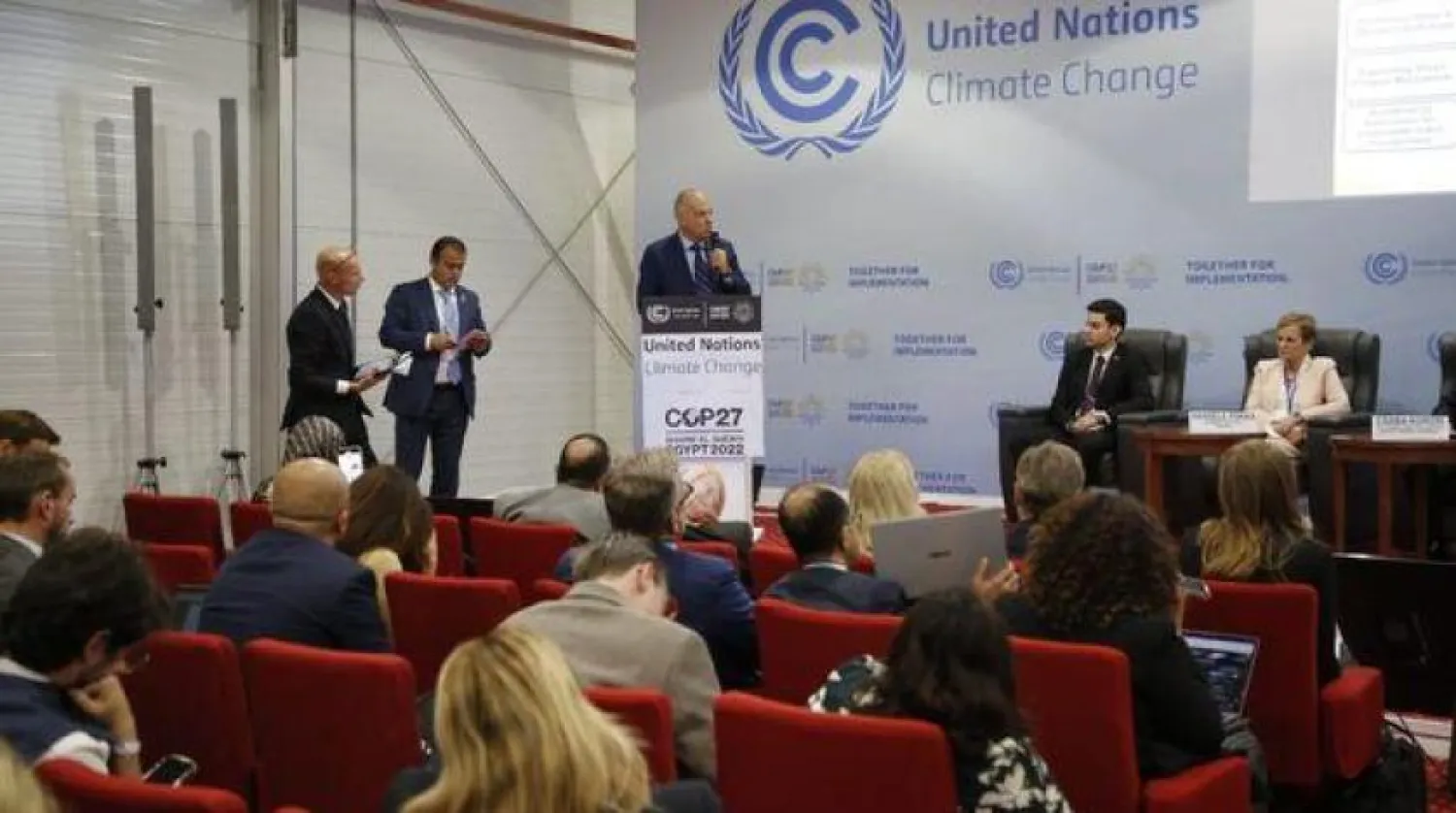
 Egypt’s Irrigation Minister during the conclusion of the Water Day, which was held on the sidelines of the Climate Summit in Sharm El-Sheikh (Egyptian government)
Egypt’s Irrigation Minister during the conclusion of the Water Day, which was held on the sidelines of the Climate Summit in Sharm El-Sheikh (Egyptian government)
TT

Egypt Hopes to Reach Agreement on GERD ‘Soon’

 Egypt’s Irrigation Minister during the conclusion of the Water Day, which was held on the sidelines of the Climate Summit in Sharm El-Sheikh (Egyptian government)
Egypt’s Irrigation Minister during the conclusion of the Water Day, which was held on the sidelines of the Climate Summit in Sharm El-Sheikh (Egyptian government)

Egypt hopes to reach an agreement on the controversial giant hydropower dam Ethiopia is building on the Blue Nile and resume talks with Addis Ababa in this regard “soon”.

Minister of Irrigation and Water Resources Hani Swailem said that the water withheld by the dam is taken from the shares of the downstream countries. However, he affirmed that Egypt’s share is highly secured.

He pointed in televised statements on Monday to Cairo’s keenness to preserve its water security and secure its water resources.

Swailem said that research centers in Egypt are developing strains that can withstand high levels of salinity.

He pointed out that Cairo seeks to make optimal use of the available water through rational use and water recycling, in addition to desalination of seawater.

“The Egyptian citizen's share of water is less than half the minimum global per capita share of water,” the minister noted.

The massive $4.2 billion Grand Ethiopian Renaissance Dam (GERD), set to be the largest hydro-electric scheme in Africa, has been at the center of a regional dispute ever since Ethiopia broke ground on the project in 2011.

Cairo says the project threatens its “rights” in the waters of the Nile River, calling for a binding legal agreement with Addis Ababa and Khartoum that regulates the rules of filling and operating the dam and preserving its water security.

Cairo has reiterated its demand that Egypt, Ethiopia, and Sudan reach a legally-binding agreement to fill and operate the dam and preserve its water security.

Egypt suffers from a scarcity of water resources and needs about 114 billion cubic meters annually, while the available water resources amount to 74 billion cubic meters.

The Nile water accounts for about 97 percent of Egypt’s needs or 55.5 billion cubic meters.

It is expecting a shortage in its water share as Addis Ababa begins operating the GERD on the Nile River.

During a meeting with the Speaker of the US House of Representatives, Nancy Pelosi, and her accompanying delegation, on the sidelines of COP 27, last week, Egyptian President Abdel Fattah El-Sisi explained the dispute with Ethiopia.

He stressed - according to the official spokesman - “the firm position on the necessity of reaching a binding legal agreement on filling and operating the dam, in order to achieve the interests of all parties and maintain Egypt’s water security.”

Negotiations between the three countries, sponsored by the African Union, have been frozen since April 2021, after their failure to achieve a breakthrough. Consequently, Egypt submitted a protest letter to the UN Security Council, demanding pressure on Ethiopia through international partners.

In order to overcome the crisis, the Ministry of Irrigation has prepared a plan to manage water in Egypt until 2037 with investments of more than $50 billion.

The plan aims to improve water quality, develop new water resources, rationalize the use of currently available resources, and create a supportive environment for water issues.



Israeli Strikes Kill Three Palestinians, Including a Child, in Gaza, Medics Say

 Palestinians inspect the site of an Israeli strike that targeted a police post, in Gaza City, May 5, 2026. (Reuters)
Palestinians inspect the site of an Israeli strike that targeted a police post, in Gaza City, May 5, 2026. (Reuters)
TT

Israeli Strikes Kill Three Palestinians, Including a Child, in Gaza, Medics Say

 Palestinians inspect the site of an Israeli strike that targeted a police post, in Gaza City, May 5, 2026. (Reuters)
Palestinians inspect the site of an Israeli strike that targeted a police post, in Gaza City, May 5, 2026. (Reuters)

Israeli strikes killed at least three Palestinians, including a child, and wounded several others in the Gaza Strip on Tuesday, health officials said.

Medics said a Palestinian was killed and two others were wounded by an Israeli airstrike near the Sheikh Radwan neighborhood in Gaza City, while another was killed and several others were wounded by Israeli tank shelling near the central area of the enclave.

Later on Tuesday, an Israeli strike targeted a police station in northern Gaza, killing a 15-year-old child, medics said. The Hamas-run interior ministry said ‌some policemen ‌were also wounded in the attack.

Reuters has previously reported ‌that ⁠Israel has intensified its ⁠attacks on Gaza's Hamas-run police force, which the group has used to reinforce its hold in the areas it controls in the strip.

There was no immediate Israeli comment on any of the incidents.

Violence in Gaza has persisted despite an October 2025 ceasefire, with Israel conducting almost daily attacks on Palestinians. Israel and Hamas have blamed each ⁠other for ceasefire violations.

At Al Shifa Hospital, the largest ‌medical facility still partially functional in the ‌enclave, relatives and friends arrived to bid farewell to one of those ‌killed on Tuesday, Mohammed Al-Ghandour. Two girls were crying and being ‌comforted by a woman outside the hospital's morgue.

"The Zionist enemy doesn't know anything called truce and does not commit to international treaties or laws or humanitarian laws," said the victim's uncle, Abu Omar Al-Naffar.

At least 830 Palestinians ‌have been killed since the ceasefire deal took effect, according to local medics, while Israel says fighters have ⁠killed four ⁠of its soldiers over the same period.

Israel says its strikes are aimed at thwarting attempts by Hamas and other Palestinian fighters to stage attacks against its forces.

More than 72,500 Palestinians have been killed since the Gaza war started in October 2023, most of them civilians, according to Gaza health authorities.

Since the truce last October, Israel still occupies more than half of Gaza, where it has ordered residents out and demolished almost all remaining structures. Nearly the entire population of more than 2 million Palestinians now lives in a narrow strip along the coast, mainly in tents and damaged buildings, under the de facto control of Hamas.


Israel Court Extends Gaza Flotilla Activists’ Detention Until Sunday

 Brazil's activist Thiago Avila is escorted into court in the Israeli coastal city of Ashkelon on May 5, 2026. (AFP)
Brazil's activist Thiago Avila is escorted into court in the Israeli coastal city of Ashkelon on May 5, 2026. (AFP)
TT

Israel Court Extends Gaza Flotilla Activists’ Detention Until Sunday

 Brazil's activist Thiago Avila is escorted into court in the Israeli coastal city of Ashkelon on May 5, 2026. (AFP)
Brazil's activist Thiago Avila is escorted into court in the Israeli coastal city of Ashkelon on May 5, 2026. (AFP)

An Israeli court has extended the detention of two foreign activists from a Gaza-bound flotilla until Sunday, a rights group representing them said, as authorities continue to question the pair.

Spanish national Saif Abu Keshek and Brazilian national Thiago Avila appeared before a court in the city of Ashkelon for their second hearing on Tuesday, after they were brought to Israel for questioning last week.

The two, held in a prison in the southern Israeli city, were among dozens of activists aboard a Gaza-bound flotilla intercepted by Israeli forces off the coast of Greece early on Thursday.

At their first hearing on Sunday, the court extended their detention by two days. A second hearing was held on Tuesday, where both appeared with their legs shackled.

"The court approved their detention until Sunday morning" at Tuesday's hearing, Miriam Azem, international advocacy coordinator at the Israeli rights group Adalah told AFP.

An AFP journalist saw the two activists brought to the courtroom.

Adalah said the two activists were on hunger strike, with Tuesday their sixth day of protest.

On Monday, the rights group alleged the pair had been subjected to physical and psychological abuse in detention.

- Abuse claims -

Both Abu Keshek and Avila are being held in isolation, with "high-intensity lighting" on at all times in their cells, Adalah said, adding that Avila was being held in "extremely cold temperatures".

"They are kept blindfolded at all times whenever they are moved outside their cells, including during medical examinations," it said.

Israeli authorities have rejected the abuse claims.

At Sunday's hearing, Adalah said the state attorney had presented a list of offences the pair were accused of, including "assisting the enemy during wartime" and "membership in and providing services to a terrorist organization".

But Adalah's lawyers challenged the state's jurisdiction, arguing there had been an "unlawful abduction" of the two activists in international waters.

Israel's foreign ministry said both individuals were affiliated with the Popular Conference for Palestinians Abroad (PCPA), a group accused by Washington of "clandestinely acting on behalf of" Palestinian group Hamas.

The ministry said Abu Keshek was a leading PCPA member, and that Avila was also linked to the group and "suspected of illegal activity".

The flotilla's vessels had set sail from France, Spain and Italy with the aim of breaking Israel's blockade of Gaza and bringing humanitarian supplies to the devastated Palestinian territory.

But they were intercepted by Israeli forces off the coast of Greece.

The Global Sumud Flotilla's first voyage last year was also intercepted by Israeli forces off the coasts of Egypt and Gaza.

Israel controls all entry points into Gaza, which has been under an Israeli blockade since 2007.

Throughout the Gaza war that started in October 2023, there have been shortages of critical supplies in the territory, with Israel at times cutting off aid entirely.


With Wood Scarce, Gaza Carpenters Make Simple Beds from Pallets

 Palestinian carpenter Mohammed Wafi builds furniture from recycled wooden pallets in his workshop amid shortages of materials in Khan Younis, in the southern Gaza Strip, May 2, 2026. (Reuters)
Palestinian carpenter Mohammed Wafi builds furniture from recycled wooden pallets in his workshop amid shortages of materials in Khan Younis, in the southern Gaza Strip, May 2, 2026. (Reuters)
TT

With Wood Scarce, Gaza Carpenters Make Simple Beds from Pallets

 Palestinian carpenter Mohammed Wafi builds furniture from recycled wooden pallets in his workshop amid shortages of materials in Khan Younis, in the southern Gaza Strip, May 2, 2026. (Reuters)
Palestinian carpenter Mohammed Wafi builds furniture from recycled wooden pallets in his workshop amid shortages of materials in Khan Younis, in the southern Gaza Strip, May 2, 2026. (Reuters)

As Israeli restrictions continue to curb the entry of goods into Gaza, local carpenters are turning to scrap wood and shipping pallets to make much-needed basic beds and tables in a strip battered by two years of war between Hamas and Israel.

In a workshop in southern Gaza, carpenters dismantle used pallets to make beds, cupboards, and shelves for families displaced by fighting, after regular construction materials became scarce or prohibitively expensive.

Mohammed Wafi, 34, a carpenter in Khan Younis, said pallets became one of the few available sources of wood when limited ‌aid trucks began entering ‌Gaza.

Demand for his handiwork has grown as people living ‌in ⁠tents seek basic furniture ⁠to get by, Wafi said. Even recycled furniture has become more costly as prices for basic components soar.

"Today people say, 'I just need something to get by, something to get my clothes off the floor'... especially those (living) in tents," said Wafi, who has worked in carpentry for 16 years.

"Due to the rats and cockroaches, they need a tent or a bed to be lifted off the ground," he said.

Rats and parasites are spreading ⁠through Gaza's tent camps, biting people as they sleep, gnawing through ‌possessions, and spreading disease.

COGAT, the Israeli military agency ‌that coordinates aid into Gaza, didn't respond to a request for comment. Wood is a construction material ‌that Israel bans from entry to Gaza because it is considered a dual-use ‌item - items for civilian but also potential military use.

"We used to get a kilo of nails for 5 shekels ($1.70). Today, a kilo of nails costs around 100 or 130 shekels," Wafi said. Hinges and other fittings have also multiplied in price.

Still, furniture made from pallets remains far ‌cheaper than conventional bedroom sets, consisting of a bed, closet and dresser, he said. A pallet set sells for 4,000 to ⁠5,000 shekels compared ⁠to 18,000 for a traditional set.

Shortages of electricity and wood have slowed production, he added, leaving carpenters unable to guarantee delivery times.

The ceasefire in Gaza has been repeatedly violated, with over 830 Palestinians and four Israeli soldiers reported killed since it began in October, according to Palestinian and Israeli tallies.

Israel cites security concerns for curbs on Gaza, and COGAT has previously said it invests considerable efforts to ensure aid reaches Gaza and has denied restricting supplies.

In tent encampments near Khan Younis, Mohammed Tayseer, who has lived in a tent for two years, said he slept on the ground until recently.

"The ground is sandy and dirty, and as you can see, you find the clothes full of sand. There are rats and mice," he said.

"One's back hurts and is stiff from sleeping on the floor... now (we) have a bed," he said.