


COP27 Summit Strikes Historic Deal to Fund Climate Damages

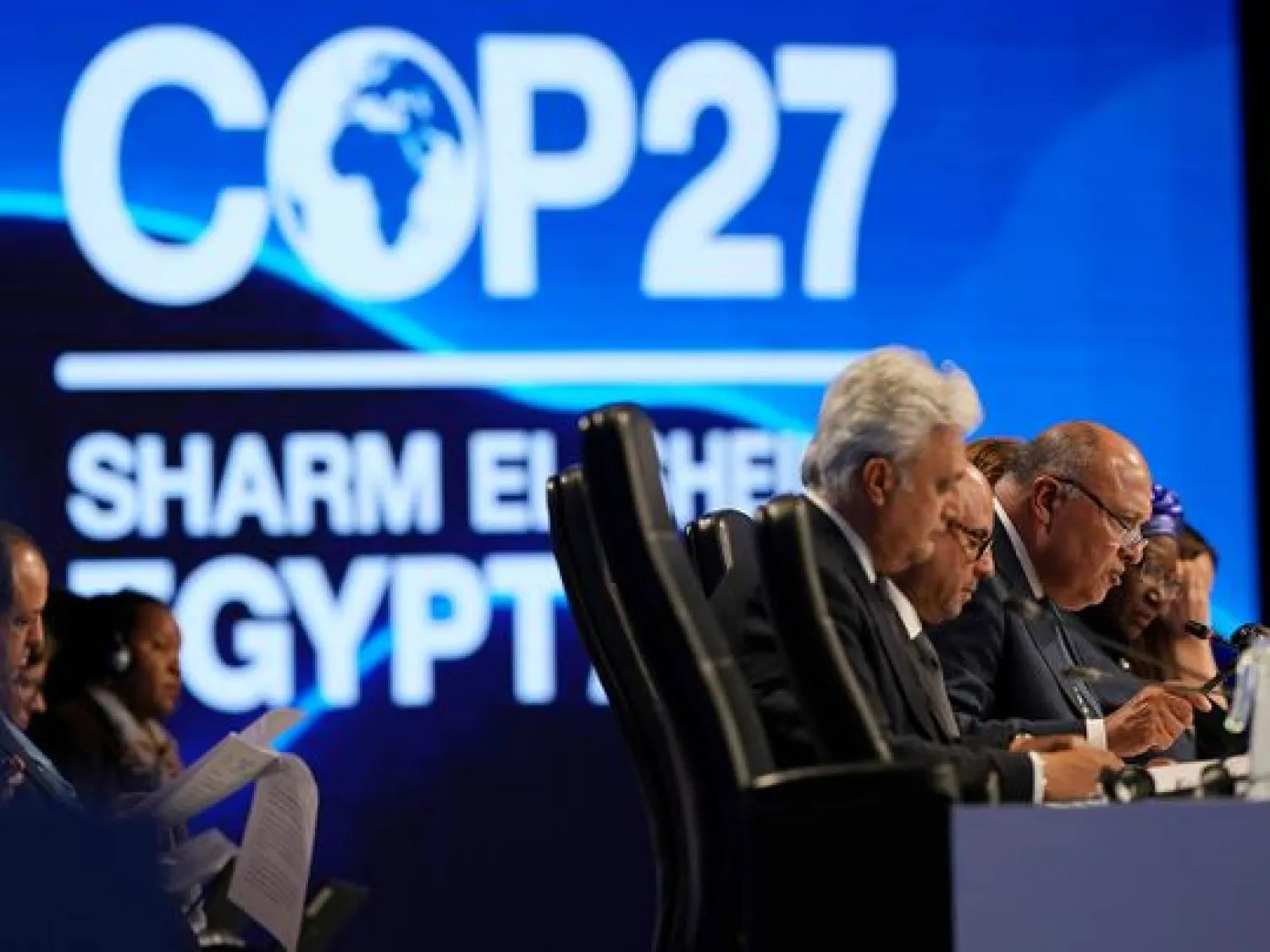
Sameh Shoukry, president of the COP27 climate summit, right, speaks during a closing plenary session at the UN Climate Summit. Image Credit: AP
TT

COP27 Summit Strikes Historic Deal to Fund Climate Damages

Sameh Shoukry, president of the COP27 climate summit, right, speaks during a closing plenary session at the UN Climate Summit. Image Credit: AP

An often fraught UN climate summit wrapped up on Sunday with sweeping agreement on how to tackle global warming and a "historic" deal to create a special fund to cover the damages suffered by vulnerable nations.

The two-week talks, which at times appeared to teeter on the brink of collapse, delivered a major breakthrough on a fund for climate "loss and damage" but left some disappointed over a failure to push further ambition on cutting emissions.

Delegates applauded after the loss and damage fund was adopted as the sun came up Sunday following days of marathon negotiations over the proposal.

Collins Nzovu, Zambia's minister of green economy and environment, said he was "excited, very, very excited."

"This is a very positive result from 1.3 billion Africans," he told AFP.

"Very exciting because for us, success in Egypt was going to be based on what we get from loss and damage."

A final COP27 statement covering the broad array of the world's efforts to grapple with a warming planet held the line on the aspirational goal of limiting global warming to 1.5 degrees Celsius from pre-industrial levels.

It also included language on renewable energy for the first time, while reiterating previous calls to accelerate "efforts towards the phasedown of unabated coal power and phase-out of inefficient fossil fuel subsidies".

But that failed to go much further than a similar decision from last year's meeting in Glasgow on key issues around, disappointing observers.

"New calls to accelerate deployment of renewable energy were very welcome," said Ani Dasgupta, head of the World Resources Institute.

"But it is mind-boggling that countries did not muster the courage to call for phasing down fossil fuels, which are the biggest driver of climate change."

As the final session stretched until sunrise after crunch talks went overnight, some delegates slept in their chairs, others struggled to keep their eyes open.

UN chief Antonio Guterres said the UN climate talks had "taken an important step towards justice" with the loss and damage fund.

"Clearly, this won't be enough, but it is a much needed political signal to rebuild broken trust. The voices of those on the frontline of the climate crisis must be heard," he said in a recorded message.

- 'Historic' deal -
A statement from the Alliance of Small Island States, comprised of islands whose very existence is threatened by sea level rise, said the loss and damage deal was a "historic" deal 30 years in the making.

"The agreements made at COP27 are a win for our entire world," said Molwyn Joseph, of Antigua and Barbuda and chair of AOSIS.

"We have shown those who have felt neglected that we hear you, we see you, and we are giving you the respect and care you deserve."

Conversely the deal on loss and damage -- which barely made it onto the negotiation agenda -- gathered critical momentum during the talks.

Developing nations relentlessly pushed for the fund during the summit, finally succeeding in getting the backing of wealthy polluters long fearful of open-ended liability.

With around 1.2C of warming so far, the world has seen a cascade of climate-driven extremes in recent months, shining a spotlight on the plight of developing countries faced with escalating disasters, as well as an energy and food price crisis and ballooning debt.

The World Bank estimated that devastating floods in Pakistan this year caused $30 billion in damage and economic loss.

Pakistan's Climate Minister Sherry Rehman said prior to the fund's approval that its creation would be "a historic reminder to vulnerable people all over the world that they have a voice and that if they unite... we can actually start breaking down barriers that we thought were impossible".

The fund will be geared towards developing nations "that are particularly vulnerable to the adverse effects of climate change" -- language that had been requested by the EU.

The EU had pushed for the wording with the aim of ensuring that wealthier developing countries such as China, which has grown into the world's second biggest economy, are not beneficiaries of the fund.

- 'On the brink' -
The Europeans had also wanted to broaden the funder base to cough up cash -- code for China and other better-off emerging countries.

The final loss and damage text left many of the thornier questions to be dealt with by a transitional committee, which will report to next year's climate meeting in Dubai to get the funding operational.

On Saturday morning, with the talks already in overtime, the European Union said it was prepared to have "no result" rather than a bad one over concerns around ambition on emissions cuts.

Scientists say limiting warming to 1.5C is a far safer guardrail against catastrophic climate impacts, with the world currently far off track and heading for around 2.5C under current commitments and plans.

"The historic outcome on loss and damage at COP27 shows international cooperation is possible," said Mary Robinson, former president of Ireland and Chair of The Elders.

"Equally, the renewed commitment on the 1.5C global warming limit was a source of relief. However, none of this changes the fact that the world remains on the brink of climate catastrophe."



WHO Appeals for $1 Bn for World’s Worst Health Crises in 2026

 Displaced Palestinian children gather at a tent camp in Gaza City, February 3, 2026. (Reuters)
Displaced Palestinian children gather at a tent camp in Gaza City, February 3, 2026. (Reuters)
TT

WHO Appeals for $1 Bn for World’s Worst Health Crises in 2026

 Displaced Palestinian children gather at a tent camp in Gaza City, February 3, 2026. (Reuters)
Displaced Palestinian children gather at a tent camp in Gaza City, February 3, 2026. (Reuters)

The World Health Organization on Tuesday appealed for $1 billion to tackle health crises this year across the world's 36 most severe emergencies, including in Gaza, Sudan, Haiti and the Democratic Republic of Congo.

The UN health agency estimated 239 million people would need urgent humanitarian assistance this year and the money would keep essential health services going.

WHO health emergencies chief Chikwe Ihekweazu told reporters in Geneva: "A quarter of a billion people are living through humanitarian crises that strip away the most basic protections: safety, shelter and access to health care.

"In these settings, health needs are surging, whether due to injuries, disease outbreaks, malnutrition or untreated chronic diseases," he warned.

"Yet access to care is shrinking."

The agency's emergency request was significantly lower than in recent years, given the global funding crunch for aid operations.

Washington, traditionally the UN health agency's biggest donor, has slashed foreign aid spending under President Donald Trump, who on his first day back in office in January 2025 handed the WHO his country's one-year withdrawal notice.

Last year, WHO had appealed for $1.5 billion but Ihekweazu said that only $900 million was ultimately made available.

Unfortunately, he said, the agency had been "recognizing ... that the appetite for resource mobilization is much smaller than it was in previous years".

"That's one of the reasons that we've calibrated our ask a little bit more towards what is available realistically, understanding the situation around the world, the constraints that many countries have," he said.

The WHO said in 2026 it was "hyper-prioritizing the highest-impact services and scaling back lower-impact activities to maximize lives saved".

Last year, global funding cuts forced 6,700 health facilities across 22 humanitarian settings to either close or reduce services, "cutting 53 million people off from health care", Ihekweazu said.

"Families living on the edge face impossible decisions, such as whether to buy food or medicine," he added, stressing that "people should never have to make these choices".

"This is why today we are appealing to the better sense of countries, and of people, and asking them to invest in a healthier, safer world."


Moscow: Russian Soldiers Helped to Repel Niger Airport Attack

A drone picture shows the main street of a suburb following the attack on the international airport in Niamey, Niger January 30, 2026. REUTERS/ Mahamadou Hamidou
TT

Moscow: Russian Soldiers Helped to Repel Niger Airport Attack

A drone picture shows the main street of a suburb following the attack on the international airport in Niamey, Niger January 30, 2026. REUTERS/ Mahamadou Hamidou

Russian soldiers helped to repel an attack on Niger's main airport in the capital Niamey last week which was claimed by the ISIS group, Moscow said on Monday.

Niger's ruling junta earlier said "Russian partners" helped to fend off the rare assault on the capital, which saw 20 attackers killed and four army soldiers wounded, AFP.

"The attack was repelled through the joint efforts of the Russian Ministry of Defense's African Corps and the Nigerien armed forces," the Russian Foreign Ministry said.

"Moscow strongly condemns this latest extremist attack," it added.

ISIS said it staged the attack and released a video of events through its propaganda agency Amaq. The video shows several dozen attackers with assault rifles firing near a hangar and setting ablaze one plane before leaving on motorbikes.

Niger's junta accused Benin, France and Ivory Coast of sponsoring the attack on the airport, which also houses a military base.

Junta chief Abdourahamane Tiani visited the Russian military base to express "personal gratitude for a high level of professionalism", the ministry said.

Russia rarely comments on its military activity in the Sahel region, where Moscow has been increasing its influence in a region that has seen a series of coups.

Facing isolation since its invasion of Ukraine, Russia has tried to build new military and political partnerships in Africa.

Apart from Niger, Russian troops or military instructors have been reported to be deployed in Burkina Faso, Equatorial Guinea, the Central African Republic and Libya.

Russia's African Corps has taken over from the Wagner paramilitary group across the continent.

According to Moscow, the corps helps "fighting terrorists" and "strengthening regional stability" in the Sahel.

Niger's authorities have been fighting the Al-Qaeda-linked Group and the Islamic State in the Sahel (EIS) for the past decade.


Shamkhani: Iran Does Not Seek Nuclear Weapons

Ali Shamkhani, advisor to Iranian Supreme Leader Ali Khamenei (AFP)
TT

Shamkhani: Iran Does Not Seek Nuclear Weapons

Ali Shamkhani, advisor to Iranian Supreme Leader Ali Khamenei (AFP)

Ali Shamkhani, adviser to Iran's Supreme Leader Ali Khamenei, spoke on the nuclear issue late Monday saying that Iran does not seek nuclear weapons and suggesting that if the talks with the US happened, they would be indirect at the beginning, then moving to direct talks if a deal appeared to be attainable.

The pan-Arab satellite channel Al Mayadeen, which is politically allied with the Iranian-backed Lebanese militant group Hezbollah, aired the interview with Shamkhani.

He also said that the US “must offer something in return” if Iran were to reduce the level of enrichment.

Shamkhani, who now sits on the country’s Supreme National Security Council and who in the 1980s led Iran's navy, wore a naval uniform as he spoke.

He suggested if the talks happened, they would be indirect at the beginning, then moving to direct talks if a deal appeared to be attainable.

Direct talks with the US long have been a highly charged political issue within Iran's theocracy, with reformists like President Masoud Pezeshkian pushing for them and hard-liners dismissing them.

The talks would solely focus on nuclear issues, he added.

Asked about whether Russia could take Iran's enriched uranium like it did in Tehran's 2015 nuclear deal with world powers, Shamkhani dismissed the idea, saying there was “no reason” to do so. Kremlin spokesperson Dmitry Peskov on Monday said Russia had “long offered these services as a possible option that would alleviate certain irritants for a number of countries.”

“Iran does not seek nuclear weapons, will not seek a nuclear weapon and will never stockpile nuclear weapons, but the other side must pay a price in return for this," he said.

Iran had been enriching uranium up to 60% purity, a short, technical step away from weapons-grade levels. The International Atomic Energy Agency had said Iran was the only country in the world to enrich to that level that wasn't armed with the bomb.

Iran has been refusing requests by the IAEA to inspect the sites bombed in the June war.

“The quantity of enriched uranium remains unknown, because part of the stockpile is under rubble, and there is no initiative yet to extract it, as it is extremely dangerous," Shamkhani said.