

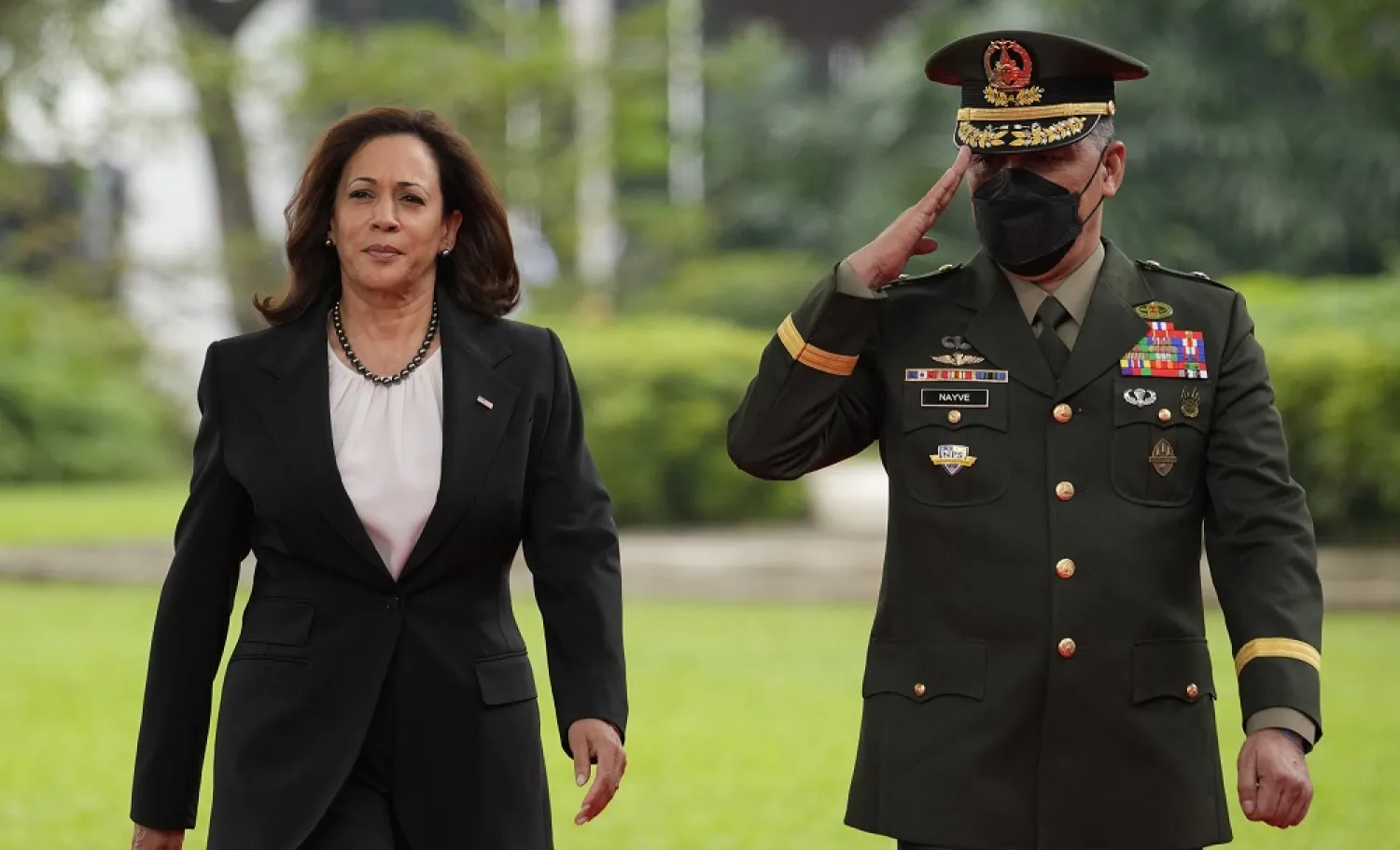

US Seeks Expansion of Military Presence in Philippines

US Vice President Kamala Harris, left, reviews an honor guard at the Malacanang presidential palace in Manila, Philippines on Monday, Nov. 21, 2022. (AP)
TT

US Seeks Expansion of Military Presence in Philippines

US Vice President Kamala Harris, left, reviews an honor guard at the Malacanang presidential palace in Manila, Philippines on Monday, Nov. 21, 2022. (AP)

The United States is seeking an expansion of its military presence in the Philippines under a 2014 defense pact, US and Philippine officials said, one of the initiatives that will be discussed during Vice President Kamala Harris's visit that focuses on the defense of its treaty ally in the face of China's sweeping territorial claims.

Harris will hold talks with President Ferdinand Jr. and other officials on Monday during a two-day visit that will include a trip to western Palawan province facing the disputed South China Sea, which Beijing claims virtually in its entirety.

She was expected to reaffirm US commitment to defend the Philippines under the 1951 Mutual Defense Treaty in case Filipino forces, ships and aircraft come under attack in the disputed waters.

“The United States and the Philippines stand together as friends, partners, and allies,” a statement issued by Harris’s aides said. “Now and always, the US commitment to the defense of the Philippines is ironclad.”

A range of US assistance and projects would also be launched by Harris to help the Philippines deal with climate change and looming energy and food shortages.

The Philippines, a former American colony, used to host one of the largest US Navy and Air Force bases outside the American mainland. The bases were shut down in the early 1990s, after the Philippine Senate rejected an extension, but American forces returned for large-scale combat exercises with Filipino troops under a 1999 Visiting Forces Agreement.

In 2014, the longtime allies signed the Enhance Defense Cooperation Agreement, which allows larger numbers of American forces to stay in rotating batches within Philippine military camp, where they could build warehouses, living quarters, joint training facilities and store combat equipment, except nuclear arms. The Philippines could take over those buildings and facilities when the Americans leave.

After the agreement was signed, the Americans launched construction projects in five Philippine camps and areas, including in the country’s south, where US counterterrorism forces have helped train and provide intelligence to their Filipino counterparts for years. Many of the projects were delayed by legal issues and other problems, Philippine defense officials said.

Large numbers of American forces stayed in local camps in southern Zamboanga city and outlying provinces at the height of threats posed by Muslim militants, which have eased in recent years. More than 100 US military personnel currently remain in Zamboanga and three southern provinces, a Philippine military official told The Associated Press.

A US official told reporters new areas have been identified and would be developed to expand joint security cooperation and training. He did not provide details, including the type of military facilities, locations and the number of American military personnel to be deployed in those sites, saying the projects would have to be finalized with the Philippines.

Philippine military chief of staff Lt. Gen. Bartolome Bacarro told reporters last week that the US wanted to construct military facilities in five more areas in the northern Philippines.

Two of the new areas proposed by the Americans were in northern Cagayan province, Bacarro said. Cagayan is across a strait from Taiwan and could serve as a crucial outpost in case tensions worsen between China and the self-governed island that Beijing claims as its own.

The other proposed sites included the provinces of Palawan and Zambales, he said. They both face the South China Sea and would allow an American military presence nearer the disputed waters to support Filipino forces.

The Philippine Constitution prohibits the presence of foreign troops in the country except when they are covered by treaties or agreements. Foreign forces are also banned from engaging in local combat.

On Tuesday, Harris is scheduled to fly to Palawan to meet fishermen, villagers, officials and the coast guard. Once there, she’ll be the highest-ranking US leader to visit the frontier island at the forefront of the long-seething territorial disputes involving China, the Philippines, Vietnam, Malaysia, Brunei and Taiwan.

The Philippine coast guard said it would welcome Harris on board one of its biggest patrol ships, the BRP Teresa Magbanua, in Palawan, where she is scheduled to deliver a speech, according to coast guard spokesperson Commodore Armand Balilo.

Harris will underscore the importance of international law, unimpeded commerce and freedom of navigation in the South China Sea, according to the US official, who said that she would affirm a 2016 ruling by an international tribunal that invalidated China’s vast territorial claims in the South China Sea on historical grounds.

China has rejected the decision by an arbitration tribunal set up in The Hague under the United Nations Convention on the Law of the Sea after the Philippine government complained in 2013 about China’s increasingly aggressive actions in the disputed waters. Beijing did not participate in the arbitration.



China FM Tells Russia’s Lavrov Willing to Work to ‘De-Escalate’ Mideast War

 Russian Foreign Minister Sergei Lavrov speaks during a joint news conference with Egyptian Foreign Minister Badr Abdelatty following their meeting in Moscow, Russia April 3, 2026. (Pavel Bednyakov/Pool via Reuters)
Russian Foreign Minister Sergei Lavrov speaks during a joint news conference with Egyptian Foreign Minister Badr Abdelatty following their meeting in Moscow, Russia April 3, 2026. (Pavel Bednyakov/Pool via Reuters)
TT

China FM Tells Russia’s Lavrov Willing to Work to ‘De-Escalate’ Mideast War

 Russian Foreign Minister Sergei Lavrov speaks during a joint news conference with Egyptian Foreign Minister Badr Abdelatty following their meeting in Moscow, Russia April 3, 2026. (Pavel Bednyakov/Pool via Reuters)
Russian Foreign Minister Sergei Lavrov speaks during a joint news conference with Egyptian Foreign Minister Badr Abdelatty following their meeting in Moscow, Russia April 3, 2026. (Pavel Bednyakov/Pool via Reuters)

China's top diplomat told his Russian counterpart on Sunday that he is willing to work together to "de-escalate" the war in the Middle East, Beijing's state media reported.

Wang Yi told Russian Foreign Minister Sergei Lavrov in a phone call that "China and Russia should uphold fairness on major issues of principle", state news agency Xinhua said, noting that the call came at Lavrov's request.

Wang said that "the situation in the Middle East is still deteriorating and fighting is escalating", Xinhua reported.

He also reiterated China's call for an "immediate ceasefire" to the fighting triggered by US-Israeli strikes against Iran that began on February 28.

"China is willing to continue cooperating with Russia in the UN Security Council, communicating promptly on major issues and making efforts to de-escalate the situation and maintain regional peace and stability and global security," Xinhua quoted Wang as saying.

Beijing and Moscow are close economic and political partners, and the relationship has deepened further since Russia's 2022 invasion of Ukraine.


Migrants Missing after Mediterranean Capsize: NGOs

Hellenic coast guard performs SAR operation, following migrant's boat collision with coast guard off the Aegean island of Chios, near Mersinidi, Greece, February 4, 2026. REUTERS
TT

Migrants Missing after Mediterranean Capsize: NGOs

Hellenic coast guard performs SAR operation, following migrant's boat collision with coast guard off the Aegean island of Chios, near Mersinidi, Greece, February 4, 2026. REUTERS

Dozens of people are missing after a migrant boat capsized in the central Mediterranean, the NGOs Mediterranea Saving Humans and Sea-Watch said Sunday on social media.

Two people died and 32 were rescued from the boat, which had left Libya on Saturday afternoon with around 105 people on board, according to Mediterranea Saving Humans, AFP reported.

"Tragic Easter shipwreck. 32 survivors, two bodies recovered and more than 70 people missing," the NGO wrote on X, adding that the boat capsized in a search-and-rescue zone handled by Libyan authorities.

Sea-Watch said two commercial ships saved the survivors and took them to the Italian island of Lampedusa.

An aerial video it posted showed two men clinging to the hull of the capsized vessel, and the approach of one of the commercial ships.

Mediterranea Saving Humans said the accident was "the consequence of policies by European governments that refuse to open safe and legal pathways" for migrants.

Lampedusa is a key entry point for migrants crossing the Mediterranean from North Africa to Europe.

Since the start of 2026, at least 683 migrants have lost their lives or gone missing on attempts to cross the sea, according to the UN's migration agency IOM.

According to the Italian government, 6,175 migrants arrived on Italian territory over the same period.


Trump Vows Strikes on Iran’s Power Plants, Bridges if Strait of Hormuz isn't Reopened

ABD Başkanı Donald Trump (Reuters)
TT

Trump Vows Strikes on Iran’s Power Plants, Bridges if Strait of Hormuz isn't Reopened

ABD Başkanı Donald Trump (Reuters)

US President Donald Trump has promised strikes on Iran’s power plants and bridges on Tuesday, restating his threat to attack civilian infrastructure if the Strait of Hormuz isn’t reopened.

In an expletive-laden post Sunday morning, Trump promised the “crazy bastards” would be “living in Hell” if the waterway isn’t opened to marine traffic, The AP news reported.

Trump had previously threatened strikes two weeks ago, but extended the deadline for Iran to reopen the waterway twice, claiming there were positive signs in negotiations with the Iranians. But there have been few public signs of progress in a diplomatic off-ramp to the war.