


Türkiye Says 3 Killed in Rocket Strikes from Kurdish Group in Syria

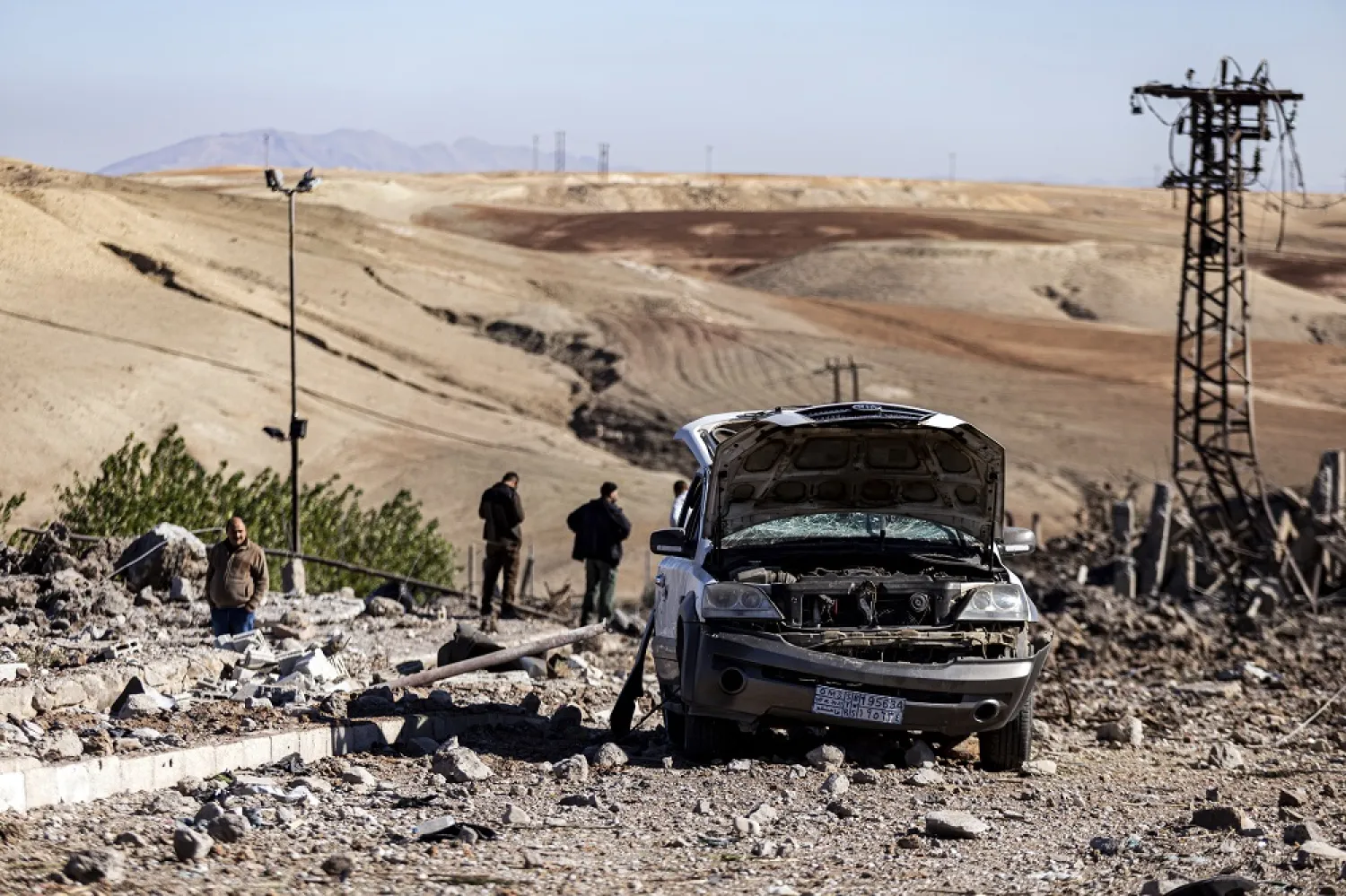
People inspect a site damaged by Turkish airstrikes that hit an electricity station in the village of Taql Baql, in Hasakeh province, Syria, Sunday, Nov. 20, 2022. (AP)
TT

Türkiye Says 3 Killed in Rocket Strikes from Kurdish Group in Syria

People inspect a site damaged by Turkish airstrikes that hit an electricity station in the village of Taql Baql, in Hasakeh province, Syria, Sunday, Nov. 20, 2022. (AP)

Türkiye said a Kurdish militia killed three people in rocket attacks from northern Syria on Monday, in an escalation of cross-border retaliation following Turkish air operations at the weekend and a bomb attack in Istanbul a week ago.

The five rockets hit a school, two houses and a truck in the Karkamis district, near a border gate in Gaziantep province, the governor Davut Gul said, adding six had been wounded. Interior Minister Suleyman Soylu later said three had died.

Broadcaster CNN Turk said the rockets were fired from the Kobani area of Syria, controlled by the People’s Protection Units (YPG).

In response to the attack, Türkiye’s armed forces were retaliating, the defense ministry said in a statement.

Turkish warplanes had already carried out air strikes on Kurdish militant bases in Syria and Iraq on Sunday, destroying 89 targets, authorities in Ankara said.

Speaking to reporters on his return from a trip to Qatar, President Tayyip Erdogan said the operations would not be limited to just an air campaign and that discussions would be held on the involvement of ground forces.

"It is not limited to just an air campaign," Erdogan was quoted by Turkish media as saying.

"Our defense ministry and our general staff decide together how much of the land forces should take part. We make our consultations, and then we take our steps accordingly."

Retaliation

The defense ministry said the weekend operation was in retaliation for a bomb attack in Istanbul last week that killed six people. Authorities have blamed the attack on the outlawed Kurdistan Workers' Party (PKK).

The PKK and Kurdish-led Syrian Democratic Forces (SDF), which includes the YPG, have denied involvement in the bombing on Nov. 13.

As part of the weekend operations, Ankara said eight security personnel had been wounded in rocket attacks by the YPG from Syria's Tal Rifat on a police post near a border gate in Türkiye’s Kilis province.

The PKK launched an insurgency against the Turkish state in 1984. It is considered a terrorist organization by Türkiye, the United States and the European Union.

Washington has allied with the YPG in the fight against ISIS in Syria, causing a rift with NATO ally Türkiye.



Israel-Backed Armed Group Burns Homes in Gaza

Palestinians inspect the damage after a person was hit by an Israeli strike while riding a bicycle, according to medics, in Gaza City, April 6, 2026. REUTERS/Dawoud Abu Alkas
TT

Israel-Backed Armed Group Burns Homes in Gaza

Palestinians inspect the damage after a person was hit by an Israeli strike while riding a bicycle, according to medics, in Gaza City, April 6, 2026. REUTERS/Dawoud Abu Alkas

Residents of Maghazi camp in central Gaza said armed men linked to Israel-backed groups set fire on Thursday to land, homes, and agricultural greenhouses.

Witnesses told Asharq Al-Awsat the fires broke out in Hamas-controlled areas west of an informal “yellow line,” while Israeli forces were stationed to the east.

Several residents accused a group known as the Abu Nasira gang, led by a former security officer, of carrying out the attack.

Such groups have become a growing concern for Hamas and its security arms, as kidnapping and assassination attempts against members of the movement, its armed wing, the Qassam Brigades, and its security forces increase.

Days earlier, east of Maghazi camp, two Qassam members were lured in an attempted abduction that escalated into clashes with Israeli fire, killing 10 Palestinians.

One witness said armed men arrived shortly before noon in several four-wheel-drive vehicles, carrying weapons. They advanced dozens of meters west of the “yellow line,” near the Hosni al-Masdar mosque east of Maghazi camp, as Israeli drones flew overhead. Infantry vehicles later reinforced them amid intermittent gunfire.

The witness, who requested anonymity, said large fires broke out soon after. Residents and field sources confirmed the blazes destroyed farmland, greenhouses, and homes.

A member of a local armed faction said Abu Nasira fighters spread across the area and carried out the arson under Israeli cover, with intensified fire directed at western areas where residents and displaced people are located.

A Hamas source repeated accusations against the group, saying it is trying to assert its presence by escalating operations. The source described it as a “major threat,” carrying out kidnappings, assassinations and direct incursions under Israeli support that provides aerial cover and, at times, ground backing.

The attack coincided with Israeli escalation elsewhere in Gaza, killing a man and a child in separate incidents. An Israeli drone killed Youssef Mansour, 33, who witnesses said was bird hunting in the Mawasi area of Rafah in southern Gaza.

In northern Gaza, tank shells hit Abu Ubaida bin al-Jarrah school in Beit Lahia, killing a young girl, Retaj Rihan. She had been in a classroom tent with dozens of displaced third-grade students. She was taken in critical condition to a clinic in Jabalia al-Balad, where she died.

Gaza’s Ministry of Education condemned the attack, holding Israel responsible and saying hundreds of students have been killed during and after the war due to repeated targeting. It called for urgent international intervention.

Shortly after the school attack, Israeli fire from remotely operated cranes east of Gaza City wounded four Palestinians. The gunfire hit Ibn al-Haytham school on the western edge of Shuja’iyya, sheltering hundreds of displaced people. Others were wounded in similar fire toward Halawa camp in Jabalia al-Balad, with one reported in critical condition.

On Wednesday evening, two Palestinians were killed in separate strikes, including journalist Mohammed Washah, drawing condemnation over the killing of journalists. The strikes have killed 262 journalists since the start of the war.

The number of Palestinians killed since a ceasefire took effect on Oct. 10, 2025 has risen to more than 740, according to available figures.


Israel Carries Out Incursions in Syria’s Quneitra as UNDOF Monitors

Israeli soldiers in the buffer zone between Israeli and Syrian forces in the Golan Heights (file photo - AFP)
TT

Israel Carries Out Incursions in Syria’s Quneitra as UNDOF Monitors

Israeli soldiers in the buffer zone between Israeli and Syrian forces in the Golan Heights (file photo - AFP)

As Israeli forces press deeper into Syrian territory along the ceasefire line in the occupied Golan Heights, a Syrian official source told Asharq Al-Awsat that increased patrols by the United Nations Disengagement Observer Force (UNDOF) stem from the 1974 disengagement agreement, not new understandings with Israel.

An Israeli force on Thursday entered the village of Al-Ajraf in northern Quneitra, according to state news agency SANA.

The unit, comprising eight vehicles and more than 30 troops, set up a temporary checkpoint and searched passersby before withdrawing without making any arrests.

The move is part of a pattern of repeated incursions into the UN-monitored buffer zone separating Syrian and Israeli forces under the 1974 agreement. The incursions have continued since the ouster of former president Bashar al-Assad in December 2024.

Israel has since escalated its operations, with near-daily incursions reaching villages and towns beyond the buffer zone, where it has set up nine military bases.

UNDOF has stepped up patrols in Quneitra and Daraa along the ceasefire line, areas frequently entered by Israeli forces. It has also begun meeting residents to document alleged violations.

Quneitra governorate’s media director, Mohammed al-Saeed, said UNDOF’s deployment remains within the framework of the 1974 agreement and does not reflect new arrangements with Israel.

He said the mission monitors the ceasefire and all parties, and is currently documenting Israeli violations against Syrian sovereignty, civilians, and property in areas entered by Israeli forces. The deployment is routine, he added, but has intensified recently.

Al-Saeed said the increased UN presence has not curbed incursions, but offers some reassurance to residents by tracking troop movements and documenting violations.

Israeli forces, he said, carry out house raids, detain civilians, set up checkpoints, search passersby, block roads, disrupt services, and fire weapons to intimidate residents.

He said the actions are aimed at pressuring residents into self-displacement.

Despite this, residents are aware of the tactics and reject leaving, he said, unwilling to repeat the displacement of 1967, when similar practices forced communities from their homes.


Netanyahu Authorizes Direct Talks with Lebanon

Heavy machinery operates at the site of an Israeli strike carried out on Wednesday, in Ain Al Mraiseh in Beirut, Lebanon, April 9, 2026. REUTERS/Raghed Waked
TT

Netanyahu Authorizes Direct Talks with Lebanon

Heavy machinery operates at the site of an Israeli strike carried out on Wednesday, in Ain Al Mraiseh in Beirut, Lebanon, April 9, 2026. REUTERS/Raghed Waked

In a potential boost to Middle East ceasefire efforts, Israeli Prime Minister Benjamin Netanyahu said Thursday that he authorized direct negotiations “as soon as possible” with Lebanon aimed at disarming Hezbollah militants and establishing relations between the two countries.

"In light of Lebanon's repeated requests to open direct negotiations with Israel, I instructed the cabinet yesterday to begin direct negotiations with Lebanon as soon as possible," his office wrote in a statement.

"Negotiations will focus on disarming Hezbollah and establishing peace relations between Israel and Lebanon. Israel appreciates today's call by the Prime Minister of Lebanon to demilitarize Beirut," the press release added.

Lebanon has spent the last 24 hours advocating for a temporary ceasefire to allow for broader talks with Israel, a senior Lebanese official told Reuters, saying it would ⁠be a "separate track ⁠but the same model" as a fragile truce brokered by Pakistan between ⁠the US and Iran.

The official said no date or location had been set yet but Lebanon needed the US as a mediator and guarantor of any agreement.

The official ⁠spoke ⁠to Reuters after Netanyahu’s announcement.