


EU Ministers Endorse New Migrant Plan after France-Italy Spat

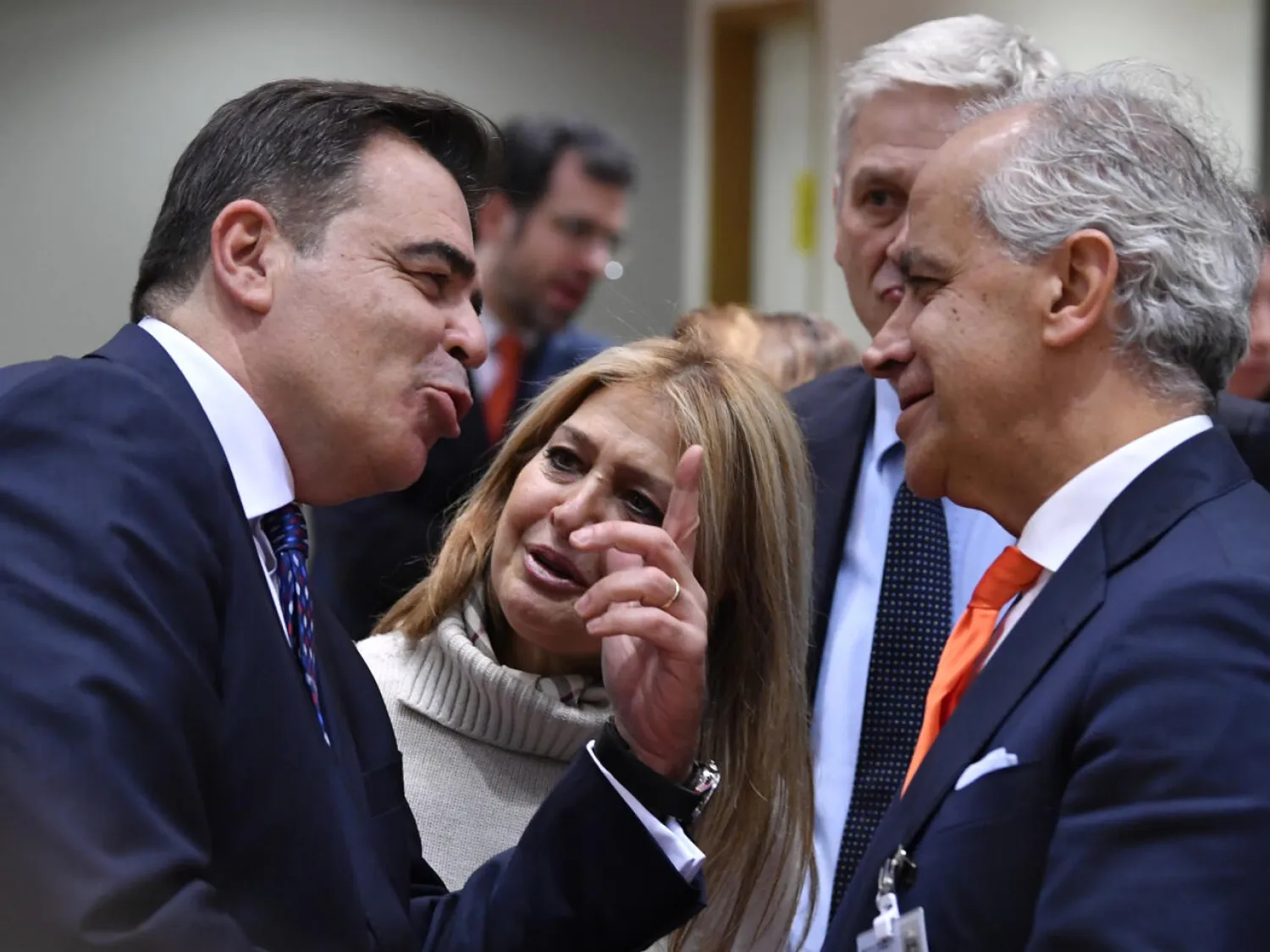
EU vice-president Margaritis Schinas (left) warned interior ministers like Italy's Matteo Piantedosi that the time for ad hoc solutions to migrant arrivals is over John THYS AFP
TT

EU Ministers Endorse New Migrant Plan after France-Italy Spat

EU vice-president Margaritis Schinas (left) warned interior ministers like Italy's Matteo Piantedosi that the time for ad hoc solutions to migrant arrivals is over John THYS AFP

European interior ministers welcomed Friday an EU plan to better coordinate the handling of migrant arrivals, after a furious row over a refugee rescue boat erupted between Italy and France.

France has accused Italy of failing to respect the law of the sea by turning away the NGO vessel earlier this month, triggering crisis talks in Brussels to head off a new EU dispute over the politically fraught issue, said AFP.

All sides described the meeting as productive, although Czech interior minister Vit Rakusan, whose country holds the EU presidency, later said all participants had agreed that "more can and must be done" to find a lasting solution.

The ministers will gather again at a pre-planned December 8 meeting to pursue the "difficult discussion", he said.

European Commission vice-president Margaritis Schinas, the commissioner charged with "promoting our European way of life", said Europe could no longer settle for just another ad hoc solution.

"We cannot continue working event-by-event, ship-by-ship, incident-by-incident, route-by-route," he said, recalling that previous crises had been seized upon by "populistic and europhobe forces".

Numbers of asylum seekers are still far lower than the levels of 2015 and 2016, but the dispute has already undermined a stop-gap pact to redistribute arrivals more evenly around the 27-nation bloc.

- No more 'ad hoc' plans -
Brussels has been struggling for years to agree and implement a new policy for sharing responsibility for migrants and asylum seekers but the ugly row has brought the issue to the fore.

Earlier this month, Italy's new government under far-right leader Georgia Meloni refused to allow a Norwegian-flagged NGO ship to dock with 234 migrants rescued from the Mediterranean.

The Ocean Viking eventually continued on to France, where authorities reacted with fury to Rome's stance, suspending an earlier deal to take in 3,500 asylum seekers stranded in Italy.

The row undermined the EU's interim solution and led to Paris calling Friday's extraordinary meeting of interior ministers from the 27 member states.

"The Ocean Viking crisis was a bit of improvisation," Schinas admitted, defending the new plan from his commission to better coordinate rescues and migrant and refugee arrivals.

"We have twenty specific actions, we have an important political agreement, everyone is committed to working so as not to reproduce this kind of situation."

French Interior Minister Gerald Darmanin said there was no reason for France to accept migrants relocated from Italy if Rome "does not take the boats, does not accept the law of the sea".

Darmanin's Italian opposite number Matteo Piantedosi played down the Ocean Viking incident, saying the meeting was "not dealing with individual cases or operational management".

He said he had shaken hands with the French minister and that there was a "convergence of positions" allowing the ministers to resume discussion at the December 8 meeting.

Belgian counterpart Nicole De Moor called for "solidarity," saying that Belgium was taking in more than its fair share of migrants leaving its reception facilities overwhelmed.

The previous plan was drawn up after Mediterranean countries closer to North African shores, like Italy and Greece, complained that they were shouldering too much responsibility for migrants.

A dozen EU members agreed to take in 8,000 asylum seekers -- with France and Germany accepting 3,500 each -- but so far just 117 relocations have actually happened.

- 'Nothing new' -
On Monday, the European Commission unveiled a new action plan to better regulate arrivals on the central Mediterranean sea route.

It was not well-received by aid agencies. Stephanie Pope, an expert on migration for aid agency Oxfam, dubbed Brussels' plan "just another reshuffle of old ideas that do not work".

And a European diplomat said that plan "contains nothing new, so it isn't going to solve the migration issue."

The ministers nevertheless accepted it and Schinas said it should prevent more crises as Europe once again attempts to negotiate a global migration plan that would have the force of EU law.

The plan would see Brussels work more closely with Tunisia, Libya and Egypt to try to stop undocumented migrants boarding smuggler vessels in the first place.

While France and Italy argue about high-profile cases of dramatic sea rescues in the central Mediterranean, other EU capitals are more concerned about land routes through the Balkans.

Almost 130,000 undocumented migrants are estimated to have come to the bloc since the start of the year, an increase of 160 percent, according to the EU border force Frontex.

Greek Interior Minister Notis Mitarachi, meanwhile, complained that Turkey is not complying with a 2016 migration agreement that includes taking back migrants who are not entitled to asylum.


South Korea's President Lee to Visit China from January 4 to 7

South Korean President Lee Jae Myung delivers a speech during a press conference to mark his first 30 days in office at Yeongbingwan of Blue House on July 3, 2025 in Seoul, South Korea. Kim Min-Hee/Pool via REUTERS/File Photo Purchase Licensing Rights
TT

South Korea's President Lee to Visit China from January 4 to 7

South Korean President Lee Jae Myung delivers a speech during a press conference to mark his first 30 days in office at Yeongbingwan of Blue House on July 3, 2025 in Seoul, South Korea. Kim Min-Hee/Pool via REUTERS/File Photo Purchase Licensing Rights

South Korean President Lee Jae Myung will visit China from January 4 to 7 and meet Chinese counterpart Xi Jinping, the Blue House said on Tuesday, aiming to keep up ‌momentum to ‌restore ties, Reuters said.

Making ‌his ⁠first visit ‌to China since he took office in June, Lee will also discuss plans with Xi to reach concrete outcomes in areas such ⁠as supply chains, presidential spokesperson Kang ‌Yu-jung told a ‍briefing.

At ‍a summit of the ‍leaders when Xi visited South Korea recently on the first trip by a Chinese leader in 11 years, Lee sought his help in ⁠efforts to resume talks with North Korea, Lee's office has said.

In January, Lee will also visit the Chinese commercial hub of Shanghai and join events to build cooperation on start-ups, Kang added.


Trump Says US Hit Dock for Venezuela Drug Boats

US President Donald Trump, with pharmaceutical executives, delivers remarks on lowering the prices of drugs and pharmaceuticals during an announcement in the Roosevelt Room of the White House in Washington, DC, USA, 19 December 2025.  EPA/WILL OLIVER / POOL
US President Donald Trump, with pharmaceutical executives, delivers remarks on lowering the prices of drugs and pharmaceuticals during an announcement in the Roosevelt Room of the White House in Washington, DC, USA, 19 December 2025. EPA/WILL OLIVER / POOL
TT

Trump Says US Hit Dock for Venezuela Drug Boats

US President Donald Trump, with pharmaceutical executives, delivers remarks on lowering the prices of drugs and pharmaceuticals during an announcement in the Roosevelt Room of the White House in Washington, DC, USA, 19 December 2025.  EPA/WILL OLIVER / POOL
US President Donald Trump, with pharmaceutical executives, delivers remarks on lowering the prices of drugs and pharmaceuticals during an announcement in the Roosevelt Room of the White House in Washington, DC, USA, 19 December 2025. EPA/WILL OLIVER / POOL

The United States hit and destroyed a docking area for alleged Venezuela drug boats, President Donald Trump said Monday, in what could amount to the first land strike of the military campaign against trafficking from Latin America.

The US leader's confirmation of the incident comes as he ramps up a pressure campaign against Venezuela's leftist President Nicolas Maduro, who has accused Trump of seeking regime change, said AFP.

"There was a major explosion in the dock area where they load the boats up with drugs," he told reporters at his Mar-a-Lago resort in Florida as he hosted Israeli Prime Minister Benjamin Netanyahu.

"So we hit all the boats and now we hit the area, it's the implementation area, that's where they implement. And that is no longer around."

Trump would not say if it was a military or CIA operation or where the strike occurred, noting only that it was "along the shore."

Sources familiar with the operation told CNN and the New York Times that the CIA had carried out a drone strike on a port facility.

The strike was believed to be targeting the Venezuelan gang Tren de Aragua, though no one was present at the time of the operation and there were no casualties, the US media outlets reported.

There has been no official comment from the Venezuelan government.

The Pentagon earlier referred questions to the White House. The White House did not respond to requests for comment from AFP.

Asked on Monday if he had spoken to Maduro recently, Trump said they had talked "pretty recently" but that "nothing much comes out of it."

Trump revealed details of the operation after being asked to elaborate on comments he made in a radio interview broadcast Friday that seemed to mention a land strike for the first time.

"They have a big plant or a big facility where they send, you know, where the ships come from," Trump told billionaire supporter John Catsimatidis on the WABC radio station in New York.

"Two nights ago, we knocked that out. So we hit them very hard."

Trump did not say in the interview where the facility was located or give any other details.

Trump has been threatening for weeks that ground strikes on drug cartels in the region would start "soon," but this is the first apparent example.

US forces have also carried out numerous strikes in both the Caribbean Sea and eastern Pacific Ocean since September, targeting what Washington says are drug-smuggling boats.

The administration has provided no evidence that the targeted boats were involved in drug trafficking, however, prompting debate about the legality of these operations.

International law experts and rights groups say the strikes likely amount to extrajudicial killings, a charge that Washington denies.

After Trump spoke Monday, the US military announced on social media that it had carried out another strike on a boat in the Eastern Pacific, killing two and bringing the total killed in the maritime campaign to at least 107.

It did not specify where exactly the strike took place.

The Trump administration has been ramping up pressure on Maduro, accusing the Venezuelan leader of running a drug cartel himself and imposing an oil tanker blockade.


Iran President Tells Government Listen to Protesters 'Legitimate Demands'

Iranian shopkeepers and traders protest against the economic conditions, as tear gas is fired by anti-riot police in Tehran, Iran, 29 December 2025. EPA/STRINGER
TT

Iran President Tells Government Listen to Protesters 'Legitimate Demands'

Iranian shopkeepers and traders protest against the economic conditions, as tear gas is fired by anti-riot police in Tehran, Iran, 29 December 2025. EPA/STRINGER

Iran's president urged his government to listen to the "legitimate demands" of protesters, state media reported Tuesday, after several days of demonstrations by shopkeepers in Tehran over economic hardships.

Shopkeepers in the capital had shut their stores for the second day in a row on Monday, after Iran's embattled currency hit new lows on the unofficial market, reported AFP.

The US dollar was trading at around 1.42 million rials on Sunday -- compared to 820,000 rials a year ago -- and the euro nearing 1.7 million rials, according to price monitoring websites.

"I have asked the Interior Minister to listen to the legitimate demands of the protesters by engaging in dialogue with their representatives so that the government can do everything in its power to resolve the problems and act responsibly," President Masoud Pezeshkian said, according to the state-run IRNA news agency.

Protesters "are demanding immediate government intervention to rein in exchange-rate fluctuations and set out a clear economic strategy", the pro-labor news agency ILNA reported Monday.

Price fluctuations are paralyzing the sales of some imported goods, with both sellers and buyers preferring to postpone transactions until the outlook becomes clearer, AFP correspondents noted.

"Continuing to do business under these conditions has become impossible," ILNA quoted protesters as saying.

The conservative-aligned Fars news agency released images showing a crowd of demonstrators occupying a major thoroughfare in central Tehran, known for its many shops.

Another photograph appeared to show tear gas being used to disperse protesters.

"Minor physical clashes were reported... between some protesters and the security forces," Fars said, warning that such gatherings could lead to instability.

-- Battered economy --

Iranian Chief Justice Gholamhossein Mohseni Ejei called for "the swift punishment of those responsible for currency fluctuations", the justice ministry's Mizan agency reported Monday.

The government has also announced the replacement of the central bank governor.

"By decision of the president, Abdolnasser Hemmati will be appointed governor of the Central Bank," presidency communications official Mehdi Tabatabaei posted on X.

Hemmati is a former economy and finance minister who was dismissed by parliament in March because of the sharp depreciation of the rial.

Pezeshkian delivered on Sunday the budget for the next Persian year to parliament, vowing to fight inflation and the high cost of living.

In December, inflation stood at 52 percent year-on-year, according to official statistics. But this figure still falls far short of many price increases, especially for basic necessities.

The country's economy, already battered by decades of Western sanctions, was further strained after the United Nations in late September reinstated international sanctions linked to the country's nuclear program that were lifted 10 years ago.

Western powers and Israel accuse Iran of seeking to acquire nuclear weapons, a charge Tehran denies.
