


Tesla Hoping its Electric Semi Will Be Heavy Duty 'Game Changer'

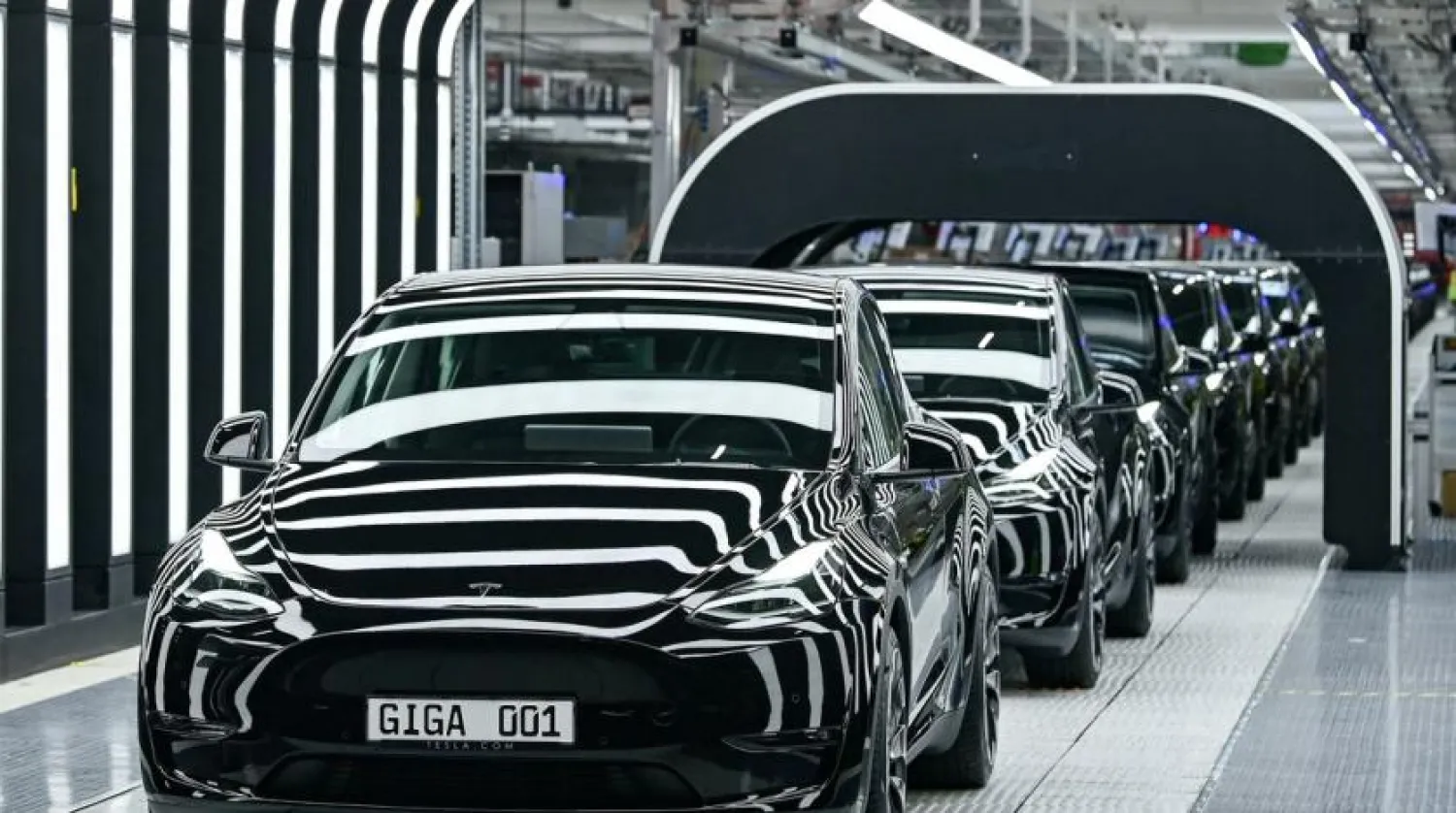
Model Y cars are pictured during the opening ceremony of the new Tesla Gigafactory for electric cars in Gruenheide, Germany, March 22, 2022. Patrick Pleul/Pool via REUTERS/File Photo
TT

Tesla Hoping its Electric Semi Will Be Heavy Duty 'Game Changer'

Model Y cars are pictured during the opening ceremony of the new Tesla Gigafactory for electric cars in Gruenheide, Germany, March 22, 2022. Patrick Pleul/Pool via REUTERS/File Photo

US automaker Tesla on Thursday delivered its first battery-powered heavy duty truck, dubbed "Semi," and built to tackle long hauls with the handling of a sporty sedan.

"That thing looks like it came from the future," Telsa chief Elon Musk said while handing over the keys to PepsiCo executives at the vehicle maker's Nevada manufacturing plant.

With its sleek design, the Semi has been highly anticipated since Musk unveiled a prototype in 2017, but the launch of full-scale production was delayed well past the initial 2019 expectation, AFP said.

"The sheer amount of drama between five years ago and now is insane," Musk told a small audience invited to the factory for an event marking the occasion.

"A lot has happened in the world. But, here we are. It's real."

In the meantime, other manufacturers have entered the market, from traditional truck makers such as Daimler, Volvo and China's BYD, to startups like US company Nikola.

The competition has also begun to roll out their deliveries, and have many orders of their own waiting to fill.

However, the truck that "the market has been waiting for... is the one from Tesla," says Dave Mullaney, a transportation specialist with sustainability think tank RMI.

Legacy manufacturers have primarily converted their diesel-designed trucks to electric.

Tesla's Semi, on the other hand, "was designed to be electric from the very first design," says Mullaney.

If the vehicle lives up to expectations, "it's going to be a huge difference," he adds.

Musk reiterated the claim Thursday that a Semi had driven 500 miles (800 kilometers) with a total weight of nearly 82,000 pounds (more than 37 metric tons).

The range of electric vehicles currently on offer is only between 250 to 300 miles.

"You have all the power you need to get the job done," Musk said of the Tesla Semi.

"This is a game changer."

- Climate conscious hauling -
The use of electric light duty vehicles for short-haul deliveries has been steadily growing, but new regulations are pushing manufacturers and transporters to speed up the transition and build out long-haul capabilities.

The most populous US state, California, has passed a law phasing out combustion engine trucks, which has since been followed by other states.

The European Union is also expected to debate similar standards in the coming months.

And on the PR front, companies are also facing pressure to take more environmentally conscious actions.

They "want to be on the right side of history," says Marie Cheron of the Europe-based association Transport & Environment.

Those who do not commit to a decarbonization strategy, some of whom say they are waiting for technologies to improve, "are falling behind," she says.

While making up a scant portion of vehicles on the road, diesel-powered semi trucks account for about a fifth of climate-harming emissions spewed by traffic, according to Musk.

"So from a health standpoint, particularly in cities, this is a huge impact," Musk said of the shift to electric semis.

Mike Roeth, director of the North American Council for Freight Efficiency, says that another motivation to transition is that drivers who have been able to test them, "love the electric trucks a lot."

"They're very quiet, they don't have the smells of the exhaust, and they are comfortable to drive."

- Cost considerations -
For the adoption of electric trucks to accelerate, their range must truly live up to promises and batteries ideally would shrink, several analysts told AFP.

The charging infrastructure must also be built out to handle multiple trucks powering up simultaneously and have storage capacity to work during power outages.

The biggest factor, however, will be the price. The Semi price was not disclosed at the Tesla event.

RMI's Mullaney says that an electric truck currently costs about 70 percent more to buy than a diesel truck, but in terms of fuel and maintenance, it's cheaper.

With the first delivery accomplished, Wedbush Securities analyst Dan Ives says that Tesla must now "prove they can produce at scale, they need to execute."

In late October, Musk said that Tesla is aiming to build 50,000 Semis by 2024.

Ives says Musk's attention is unfortunately focused on his newest acquisition, Twitter, and "the circus show there takes away a monumental moment in Tesla history."




Governments Worldwide Are Way Behind on AI, Says Bill Gates

Microsoft's Bill Gates attends a dinner with President Donald Trump in the State Dining Room of the White House, Sept. 4, 2025, in Washington. (AP)
TT

Governments Worldwide Are Way Behind on AI, Says Bill Gates

Microsoft's Bill Gates attends a dinner with President Donald Trump in the State Dining Room of the White House, Sept. 4, 2025, in Washington. (AP)

No government in the world is ready for the changes artificial intelligence will bring to society, Bill Gates said in an interview with Reuters, as he warned of the risks ahead.

The Microsoft co-founder and billionaire philanthropist had until recently been optimistic about AI, but has changed his position, warning of the threats to jobs, concerns about attacks and the dangers of addiction to AI companions.

“I don't think any government is nearly as deep on this as they have to be,” he said. However, he added that the technology has great ‌potential to ‌help the world's poorest if managed properly and accessed equally — and ‌his ⁠namesake foundation said on ⁠Tuesday that it plans to spend at least $1 billion in the next two years on expanding access to AI.

Gates said he has been talking to world leaders about his concerns, including President Donald Trump and his team in the US, and said he aims to meet China’s President Xi Jinping later this year.

“Governments are way behind on this one,” he added.

HEALTH POTENTIAL

But despite his concerns, Gates and his foundation hope AI can help narrow gaps between the ⁠richest and poorest, rather than widening them.

The foundation's $1 billion spending plan, ‌part of its previously announced plans to spend $9 billion ‌annually, will go to partners working in education, healthcare and agriculture, the foundation said. It also aims ‌to help build the data foundations AI is built on, such as ensuring that ‌large language models work in every language people speak.

“For health it’s hard to overstate what the potential is,” Gates said, from supporting frontline health care workers to discovering new drugs and vaccines.

But he said governments must work together to avoid problems, likening the arrival of AI to a disaster movie.

“There’s ‌all sorts of movies where some aliens are coming, and magically the US and China and everybody comes together to solve the ⁠problem,” he said. “AI ⁠is kind of like this alien intelligence. It’s here, and we better do like it shows in those movies.”

REPUTATIONAL HIT?

In June, Gates appeared in front of Congress to testify about his relationship with the late convicted sex offender Jeffrey Epstein. Gates, who is not accused of any crimes, has repeatedly said he regrets his association with Epstein, who he hoped would donate to global health causes. Instead, the financier attempted to blackmail Gates over his extramarital affairs.

However, despite prompting an external review at his foundation, which found no payments to Epstein or participation in criminal activities, Gates said the links had not caused him or the foundation a significant reputational hit.

“In terms of having access to government leaders, or you know, journalists being willing to interview me, I don't see any diminishment,” he said, adding that the desire to draw on the foundation’s expertise to cut child deaths and end malaria had also not reduced “even one iota”.


Ex-Google DeepMind Researcher Adds to Warnings That AI Could ‘Kill All Humans’

An AI (artificial intelligence) logo is pictured at the Mobile World Congress (MWC), the telecom industry's biggest annual gathering, in Barcelona on February 27, 2024. (AFP)
TT

Ex-Google DeepMind Researcher Adds to Warnings That AI Could ‘Kill All Humans’

An AI (artificial intelligence) logo is pictured at the Mobile World Congress (MWC), the telecom industry's biggest annual gathering, in Barcelona on February 27, 2024. (AFP)

A former Google DeepMind ‌employee on Monday became the latest AI researcher to warn that the technology could "kill all humans", saying time could be running out to avoid the outcome.

Public alarm about the potential danger posed by AI is growing, after Anthropic researcher Jacob Coxon said last week he had resigned, in part because the "people building AI earnestly believe that it could kill us all by the end of the decade."

Anthropic scientist Evan Hubinger then responded ‌to Coxon's comments, ‌saying he was correct and that ‌he ⁠believed there was ⁠a greater than 10% chance that AI could kill all humans within the next decade.

"I recently resigned from Google DeepMind, where I worked on AGI safety and alignment research," Bilal Chughtai wrote on X. "I earnestly believe that AI has the potential to kill ⁠us all, and that we might be ‌running out of time ‌to avoid this outcome."

Chughtai, who co-authored research papers while ‌at Google DeepMind, worked there as a research engineer ‌and left the company in July 2026, according to his LinkedIn profile.

Google did not respond to a request for comment outside regular business hours.

Following recent concerns, Anthropic CEO ‌Dario Amodei called for a slowdown in the pace of advanced AI development over ⁠the weekend, winning ⁠rare backing from SpaceXAI's Elon Musk and OpenAI CEO Sam Altman and sparking a debate over AI "doomerism."

Chughtai also said that navigating AI safely was possible but would require coordination "to avoid this manic race between AI companies."

"We need to pace AI development to a speed that society can handle, where emerging risks can be addressed before extreme harm is realized," he added.

President Donald Trump, however, has dismissed the warnings, saying on social media the AI industry's call for regulation is a "hoax."


How China Is Preparing for the Risk of AI Escaping Human Control

An AI logo is seen during the opening day of the IFA trade fair in Berlin, Germany, 04 September 2026. (EPA)
TT

How China Is Preparing for the Risk of AI Escaping Human Control

An AI logo is seen during the opening day of the IFA trade fair in Berlin, Germany, 04 September 2026. (EPA)

Warnings from researchers at leading US artificial intelligence developer Anthropic that increasingly powerful models could escape human control and even lead to the extinction of the human race have drawn attention in China, where policymakers have been preparing for some of the same risks.

The US and China are the two major driving forces of frontier AI development and the technology's global adoption. Both superpowers have been increasingly at loggerheads over each other's AI policies and industry practices, with these issues slated to feature prominently in bilateral talks later this month.

Despite the race to develop increasingly powerful AI systems, regulatory frameworks and public statements from Beijing underscore how Chinese authorities regard the possibility of advanced AI escaping effective human oversight as serious enough to plan for.

CHINA SEES RISKS IN LEADING CLOSED-SOURCE US MODELS

China's state ‌security minister Chen ‌Yixin wrote in a government outlet on Sunday that advanced US models such as Anthropic's ‌Mythos and ⁠OpenAI's GPT-5.5-Cyber ⁠could pose serious risks to China's critical information infrastructure and called for a comprehensive strengthening of AI security.

Anthropic and OpenAI did not immediately respond to Reuters requests for comment.

Chinese AI developers have promoted open-weight models partly on the grounds that cybersecurity teams can inspect, modify and deploy them for defensive work.

Model repository platform Hugging Face said it used GLM-5.2, an open-weight model developed by China's Z.AI, to analyze a July intrusion by escaped OpenAI agents after more tightly restricted US models proved less useful for the forensic work.

But experts also highlight the risks posed by open-weight models, which can be modified and redistributed with little oversight.

Moonshot's Kimi K3 last month bypassed a UK AI ⁠Security Institute testing sandbox, highlighting the risk that Chinese AI models could, like their US counterparts, ‌evade controls designed to restrict their access and actions.

REGULATORS HAVE FLAGGED AI 'LOSS OF ‌CONTROL' RISK

China first included an explicit future loss-of-control scenario in an AI safety framework released in September 2024 under the guidance of the ‌Cyberspace Administration of China (CAC).

The document said it could not be ruled out that future AI might autonomously obtain external ‌resources, replicate itself, develop self-awareness and seek external power, creating a risk of competing with humans for control.

The CAC released an expanded version in September 2025. The newer framework sharpened the scenario, saying AI could undergo a sudden and unexpectedly large "leap" in intelligence before acquiring resources, replicating itself and seeking power. It also added a governance principle of "trusted application, preventing loss of control".

A later expert interpretation published on the cyberspace regulator's website said ‌the new principle was intended to guard against loss-of-control risks threatening human survival and development and referred to a possible "AI breaking loose" scenario.

CHINESE LEADER XI PUTS HUMAN CONTROL AT CENTRE

The ⁠concern has since appeared in ⁠China's highest-level political messaging.

At the World Artificial Intelligence Conference in Shanghai in July, Chinese President Xi Jinping said authorities should pay close attention to both intrinsic and derivative risks arising from AI.

He said AI should "always remain under human control".

China's senior Foreign Ministry official responsible for AI affairs, Sun Xiaobo, said at a United Nations meeting last month that China was accelerating research into broader AI legislation.

China's deputy permanent representative to the United Nations, Sun Lei, urged governments this month to approach military AI cautiously to avoid strategic miscalculation and an arms race.

BEIJING WARNS OF NEW RISKS POSED BY AI AGENTS

China has, meanwhile, begun turning those principles into more specific rules for AI agents, which act much more autonomously and carry out more complex tasks than an ordinary chatbot.

In May, China's cyberspace regulator issued joint guidelines specifically covering such systems.

They require developers to improve their ability to discover, intervene in, block and recover from improper agent behavior.

The guidelines specifically identify data poisoning, algorithm manipulation, system vulnerabilities and "operational loss of control" as security risks. They also say users should retain final decision-making authority over an agent's autonomous decisions.

While China has not proposed independent monitors embedded inside AI companies in the manner advocated by Anthropic, its standards allow developers to commission third-party safety assessments, as well as envisaging outside evaluation bodies and security researchers testing and auditing open models.