

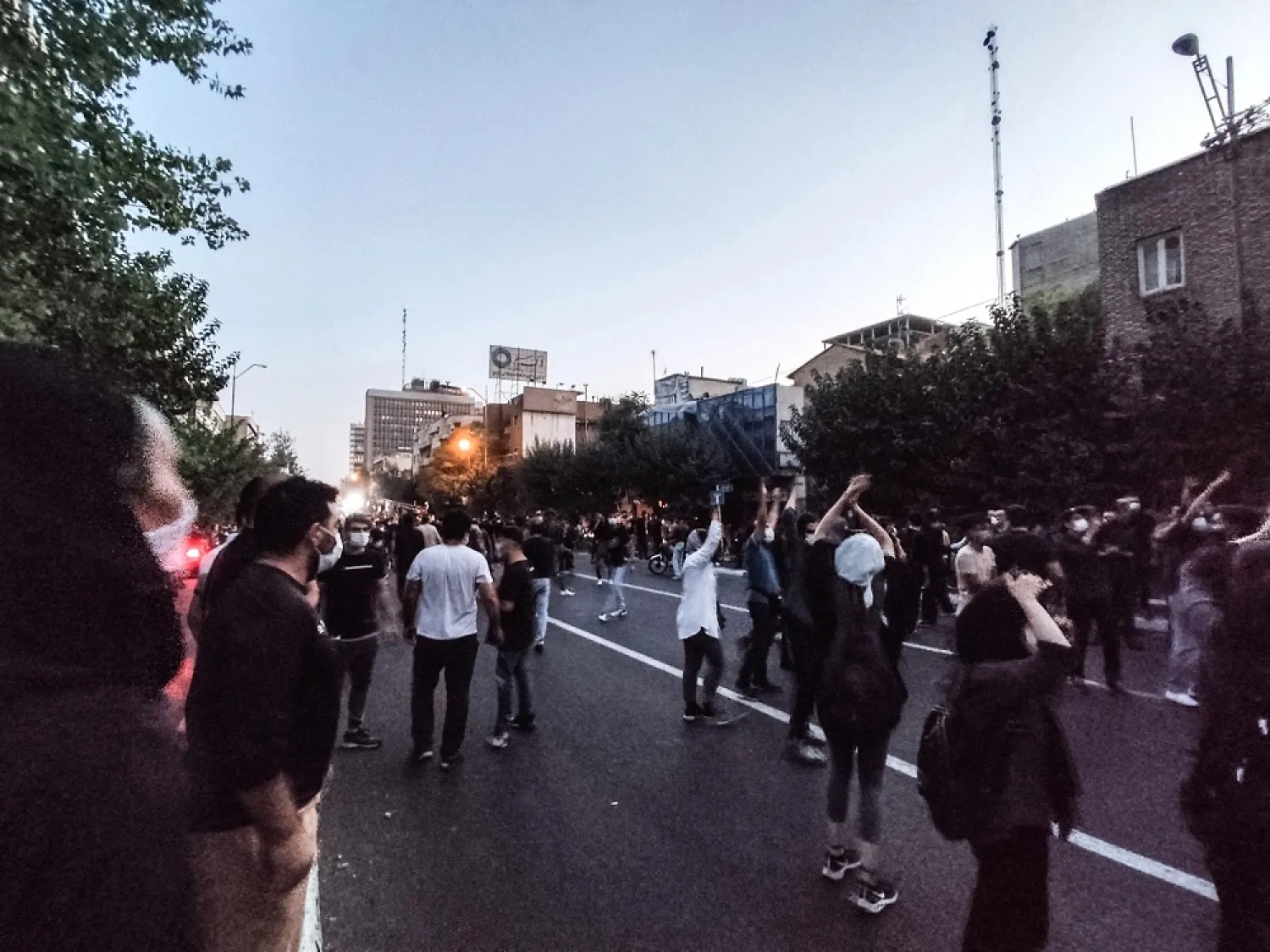

Women Join Protests in Iran’s Conservative Southeast 

Women in Iran's Sistan-Baluchistan province on Friday joined nationwide protests sparked by Mahsa Amini's death. (AFP file photo)
TT

Women Join Protests in Iran’s Conservative Southeast 

Women in Iran's Sistan-Baluchistan province on Friday joined nationwide protests sparked by Mahsa Amini's death. (AFP file photo)

Black-clad women in Iran's Sistan-Baluchistan province on Friday joined nationwide protests sparked by Mahsa Amini's death, in what a rights group called a "rare" move in the staunchly conservative region. 

Online videos showed dozens of women on the streets of the provincial capital Zahedan holding banners that declared "Woman, life, freedom" -- one of the main slogans of the protest movement that erupted in mid-September.  

"Whether with hijab, whether without it, onwards to revolution," women dressed in body-covering chador garments chanted in videos posted on Twitter and verified by AFP. 

Women-led protests have swept Iran since Amini, a 22-year-old Iranian of Kurdish origin, died following her arrest in Tehran for an alleged breach of the Islamic republic's dress code based on sharia law.  

Security forces have killed at least 448 protesters, with the largest toll in Sistan-Baluchistan on Iran's southeastern border with Afghanistan and Pakistan, according to Iran Human Rights, an Oslo-based non-governmental organization.  

"It is indeed rare," IHR director Mahmood Amiry-Moghaddam said of the protests by women in Zahedan, which has seen men take to the streets after Friday prayers for more than two months.  

"The ongoing protests in Iran are the beginning of a revolution of dignity," he told AFP.  

"Women and minorities, who have for more than four decades been treated as second class citizens, are empowered through these protests to come out to the streets and demand their fundamental human rights."  

Baluchi women were among the "most oppressed" in Iran and their protests were the most organized by them so far since demonstrations broke out across the country, Amiry-Moghaddam added.  

Scores of men also took to the streets again on Friday, chanting "we don't want a child-killing government", footage posted online by activists showed.  

Security forces were seen opening fire with bird shot and tear gas on male protesters in Taftan, a locality in Sistan-Baluchistan, in a video published by IHR.  

'Bloody Friday' 

Mainly Sunni Muslim Sistan-Baluchistan is Iran's poorest region whose ethnic Baluch inhabitants feel discriminated against.  

At least 128 people have been killed in Sistan-Baluchistan during the protest crackdown, according to IHR, by far its biggest toll for deaths recorded in 26 of Iran's 31 provinces.  

More than 90 of them were killed on September 30 alone -- a massacre that activists have dubbed "Black Friday".  

Those protests were triggered by the alleged rape in custody of a 15-year-old girl by a police commander in the province's port city of Chabahar.  

Analysts say the Baluchi were inspired by the protests that flared over Amini's death, which were initially driven by women's rights but expanded over time to include other grievances.  

"Iran's Baluchi minority face entrenched discrimination that curtails their access to education, health care, employment, adequate housing and political office," Amnesty International said on Tuesday.  

"The Baluchi minority have borne the brunt of the vicious crackdown by security forces during the uprising that has swept across Iran since September," Amnesty said in a statement.  

The second province on IHR's list is Amini's home province of Kurdistan on Iran's western border with Iraq, another epicenter of the protests with a Sunni majority, where 53 people died.  

Iran accuses its arch enemy the United States and its allies Britain and Israel of fomenting what it calls "riots".  

State news agency IRNA on Friday reported that authorities had summoned foreign diplomats 12 times since the protests erupted "in reaction... to unprecedented pressure" imposed on Tehran by their countries.  

Foreign Minister Hossein Amir-Abdollahian meanwhile complained, in a phone call with UN chief Antonio Guterres, about "actions carried out by the United States and other Western countries to incite riots in Iran", IRNA said.  

Iran has blamed protest-related violence in Kurdistan on separatists, and has repeatedly launched deadly cross-border strikes on Kurdish groups exiled in Iraq.  

An Iranian general said this week that "more than 300 martyrs and people" have been killed in the unrest.  

Thousands of Iranians and around 40 foreigners have been arrested during the demonstrations and more than 2,000 people have been charged, according to the country's judicial authorities.  

On Friday, UN experts urged Iran to release prominent rights activist Arash Sadeghi from "unlawful" detention, saying he suffers from "life-threatening bone cancer". 


Top Trump Iran Negotiator Says Visits US Aircraft Carrier in Middle East

US Special Envoy Steve Witkoff delivers a press conference upon the signing of the declaration on deploying post-ceasefire force in Ukraine, during the so-called "Coalition of the Willing" summit, at the Elysee Palace in Paris, France, January 6, 2026. (Reuters)
TT

Top Trump Iran Negotiator Says Visits US Aircraft Carrier in Middle East

US Special Envoy Steve Witkoff delivers a press conference upon the signing of the declaration on deploying post-ceasefire force in Ukraine, during the so-called "Coalition of the Willing" summit, at the Elysee Palace in Paris, France, January 6, 2026. (Reuters)

US President Donald Trump's lead Iran negotiator Steve Witkoff on Saturday said he visited the USS Abraham Lincoln aircraft carrier currently in the Arabian Sea, with Washington and Tehran due to hold further talks soon.

"Today, Adm. Brad Cooper, Commander of US Naval Forces Central Command, Jared Kushner, and I met with the brave sailors and Marines aboard the USS Abraham Lincoln, her strike group, and Carrier Air Wing 9 who are keeping us safe and upholding President Trump's message of peace through strength," said Witkoff in a social media post.

Iranian Foreign Minister Abbas Araghchi said on Saturday he hoped talks with the United States would resume soon, while reiterating Tehran's red lines and warning against any American attack.


Israel’s Netanyahu Expected to Meet Trump in US on Wednesday and Discuss Iran

Israeli Prime Minister Benjamin Netanyahu delivers a speech during a special session to mark the 77th anniversary of the Knesset's establishment and the 60th anniversary of the dedication of the current building at the Knesset, the Israeli parliament, in Jerusalem, 02 February 2026. (EPA)
TT

Israel’s Netanyahu Expected to Meet Trump in US on Wednesday and Discuss Iran

Israeli Prime Minister Benjamin Netanyahu delivers a speech during a special session to mark the 77th anniversary of the Knesset's establishment and the 60th anniversary of the dedication of the current building at the Knesset, the Israeli parliament, in Jerusalem, 02 February 2026. (EPA)

Israeli Prime Minister Benjamin Netanyahu is expected to meet US President Donald Trump on Wednesday in Washington, where they will discuss negotiations with Iran, Netanyahu's office said on Saturday.

Iranian and US officials held indirect nuclear ‌talks in the ‌Omani capital ‌Muscat ⁠on Friday. ‌Both sides said more talks were expected to be held again soon.

A regional diplomat briefed by Tehran on the talks told Reuters Iran insisted ⁠on its "right to enrich uranium" ‌during the negotiations with ‍the US, ‍and that Tehran's missile capabilities ‍were not raised in the discussions.

Iranian officials have ruled out putting Iran's missiles - one of the largest such arsenals in the region - up ⁠for discussion, and have said Tehran wants recognition of its right to enrich uranium.

"The Prime Minister believes that any negotiations must include limiting ballistic missiles and halting support for the Iranian axis," Netanyahu's office said in a ‌statement.


Italy FM Rules Out Joining Trump’s ‘Board of Peace’

Italy's Minister for Foreign Affairs Antonio Tajani speaks to the press during the EPP Leaders’ meeting, in Zagreb, Croatia, 30 January 2026. (EPA)
TT

Italy FM Rules Out Joining Trump’s ‘Board of Peace’

Italy's Minister for Foreign Affairs Antonio Tajani speaks to the press during the EPP Leaders’ meeting, in Zagreb, Croatia, 30 January 2026. (EPA)

Italy will not take part in US President Donald Trump's "Board of Peace", Italian Foreign Minister Antonio Tajani said Saturday, citing "insurmountable" constitutional issues.

Trump launched his "Board of Peace" at the World Economic Forum in Davos in January and some 19 countries have signed its founding charter.

But Italy's constitution bars the country from joining an organization led by a single foreign leader.

Prime Minister Giorgia Meloni, a Trump ally, last month noted "constitutional problems" with joining, but suggested Trump could perhaps reopen the framework "to meet the needs not only of Italy, but also of other European countries".

Tajani appeared Saturday to rule that out.

"We cannot participate in the Board of Peace because there is a constitutional limit," he told the ANSA news agency.

"This is insurmountable from a legal standpoint," he said, the day after meeting US Secretary of State Marco Rubio and US Vice President JD Vance at the Olympics in Milan.

Although originally meant to oversee Gaza's rebuilding, the board's charter does not limit its role to the Palestinian territory and appears to want to rival the United Nations.
