

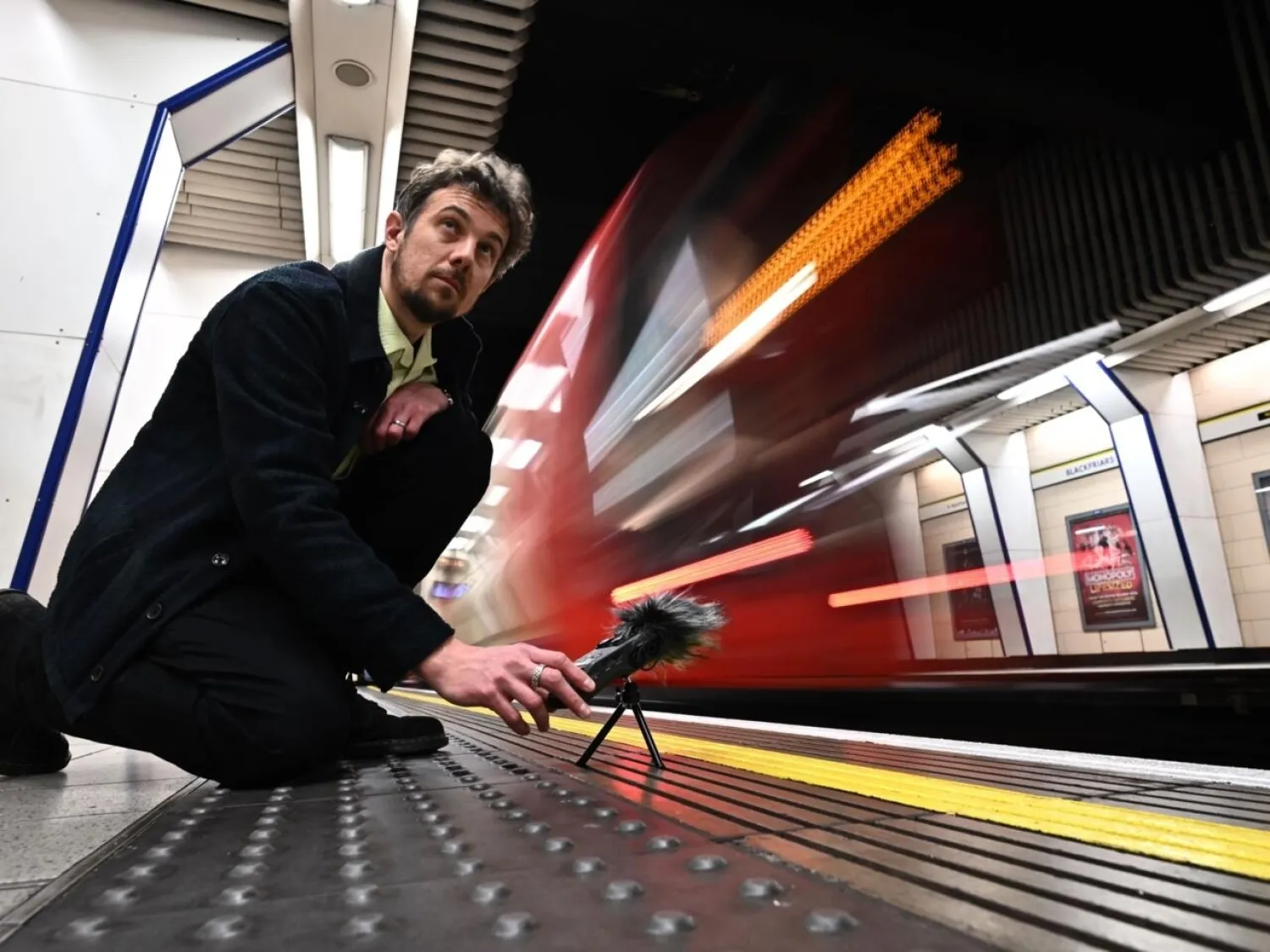

Art of Noise: UK Project Aims to Save Lost Sounds

Musician and sound artist Stuart Fowkes is trying to capture old sounds before they disappear. Ben Stansall / AFP
TT

Art of Noise: UK Project Aims to Save Lost Sounds

Musician and sound artist Stuart Fowkes is trying to capture old sounds before they disappear. Ben Stansall / AFP

The mostly defunct red phone boxes no longer attract much attention in London except from tourists. But Stuart Fowkes is thrilled to stumble upon one still in working order.

Its ring is one of the world's disappearing noises that his pioneering "obsolete sounds" project is dedicated to preserving, AFP said.

He whips out a hand-held recording device and swings into action, explaining, "I've always had sonic curiosity.

"New sounds are appearing faster than at any time in history but they are also changing and disappearing faster than ever before."

Over the past five years Fowkes' Cities and Memories website has collected and remixed more than 5,000 sounds from 100 countries which are being archived by the British Library.

Now, his latest project aims to preserve sounds that are "just on the edge of memory".

These sounds that we are "just about forgetting" are the ones that have the "greatest emotional resonance", he told AFP.

"What I have been struck by is how people have responded emotionally to some of the recordings.

"You've got people who heard the sound of a Super 8 film camera and this reminded them of being in their living room in 1978 with their dad showing them home movies for the first time."

The "obsolete sounds" project features more than 150 recordings collected from around the world, and also includes remixes of those sounds by musicians and sound artists.

Billed as the biggest collection of its kind, it includes everything from Walkman personal stereo cassette players and old video game consoles, to steam trains and vintage racing cars, as well as sounds that evoke the rapidly changing natural environment, such as crumbling glaciers.

"Before the industrial revolution, our sound environment -- bells and horses' hooves and manual industry -- would not have changed much for hundreds of years," says Fowkes.

"Today, the pace of change is ridiculous. Things that are only a few years old, like ring tones on mobile phones, already sound dated."

- Sound of the Underground -
Moving below street level down into London's Underground train network, Fowkes gets to work again.

A bit like the "trainspotters" who were once a familiar sight on the platforms of UK railway stations, Fowkes is a dedicated "soundspotter".

But to him, there is nothing dull or uninteresting about the screeching of the train's wheels scraping against the curves in the metal tracks or the clunk of the doors opening and closing.

"I've always been someone who listens to the world. As soon as I have a recording device in my hand I start to listen to the world kind of differently and hear things that other people wouldn't necessarily notice or listen to," he says.

The digital consultant launched Cities and Memories in 2015 and has drawn in some 1,000 collaborators across the globe.

"Every morning I wake up to emails with recordings from somewhere completely unexpected, like a beach in Bali or even the metro in Pyongyang," he says.

Field recordings are "having a moment", he adds, with artists such as ethereal Icelandic singer Bjork using them in their music.

"It used to be seen as very niche, even trainspotter-like behavior, but now anyone can make a decent recording on their phone and it's becoming increasingly mainstream."

Fowkes has been thrilled by the response to his project -- but is keen to receive more, especially from African cities.

Anyone can contribute, he says, just by "sticking their mobile phone out of the window" and then visiting citiesandmemories.com.

In the meantime, he'll keep on adding his own recordings, while admitting his dedication can sometimes be a source of mild irritation for his wife.

"Whenever we go to a new holiday destination... I am going 'have you heard that pedestrian crossing? I have to go and record it'."



New York Seeks Rights for Beloved but Illegal ‘Bodega Cats’

Guest Dan Rimada, founder of Bodega Cats of New York holds a cat named Ashley in a bodega corner store on December 17, 2025 in New York City. (AFP)
TT

New York Seeks Rights for Beloved but Illegal ‘Bodega Cats’

Guest Dan Rimada, founder of Bodega Cats of New York holds a cat named Ashley in a bodega corner store on December 17, 2025 in New York City. (AFP)

Simba, a large cat with thick ginger and white fur, is one of thousands of felines that live in New York's corner shops known as "bodegas" -- even if their presence is illegal.

Praised for warding off pests, so-called bodega cats are also a cultural fixture for New Yorkers, some of whom are now pushing to enshrine legal rights for the little store helpers.

"Simba is very important to us because he keeps the shop clean of the mice," Austin Moreno, a shopkeeper in Manhattan, told AFP from behind his till.

The fluffy inhabitant also helps to entice customers.

"People, very often, they come to visit to ask, what is his name? The other day, some girls saw him for the first time and now they come every day," said Moreno.

Around a third of the city's roughly 10,000 bodegas are thought to have a resident cat despite being liable to fines of $200-$350 for keeping animals in a store selling food, according to Dan Rimada, founder of Bodega Cats of New York.

Rimada photographs the felines for his social media followers and last year launched a petition to legalize bodega cats, which drew nearly 14,000 signatures.

"These cats are woven into the fabric of New York City, and that's an important story to tell," he said.

- Pressure point -

Inspired by Rimada's petition, New York City council member Keith Powers has proposed a measure to shield the owners of bodega cats from penalties.

His legislation would also provide free vaccinations and spay or neuter services to the felines.

But animal shelters and rights groups say this wouldn't go far enough.

While Simba can nap in the corner of his shop with kibble within paw's reach, many of his fellow cats are locked in basements, deprived of food or proper care, and abandoned when they grow old or fall ill.

Becky Wisdom, who rescues cats in New York, warned that lifting the threat of fines could remove "leverage" to encourage bodega owners to better care for the animals.

She also opposes public funds being given to business owners rather than low-income families who want their cats spayed or neutered.

The latter is a big issue in New York, where the stray cat population is estimated at around half a million.

- Radical overhaul -

Regardless of what the city decides, it is the state of New York that has authority over business rules, said Allie Taylor, president of Voters for Animal Rights.

Taylor said she backs another initiative proposed by state assembly member Linda Rosenthal, a prominent animal welfare advocate, who proposes allowing cats in bodegas under certain conditions.

These would include vet visits, mandatory spaying or neutering, and ensuring the cats have sufficient food, water and a safe place to sleep.

Beyond the specific case of bodega cats, Taylor is pushing for a more radical overhaul of animal protection in New York.

"Instead of focusing on one subset of cats, we need the city to make serious investments, meaning tens of millions of dollars per year into free or low cost spay, neuter and veterinary care," she said.


Warming Climate Threatens Greenland’s Ancestral Way of Life

Musher Nukaaraq Lennert Olsen offers some dry food to his dogs after a ride near the "dog town" ofSisimiut, Greenland on January 31, 2026. (AFP)
TT

Warming Climate Threatens Greenland’s Ancestral Way of Life

Musher Nukaaraq Lennert Olsen offers some dry food to his dogs after a ride near the "dog town" ofSisimiut, Greenland on January 31, 2026. (AFP)

Standing in his boat with binoculars in hand, hunter Malik Kleist scans the horizon for seals. But this February, the sea ice in southwestern Greenland has yet to freeze, threatening traditional livelihoods like his.

"Normally the seals are on the ice or in the more calm waters. But today we had to sail all the way into the fjords to find them," the 37-year-old tells AFP.

The Arctic region is on the frontline of global warming, heating up four times faster than the rest of the planet since 1979, according to a 2022 study in scientific journal Nature, causing the sea ice to retreat.

Seals rely on pack ice to give birth, to rest and for protection.

Hunters increasingly have to sail farther along the jagged coast of Sisimiut, navigating into the fjords for several hours to find them.

Traditionally, hunters' boats would head straight out to sea, slowly pushing through the ice and creating holes that attract seals coming up for air.

But without any ice, "it's too windy and the waves are too big," Kleist says.

Last year was exceptionally warm in the vast autonomous territory, with several temperature records beaten, according to the Danish Meteorological Institute (DMI).

In December, the Summit Station, located at the height of Greenland's ice sheet, recorded an average temperature of -30.9 degrees C (-23.6 Fahrenheit), 8.1C higher than the December average during the period 1991-2020.

"It affects everything we do. Because normally around November, December the ice comes. And this year there's no ice, so it affects our living a lot," Kleist says.

- Financial woes -

For the same reason, the government has also had to postpone the annual winter musk ox hunt that was due to start on January 31.

There wasn't enough snow and ice to transport the massive animals that roam the Arctic tundra back from Kangerlussuaq where they are predominantly found, around 165 kilometers (103 miles) away. Greenland has no roads connecting its towns.

That has left some Sisimiut hunters with less income than usual.

"This time of year there is not much to hunt. So we rely on musk ox meat and skin," Kleist says.

"Many of my fellow hunters are struggling with money right now."

Every part of the animal, from the fur to the meat, is either used or sold.

The summer hunting season has therefore gained importance, enabling Greenlanders to fill their freezers to get them through the winter months, he tells AFP over a steaming bowl of fish stew.

The shorter winter season has also impacted another key activity in Greenland, one that has become increasingly important to the tourism sector: dogsled tours.

In the Sisimiut neighborhood where the dogs are kept, their thunderous barking mounts as Nukaaraq Olsen, a 21-year-old musher, attaches them to the sled.

Raring to get going, his 18 dogs are hard to hold back. Twenty minutes later, the group bounds off.

But the road is bumpy, and several times Olsen has to get up to manually push the sled, stuck on the tundra's rocks in patches where there is no ice.

"This year we had a lot of hot, warm days, even though it's December or January," he says.

Other parts of the route are no longer safe to use, due to repeated melting and freezing of snowfall which causes uneven layers, he explains.

- Dehydrated dogs -

The dogs' health is also affected by the changing climate.

They are used to quenching their thirst with snow, but with little or no snowfall, they can easily get dehydrated. Mushers have to take that into account when caring for their animals.

Many have even had to get rid of their dogs, the business of maintaining them no longer profitable with the dogsled season shrinking to just two months, says Emilie Andersen-Ranberg, a researcher at the University of Copenhagen who runs a dog clinic in Sisimiut.
Others, such as 72-year-old Johanne Bech, are finding novel ways to adapt.

She plans to put wheels on her sled to continue running dogsled tours during the summer period.

That solution is growing in popularity, as "the window with snow is getting more and more narrow," the veterinarian says.

Over the past 20 years, the number of sleddogs has been halved from 25,000 to 13,000, according to a 2024 article from the University of Greenland in 2024.

Yet Johanne Bech remains optimistic about the future.

"I hope this is just for a short time, so we can go back to a little more stable snow or more ice in the future."


January Was Fifth Hottest on Record despite Cold Snap

This handout photo taken on February 7, 2026 and received on February 10 from Japan's Ministry of Defense shows members of the Japan Ground Self-Defense Force's 5th Infantry Regiment, stationed in Aomori Prefecture, carrying out snow removal work in a town within Aomori Prefecture. (Photo by Handout / Japan's Ministry of Defense / AFP)
TT

January Was Fifth Hottest on Record despite Cold Snap

This handout photo taken on February 7, 2026 and received on February 10 from Japan's Ministry of Defense shows members of the Japan Ground Self-Defense Force's 5th Infantry Regiment, stationed in Aomori Prefecture, carrying out snow removal work in a town within Aomori Prefecture. (Photo by Handout / Japan's Ministry of Defense / AFP)

The planet experienced its fifth-hottest January on record despite a cold snap that swept across the United States and Europe, the EU's climate monitor said Tuesday.

The Northern Hemisphere was hit by severe cold waves in the final weeks of January as a polar jet stream blew icy air into Europe and North America, according to the Copernicus Climate Change Service.

But monthly temperatures were above average over much of the globe, including in large parts of the Arctic and western North America, according to Copernicus.

"January 2026 delivered a stark reminder that the climate system can sometimes simultaneously deliver very cold weather in one region, and extreme heat in another," said Samantha Burgess, strategic lead for climate at the European Centre for Medium-Range Weather Forecasts (ECMWF).

The average global temperature in January was 1.47C above preindustrial times.

Europe endured its coldest January since 2010, with an average temperature of 2.34C, the service said.

The United States, meanwhile, was hit by a monster winter storm that dumped snow and crippling ice from New Mexico to Maine. It was linked to more than 100 deaths.

The planet remains in an extended run of human-driven warming, with 2024 setting a record high, 2023 ranking second 2025 now third warmest.