
Asian Equities, Oil Prices Dragged by Recession Fears

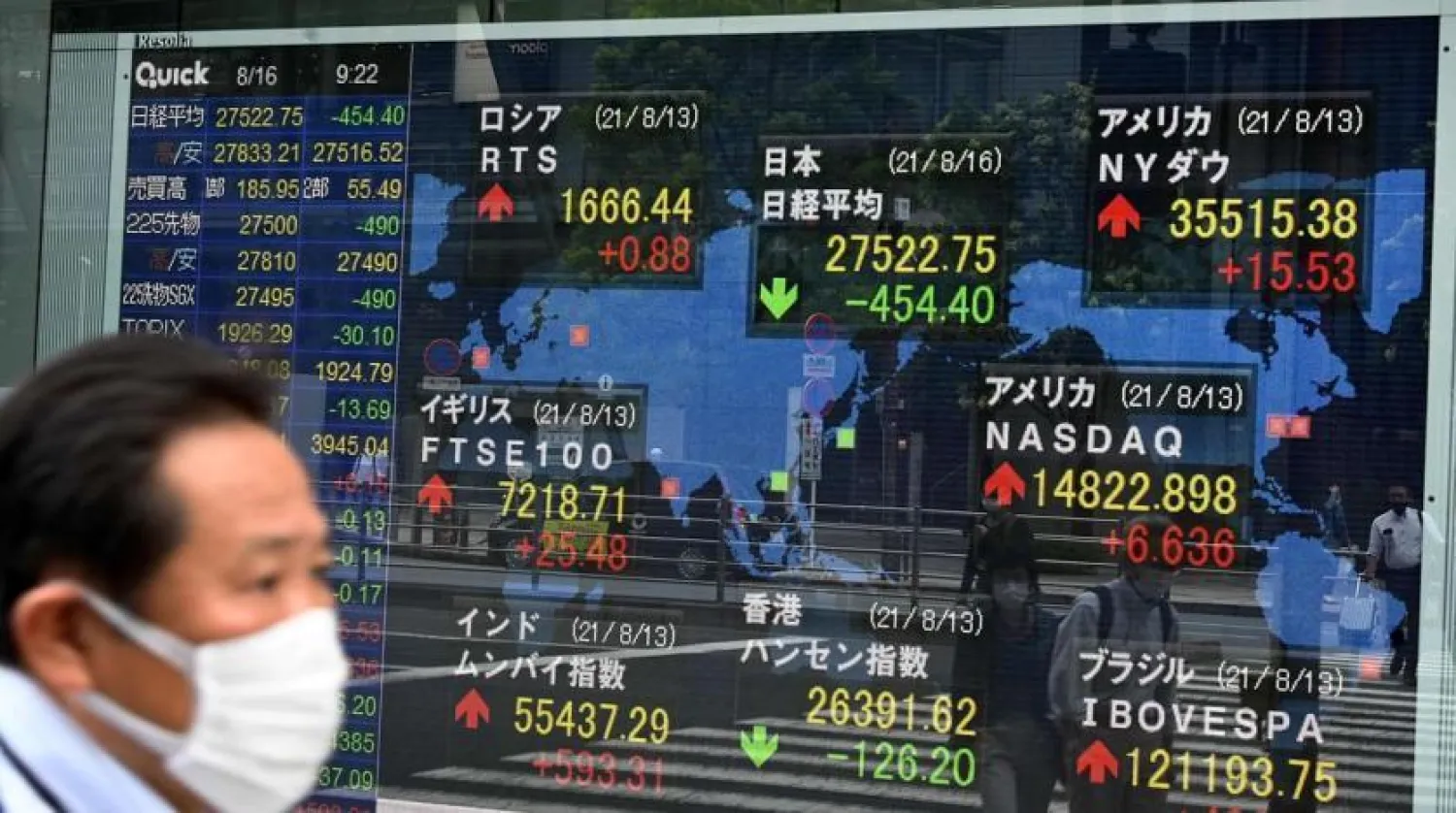
A pedestrian walks past a stock indicator displaying the Nikkei 225 of the Tokyo Stock Exchange (C, top) and other world stock markets in Tokyo on 16 August 2021. AFP
TT

Asian Equities, Oil Prices Dragged by Recession Fears

A pedestrian walks past a stock indicator displaying the Nikkei 225 of the Tokyo Stock Exchange (C, top) and other world stock markets in Tokyo on 16 August 2021. AFP

Asian investors extended a sell-off across global markets Wednesday while oil held losses on growing fears Federal Reserve monetary tightening will tip the US economy into recession.

The drop followed another day deep in the red for New York's three main indexes after the heads of Wall Street's leading banks warned of tough times ahead in 2023, AFP said.

JPMorgan Chase chief Jamie Dimon tipped a "mild to hard recession" and Goldman Sachs' David Solomon said jobs and pay would be hit, while Morgan Stanley and Bank of America were also uneasy about the outlook.

The comments added to the downbeat mood that has coursed through trading floors at the start of the week, after forecast-beating reports on jobs and the giant US services sector fanned worries the Fed will have to push interest rates higher than hoped.

Markets had been rising healthily ahead of Friday's employment figures after a weaker-than-expected inflation reading for October suggested the almost year-long tightening campaign was finally affecting prices.

"Any hopes that the Fed would turn more dovish in the months ahead have been dashed significantly as the vast US services industry is where sticky inflation hangs out," said SPI Asset Management's Stephen Innes.

He added that the latest readings suggest rates will go above five percent before the Fed stops hiking, while several observers have suggested they will not be reduced until 2024.

In early trade, Tokyo, Shanghai, Sydney, Seoul, Singapore, Manila and Jakarta were all down. However, Hong Kong, which has been the standout performer in recent weeks, clipped slightly higher.

But Lauren Goodwin, at New York Life Investments, saw further pain ahead for markets.

"We have not yet seen the bottom on equity prices," she said, according to Bloomberg News. "While this phase of equity market volatility is likely to end in the next few months, earnings have not yet adapted to a recessionary environment."

The sombre outlook overshadowed hopes that China's moves to wind back some of its harsh Covid rules will kickstart the world's number two economy, which has been battered this year by months of lockdowns and other containment measures.

It also kept oil prices at lows not seen for around a year as demand expectations tumble.

Brent on Tuesday sank below $80 for the first time since January, while WTI was at its lowest since December, having plunged from the 14-year highs of around $140 touched in March after Russia invaded Ukraine. Both contracts were barely moved in Asian trade.

"The crude demand outlook is getting crushed as we are in a slowdown basically across all the major economies," said OANDA's Edward Moya.

"Supplies seem plentiful over the near term and that has everyone hesitating on what was one of the easiest trades of the year."

- Key figures around 0230 GMT -
Tokyo - Nikkei 225: DOWN 0.5 percent at 27,756.94 (break)

Hong Kong - Hang Seng Index: UP 0.5 percent at 19,529.70

Shanghai - Composite: DOWN 0.3 percent at 3,201.71

Euro/dollar: DOWN at $1.0465 from $1.0470 on Tuesday

Dollar/yen: UP at 137.11 yen from 137.04 yen

Pound/dollar: UP at $1.2135 from $1.2133

Euro/pound: DOWN at 86.24 pence from 86.26 pence

West Texas Intermediate: DOWN 0.1 percent at $74.16 per barrel

Brent North Sea crude: UP 0.2 percent at $79.48 per barrel

New York - Dow: DOWN 1.0 percent at 33,596.34 (close)

London - FTSE 100: DOWN 0.6 percent at 7,521.39 (close)



Saudi E-Commerce Hits Record Monthly Sales over SAR30.7 Billion in October

A view of Riyadh, Saudi Arabia. (SPA file)
TT

Saudi E-Commerce Hits Record Monthly Sales over SAR30.7 Billion in October

A view of Riyadh, Saudi Arabia. (SPA file)

E-commerce sales in Saudi Arabia via "mada" cards soared to an all-time monthly high in October 2025, surpassing SAR30.7 billion.

The surge in sales represents a 68% year-on-year increase, totaling about SAR12.4 billion more than the SAR18.3 billion recorded in October 2024, according to the Saudi Central Bank (SAMA) statistical bulletin on Wednesday.

E-commerce sales for the third quarter (Q3) of 2025 hit SAR88.3 billion, up 15.2% from the previous quarter, representing an increase of about SAR11.6 billion over the SAR76.6 billion recorded in Q2.

On a monthly basis, e-commerce sales in October rose 6%, gaining approximately SAR1.6 billion over September’s total of SAR29.1 billion.

From January to October, "mada" data showed e-commerce sales grew 47.3%, rising by around SAR9.9 billion over the SAR20.9 billion recorded in January.

These figures cover transactions made via "mada" cards on e-commerce websites, apps, and digital wallets, and do not include credit-card payments.


Jeddah's King Abdulaziz Airport Launches First Direct Flight to Moscow

The expansion supports Jeddah Airports Company’s goal of broadening travel options and increasing air traffic revenue, leveraging the Kingdom's strategic location. (SPA)
TT

Jeddah's King Abdulaziz Airport Launches First Direct Flight to Moscow

The expansion supports Jeddah Airports Company’s goal of broadening travel options and increasing air traffic revenue, leveraging the Kingdom's strategic location. (SPA)

Jeddah's King Abdulaziz International Airport (KAIA) celebrated the launch of its first direct flynas flight to Moscow, operating three weekly flights between Jeddah and Vnukovo International Airport.

This initiative, in partnership with the Saudi Tourism Authority and the Air Connectivity Program, boosts air links between Saudi Arabia and Russia.

It marks KAIA's third direct Russian destination, following Makhachkala and Mineralnye Vody, which were inaugurated earlier this month by Azimuth Airlines.

The expansion supports Jeddah Airports Company’s goal of broadening travel options and increasing air traffic revenue, leveraging the Kingdom's strategic location.


China Widens Foreign Investment Incentive List to Stem Falling Inflows

People visit a shopping center in Beijing on December 20, 2025. (AFP)
TT

China Widens Foreign Investment Incentive List to Stem Falling Inflows

People visit a shopping center in Beijing on December 20, 2025. (AFP)

China on Wednesday listed more sectors eligible for foreign investment incentives, from tax breaks to preferential ​land use, in its latest effort to stem a prolonged decline in overseas capital inflows.

Under the 2025 edition of the catalogue of industries for encouraging foreign investment, China added more than 200 and revised about 300, with a ‌focus on ‌advanced manufacturing, modern services and ‌green ⁠and ​high-tech ‌sectors, the list jointly issued by the National Development and Reform Commission and the commerce ministry showed.

The new catalogue, which takes effect on February 1, 2026, replaces the 2022 version and continues a policy framework ⁠that offers foreign-invested enterprises tariff exemptions on imported equipment, preferential ‌land pricing, reduced corporate income ‍tax rates in ‍designated regions and tax credits for reinvestment ‍of profits.

The catalogue also extends incentives to central and western regions, as well as the northeast and Hainan, as Beijing seeks to attract ​more foreign investment into less developed areas.

China has in recent months ⁠taken a raft of measures to boost foreign investment, including pilot programs in Beijing, Shanghai and other regions to expand market access in services such as telecoms, healthcare and education, amid trade tensions with the United States.

Foreign direct investment in China totaled 693.2 billion yuan ($98.84 billion) from January to November this year, down 7.5% from the ‌same period last year, data from the commerce ministry showed.