


Oldest DNA Reveals Life in Greenland 2 Million Years Ago 

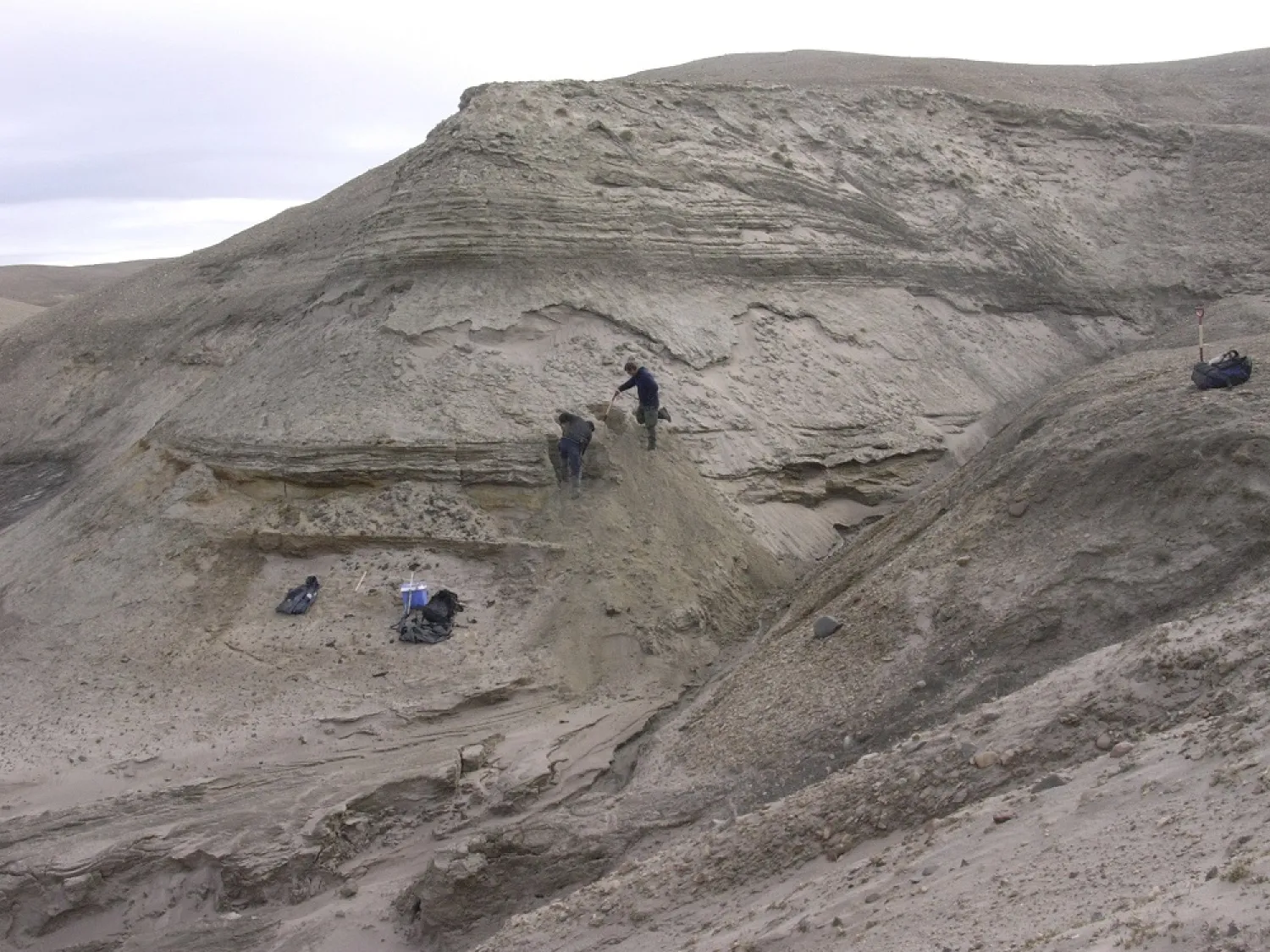
Professors Eske Willerslev and Kurt H. Kjaer expose fresh layers for sampling of sediments at Kap Kobenhavn, Greenland. (Svend Funder via AP)
TT

Oldest DNA Reveals Life in Greenland 2 Million Years Ago 

Professors Eske Willerslev and Kurt H. Kjaer expose fresh layers for sampling of sediments at Kap Kobenhavn, Greenland. (Svend Funder via AP)

Scientists discovered the oldest known DNA and used it to reveal what life was like 2 million years ago in the northern tip of Greenland. Today, it’s a barren Arctic desert, but back then it was a lush landscape of trees and vegetation with an array of animals, even the now extinct mastodon. 

“The study opens the door into a past that has basically been lost,” said lead author Kurt Kjær, a geologist and glacier expert at the University of Copenhagen. 

With animal fossils hard to come by, the researchers extracted environmental DNA, also known as eDNA, from soil samples. This is the genetic material that organisms shed into their surroundings — for example, through hair, waste, spit or decomposing carcasses. 

Studying really old DNA can be a challenge because the genetic material breaks down over time, leaving scientists with only tiny fragments. 

But with the latest technology, researchers were able to get genetic information out of the small, damaged bits of DNA, explained senior author Eske Willerslev, a geneticist at the University of Cambridge. In their study, published Wednesday in the journal Nature, they compared the DNA to that of different species, looking for matches. 

The samples came from a sediment deposit called the Kap København formation in Peary Land. Today, the area is a polar desert, Kjær said. 

But millions of years ago, this region was undergoing a period of intense climate change that sent temperatures up, Willerslev said. Sediment likely built up for tens of thousands of years at the site before the climate cooled and cemented the finds into permafrost. 

The cold environment would help preserve the delicate bits of DNA — until scientists came along and drilled the samples out, beginning in 2006. 

During the region's warm period, when average temperatures were 20 to 34 degrees Fahrenheit (11 to 19 degrees Celsius) higher than today, the area was filled with an unusual array of plant and animal life, the researchers reported. The DNA fragments suggest a mix of Arctic plants, like birch trees and willow shrubs, with ones that usually prefer warmer climates, like firs and cedars. 

The DNA also showed traces of animals including geese, hares, reindeer and lemmings. Previously, a dung beetle and some hare remains had been the only signs of animal life at the site, Willerslev said. 

One big surprise was finding DNA from the mastodon, an extinct species that looks like a mix between an elephant and a mammoth, Kjær said. 

Many mastodon fossils have previously been found from temperate forests in North America. That’s an ocean away from Greenland, and much farther south, Willerslev said. 

“I wouldn’t have, in a million years, expected to find mastodons in northern Greenland,” said Love Dalen, a researcher in evolutionary genomics at Stockholm University who was not involved in the study. 

Because the sediment built up in the mouth of a fjord, researchers were also able to get clues about marine life from this time period. The DNA suggests horseshoe crabs and green algae lived in the area — meaning the nearby waters were likely much warmer back then, Kjær said. 

By pulling dozens of species out of just a few sediment samples, the study highlights some of eDNA’s advantages, said Benjamin Vernot, an ancient DNA researcher at Germany’s Max Planck Institute for Evolutionary Anthropology who was not involved in the study. 

“You really get a broader picture of the ecosystem at a particular time,” Vernot said. “You don’t have to go and find this piece of wood to study this plant, and this bone to study this mammoth.” 

Based on the data available, it’s hard to say for sure whether these species truly lived side by side, or if the DNA was mixed together from different parts of the landscape, said Laura Epp, an eDNA expert at Germany’s University of Konstanz who was not involved in the study. 

But Epp said this kind of DNA research is valuable to show “hidden diversity” in ancient landscapes. 

Willerslev believes that because these plants and animals survived during a time of dramatic climate change, their DNA could offer a “genetic roadmap” to help us adapt to current warming. 

Stockholm University's Dalen expects ancient DNA research to keep pushing deeper into the past. He worked on the study that previously held the “oldest DNA” record, from a mammoth tooth around a million years old. 

“I wouldn’t be surprised if you can go at least one or perhaps a few million years further back, assuming you can find the right samples,” Dalen said. 


Trying to Improve Your Health and Wellness in 2026? Keep it Simple

A man is silhouetted against the sky at sunset as he jogs in a park at the close of a hot summer day, Aug. 1, 2022, in Kansas City, Mo. (AP Photo/Charlie Riedel, File)
TT

Trying to Improve Your Health and Wellness in 2026? Keep it Simple

A man is silhouetted against the sky at sunset as he jogs in a park at the close of a hot summer day, Aug. 1, 2022, in Kansas City, Mo. (AP Photo/Charlie Riedel, File)

The new year is a time when many try to start new good habits and commit to improving health and wellness.

But resolutions, lofty as they may be, can turn daunting quickly with all the advice and sometimes contradicting information coming at you from news reports, advertisers, influencers, friends and even politicians.

But they don't have to be.

This year, The Associated Press got the downlow on all manner of health and wellness claims and fads. The good news is that the experts mostly say to keep it simple.

As 2026 arrives, here's what you can skip, what you should pay attention to and how to get credible information when you are inevitably faced with more confusing claims next year.

Protein and fiber are important, but you probably don't need to pay more When it comes to your diet, experts say most people can skip the upcharge. If you're eating enough, you're probably getting enough protein and don't need products that promise some big boost.

And it's true that most people could use more fiber in their diets. But, please, ditch the “fiber-maxxing” trend. Instead, eat whole foods such as fruits, vegetables, beans and whole grains.

A good skin care routine is not expensive or complicated That 20-step skin care routine and $200 serum some TikToker sold you on? Dermatologists say you really don't need it. Stay away from the beef tallow and slather on a good sunscreen instead (yes, even if you have darker skin ), they say.

And the same rule for simplicity applies to that hourlong “everything shower." The best showers are simple and short, dermatologists say, no "double cleansing" required.

There are many simple ways to get that workout in If the gym and all its equipment feel intimidating, you can drop the illusion that a good workout requires either. This year, the comeback of calisthenics put the focus back on no frills, bodyweight workouts you can do in the comfort of home. Research shows calisthenics helps with muscle strength and aerobic conditioning. You may eventually need weightlifting or other equipment, but it is a great place to start to build consistency and confidence.

Be wary of wellness fads and treatments — they are often too good to be true Even if you imbibe too much this New Year's Eve, doctors say you can do without “ IV therapy ” which have vitamins you can get more easily and cheaper in pill form — if you even need more, which is unlikely if you have a balanced diet. You're pretty much just paying for “expensive urine,” one doctor said.

Same for “wellness” focused products like microbiome testing kits that generate information that doctors can't actually act on. And if you don't have diabetes, there's scant evidence that you need a continuous glucose monitor.

To improve your health, go back to the basics The idea of a panacea pill, product or routine can be enticing. But science already knows a lot about how to improve mental and physical health, and they are tried and true:

1. Whether you're in the city or the country — walk more. Research shows walking is great for physical and mental health. It's so good for you, doctors are literally prescribing time in the outdoors to their patients.

2. Take steps to get certain health metrics under control, likehigh blood pressure, which often goes undiagnosed and is known to cause a range of health problems down the road. Prioritize getting enough sleep, and make sure your family does too. Don't just eat right — eat slower.

3. Give your mind some care too. Set better boundaries with your technology andregain and retrain your attention span. Build out your social networks and invest inall forms of love for the people around you.

These lifestyle changes don't just make you feel better in the moment. Research shows they impact your life for years to come, by lowering the risk of dementia and many other health issues.

Don't know who to trust? Start with your doctor It can be tough to know who to listen to about your health, faced with compelling personal stories on social media from people who swear something worked from them, or clever marketing and advertising from companies that scare you or promise an easy fix.

Doubts have been raised this year about established medicine, including the safety of food dyes, fluoride dental treatments,hepatitis B shot for newborns, and hormone therapies for menopause.

While the medical system is not perfect, your doctor remains the best person to talk to about prevention, health concerns and potential treatments.

If you can't get to a human doctor and turn to Dr. Google instead, be sure to follow these tips and never use it to diagnose yourself. When you do get that doctor's appointment, you can make the most of it by bringing a list of written questions — and don't hesitate to ask for any clarification you need.


Citrus Harvest Season Kicks off in AlUla

The citrus harvest in AlUla is a significant agricultural and economic event  - SPA
The citrus harvest in AlUla is a significant agricultural and economic event - SPA
TT

Citrus Harvest Season Kicks off in AlUla

The citrus harvest in AlUla is a significant agricultural and economic event  - SPA
The citrus harvest in AlUla is a significant agricultural and economic event - SPA

The citrus harvest season has officially begun in AlUla Governorate, which is renowned for its agricultural production, according to SPA.

Citrus groves in AlUla cover approximately 654.57 hectares and contain around 261,826 trees, yielding about 6,545.65 tons of fruit annually.

The governorate produces a variety of delicious and nutritious citrus fruits, most notably navel oranges, citron, and sweet lemons. The citrus harvest season typically runs from December to March.

These fruits are distinguished by their high quality, attributed to the governorate's unique climate and fertile soil, resulting in exceptional flavor and high nutritional value.

The citrus harvest in AlUla is a significant agricultural and economic event that highlights the diversity of the governorate's agricultural production. It also plays a crucial role in supporting agricultural activity and promoting local products in the marketplace.


Saudi Arabia's Qassim National Park Records Third Consecutive Arabian Oryx Births

Saudi Arabia's Qassim National Park recorded the birth of an Arabian oryx for the third consecutive year. (SPA)
TT

Saudi Arabia's Qassim National Park Records Third Consecutive Arabian Oryx Births

Saudi Arabia's Qassim National Park recorded the birth of an Arabian oryx for the third consecutive year. (SPA)

Saudi Arabia's Qassim National Park in Buraidah recorded the birth of an Arabian oryx for the third consecutive year, reported the Saudi Press Agency on Monday.

The development is an important environmental milestone that reflect the ongoing success of release and reintroduction programs led by the National Center for Wildlife (NCW), which aims to preserve endangered wild species and boost biodiversity in their natural habitats.

The achievement exemplifies a pioneering collaboration between the NCW and the National Center for Vegetation Cover Development and Combating Desertification through initiatives such as vegetation enhancement, natural habitat rehabilitation, and the creation of suitable conditions for the breeding and sustainability of wild species.

Qassim National Park is one of several national parks implementing afforestation and environmental rehabilitation projects under the Saudi Green Initiative, strengthening the region’s ecological diversity and showcasing the role of national parks as models of successful environmental sustainability programs in the Kingdom.
