


Saudi Energy Minister: OPEC+ Adopts Economic Approach that Keeps Politics Out

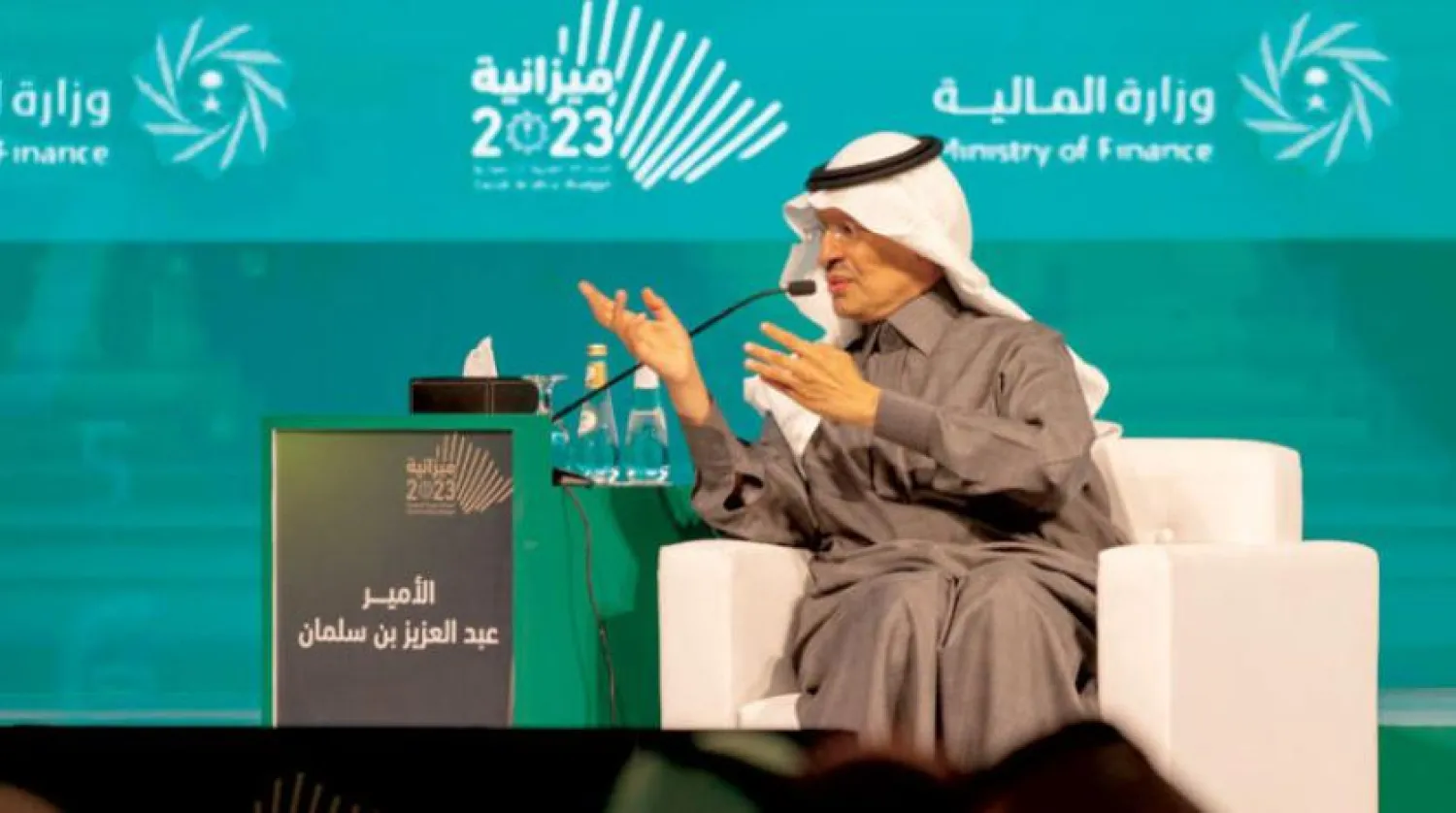
Saudi Minister of Energy speaking during the forum on Sunday (Photo: Saleh Al-Ghanam)
TT

Saudi Energy Minister: OPEC+ Adopts Economic Approach that Keeps Politics Out

Saudi Minister of Energy speaking during the forum on Sunday (Photo: Saleh Al-Ghanam)

Saudi Energy Minister Prince Abdulaziz bin Salman said that the OPEC+ operated according to a purely economic perspective, without entering into political aspects and alliances.

“OPEC+ operates from an economic position and does not get involved in political aspects,” he said on Sunday.

The minister’s comments came during the sessions of the Budget 2023 Forum, which was organized by the Ministry of Finance at King Abdullah Petroleum Studies and Research Center (KAPSARC), with the participation of a number of senior officials.

Prince Abdulaziz said OPEC+ operated in all stages to coexist with all variables, adding that the main challenge lied in preserving sources of income, regardless of certain influences, in addition to reducing market fluctuations to enhance investment opportunities and empower the sector.

He emphasized that the ongoing global developments have proven that OPEC+ has taken the right decision.

The collective efforts of the group have led to what he described as the “miracle” in 2020.

The Saudi Energy Minister insisted every OPEC+ alliance member take part in decision-making, adding that this “has helped us build trust”.

Moreover, he noted that the group succeeded in overcoming all geo-political challenges and the coronavirus pandemic, adding that OPEC+ would continue to focus on market stability in the year ahead.

“Group action requires agreement and therefore I continue to insist that every OPEC+ member, whether a big or small producer...be a part of decision-making,” he said. “Consensus has positive implications on the market.”

Meanwhile, Mohammad Abunayyan, Chairman of ACWA Power, said that the cost of renewable energy production in Saudi Arabia was the lowest in the world, stressing the need to separate between the regulator and the legislator in the energy sector.

Abunayyan noted that the Shoaiba oil-fired CCGT power plant complex in western Saudi Arabia uses approximately 62,000 barrels per day of light Arabian oil, while it produces 900 megawatts of electricity and 880,000 cubic meters of desalinated water. He indicated that in 2025 there will be “zero” use of oil.

The Chairman of ACWA Power went on to say that promoting local content required empowering the private sector.

He pointed to the local investors’ confidence thanks to the “high efficiency of the government sector”, stressing that the Kingdom would lead the world in clean energy.

Separately, the Asbar Forum underlined the importance of diversifying energy sources in the Kingdom and moving to a cleaner and more sustainable energy system through the production of green hydrogen.

In a report entitled, “The future of green hydrogen as clean energy in the Kingdom of Saudi Arabia,” the Asbar Forum said that Saudi Arabia has achieved great strides within the framework of Vision 2030 by diversifying energy sources and increasing local content, through the development of new industrial sectors and the use of existing supply chains.

The report concluded with a number of recommendations, including the importance of establishing an infrastructure to extend natural gas or hydrogen networks to be linked to industrial complexes in Jubail, Yanbu, industrial cities and others.

It also underlined the need to enact legislation and policies that stimulate the use of renewable and clean energy in manufacturing in particular and economic activities in general, and invest in renewable energy research and technologies by unifying efforts under the umbrella of King Abdullah City for Atomic and Renewable Energy, as well as concluding cooperation agreements with developed countries in the field of renewable energy.

The report urged companies to pay more attention to the negative impact of products on the environment and society, and the need to adopt green manufacturing concepts to avoid toxic and hazardous waste, as part of their social and moral responsibility.



GASTAT: Construction Costs in Saudi Arabia Rose 1% in November

The monthly Construction Cost Index survey results showed price stability in November 2025 compared with October 2025. SPA
TT

GASTAT: Construction Costs in Saudi Arabia Rose 1% in November

The monthly Construction Cost Index survey results showed price stability in November 2025 compared with October 2025. SPA

The Construction Cost Index in Saudi Arabia rose 1% in November 2025 compared with the same month last year, driven by equal 1% increases in both residential and non-residential construction costs, according to data released by the Kingdom’s General Authority for Statistics (GASTAT).

The monthly Construction Cost Index survey results showed price stability in November 2025 compared with October 2025.

The Construction Cost Index bulletin is part of GASTAT’s ongoing efforts to develop statistical products for vital sectors and provide a reliable and effective reference with accurate estimates to support decision-making by contractors, real estate developers, and relevant entities.

These efforts contribute to drawing a clear roadmap for residential and non-residential construction projects in the building and construction sector.


Gold Breaks $4,400 for 1st Time on Fed Rate-cut Bets, Silver Hits New High

FILE PHOTO: UK gold bullion bars are stacked at Baird & Co in Hatton Garden in London, Britain, October 8, 2025. REUTERS/Hiba Kola/File Photo
TT

Gold Breaks $4,400 for 1st Time on Fed Rate-cut Bets, Silver Hits New High

FILE PHOTO: UK gold bullion bars are stacked at Baird & Co in Hatton Garden in London, Britain, October 8, 2025. REUTERS/Hiba Kola/File Photo

Gold jumped past the $4,400-per-ounce level for the first time on Monday, riding on growing expectations of further US rate cuts and strong safe-haven demand, with silver also joining the rally to hit an all-time high.

Spot gold was up 1.7% at $4,411.01 per ounce, as of 0822 GMT, having climbed down from the record high of $4,420.01 hit earlier in the day. Spot silver climbed 2.5% to hit $69.44, Reuters reported.

US gold futures for February delivery rose 1.3% to $4,444.00 per ounce.

Bullion has gained 67% ⁠so far this year, shattering multiple records and breaching the $3,000 and $4,000 per-ounce milestones for the first time. It is poised for its biggest annual gain since 1979.

Silver has surged 138% year-to-date, vastly outperforming gold, underpinned by robust investment inflows and persistent supply constraints.

"With December usually producing positive returns for gold and silver, seasonality is on their side," said StoneX ⁠senior analyst Matt Simpson.

"Given that gold has already risen 4% this month and we're nearing the end of the year, bulls may want to tread with caution as volumes are to deplete and odds of profit-taking are also likely on the rise."

Spot gold may extend gains to $4,427 per ounce, as it has broken a key resistance at $4,375, Reuters technical analyst Wang Tao said.

Traditionally viewed as a safe-haven asset, gold has been supported by heightened geopolitical and trade tensions, steady central bank buying and expectations of lower interest rates next year.

A ⁠softer dollar has provided an additional tailwind by making the metal cheaper for overseas buyers.

Markets are currently pricing in two US rate cuts for next year despite the Federal Reserve signaling caution. Non-yielding assets such as gold tend to benefit in lower interest rate environments.

Simpson said two Fed rate cuts were penciled in for 2026, with a faster US jobs slowdown and a shift to a more dovish Fed likely to add further upside to gold.

Elsewhere, platinum jumped 4.3% to $2,058.35, hitting its highest in more than 17 years, while palladium climbed 4.1% to $1,784.00, a near three-year high.


UK Growth Revised Down in Second Quarter 

Shoppers fill the pavement on Regent Street in central London on December 21, 2025. (AFP)
TT

UK Growth Revised Down in Second Quarter 

Shoppers fill the pavement on Regent Street in central London on December 21, 2025. (AFP)

Britain's economy expanded less than initially estimated in the second quarter, according to revised official data released Monday, dealing a fresh setback to the Labour government.

Gross domestic product was revised down to 0.2 percent in the April-June period from a previous estimate of 0.3 percent, the Office for National Statistics said in a statement.

Growth in the third quarter stood at an unrevised 0.1 percent, the ONS said, marking a sustained slowdown from the 0.7 percent expansion recorded in the first three months of the year.

"The economy is still pretty weak and is heading into 2026 with very little momentum," noted Alex Kerr, UK economist at Capital Economics.

Prime Minister Keir Starmer has struggled to revive Britain's sluggish economy since his Labour party came to power in July 2024.

Finance minister Rachel Reeves raised taxes on businesses in her inaugural budget last year -- a decision widely blamed for causing weak UK economic growth and rising unemployment.

She returned in her November budget with fresh tax hikes to bring down government debt, this time hitting workers.

The Bank of England last week cut its key interest rate to 3.75 percent after UK inflation eased faster than expected and as the economy weakens.