Saudi Arabia, Kuwait sign MoU to Develop Durra Gas Field https://english.aawsat.com/home/article/4039266/saudi-arabia-kuwait-sign-mou-develop-durra-gas-field
Saudi Arabia, Kuwait sign MoU to Develop Durra Gas Field
Saudi Arabia and Kuwait sign an MoU to develop the Durra gas field. (Asharq Al-Awsat)
Saudi Aramco’s wholly-owned subsidiary Aramco Gulf Operations Company signed on Saturday a memorandum of understanding (MoU) with state-owned Kuwait Gulf Oil Company (KGOC) to develop the joint Durra gas field.
Kuwait’s Deputy Prime Minister and Minister of Oil Badr al-Mulla and Saudi Minister of Energy Prince Abdulaziz bin Salman attended the signing ceremony in Kuwait.
In March, the two countries signed a document to jointly develop and explore the Durra gas field.
The signing of the MoU is considered an implementation of an agreement to develop submerged field that was signed on Dec. 24, 2019 between the governments of the two Gulf States.
The development work will resume directly and the work will be accelerated according to the program implementation scheme and the timetable approved by the two countries.
The field is expected to produce roughly one billion cubic feet of natural gas per day, along with 84,000 barrels of liquefied gas.
Oil Heads for Weekly Gain with Mideast Supply Risks
TOPSHOT - A flare stack burns off byproduct gasses at the Toa oil refinery in Kawasaki on October 14, 2026. (Photo by Andrew Caballero-Reynolds / AFP)
Oil prices eased on Friday but were heading for weekly gains on the uncertainty over Middle East supplies and a larger-than-expected crude stocks draw in the United States.
Brent crude futures fell 71 cents, or 0.67%, to $105.21 a barrel by 0352 GMT, while US West Texas Intermediate crude futures were down 77 cents, or 0.79%, to $97.20, Reuters reported.
WTI settled up more than 3% on Thursday after a big US crude stock draw on hurricane production shut-ins.
For this week so far, Brent increased 0.44%, while WTI jumped 5.81%.
"Uncertainty in the Middle East and concerns over the sustainability of oil flows through the Strait of Hormuz has the market pricing in a significant risk premium," ING analysts wrote in a note on Friday.
There needs to be some kind of agreement between the US and Iran to provide the market with more confidence that stronger oil flows from the region will continue, they added.
Supply jitters also rose as attacks around the Strait of Hormuz have surged over the past 10 days, with Iran saying it was stepping up strikes in response to the US blockade of its ports and tougher sanctions introduced last month.
Total Hormuz clearance averaged 11.62 million barrels per day over seven days to October 13, about 68% of the 17.15 million bpd baseline, according to ship tracking firm Kpler.
"Intensified Iranian attacks drove Gulf crude flows sharply lower," Kpler analysts said in a report on Thursday, adding that they expected a slower and more uneven Hormuz recovery, without a comprehensive political deal.
The Houthis fired missiles at the presidential palace complex in the southern city of Aden on Thursday, killing two guards.
The International Energy Agency agreed on Thursday to release over 20 million barrels of diesel to the market and any oil remaining from a record release of emergency reserves pledged in March to boost supply and cool soaring prices.
During the previous trading session, oil prices rose overnight in a sign that "investors were dissatisfied with these measures," Haitong Futures said in a note on Friday.
"What would really cool the oil market is an easing of tensions in the Middle East."
The Trump administration is considering lifting sanctions on some so-called shadow fleet vessels that have transported oil and petroleum products from countries including Russia, Iran and Venezuela, in an effort to reduce record-high global freight rates, a US official said on Wednesday.
The discussions come days after US President Donald Trump temporarily lifted sanctions on Russian diesel fuel, a move met with criticism from Ukrainian President Volodymyr Zelenskiy, European countries and some of Trump's fellow Republicans.
IEA to Speed up Oil Stocks Release Including Over 20 Million Barrels of Dieselhttps://english.aawsat.com/business/5330126-iea-speed-oil-stocks-release-including-over-20-million-barrels-diesel
An aerial view shows the fuel depot of Aral at the Ruhr Oel petroleum refineries of BP Gelsenkirchen GmbH in Gelsenkirchen, western Germany on October 15, 2026. (AFP)
TT
TT
IEA to Speed up Oil Stocks Release Including Over 20 Million Barrels of Diesel
An aerial view shows the fuel depot of Aral at the Ruhr Oel petroleum refineries of BP Gelsenkirchen GmbH in Gelsenkirchen, western Germany on October 15, 2026. (AFP)
The International Energy Agency agreed on Thursday to release over 20 million barrels of diesel to the market and any oil remaining from a record emergency reserves release pledged in March to boost supply and cool soaring prices.
US President Donald Trump has pressed European Union countries to draw down reserves or face a potential US diesel export ban as he seeks to lower prices ahead of November 3 midterm elections.
Diesel prices have surged to record highs in many markets due to disrupted supply because of the Iran war and the Russia-Ukraine conflict, posing inflation and cost-of-living threats to governments and consumers.
The 32-nation IEA's board met on Thursday to discuss the scale and timing of stock releases.
"The IEA governing board reaffirmed its commitment to continue delivering on the March 2026 Collective Action in response to the Strait of Hormuz crisis," it said in a statement after the meeting.
In March, countries had pledged to release more than 400 million barrels of crude and oil products as prices soared.
On Thursday, members "agreed to accelerate the release of the remaining volumes, with specific plans already in place, including over 20 million barrels of diesel as soon as possible."
SOME DISAPPOINTMENT OVER LACK OF EXTRA BARRELS
Reuters reported this month that EU governments were discussing a French proposal for the release of 50 million barrels of diesel alongside 50 million barrels of crude from IEA members.
"The IEA announcement is a step in the right direction, but falls short on the details the market was looking for," said Abhishek Kumar, an analyst at Sparta Commodities. "The 20+ million barrels of diesel appear to be an acceleration of existing commitments rather than genuinely new volumes."
The IEA, which coordinates industrialized nations' releases of oil from emergency stocks, said some members had already released more than they pledged in March and that others planned to do so.
Members have released approximately 330 million barrels so far, the IEA said.
The US Energy Department said further IEA releases, with a focus on diesel, are under review and in progress, citing the IEA statement.
But the Trump administration "continues to hold European nations accountable for failing to fulfill their previous commitments to minimize supply disruptions in global energy markets and to help lower energy prices," the Energy Department spokesperson added.
The White House, when asked if it was unhappy with the IEA's commitment to draw down reserves, provided the IEA's statement from Thursday on the releases.
Spain said on Thursday it would release 4.4 million barrels from strategic reserves in October.
Spain has released 3.7 million of the 11.5 million barrels it pledged in March.
Al-Jadaan: Saudi Investments in Alternative Routes Ensure Continuity of Energy Supplies and Tradehttps://english.aawsat.com/business/5329894-al-jadaan-saudi-investments-alternative-routes-ensure-continuity-energy-supplies
Al-Jadaan: Saudi Investments in Alternative Routes Ensure Continuity of Energy Supplies and Trade
General view of the Kingdom Tower in downtown Riyadh, Saudi Arabia, October 12, 2026. Picture taken with a mobile phone. REUTERS
Saudi Finance Minister Mohammed Al-Jadaan said the Kingdom’s investments in alternative routes have helped ensure the continuity of energy supplies and trade flows amid uncertainty.
He stressed that strengthening economic resilience requires diversifying sources of economic strength, protecting the foundations of growth, and maintaining the capacity to deal with recurring and prolonged disruptions.
Speaking at the third meeting of G20 Finance Ministers and Central Bank Governors under the US presidency, held Thursday in Bangkok, Al-Jadaan said the global economy had demonstrated an ability to adapt to repeated disruptions. He explained that resilience is fundamental to this adaptability, but strengthening it requires an understanding of its cost, how it can be developed, and how it should be financed.
He said the success of economic policies in confronting shocks is not limited to mitigating the impact of current challenges. It also depends on preserving the ability to support future ambitions and sustain the long-term path of economic transformation, while maintaining sufficient buffers to deal with any new developments that may arise.
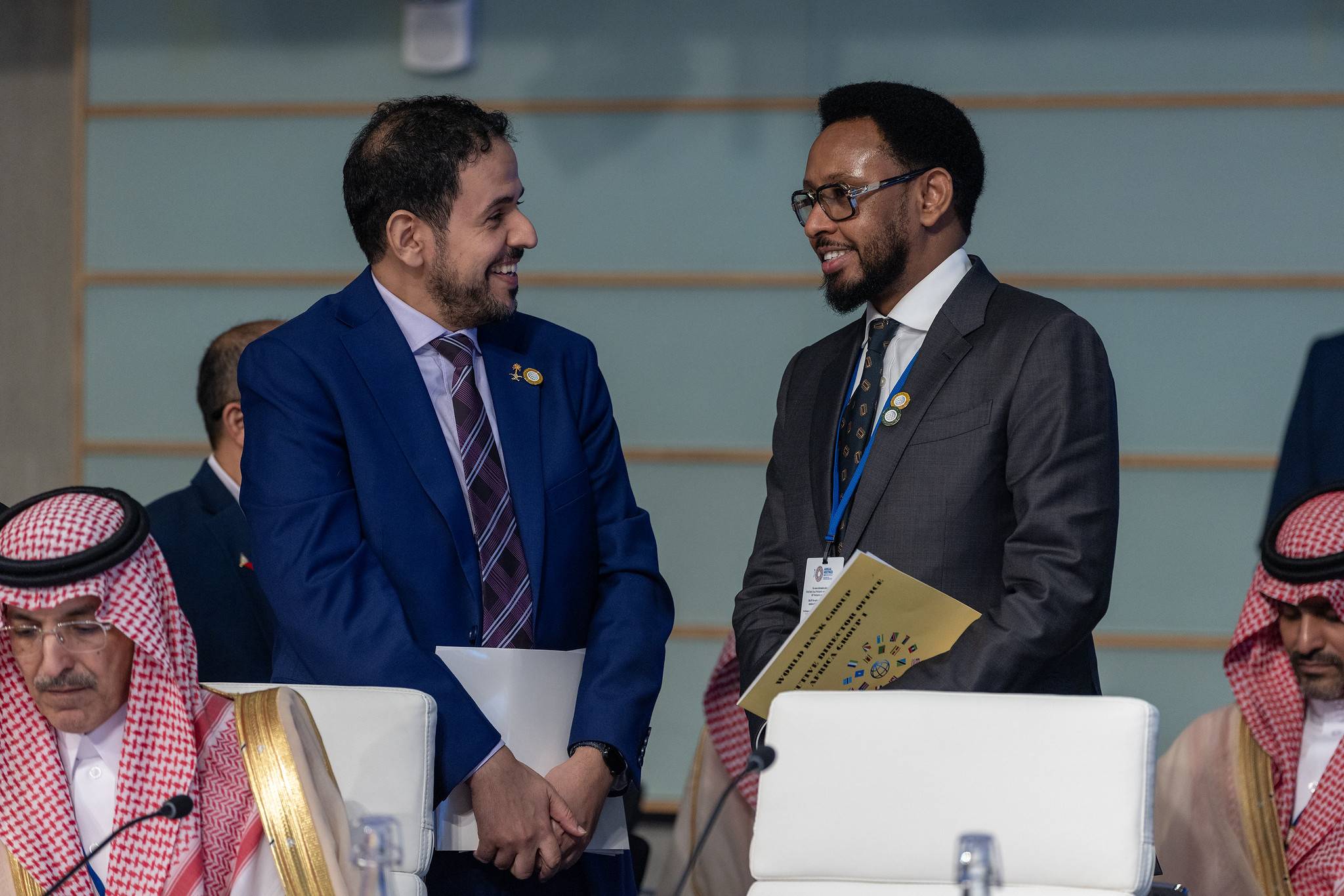
Al-Jadaan participates in one of the sessions at the annual meetings of the IMF and World Bank in Bangkok (IMF)
The Finance Minister stressed that fiscal policies must protect the foundations of growth, highlighting the importance of effective international cooperation in achieving economic stability.
He said access to reliable and affordable energy, along with the uninterrupted flow of essential goods, helps contain price pressures and ease the burden on national budgets, thereby strengthening countries’ ability to navigate uncertainty.
In this context, Al-Jadaan said the Kingdom, through its investments in alternative routes, has helped ensure the continuity of energy supplies and trade flows amid disruptions. This underscores the importance of infrastructure and transportation and supply routes in strengthening economies’ ability to withstand shocks and limiting their impact on markets and the flow of essential goods.
Managing Shocks and Strengthening Resilience
Discussing ways to enhance economic resilience, Al-Jadaan said dealing with prolonged shocks depends not only on the size of the buffers available to countries, but also on how these buffers are managed over time, while preserving sufficient capacity to respond to future developments.
He noted that strengthening economic resilience requires reducing exposure to risks through economic diversification, reinforcing energy and food security, and developing more resilient supply chains and infrastructure. These priorities have become increasingly important amid recurring disruptions affecting trade flows, the availability of essential goods, and the cost of obtaining them.
Al-Jadaan also addressed artificial intelligence, noting that it has evolved beyond a purely technological issue to become part of a broader agenda aimed at achieving sustainable growth and strengthening economic resilience. This reflects the expanding scope of policies required to build economies capable of adapting to change while preserving opportunities for long-term growth and transformation.
The Role of International Financial Institutions
The Finance Minister emphasized the important role played by multilateral financial institutions in helping economies that are most vulnerable to risk cope with financing pressures through financial and technical support programs and policy advice, thereby strengthening their ability to withstand shocks and maintain economic stability.
Al-Jadaan concluded his participation in the third meeting of G20 Finance Ministers and Central Bank Governors, held on the sidelines of the 2026 Annual Meetings of the International Monetary Fund and the World Bank Group in Thailand.
He met with a number of officials, heads of international financial institutions, and representatives of credit rating agencies. The meetings addressed developments in the global economy and policies aimed at supporting its stability, while also reviewing developments and reforms in the Saudi economy as part of the Kingdom’s efforts to strengthen its presence in international economic and financial dialogue.
لم تشترك بعد
انشئ حساباً خاصاً بك لتحصل على أخبار مخصصة لك ولتتمتع بخاصية حفظ المقالات وتتلقى نشراتنا البريدية المتنوعة