


BTS Member Jin Begins Military Duty at Frontline Boot Camp

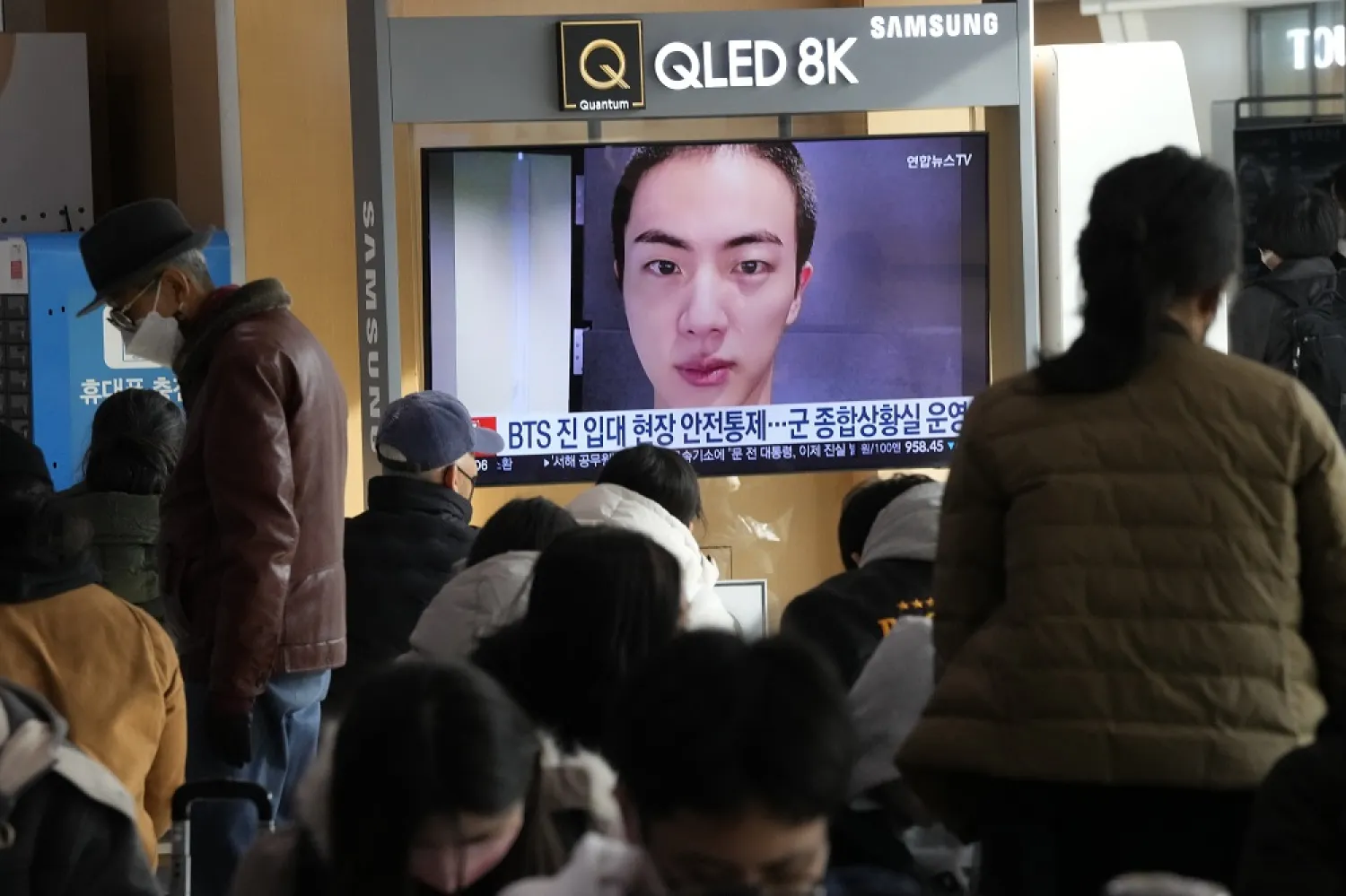
A TV screen shows an image of BTS's member Jin with buzz cut, at the Seoul Railway Station in Seoul, South Korea, Monday, Dec. 12, 2022. (AP)
TT

BTS Member Jin Begins Military Duty at Frontline Boot Camp

A TV screen shows an image of BTS's member Jin with buzz cut, at the Seoul Railway Station in Seoul, South Korea, Monday, Dec. 12, 2022. (AP)

Jin, the oldest member of K-pop supergroup BTS, began his 18 months of mandatory military service at a frontline South Korean boot camp Tuesday, as fans gathered near the base to say goodbye to their star.

Six other younger BTS members are to join the military in coming years one after another, meaning that the world's biggest boy band must take a hiatus, likely for a few years. Their enlistments have prompted a fierce domestic debate over whether it’s time to revise the country’s conscription system to expand exemptions to include prominent entertainers like BTS, or not to provide such benefits to anyone.

With lawmakers squabbling at Parliament and surveys showing sharply split public opinions over offering exemptions to BTS members, their management agency said in October that all BTS members would perform their compulsory military duties. Big Hit Music said that both the company and the members of BTS “are looking forward to reconvening as a group again around 2025 following their service commitment.”

Jin, who turned 30 earlier this month, entered the boot camp at Yeoncheon, a town near the tense border with North Korea, for five weeks of basic military training together with other new conscript soldiers, the Defense Ministry said. After the training involving rifle-shooting, grenade-throwing and marching practices, he and other conscripts would be assigned to army units across the country.

About 20-30 fans — some holding Jin’s photos — and dozens of journalists gathered near the camp. But Jin didn't meet them as a vehicle carrying him moved into the boot camp without getting him out.

“I want to wait (for) Jin and see him go into the military and wish him all the best,” Mandy Lee from Hong Kong said before Jin’s entrance to the camp.

“Actually it’s complicated. I wanna be sad. I wanna be happy for him,” said Angelina from Indonesia. "Mixed feelings. He has to serve (for) his country.” Angelina, like many Indonesians, uses only one name.

A couple dozen fans could be seen as a small turnout given Jin's huge popularity. But Jin and his management agency had earlier asked fans not to visit the site and notified them there wouldn’t be any special event involving the singer, in order to prevent any issue caused by crowding.

Authorities still mobilized 300 police officers, soldiers, emergency workers and others to maintain order and guard against any accidents, according to the army. Strict safety steps were expected as South Korea is still reeling from the devastating Halloween crush in October in Seoul that killed 158 people.

Hours before entering the camp, Jin — whose real name is Kim Seok-jin — wrote on the on the online fan platform Weverse that “It’s time for a curtain call.” He posted a photo of himself Sunday with a military buzzcut and a message saying, “Ha ha ha. It’s cuter than I had expected.”

By law, all able-bodied South Korean men must serve in the military for 18-21 months under a conscription system established to deal with threats from North Korea. But the law gives special exemptions to athletes, classical and traditional musicians, and ballet and other dancers if they have won top prizes in certain competitions and enhance national prestige. K-pop stars and other entertainers aren’t given such benefits even if they gain worldwide fame and win big international awards.

“Though BTS members have opted to go to the military, there are still some sort of regrets,” said Jung Duk-hyun, a pop culture commentator. “Those in the pop culture sector experience little bit of disadvantages and unfairness, compared with those in the pure art sector or athletes. This will likely continue to be an issue of controversy so I wonder if it must be discussed continuously.”

Exemptions or dodging of duties are a highly sensitive issue in South Korea, where the draft forces young men to suspend their studies or professional careers. Defense Minister Lee Jong-sup and Lee Ki Sik, head of South Korea’s enlistment office, previously said it would be “desirable” for BTS members to fulfill their military duties to ensure fairness in the country’s military service.

Chun In-bum, a retired lieutenant general who commanded South Korea’s special forces, said the government must move to repeal any exemptions as the military’s shrinking recruitment pool is “a very serious” problem amid the country’s declining fertility rate. He called a debate over BTS’s military service “unnecessary” as it wasn’t raised by BTS members, who have shown willingness in carrying out their duties.

BTS was created in 2013 and has a legion of global supporters who call themselves the “Army.” Its other members are RM, Suga, J-Hope, Jimin, V and Jungkook, who is the youngest at 25. The group expanded its popularity in the West with its 2020 megahit “Dynamite,” the band’s first all-English song that made BTS the first K-pop act to top Billboard’s Hot 100. The band has performed in sold-out arenas around the world and was even invited to speak at United Nations meetings.

Hybe Corp., the parent company of Big Hit, said in October that each member of the band for the time being would focus on individual activities scheduled around their military service plans. In October, Jin released “The Astronaut,” a single co-written by Coldplay.

Jung, the commentator, said sold projects could give BTS members much-needed time to develop themselves after working together as a group for many years. But Cha Woo-jin, a K-pop commentator, said it’s unclear if BTS would enjoy the same popularity as a group when they get together again after finishing their military duties in a few years.

In August, Lee, the defense minister, said BTS members who are serving would likely be allowed to continue practicing and to join other non-serving BTS members in overseas group tours.

Cha said K-pop’s global influence wouldn’t be hurt much because of BTS members’ enlistments as they “appear to represent K-pop but aren’t everything of K-pop.” Chung agreed, saying that other K-pop groups like BLACKPINK, Stray Kids and aespa could rise further.



‘One Battle’ Triumphs at BAFTAs That Honor British Talent 

Director Paul Thomas Anderson poses in the press room after winning the awards for Best Film, Best Adapted Screenplay, and Best Director for "One Battle After Another" during the EE BAFTA Film Awards 2026 at the Royal Festival Hall in London, Britain, 22 February 2026. (EPA)
TT

‘One Battle’ Triumphs at BAFTAs That Honor British Talent 

Director Paul Thomas Anderson poses in the press room after winning the awards for Best Film, Best Adapted Screenplay, and Best Director for "One Battle After Another" during the EE BAFTA Film Awards 2026 at the Royal Festival Hall in London, Britain, 22 February 2026. (EPA)

Paul Thomas Anderson's "One Battle After Another" continued its awards season streak by winning the top prize at the BAFTAs on Sunday, with the British awards also recognizing homegrown talent across categories.

Following in the footsteps of Hollywood ceremonies last month, the BAFTAs gave the best film award to the offbeat thriller "One Battle After Another".

Paul Thomas Anderson won the best director award for the political thriller, which has struck a chord with its portrayal of a deeply polarized United States -- and also won the most prizes of the night with a tally of six.

"Unfortunately, the title makes sense," Anderson told reporters after the ceremony. "It just does start to seem like one battle after another these days. But stay hopeful."

Chalamet's ping-pong drama "Marty Supreme" left the night with no awards -- having been nominated in 11 categories -- but Guillermo del Toro's "Frankenstein" walked off with three wins in the technical categories.

Vampire period film "Sinners" left the night with three awards, including for best score and best original screenplay.

The BAFTA ceremony, often seen as a weather vane for the Oscars in three weeks time, recognized British and Irish talent in some of the top categories.

- Aramayo, local hero -

Loud cheers erupted in London's Southbank Centre when British actor Robert Aramayo triumphed over established stars Timothee Chalamet and Leonardo DiCaprio to snag the best actor honor.

Aramayo, the underdog in the category, won for his portrayal of a man with Tourette syndrome in "I Swear", inspired by the real life story of Scot John Davidson whose life was irrevocably changed by the condition.

"I honestly cannot believe I won this award. I really, really cannot," said a tearful Aramayo, who had already won in the rising star category.

"I'm just really happy that 'I Swear' has shown a spotlight on something that is really, really misunderstood," he added.

Ireland's Jessie Buckley continued her winning streak for her heart-wrenching portrayal of Shakespeare's wife Agnes in "Hamnet", scooping the best actress award, beating off strong competition from stars including Kate Hudson and Emma Stone

"This really does belong to the women past, present and future that have taught me and continue to teach me how to do it differently," said Buckley, who made history as the first Irish actress to win a BAFTA in the category.

- Royals in attendance -

Unlike France's Cesar Awards or Spain's Goya Awards, which champion national cinema, the BAFTAs are open to all nationalities. As a consequence, the awards have previously faced some criticism for the American-dominated roster.

This year, however, local talent got wide recognition.

"Hamnet" won outstanding British film, and Nigerian-British actress Wunmi Mosaku won best supporting actress for her role in "Sinners".

Adapted from a novel by Maggie O'Farrell, "Hamnet" follows William Shakespeare and his wife Agnes as they navigate the loss of their son in plague-ravaged Elizabethan England.

"Sentimental Value" won in the foreign language film category, becoming the first Norwegian film to win at the BAFTAs, according to director Joachim Trier.

The intimate drama follows the relationship between two daughters and their estranged father, as he struggles to reconnect with them while making a film in their now hollowed-out family home.

"We felt ready to try to talk about family life, intergenerational trauma and all those things we don't know how to talk about," Danish-Norwegian filmmaker Trier told reporters.

Hollywood and British royalty were in attendance, including BAFTA president Prince William, his wife Princess Catherine, and A-listers DiCaprio, Chalamet and Cillian Murphy.

William, the eldest son of King Charles III, was the latest royal to go about business-as-usual at the end of a dramatic week that saw his uncle and ex-prince Andrew arrested.

The Prince of Wales said he was not calm "at the moment" when asked about whether he had watched "Hamnet", according to the PA news agency.

"I need to be in quite a calm state and I'm not at the moment," William told Elaine Bedell, chief executive of the Southbank Centre.

But even the heir-to-the-throne smiled wide as Paddington Bear came onto the stage to present the award for best children and family film.


'GOAT' Battles to Top of N. America Box Office

'GOAT' Battles to Top of N. America Box Office
TT

'GOAT' Battles to Top of N. America Box Office

'GOAT' Battles to Top of N. America Box Office

Sony animated film "GOAT," produced by NBA superstar Stephen Curry, glided into the number one spot at the North American box office, taking in $17 million, industry estimates showed Sunday.

The film, the story of an undersized goat who wants to join a basketball-like "roarball" team, features Curry in a voice role.

Caleb McLaughlin and David Harbour ("Stranger Things"), Gabrielle Union and country star Jelly Roll also star in the family-friendly movie.

"GOAT" moved ahead of steamy literary adaptation "Wuthering Heights," which earned $14.2 million in its second week of release, according to Exhibitor Relations.

The Warner Bros film, starring Margot Robbie and Jacob Elordi as the doomed lovers Cathy and Heathcliff from Emily Bronte's classic novel, features original songs from Charli XCX.

Debuting in third place with $8 million was Lionsgate's "I Can Only Imagine 2," a sequel about the singer who wrote and performed the number one Christian single of all time, AFP reported.

In fourth place was Amazon MGM's heist thriller "Crime 101," starring Chris Hemsworth, Halle Berry and Mark Ruffalo, with $5.8 million.

And in fifth place was horror flick "Send Help" from 20th Century, starring Rachel McAdams and Dylan O'Brien as a woman and her boss trying to survive on a deserted island after a plane crash.

It earned $4.5 million.

"It's a quiet weekend for new releases. The market is full right now, and a number of pictures are having good runs," said analyst David A. Gross of Franchise Entertainment Research.


AI Revolution Looms Over Berlin Film Fest

Director and screenwriter Yoshitoshi Shinomiya attends a press conference for “A New Dawn” during the 76th Berlin International Film Festival, in Berlin, Germany, 18 February 2026. (EPA)
TT

AI Revolution Looms Over Berlin Film Fest

Director and screenwriter Yoshitoshi Shinomiya attends a press conference for “A New Dawn” during the 76th Berlin International Film Festival, in Berlin, Germany, 18 February 2026. (EPA)

The artificial intelligence revolution sweeping through the entertainment sector was at first glance not evident at this year's Berlin Film Festival, but the potential for widespread changes was still on people's minds.

The festival has had the air of an arthouse bubble when it comes to the topic of AI and the event's leadership is keeping above the fray.

"At present, we do not intend to issue any statements regarding the use of AI in the film industry," the festival said in a statement sent to AFP, adding: "We are monitoring developments with great interest."

Nevertheless, some of the filmmakers present addressed the question of how the technology is changing the industry.

Yoshitoshi Shinomiya, director of the only animated feature in competition, "A New Dawn," told reporters he had briefly considered using AI in his film.

"During production, we weren't entirely sure we would be able to complete the film. At one point we wondered whether we should use AI for the backgrounds," he said.

But Shinomiya concluded that AI is not yet "well-developed enough" to do that sort of work.

Juliette Prissard from Eurocinema, an organization representing French film and TV producers, said it's only a matter of time until the tools improve.

"It's reasonable to think that in one, two or three years... you won't be able to tell the difference anymore," she told AFP.

AI can already "write scripts" and replace extras in crowd scenes or even generate "digital replicas" of someone.

- 'No choice' -

In France, where foreign-language films are frequently shown with dubbing, voice actors have already been raising the alarm about AI's impact on their profession.

But Prissard warns other film industry jobs could be replaced in the "near" future, such as "technicians, the set designers" and even "the producers themselves".

Sevara Irgacheva, secretary general of the European Film Agency Directors' association (EFAD), said that already "junior jobs are disappearing: all the assistant editors, assistant screenwriters".

Despite this, the industry "is leaning toward accepting" AI "because, in any case, we have no choice".

The tools have the potential to help the sector become more efficient and "save time at every stage of production", particularly in the more "bureaucratic" aspects of the process.

A survey carried out in early 2025 by France's National Center for Cinema (CNC) found that 90 percent of film and audiovisual professionals surveyed were already using AI tools in their work.

In Berlin, Austrian director Georg Tiller presented a short film mixing filmed footage and AI-generated images, saying it was an attempt to encourage his fellow filmmakers to fight for a place in the new "digital cinema".

"If we don't then I fear that that we will die a slow death, because it will just steamroll over us," Tiller told AFP.

- The 'temptation' of deregulation -

The issue garnered some relief with a December agreement between OpenAI and Disney, which allowed the use of the entertainment giant's characters on Sora, the AI-generated video platform.

In return, Disney now has "privileged access" to OpenAI's "highly sophisticated" tools, giving it a "technological advantage over the rest of the sector," said Prissard.

But the use of AI in cinema has prompted thorny legal questions over intellectual property and the very notion of authorship, at a time when legislation is only just beginning to grapple with the subject.

Under EU rules, streaming platforms such as Netflix and Amazon Prime must carry at least 30 percent of European content in their catalogues.

Prissard questioned how those enforcing the rules "will be able to tell the difference" between original creations and "synthetic" ones.

Given "the fear of falling behind" the United States and China in developing AI technologies, Prissard said that Europe may succumb to the "temptation to allow more leeway to innovate without obstacles".