


Washington Defends ‘Lawfulness’ of Flying Lockerbie Bombing Accused from Tripoli

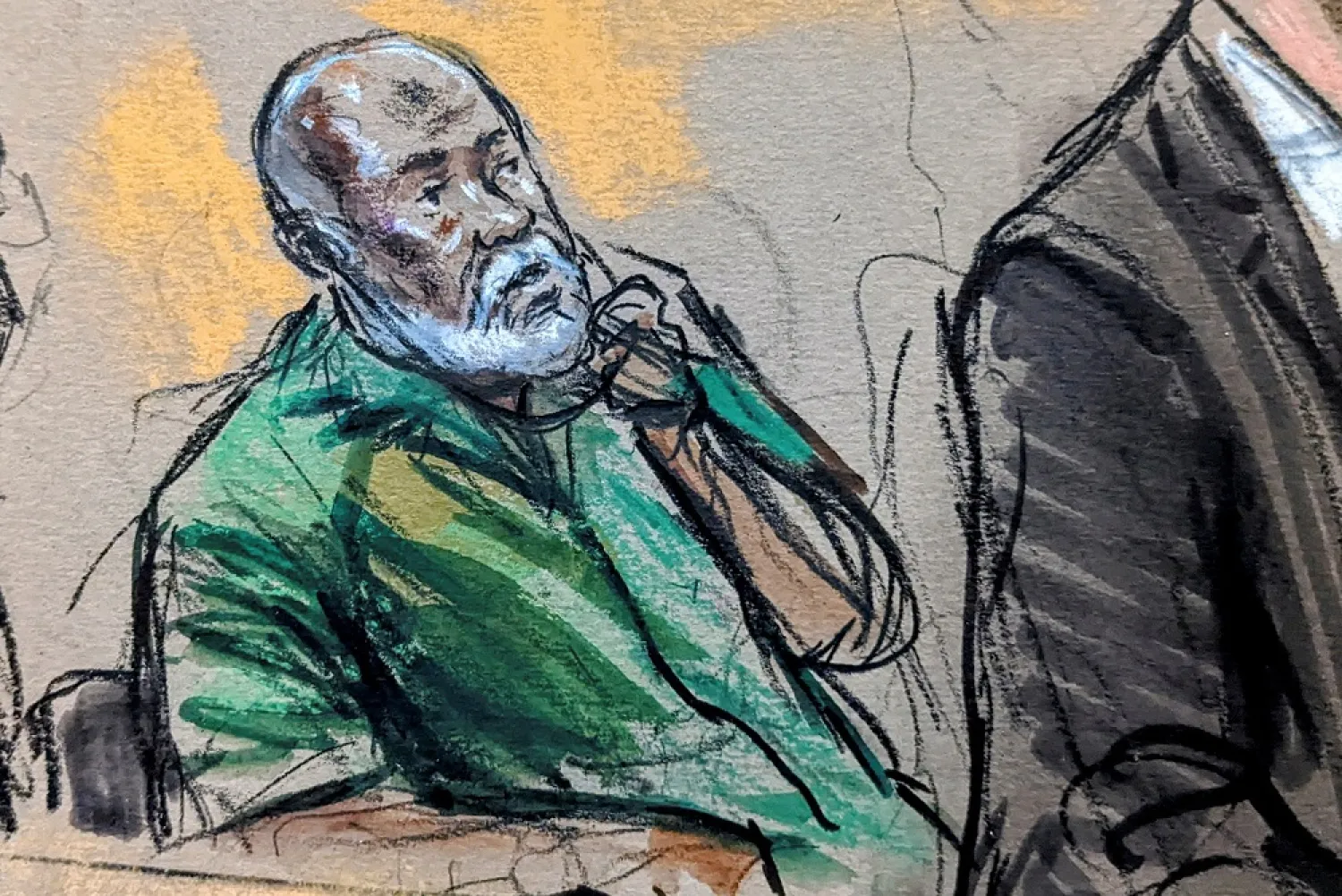
Abu Agila Mohammad Masud Kheir Al-Marimi, also known as Mohammed Abouajela Masud, accused of making the bomb that blew up Pan Am flight 103 over Lockerbie in Scotland in 1988, is shown listening in this courtroom sketch drawn during an initial court appearance in US District Court in Washington, US, December 12, 2022. (Reuters)
TT

Washington Defends ‘Lawfulness’ of Flying Lockerbie Bombing Accused from Tripoli

Abu Agila Mohammad Masud Kheir Al-Marimi, also known as Mohammed Abouajela Masud, accused of making the bomb that blew up Pan Am flight 103 over Lockerbie in Scotland in 1988, is shown listening in this courtroom sketch drawn during an initial court appearance in US District Court in Washington, US, December 12, 2022. (Reuters)

More than three decades after a bomb brought down Pan Am Flight 103 over Lockerbie, Scotland, killing everyone aboard, a former Libyan intelligence official accused of making the explosive appeared Monday in federal court, charged with an act of international terrorism.

The extradition of Abu Agila Mohammad Masud Kheir Al-Marimi marked a milestone in the decades-old investigation into the attack that killed 259 people aboard the plane and 11 on the ground. His arrival in Washington sets the stage for one of the Justice Department's more significant terrorism prosecutions in recent memory.

The Justice Department announced Sunday that Masud had been taken into US custody, two years after it revealed that it had charged him in connection with the explosion. Two other Libyan intelligence officials have been charged in the US for their alleged involvement in the attack, but Masud was the first defendant to appear in an American courtroom for prosecution.

The New York-bound Pan Am flight exploded over Lockerbie less than an hour after takeoff from London on Dec. 21, 1988. Citizens from 21 countries were killed. Among the 190 Americans on board were 35 Syracuse University students flying home for Christmas after a semester abroad.

US National Security Advisor Jake Sullivan told a press briefing on Monday that Masud was brought to the US “in a lawful manner, according to established procedures.”

American authorities did not, however, disclose how he was arrested. Libya and the US do not share an extradition agreement.

Libyan media had reported that Masud was abducted by gunmen from his place of residence in the Libyan capital, Tripoli, in November. He was then flown to the US on board a private jet.

“Although nearly 34 years have passed since the defendant's actions, countless families have never fully recovered," Assistant US Attorney Erik Kenerson said during a court proceeding attended by victims' relatives.

The bearded and balding Masud wore a green jail uniform, and walked with a halting gait to the defense table. He spoke occasionally through an interpreter, and the federal defenders who represented him at the hearing said he wanted to be represented by lawyers of his own choice.

At one point, as the charges were being discussed, Masud said in Arabic that he could not speak until he saw his attorney.

A detention hearing was set for later in the month.

The announcement of charges against Masud on Dec. 21, 2020, came on the 32nd anniversary of the bombing and in the final days of the tenure of then-Attorney General William Barr. At the time, Masud was in Libyan custody. The announcement was a career bookend for Barr, who in his first stint as attorney general in the early 1990s had announced criminal charges against two other Libyan intelligence officials.

The Libyan government initially balked at turning over those two men, Abdel Baset Ali al-Megrahi and Lamen Khalifa Fhimah, before ultimately surrendering them for prosecution before a panel of Scottish judges sitting in the Netherlands as part of a special arrangement.

In Masud's case, a newly unsealed Justice Department indictment includes three charges related to the explosion, including destruction of an aircraft, resulting in death. Prosecutors said in court that they would not be pursuing the death penalty because that punishment was not available for those specific crimes at the time the bombing occurred.

A breakthrough in the Justice Department's investigation came when US officials in 2017 received a copy of an interview that Masud, a longtime explosives expert for Libya’s intelligence service, had given to Libyan law enforcement in 2012 after being taken into custody following the collapse of the government of the country’s leader, Col. Moammar Gaddafi.

In that interview, US officials said, Masud admitted building the bomb in the Pan Am attack and working with two other conspirators to carry out the attack. He also said the operation was ordered by Libyan intelligence and that Gaddafi thanked him and other members of the team after the attack, according to an FBI affidavit.

That affidavit said Masud told Libyan law enforcement that he flew to Malta to meet al-Megrahi and Fhimah. He handed Fhimah a medium-sized Samsonite suitcase containing a bomb, having already been instructed to set the timer so that the device would explode exactly 11 hours later, according to the document. He then flew to Tripoli, the FBI said.

Al-Megrahi was convicted in the Netherlands while Fhimah was acquitted of all charges. Al-Megrahi was given a life sentence, but Scottish authorities released him on humanitarian grounds in 2009 after he was diagnosed with prostate cancer. He died in Tripoli, still protesting his innocence.

Outrage in Libya

In Libya, Masud’s arrest stoked anger against Abdulhamid al-Dbeibah's Government of National Unity (GNU), but US Ambassador to Tripoli Richard Norland was quick to stress that Washington respects the country’s sovereignty and had operated according to legal procedures.

Libyan National Security Advisor Ibrahim Bouchnaf discussed the arrest in a telephone call with the ambassador.

Prime Minister Fathi Bashagha called Tuesday for Masud’s release, questioning the way he was transferred to the US.

“My question directed to the American administration is how...he reached Washington,” he told a local Libyan television channel as he was leaving a meeting of the country’s East-based parliament.

“What we think is that he was kidnapped. Of course, this is outside the legal, judicial and legitimacy framework, and this is something I reject and do not recognize. At all.”

The High Council of State held Dbeibah’s government “legally, morally and historically” responsible for “shamefully” turning over Masud to American authorities.

It called on the Presidential Council, parliament and general prosecutor to take the necessary measures to end such meddling in Libyan affairs.

It urged the relevant security agencies to clarify how Masud “disappeared and was turned over to the US.”

The Union of Libyan Tribes called on Tuesday for protests against Washington’s “heinous criminal behavior” against a Libyan national.

It demanded that the general prosecution bring to justice all people complicit in “treason, collaborating with foreign intelligence and undermining national sovereignty.”



Yemen's PLC Imposes No Fly-Zone, Sea and Ground Blockade on All Ports and Crossings

Chairman of Yemen's Presidential Leadership Council Dr. Rashad al-Alimi. (Saba)
TT

Yemen's PLC Imposes No Fly-Zone, Sea and Ground Blockade on All Ports and Crossings

Chairman of Yemen's Presidential Leadership Council Dr. Rashad al-Alimi. (Saba)

Chairman of Yemen's Presidential Leadership Council Dr. Rashad al-Alimi declared on Tuesday a state of emergency throughout the country in wake of the "internal strife caused by the military rebellion in eastern provinces aimed at dividing the republic."

He called for all military formations and forces in the Hadhramaut and Al-Mahra governorates to coordinate completely with the Coalition to Restore Legitimacy in Yemen, represented by Saudi Arabia, and to immediately return to their original positions without a fight. They should cede their positions in the two governorates to the National Shield forces.

Al-Alimi said the state of emergency will last 90 days, which can be extended. He also imposed a no fly-zone, sea and ground blockade on all ports and crossings for 72 hours.

The move also stems from "the commitment to the unity of Yemen, its sovereignty, independence, and territorial integrity and the need to confront the Houthi coup that has been ongoing since 2014," he stressed.

Moreover, al-Alimi called on "all United Arab Emirates forces to leave the country within 24 hours."

"We will firmly deal with any rebellion against state institutions," he warned.

He called on the Southern Transitional Council to "return to reason and quickly and unconditionally withdraw its forces from Hadhramaut and Al-Mahra."

Al-Alimi announced the state of emergency shortly after the Saudi-led Arab coalition carried out a "limited" airstrike targeting a military shipment that had arrived in Yemen's Al-Mukalla port.

In a statement, coalition spokesman Major General Turki al-Malki said the forces detected on Saturday and Sunday the arrival of two vessels from the Port of Fujairah to Mukalla without obtaining any permits from the Joint Forces Command.

Saudi Arabia expressed on Tuesday its disappointment in the United Arab Emirates for pressuring the STC to carry out military operations on the Kingdom's southern borders in Hadhramaut and Al-Mahra.

A Saudi Foreign Ministry statement said: "The steps taken by the UAE are considered highly dangerous, inconsistent with the principles upon which the Coalition to Restore Legitimacy in Yemen was established, and do not serve the coalition's purpose of achieving security and stability for Yemen."

"The Kingdom stresses that any threat to its national security is a red line, and the Kingdom will not hesitate to take all necessary steps and measures to confront and neutralize any such threat," it declared.


STC Accused of Committing Hundreds of Violations in Yemen's Hadhramaut 

A person waves a South Yemen flag during a rally in the southern port city of Aden, Yemen, 25 December 2025. (EPA)
TT

STC Accused of Committing Hundreds of Violations in Yemen's Hadhramaut 

A person waves a South Yemen flag during a rally in the southern port city of Aden, Yemen, 25 December 2025. (EPA)

Yemeni Defense Minister Mohsen Mohammed al-Daeri welcomed on Monday Saudi Defense Minister Prince Khalid bin Salman's message to the Yemeni people in which he called on the Southern Transitional Council (STC) to withdraw its forced from the Hadhramaut and al-Mahra governorates.

He said the message underscores "Saudi Arabia's firm support to Yemen and its legitimate authorities and its constant keenness on backing its unity."

The Kingdom has backed Yemen's efforts to restore state institutions, liberate all of its territories and achieve the goals of the Arab coalition and therefore bolster security and stability in Yemen and the region, he added in a post on Facebook.

He expressed his "absolute trust in the Saudi leadership and its ability to overcome and resolve any differences to help guide both northern and southern Yemen to safety."

He hailed the "Saudi sacrifices and its continuous generous support" to Yemen in all fields, voicing his pride "in this strategic partnership that will remain a cornerstone to completing the liberation and building a secure and prosperous future."

Hundreds of violations

Separately, as the STC continues its unilateral military escalation, reports have emerged of hundreds of violations it has committed in Hadhramaut.

The Yemeni Network for Rights and Freedoms (YNRF) documented 614 violations in the governorate between December 2 and 25. It spoke of a "systematic" targeting of civilians and social infrastructure that has displaced some 5,000 families.

In a report on Monday, it said that the "extent of the violations reflects a systematic pattern of practices that cannot be described as incidental. Rather, they are part of a methodical policy that threatens social peace and undermines the rule of law in one of Yemen's most relatively stable governorates."

The violations include murder, extrajudicial killings, arbitrary arrests, forced disappearances and displacement, and looting of private and public property. It documented the killing of 35 members of the army and 12 civilians, and the injury of 56 others, in Hadhramaut.

It documented seven cases of extrajudicial killings of prisoners and 316 cases of arbitrary arrest against civilians. It reported 216 cases of forced disappearances in Hadhramaut, Raymah, Hajjah, Taiz, Dhumar, Abyan, Ibb and other provinces.

The network noted the looting of 112 homes and 56 commercial establishments.

It said that it has received dozens of notices about the detention and forced disappearance of civilians. It revealed that hundreds of military personnel have been reported missing in grave violation of national law and international standards.

The network said the STC violations are a flagrant violation of international humanitarian law and commitments that have been made in Yemen. Some of the violations can also amount to war crimes and crimes against humanity.

It warned of the "catastrophic" humanitarian consequences of the violations, such as the breakup of the social fabric, greater internal displacement, and collapse of the local economy.

It demanded clear international condemnation of the violations in Hadhramaut, urging an immediate and unconditional end to them. It called for the immediate release of all arbitrarily held detainees and that looted property be returned to their owners. It also demanded that those responsible be held to account.

The developments in Hadhramaut "were not an isolated incident, but part of a systematic pattern that undermines the opportunities for stability and peace in Yemen," it warned.


Syria Reveals New Post-Assad Banknotes

Syria's President Ahmed al-Sharaa (L) and Syria's Central bank chief Abdul Qadir al-Hasriya (R) hold one of the country's new revamped currency notes at the Conference Palace in the Syrian capital Damascus on December 29, 2025. (AFP)
TT

Syria Reveals New Post-Assad Banknotes

Syria's President Ahmed al-Sharaa (L) and Syria's Central bank chief Abdul Qadir al-Hasriya (R) hold one of the country's new revamped currency notes at the Conference Palace in the Syrian capital Damascus on December 29, 2025. (AFP)

Syrian leader Ahmed al-Sharaa unveiled on Monday new banknotes replacing those showing ousted ruler Bashar al-Assad and his family, hoping the Syrian pound can regain some of the value lost to over a decade of war.

Improving the standing of the Syrian pound is among the greatest challenges for Syria's new authorities, who will remove two zeros, in a process known as redenomination.

The new bills, which range from 10 to 500 Syrian pounds, will enter circulation on January 1. They show images of roses, wheat, olives, oranges and other agricultural symbols for which Syria is famous.

After unveiling the banknotes, Sharaa said the new currency marks "the end of a previous, unlamented phase and the beginning of a new phase that the Syrian people... aspire to".

"The new currency design is an expression of the new national identity and a move away from the veneration of individuals."

Since the start of Syria's civil war in 2011, the pound has plunged from 50 to around 11,000 against the greenback, and Syrians are forced to carry huge wads of banknotes even for basic needs like grocery shopping.

The removal of the zeros, which does not impact the currency's value, was done to make transactions easier and restore trust in the Syrian pound.

"If someone wants to buy something simple, they need to carry bags in order to trade, so people go for dollars," Sharaa said, adding that the currency revamp will boost "the national currency within the country and strengthen trust".

"Syria deserves a strong economy and a stable currency."

Syria's old banknotes were printed in Russia, Assad's former backer.

When asked by journalists, Syrian central bank chief Abdul Qadir al-Hasriya did not specify where the new currency will be printed.