

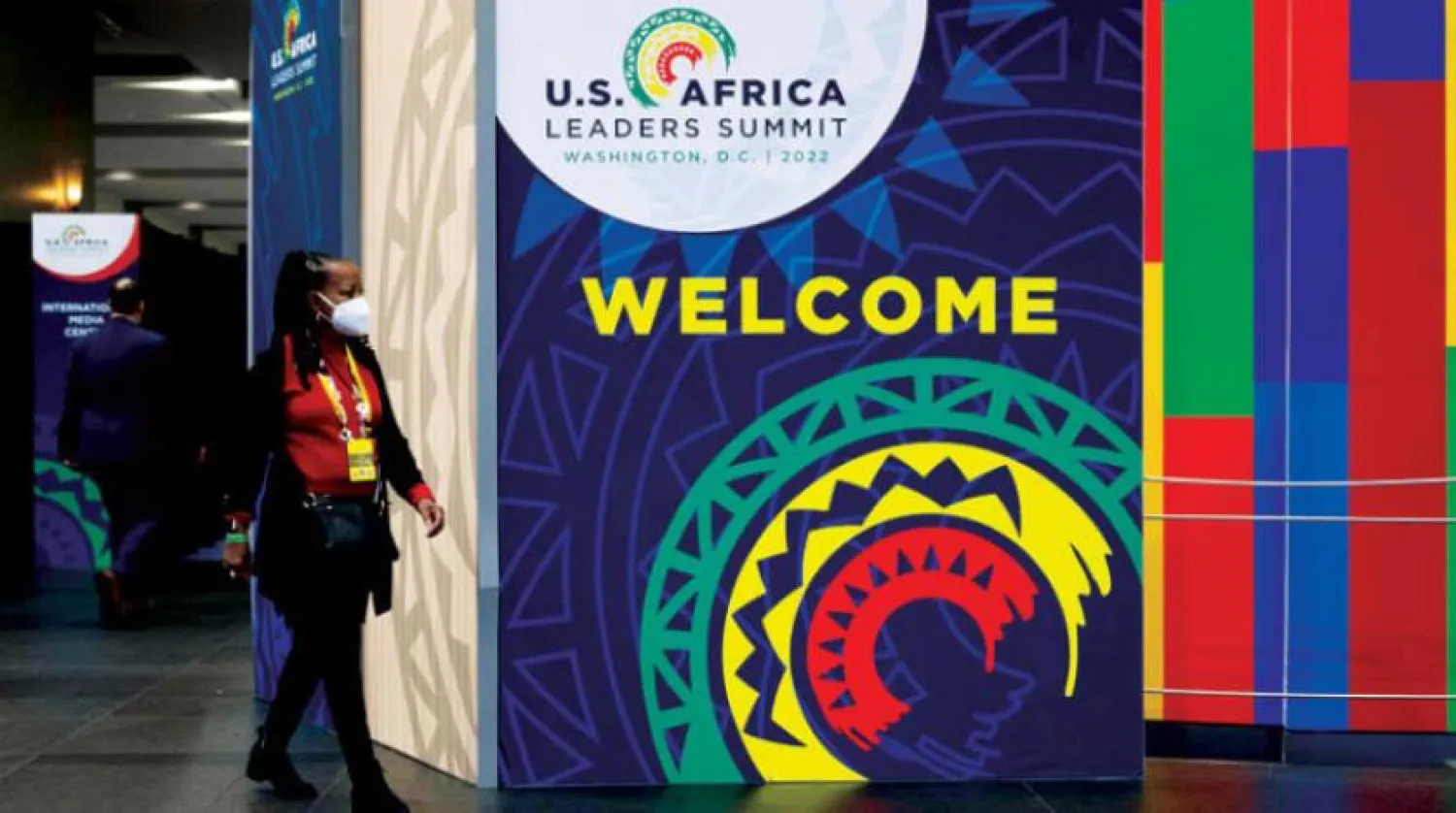

US Commits $55 Billion to Africa

The Walter E. Washington Convention Center, where the US-Africa Summit is being held (AFP)
TT

US Commits $55 Billion to Africa

The Walter E. Washington Convention Center, where the US-Africa Summit is being held (AFP)

The US-Africa Summit kicked off on Tuesday, with the announcement of the administration of US President Joe Biden to allocate $55 billion to finance initiatives related to food security, health care, infrastructure, digital technology, security and governance, in addition to other projects in the areas of renewable energy and combating climate change.

Biden will meet on Wednesday with African leaders and will announce his country’s pledges to achieve development in the continent. The White House will also organize a dinner party for all leaders participating in the summit.

The US president is also expected to announce a foreign tour that will include a number of African countries at the beginning of 2023, with the aim of deepening relations.

US National Security Adviser Jake Sullivan has noted that there would be a commitment by administration officials to travel to the African continent during 2023.

Dana Banks, Biden’s Special Assistant and NSC Special Adviser for the African Leaders Summit, said that Biden would sign an executive order to establish an advisory council to manage the affairs of African expatriates in the United States, and to advise the president on a number of issues.

Senegalese President Macky Sall, who holds the rotating presidency of the African Union, pointed to the importance that the US give up lecturing and take the initiative to become a strategic partner “without anyone telling us what to do or not… We want to work and trade with everyone.”

Several African countries have expressed their desire to see a tangible US commitment in terms of debt relief and compensation for losses and damages to the African continent from climate change and carbon emissions caused by rich and industrialized countries, such as the US, China and European countries.

Leaders and representatives of 49 African countries continued to arrive at Andrews Military Air Base on Tuesday.

US Secretary of State Antony Blinken and Secretary of Defense Lloyd Austin received African leaders, businessmen, and heads of civil society organizations participating in the summit, which is being held at the Convention Center in downtown Washington, DC.

During a session of trade ministers on Tuesday, the participants discussed the extension of trade agreements between the US and Africa based on the African Growth and Opportunity Act (AGOA), which was enacted by former US President Bill Clinton to grant African countries some advantages and tax exemptions.

Countries such as Ethiopia, Kenya and South Africa have taken advantage of this law to facilitate access to the US market.

During the sessions of civil society organizations, participants from Kenya and Nigeria demanded US assurances to fight militants and terrorist groups in Somalia and the Sahel region, and to implement development projects.

The first day of the summit also witnessed the signing of an agreement on space cooperation to meet the challenges of the 21st century, and to respond to climate and food crises.

The agreement stipulates the use of satellites to provide geographic solutions that help meet the priorities of resource and forest management and renewable energy.

The Biden administration has faced criticism, as none of the senior foreign policy officials visited Africa during the first nine months of its term, in contrast to dozens of trips to Europe and Southeast Asia. Biden held phone conversations with only three leaders of the continent and visited only Egypt during the Climate Summit (COP27).

In an attempt to avoid criticism, Blinken conducted a number of trips to Africa, the last of which was in August, when he announced the new US strategy for Africa.

During a press conference at the White House on Monday, Sullivan announced that the US administration approved the allocation of $55 billion over the next three years, to finance initiatives and agreements that will be announced by the summit, stressing that Biden would take advantage of the AU meeting to announce his support for adding the African Union as a permanent member of the Group of Twenty.

The president also plans to underscore his commitment to reforming the UN Security Council and to allocate a permanent membership for the African continent.

“This summit will underscore the value the United States places on our collaboration with Africa on the most pressing global challenges and opportunities, as well as on the Biden administration’s commitment to revitalizing global partnerships and alliances,” US Press Secretary Karine Jean-Pierre told journalists at the White House last week.

“We expect to engage a wide range of African and US stakeholders to illustrate the breadth and the depth of American partnerships with African governments, businesses, civil — civil society, and citizens — partnerships based on dialogue that harness the creativity of the peoples — of our peoples,” she added.



NATO Chief Visits Kyiv After Russian Strikes

In this handout photograph taken and released by the Ukrainian Foreign Ministry on June 3, 2026, Ukraine's Foreign Minister Andrii Sybiha (L) greets NATO Secretary General Mark Rutte (R) upon his arrival in Kyiv, amid the Russian invasion of Ukraine. (Handout / Ukrainian Foreign Ministry / AFP)
TT

NATO Chief Visits Kyiv After Russian Strikes

In this handout photograph taken and released by the Ukrainian Foreign Ministry on June 3, 2026, Ukraine's Foreign Minister Andrii Sybiha (L) greets NATO Secretary General Mark Rutte (R) upon his arrival in Kyiv, amid the Russian invasion of Ukraine. (Handout / Ukrainian Foreign Ministry / AFP)

NATO chief Mark Rutte arrived in Kyiv on Wednesday for an unannounced trip, after a series of large-scale fatal Russian attacks on the Ukraine.

President Volodymyr Zelensky, who is expected to meet with Rutte, has been appealing to members of the defense bloc for help protecting Ukraine from Russian ballistic missile attacks.

A spokesman confirmed Rutte had arrived along with NATO ambassadors from alliance members after Ukraine's national railway operator posted images of his arrival in Kyiv.

"We are gladly welcoming NATO Secretary General Mark Rutte," Ukrzaliznytsia wrote on social media.

"This visit is extremely important, just like all the previous ones, because it is a gesture of solidarity and support from the Alliance for our country," Ukrzaliznytsia added. The post was later deleted.

His visit comes hours after Ukrainian drones hit energy and military sites in the northern Russian city of Saint Petersburg where officials and visiting dignitaries were gathering for a flagship economic forum.

Russian missile and drone attacks a day earlier killed 23 people in strikes on Kyiv and the eastern city of Dnipro.

Zelensky has been pushing NATO countries to up their deliveries of air defense systems -- in particular US-made Patriot batteries and ammunition, which Kyiv says it needs to shoot down Russian ballistic missiles.


Putin Squeezes Armenia as Russia Seeks to Retain Global Clout

Russian President Vladimir Putin and Armenian Prime Minister Nikol Pashinyan attend a meeting at the Kremlin in Moscow, Russia, April 1, 2026. (Sputnik/Sofya Sandurskaya/Pool via Reuters)
TT

Putin Squeezes Armenia as Russia Seeks to Retain Global Clout

Russian President Vladimir Putin and Armenian Prime Minister Nikol Pashinyan attend a meeting at the Kremlin in Moscow, Russia, April 1, 2026. (Sputnik/Sofya Sandurskaya/Pool via Reuters)

President Vladimir Putin has read long-term ally Armenia the riot act: persist in wanting to join the European Union and you can kiss goodbye to cheap Russian oil and gas.

The Russian leader issued the warning before a parliamentary election in Armenia on Sunday, which polls suggest the party of Western-leaning Prime Minister Nikol Pashinyan will win.

It is not an empty threat. Armenia, a landlocked country of 3 million with centuries-old ties to Russia, is highly dependent on Moscow, which has imposed temporary bans on important Armenian exports before the vote.

But Putin's words also reflect an uncomfortable truth for Moscow. Waging war in Ukraine with no end in sight after more than four years of fighting, Russia is mounting an intensifying and increasingly complex rearguard action around the world to try to retain its geopolitical clout.

While Moscow focuses resources on the war in Ukraine, the European Union and the United States have been courting and squeezing traditional Russian allies and interests, both in ‌what Moscow sees as ‌its own backyard and also further afield.

From Havana and Caracas, from Belgrade to the ‌steppes ⁠of Central Asia, and ⁠even in west Africa, where Moscow's forces are helping fight extremists, Russian influence is under pressure.

RUSSIAN CONCERN

Armenia, a longstanding recipient of Russian largesse and home to a Russian military base, signed a partnership agreement with the US last month and Pashinyan won fulsome endorsement from President Donald Trump.

Armenia, once part of the Soviet Union, also passed a law last year setting out a legal basis for it to join the EU.

"Of course, we are deeply concerned about the Armenian authorities’ policy of rapprochement with the Euro-Atlantic community whose core policy is directed against Moscow," Maria Zakharova, Russia's Foreign Ministry spokeswoman, told reporters.

"The Anglo-Saxons are openly boasting about 'detaching' Armenia, as they say, from the bear ⁠hug of 'authoritarian Russia'".

Russian war bloggers and analysts say Russia is facing a concerted and largely Western ‌attempt - as in other regions across the world - to squeeze it out of ‌the wider South Caucasus region, of which Armenia is part.

"In such conditions, the question of adapting Russian strategy (to embrace soft power and economic ‌levers) becomes key," said Russian analytical Telegram channel "The Secret Chancery", which has over 400,000 followers.

One source close to the Russian government ‌said Moscow could see that countries such as Armenia were "all waiting to see how the war (in Ukraine) ends" and some were already building new ties while Moscow was largely distracted elsewhere.

For Moscow, Armenia's hosting a meeting of European leaders including Ukrainian President Volodymyr Zelenskiy last month was the last straw.

Since then, Russia has temporarily banned the import of many Armenian goods, warned it might cut off cheap oil, gas and rough diamond ‌exports, suggested Armenia could be expelled from the Eurasian Economic Union, a Russian-led trade bloc, and recalled its envoy to Armenia for consultations.

Dmitry Medvedev, the outspoken deputy chairman of Russia's powerful ⁠Security Council, also hinted that ⁠Armenia's prime minister could, if not careful, suffer the fate of Bolshevik revolutionary Leon Trotsky whom Josef Stalin had killed with an ice pick.

RUSSIA UNDER PRESSURE

Meanwhile, Trump, who Moscow hoped would have strong-armed Ukraine into suing for peace by now, has instead targeted three traditional Russia-friendly countries - Iran, Venezuela and Cuba.

His actions have lifted oil prices, offering some respite to the war-battered Russian economy, but they have also exposed Moscow's inability to meaningfully help old friends. Havana has received only one shipment of Russian oil so far.

In Europe, Moscow complains it faces an increasingly hostile continent that is re-arming while holding out the prospect of EU membership to countries where Russia once held sway.

Putin ally Viktor Orban lost power in Hungary in April, leading to the unlocking of billions of euros in EU funding for Budapest. Serbian President Aleksandar Vucic, another Russian ally, is under pressure, with moves under way to abolish visa-free entry for Russians as Belgrade seeks EU membership.

Russia is also feeling the heat in Transdniestria, a Russian-garrisoned separatist enclave which is internationally recognized as part of Moldova, whose current political leadership wants to join the EU.

Russia is also worried about what it casts as encroaching Western influence in Central Asia, while in the South Caucasus Putin is trying to move past a rocky period in relations with oil-producing Azerbaijan, which has strengthened ties with the West in recent years.


US Sanctions Iran’s Largest Crypto Exchange over IRGC Links

Signage is seen at the United States Department of the Treasury headquarters in Washington, DC, US, August 29, 2020. (Reuters)
TT

US Sanctions Iran’s Largest Crypto Exchange over IRGC Links

Signage is seen at the United States Department of the Treasury headquarters in Washington, DC, US, August 29, 2020. (Reuters)

The United States announced sanctions on Iran’s biggest cryptocurrency exchange on Tuesday, accusing it of enabling the Iranian government and blacklisted state institutions to circumvent Western sanctions.

The new sanctions follow a Reuters investigation published on May 1 which showed how Nobitex had become a central node in a parallel financial system used to process hundreds of millions of dollars for Iran’s central bank and the Revolutionary Guard Corps.

The report also revealed how Nobitex continued operating even after ‌the government-imposed ‌internet shutdown, processing millions of dollars of transactions.

“While Iran’s economy ‌is ⁠in free fall, ⁠the regime has chosen to co-opt digital asset technologies for its own corrupt agenda, including evading sanctions and transferring wealth out of the country,” Treasury Secretary Scott Bessent said in a statement.

The Reuters investigation showed how Nobitex is controlled by two brothers from one of Iran’s most powerful families, with close ties to the new supreme leader.

The two are members of the Kharrazi family, one of the ⁠most influential dynasties in the country. Corporate records show ‌that when the exchange started, the brothers were ‌listed under a surname rarely used by members of the family.

The US Treasury announced ‌Tuesday that the two brothers, Mohammad Ali Aghamir Mohammad Ali and ‌Mohammad Aghamir Mohammad Ali, had also been individually sanctioned, along with the exchange’s chief executive officer, Amir Hossein Rad.

Nobitex had provided “significant support” to the Iranian government and facilitated a “significant number” of digital transactions linked to the IRGC and Iran’s central bank, the US Treasury said in ‌the statement.

“Following the commencement of US combat operations in Iran, Nobitex played a role in protecting and moving assets and ⁠funds out ⁠of Iran to shield regime wealth despite internet blackouts.”

Nobitex could not be reached for comment on the sanctions, which were announced after normal business hours in Iran.

In a statement to customers Wednesday on its Telegram account, the exchange said it had anticipated possible sanctions-related issues for years given "the unique challenges faced by Iranian businesses operating internationally."

"Accordingly, the necessary technical and operational preparations to deal with such circumstances have long been part of our planning," the statement said.

In an emailed statement to Reuters in April, Nobitex said it had no direct government connections and denied assisting the state.

It said that any illicit funds moving through Nobitex did so without management approval or awareness. The company also said that the two brothers had never used an alternative identity or changed their identity.