


A Democratic Party View of 2023: Modest Victories and a Bumpy Road Ahead

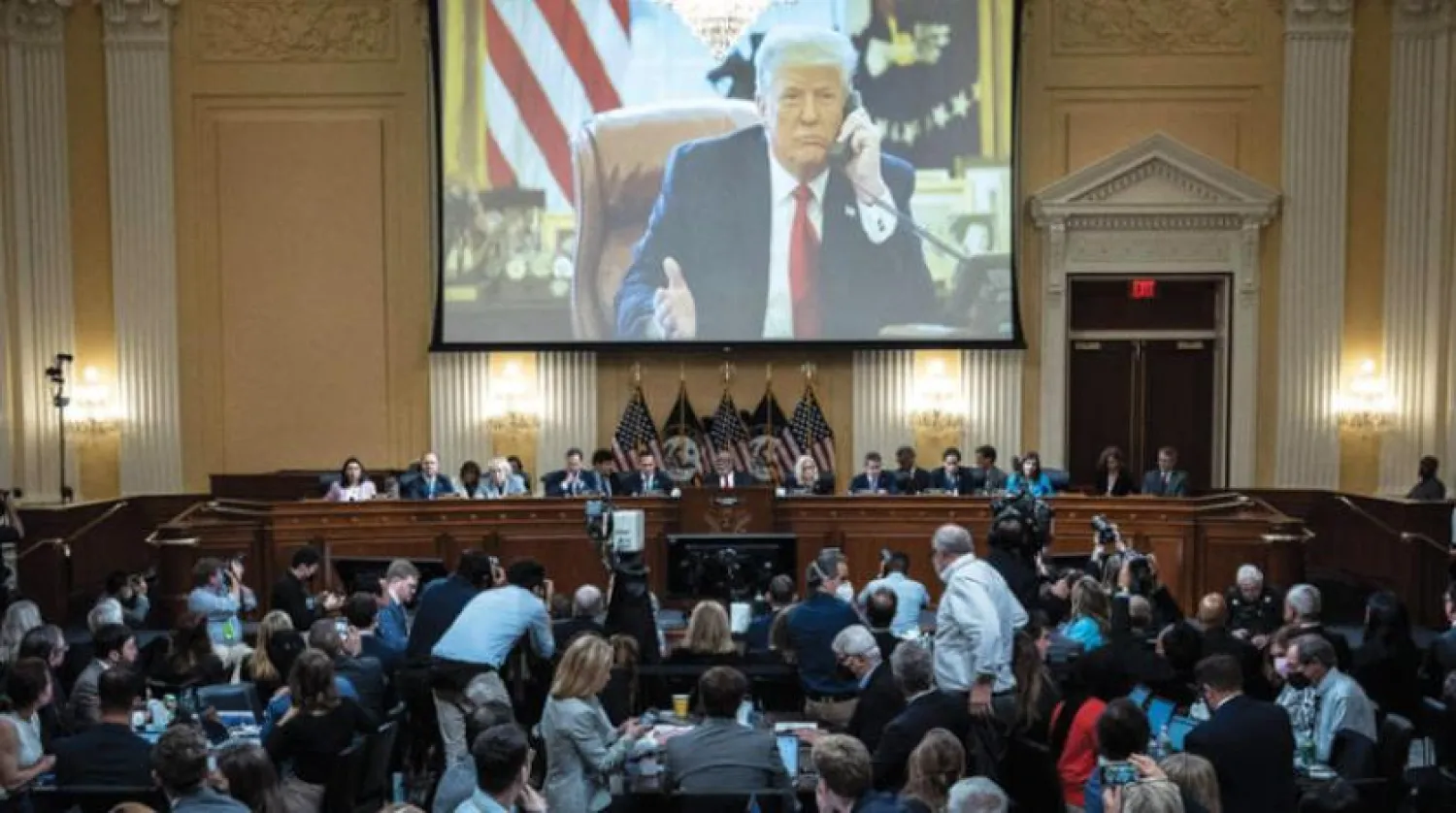
An image of former President Donald Trump is displayed during the committee's third hearing on June 16. (AFP/Getty Images)
TT

A Democratic Party View of 2023: Modest Victories and a Bumpy Road Ahead

An image of former President Donald Trump is displayed during the committee's third hearing on June 16. (AFP/Getty Images)

Democrats have good reason to be happy with 2022. In Congress and at the polls, they had an extraordinary year. Led by President Joe Biden, Congress passed a $1 trillion infrastructure bill, a $750 billion package to fight climate change and reduce the cost of prescription drugs for senior citizens, a $52 billion measure to revive the US semiconductor industry, and the first gun safety law in 30 years.

Internationally, President Biden led the world in helping Ukraine push back the Russian invasion and killed al-Qaeda terrorist leader Ayman al-Zawahiri. Quite a record for President Biden and his party, which did it all with a tiny majority in the House of Representatives and the slimmest possible majority in the Senate.

But if US history is to be believed, the President's party loses – and loses big – at the polls two years into his term. The thing is...that's not what happened. Instead of picking up 30, 40, or more seats in the House, the Republicans only gained nine. In the Senate, the Democrats did even better. Rather than losing seats, they picked up one.

Taken together, that's virtually unheard of. Analysts say that popular opposition to the Supreme Court's overruling of Roe v. Wade, which guaranteed the right to abortion, and incompetent, even buffoonish, candidates backed by former President Donald Trump drove the Democrats' strong electoral performance.

But 2023 ain't gonna be 2022...to say the least. Republicans now control the House, and that's going to make a huge difference.

Democrats will lose the ability to drive bills through the lower chamber, and Republicans will unleash their House committees to investigate everything from serious issues like the Afghanistan withdrawal and migrants and drugs crossing America's borders to conspiracy theories about Hunter Biden, Covid vaccines, and virtually anything else they can think of.

The Democrats still control the Senate, but not with a filibuster-proof margin – so moving legislation will remain difficult and require compromise with Republicans.

Given the headwinds, Democrats options are limited. They'll have to curtail their agenda and be prepared to defend the Biden Administration. Nevertheless, there are still things the Democrats can achieve.

First, their ability to approve the President's nominees for executive branch positions and federal judgeships – which come with life-long appointments – has grown substantially. Even though the Democrats only upped their Senate majority by one seat, from 50 to 51, that one seat makes a big difference. In a 50/50 Senate, committees were divided 50/50 between Democrats and Republicans. But now the Democrats will have a majority on every Senate Committee and will be able to advance President Biden's nominees on their own, speeding the process in the usually plodding Senate.

Second, given that legislating in a divided Congress will be exceptionally more difficult, Democrats' attention will turn to getting the most out of President Biden's executive powers. They'll seek to work with the President and the various cabinet departments to see that laws are implemented and money is spent in accordance with their shared priorities.

Democrats will try to contrast their legislative successes of 2022 in which they seek to use the power of government to help people and grow the economy against Republican efforts in 2023 to cut taxes and shrink the size of the government. This debate has echoed in the United States across many decades and will do so again next year on key issues, including climate change, healthcare, transportation, energy, and education.

Third, just as Republicans will utilize House committees to investigate President Biden's agenda, family, and cabinet members, the Democrats will seek to awaken the investigative powers of Senate committees. Unlike House Republicans, however, they don't have an Administration of the opposite party to rake over the coals. Even if grass roots Democrats think Congress should still try to expose excesses of the former Trump Administration, the general public may be done looking through the rear-view mirror – so Senate Democratic-run committees will have to pick their battles carefully.

Finally, during the last decade, Democrats were relatively unified when in the majority. While there were certainly divisions between the far left and moderates, in the end, they usually stood together on big picture items even with their slim majorities.

That may not be the case with Republicans. Their Trumpian far-right, now with even more members, has much greater power in the Republican Party and is not particularly interested in governing. The future Republican Speaker of the House will struggle to round up 218 Republican votes to pass key appropriations bills or raise the debt ceiling. This means Speaker Kevin McCarthy – or whoever wins that post – will likely have to turn to Democrats to keep the government operating and the country out of default...and the new House Democratic minority leadership will be waiting to exploit the division to press for greater domestic spending on health, education, and the environment.

We shouldn't be surprised if we see a meltdown or two in the House Republican conference, possibly leading to a government shutdown, before major bills pass.

Even though Democrats and Republicans are deeply divided at home – especially on former President Trump's twisted efforts to overturn the election of 2020 – the parties have often been more united on foreign policy. For the most part, they both support efforts to help Ukraine battle Russia, share concerns about the Iranian nuclear program and support popular demonstrators, and recognize the challenges posed by China.

But there are definitely distinctions. Some on the Republican MAGA right have had sympathies for Vladimir Putin's Russia, and Republican leadership in the Senate and House will look for ways to placate them with enhanced oversight and legislative gimmicks which will seem like they are pushing back against Biden's policy when they really aren't.

On Iran, disagreements about former President Barack Obama's Iran nuclear deal have, for the time being, given way to bipartisan support for the women and men taking on the Iranian regime. But Iran's expanding nuclear program and its growing stockpile of enriched uranium will likely capture American attention once again, reinvigorating disputes over how to keep the Ayatollahs from building an atomic weapon.

And while both parties are increasingly concerned about China's threats against Taiwan and its expanding military presence in the South China Sea, congressional Republicans are decidedly more hawkish.

No discussion of 2023 would be complete without talking about 2024. In America, the next election begins as soon as the last one ends and both parties will begin the process of selecting their presidential candidates in the coming year.

On the Democratic side, President Biden is the obvious front-runner and almost certainly will be the party's candidate. But he is 80 years old and whispers of concern across the party may grow.

For Republicans, their top candidate remains former President Trump. But he is substantially weakened given his party's poor performance in the 2022 elections and may face indictments in the coming year for his efforts to overturn the 2020 election, his improper possession and storage of classified documents, and his business practices, for which his company has already been criminally convicted. Regardless, many believe Trump can again win his party's nomination among a divided Republican field, potentially teeing up a rematch with President Biden.

So, buckle in and put your tray tables in their upright and locked position because 2023 is going to be a bumpy political year. We'll likely see fights over policy and politics, possible indictment of a former president, and even a government shutdown or two. Save me a seat and buy me some popcorn. Let's watch together.

*Jason Steinbaum worked on Capitol Hill for more than three decades, during which time he served as Staff Director of the House Committee on Foreign Affairs.



Moscow Car Blast Kills Russian General 

An investigator works at the scene where Lieutenant General Fanil Sarvarov, head of the Russian General Staff's army operational training directorate, was reportedly killed in a car bomb in Moscow, Russia, December 22, 2025. (Russia's Investigative Committee/Handout via Reuters)
TT

Moscow Car Blast Kills Russian General 

An investigator works at the scene where Lieutenant General Fanil Sarvarov, head of the Russian General Staff's army operational training directorate, was reportedly killed in a car bomb in Moscow, Russia, December 22, 2025. (Russia's Investigative Committee/Handout via Reuters)

A senior Russian general was killed in southern Moscow on Monday after an explosive device placed under his car went off, investigators said in a statement.

Russia's Investigative Committee, which examines major crimes, said it had opened a probe into the "murder" of Lieutenant General Fanil Sarvarov, head of the training department within the General Staff.

The possibility that the attack was "linked" to "Ukrainian special forces" was among the lines of inquiry, it said.

Since Moscow sent troops into Ukraine in February 2022, Kyiv has been blamed for several attacks targeting Russian military officials and pro-Kremlin personalities in Russia and in Russian-controlled Ukrainian regions.

General Yaroslav Moskalik, a deputy of the General Staff, was killed in a car blast near Moscow in April.

In December 2024, Igor Kirillov, the head of the Russian radiological, chemical and biological defense forces, was killed when a booby-trapped electric scooter exploded in Moscow, an attack claimed by Ukraine's SBU security service.

A Russian military blogger, Maxim Fomin, was killed when a statuette exploded in a Saint Petersburg cafe in April 2023.

And in August 2022, a car bomb killed Daria Dugina, the daughter of ultranationalist ideologue Alexander Dugin.


Iran Does Not Rule Out New Israeli Attacks against it

Russian Foreign Minister Sergei Lavrov, right, and Iranian Foreign Minister Abbas Araghchi shake hands after a joint news conference at Zinaida Morozova's Mansion in Moscow, Wednesday, Dec. 17, 2025. (Ramil Sitdikov/Pool Photo via AP)
TT

Iran Does Not Rule Out New Israeli Attacks against it

Russian Foreign Minister Sergei Lavrov, right, and Iranian Foreign Minister Abbas Araghchi shake hands after a joint news conference at Zinaida Morozova's Mansion in Moscow, Wednesday, Dec. 17, 2025. (Ramil Sitdikov/Pool Photo via AP)

Iran's Foreign Minister Abbas Araghchi on Sunday said Tehran “does not rule out” the possibility of a new Israeli or US attack on its nuclear facilities, but remains “fully prepared, even more than before.”

“This doesn't mean that we welcome another war, but it is exactly to prevent a war. And the best way to prevent war is to be prepared for that. And we are fully prepared,” Araghchi said in an interview with Russia Today (RT).

The minister said Iran has rebuilt everything that was damaged by Israeli and US strikes during the 12-day war in June.

“If they want to repeat the same failed experience, they will not achieve a better result,” he stressed.

Araghchi made the remarks during a visit last week to Moscow, where he held political and diplomatic talks with Russian officials, including his counterpart, Sergei Lavrov.

Araghchi said he is no longer in contact with US Special Envoy for the Middle East Steve Witkoff, revealing that their communication channel has been inactive for months.

Iran and the envoy had held five rounds of talks between April and June. A sixth round, scheduled for June 15, was canceled after Israel launched its strikes on Iran.

Araghchi said that following the war, he maintained contacts with Witkoff. He said that while the US insisted on resuming negotiations, it had adopted what he described as a “very wrong” approach.

Commenting on the US strikes on Iran's nuclear facilities in Natanz and Fordow in June, the FM acknowledged: “Our facilities have been damaged, seriously damaged.”

However, he added: “There is also another fact, that our technology is still there, and technology cannot be bombed. And our determination is also there. We have a very legitimate right to peaceful use of nuclear technology, including enrichment.”

Araghchi reiterated that Iran is ready to provide full assurance that its nuclear program is peaceful as it did in 2015 when Tehran agreed to build confidence over the peaceful nature of its program in exchange of the lifting of sanctions.

He noted that military operations have failed to achieve their goals, while diplomacy was a successful experience.

Asked if he expects Israel will maintain its approach in 2026, the FM replied: “They will continue their aggressive behavior in 2026 due to the full impunity which is given to them by the US and Europeans.”

NBC News reported last week that Israeli officials have grown increasingly concerned that Iran is expanding production of its ballistic missile program, which was damaged by Israeli strikes in June, and are preparing to brief President Donald Trump about options for attacking it again, according to a person with direct knowledge of the plans and four former US officials briefed on the plans.

On Iran’s relations with the International Atomic Energy Agency (IAEA), Araghchi said: “We remain a committed member of the Non-Proliferation Treaty (NPT) and are ready to cooperate with the Agency.”

“We have a simple question for the Agency: Please tell us, how should a nuclear facility that has been attacked be inspected? And there is no answer to this question, because there is no precedent to this,” he added.


Alleged Bondi Shooters Conducted ‘Tactical’ Training in Countryside, Police Say 

21 December 2025, Australia, Sydney: Australian Prime Minister Anthony Albanese (R) and his wife Jodie Haydon attend a National Day of Reflection vigil and commemoration for the victims and survivors of the Bondi Massacre at Bondi Beach in Sydney. (Dean Lewins/AAP/dpa)
TT

Alleged Bondi Shooters Conducted ‘Tactical’ Training in Countryside, Police Say 

21 December 2025, Australia, Sydney: Australian Prime Minister Anthony Albanese (R) and his wife Jodie Haydon attend a National Day of Reflection vigil and commemoration for the victims and survivors of the Bondi Massacre at Bondi Beach in Sydney. (Dean Lewins/AAP/dpa)

Two suspects in last week's deadly mass shooting at Australia's Bondi Beach trained for the attack in the countryside, police alleged in court documents Monday, as Prime Minister Anthony Albanese vowed tougher laws against hate speech and extremism.

Father and son Sajid Akram and Naveed are accused of targeting a Hanukkah event on Bondi Beach, killing 15 people in the nation's deadliest mass shooting in almost three decades.

Police documents released Monday said the two had carried out "firearms training" in what was believed to be the New South Wales countryside prior to the shooting.

Pictures were released showing the accused firing shotguns and moving in what authorities described as a "tactical manner".

The pair also recorded a video in October railing against "Zionists" while sitting in front of a flag of the ISIS group and detailing their motivations for the attack, police said.

And they made a nighttime "reconnaissance" trip to Bondi Beach just days before the killings, documents showed.

Australia observed a minute's silence at 6:47 pm (0747 GMT) on Sunday -- exactly a week since the first reports of gunfire.

On Monday, Albanese said he would push for tough new laws creating "an aggravated offense for hate preaching".

"We're not going to let the ISIS inspired terrorists win. We won't let them divide our society, and we'll get through this together," Albanese told reporters.

"As Prime Minister, I feel the weight of responsibility for an atrocity that happened whilst I'm Prime Minister, and I'm sorry for what the Jewish community and our nation as a whole has experienced," he said.

"The government will work every day to protect Jewish Australians, to protect the fundamental right as Australians that they have to be proud of who they are, to practice their faith, to educate their children and to engage in Australian society in the fullest way possible," he added.

- Crackdown on guns, 'terrorist symbols' -

Australia's federal government has flagged a suite of reforms to gun ownership and hate speech laws, as well as a review of police and intelligence services.

Albanese also announced last week a sweeping buyback scheme to "get guns off our streets".

It is the largest gun buyback since 1996, when Australia cracked down on firearms in the wake of a mass shooting that killed 35 people at Port Arthur.

And the government of New South Wales -- where the shooting took place -- recalled its parliament for two days on Monday to introduce what it called the "toughest firearm reforms in the country".

"We can't pretend that the world is the same as it was before that terrorist incident on Sunday," New South Wales Premier Chris Minns told reporters.

"I'd give anything to go back a week, a month, two years, to ensure that didn't happen, but we need to make sure that we take steps so that it never happens again."

The new rules will cap the number of guns an individual can own to four, or ten for exempted individuals like farmers.

There are more than 1.1 million firearms in the state, officials said.

The legislation would also ban the display of "terrorist symbols", including the flag of the ISIS, which was found in a car linked to one of the alleged shooters.

Authorities will also be able to prohibit protests for up to three months following a terrorism incident.

One of the alleged gunmen, Sajid Akram, 50, was shot and killed by police during the attack. An Indian national, he entered Australia on a visa in 1998.

His 24-year-old son Naveed, an Australian-born citizen, was moved from hospital to jail on Monday, police said.

Minns said Monday he would also look into stricter hate speech legislation next year.