


Iran’s Protest Movement and the Future of the Regime

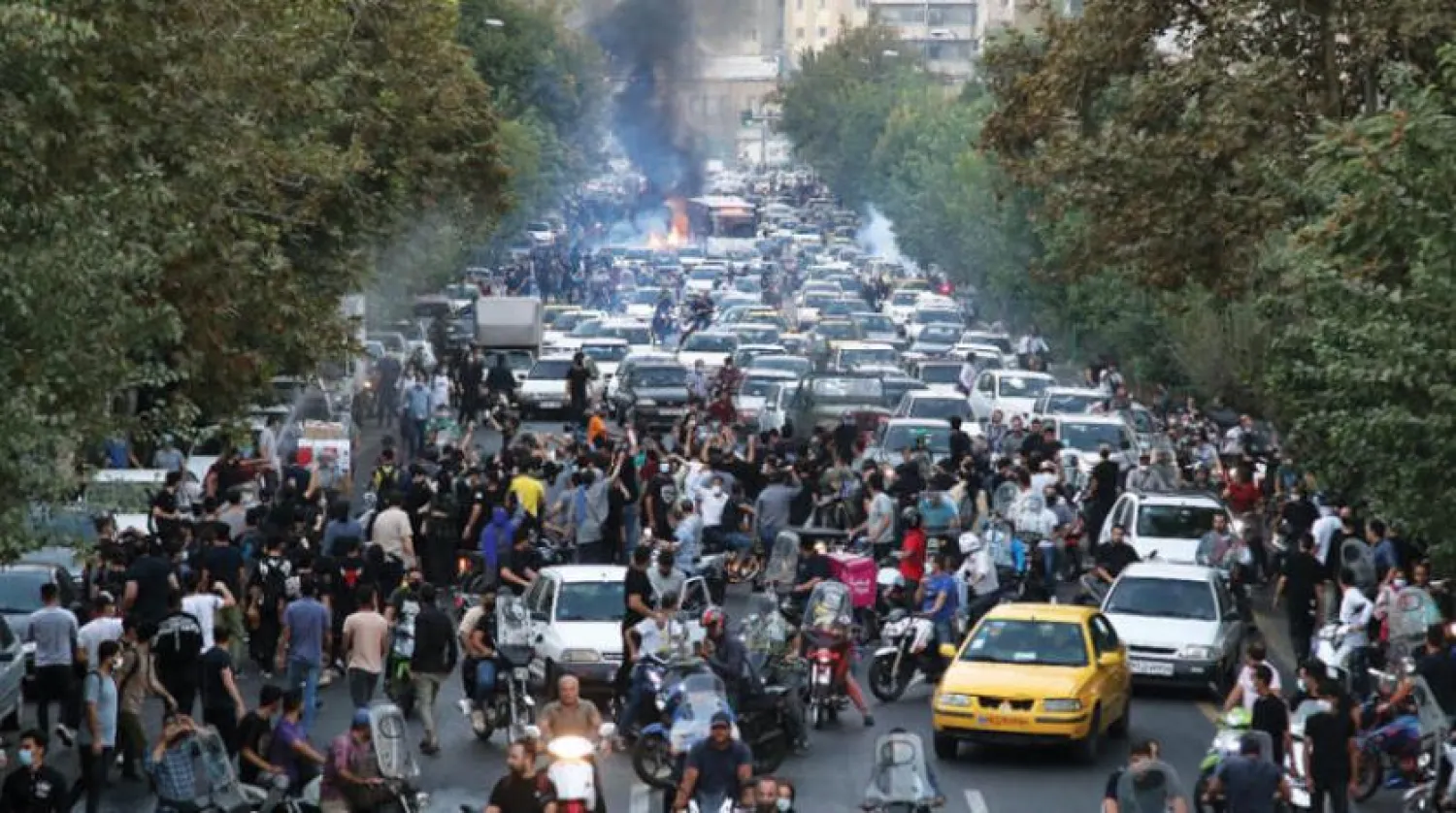
Protesters clash with police after taking to the streets in Tehran in wake of the death of Mahsa Amini, September 21. (AFP)
TT

Iran’s Protest Movement and the Future of the Regime

Protesters clash with police after taking to the streets in Tehran in wake of the death of Mahsa Amini, September 21. (AFP)

Since assuming power in 1989, Iran’s supreme leader Ali Khamenei did not find any president agreeable to his desires and line of thought until Ebrahim Raisi, the current president, took office in 2021. Even Mahmoud Ahmadinejad, who came to office with the support of the Revolutionary Guards (IRGC), and pretended to be obedient to Khamenei, gradually adopted positions opposing Khamenei’s will, which, in his second term, brought him into direct conflict with the Iranian leader.  

The conflict between Khamenei and the three presidents, Akbar Hashemi Rafsanjani (1989-1997), Mohammad Khatami (1997-2005), and Hassan Rouhani (2013-2021), was mainly over the leader’s unconditional support of the hard-line conservatives, which on several occasions would lead to sabotaging the three presidents’ policies.  

Foreign policy was at the heart of the clash between Khamenei and the Revolutionary Guards, on one side, and the presidents on the other. Relations with the world, especially with the United States and to a lesser degree with the West in general, and regional policies that Khamenei and the IRGC viewed as a means to broaden the Islamic Republic’s sphere of influence (inspired by the doctrine of exporting the revolution) stood at the center of the battle.

Hard-liners, who form the core of power, consider enmity with America a justification of their existence and identity. Reconciliation with America would mean the end of the revolution. With the end of the revolution, there would be no need for the leader of the revolution, nor for the Revolutionary Guards, and the hard-liners’ camp would become totally irrelevant. The IRGC emphasizes that the US-Iran conflict is “fundamental, ideological, and existential and cannot be resolved through negotiations”.  

At the end of Hassan Rouhani's presidency in 2021, Khamenei and his supporters decided to put an end to the caricature-like state of democracy in Iran for good and purge reformists and moderates inside the pyramid of power for good.  

Hard-liners, under the leadership of Khamenei, decided that, by having the Guardian Council disqualify moderate or reformist first-tier, and even second-tier, candidates, they would pave the way for the hard-liners to gain control over the legislative and executive branches, thus, extinguishing any glimmers of hope for a huge faction of the society that supports modernity - a major reason behind the current uprising.  

In fact, the current uprising is mainly the continuation of a century-old battle between the conservative camp, meaning the traditionalists, and the modernists (liberal Muslims and secularists). In any case, the disaffected faction of society, which for about 25 years was devoted to the theory that reforms are possible through the ballot box, faced a new reality.  

As a result, this extremely large faction turned their backs on the ballot boxes in the 2019 parliamentary elections. The turnout rate was slightly more than 40%, the lowest in 11 parliamentary elections. In the Tehran province, participation decreased from 50% in the previous elections to 25%: of about 10 million eligible voters, about 7.5 million did not vote.  

Since holding an independent and reliable poll is not possible in Iran, it is hard to determine accurately what percentage of society opposes the regime. But perhaps one of the most striking findings from the secret bulletin, prepared by Fars News - the news agency managed by the IRGC - for IRGC commander Hossein Salami and leaked by the hacker group Black Reward, depicts “religious democracy” in Iran.  

The report states: “70% of people do not want to participate in a march in support of the regime and the revolution while 21.4% chose the option ‘very much’ and 5.9% chose the option ‘somewhat.’” Simply put, according to a survey conducted by the regime itself, between 70 and 75% of the country's population do not support the regime, considering that conservative supporters of the regime are too devoted not to participate in a simple demonstration.  

There are many reports about the protests of November 2019 (known as Bloody November), all of which emphasize that the backbone of the protests was the poor “tohidestan”.  

Outspoken former MP Ali Motahari said in a speech in parliament: “According to the confession of the intelligence agencies, the protesters were the poor masses.” With the widespread and brutal crackdown on the protests, which, according to Yadullah Javani, the political deputy of the IRGC, took place “in 29 provinces” (out of 31) and “hundreds of cities”, the regime became overconfident that it had nullified the potential for new protest movements for several years. 

Following the elimination of reformist and moderate candidates in the parliamentary elections, the Guardian Council also staged the 2021 presidential elections, which led to the election of Ebrahim Raisi and his accompanying team, undoubtedly the most incompetent among all post-revolutionary administrations.  

A glaring outcome of this move was the new administration adopting a scornful position during the nuclear talks in Vienna, thus losing the opportunity to reach a nuclear agreement, which would lead to the removal of the US sanctions and the release of billions of dollars of Iran’s blocked funds. For instance, the hard-line negotiators insisted that an inquiry by the International Atomic Energy Agency into nuclear particles found at Iran’s nuclear sites must be dropped as a pre-condition to signing a nuclear agreement. 

Confident that they would face no resistance, radical fanatics reactivated the Guidance Patrol, now operating under the Morality Police, to arrest women who violated the Islamic dress code. Shocking scenes of arresting women over the hijab issue were recorded and posted on social networks.  

The tragic death of 22-year-old Mahsa Amini in September, following a violent encounter with the Morality Police, was the spark that activated the dormant volcano of public anger. “Woman, life, freedom” became the central slogan of the protests, and women formed the main pillar of the movement in an unprecedented way.   

But a major difference between this new wave of protests and those in 2019 was evident. The massive attacks by the protesters on chain stores and banks in 2019 showed that the poor were the leading force behind that uprising. Slogans also indicated that protesters’ main concerns were livelihood and economic hardships. Slogans such as: “poverty, massacre, high cost - people have become victims” or “fuel has become more expensive - the poor have become poorer” were common, although the slogans of “death to the dictator” and “death to Khamenei” were also chanted.  

In the recent protests, however, the slogans are mainly based on women’s rights and express intense abhorrence of dictatorship. 

Another point that distinguishes the protests of 2019 and 2022 from each other was the 2019 use of slogans praising the last two Shahs of Iran, whose dynasty the 1979 revolution overthrew. Those slogans have not been heard often in the recent protests. This shows that the 2019 protesters were not sensitive about dictatorship and were only looking for relief from livelihood hardships. 

On the contrary, this year’s protesters had a strong anti-dictatorship position and, even opposing the Islamic Republic, did not demand the return of a government like that of Reza Shah and Mohammad Reza Shah. 

This year's protests, like all in the past, lacked a “leader with high popularity beyond the reach of the Islamic Republic” and were therefore vulnerable. A false comparison was common among protesters who argued that the countries where the “Arab Spring” took place did not have any clear and well-known leaders. The problem with this argument is that, precisely for that reason, all those movements faced defeat after the fall of the incumbent regimes.  

To succeed, a protest movement needs a popular leader who can mobilize and unite the protesters, give them direction, and, finally, fill the power vacuum after the fall of the current regime.  

Another major weakness of the current protests is the inability to attract the low-income classes of the society. Since the driving force of the movement is the defense of women’s rights and opposition to the dictatorship, livelihood-related slogans were seldom heard. The protests do not attract the huge low-income faction of society whose concern is bread.  

It is puzzling that, throughout the life of the Islamic Republic, no matter who has appeared as the leader of the opposition, inside and outside of Iran and including reformist leaders who came from the urban middle classes, not one emerged as the voice of the huge population of the poor.

According to the Ministry of Labor, 30 million Iranians live in “absolute poverty. A report by the semiofficial Iranian Labour News Agency (ILNA) maintains that seven out of ten Iranians live under poverty line.

The leader of the Iranian 1979 revolution, Khomeini, grasped this concept. He constantly emphasized that the main feature of his movement was the revolution of kookh’neshinan (those who live in very poor accommodations), the barefoot, and the oppressed.  

He used to say, “We will build housing for the homeless all over Iran. We will provide free water and electricity for the poor, free buses for the poor,” although not a single one of those promises was fulfilled. 

Explaining the state of Iran's disintegrated economy requires a separate article. It is enough to know that food prices have risen so dramatically that, according to the latest World Bank report, Iran is third in “real food inflation” among 161 countries, after Zimbabwe and Lebanon. 

To tackle the economic crisis, the Raisi administration, as dictated by Khamenei, instead of seeking the removal of US sanctions to increase desperately-needed foreign currency income and release of blocked assets, printed money at an astronomical rate, leading to the explosion of prices. 

The exchange rate with the dollar, which was 250,000 rials at the beginning of Raisi's presidency, has surpassed the 420,000 mark at the time of writing this article. Simply put, within 16 months, the national currency lost 45% of its value. 

While the depreciation of the national currency has accelerated, experts in Iran consider the current internal unrest and the resulting political instability as the main reason behind the trend.  

Another factor that has caused concern in Iran and made the situation of Iran’s currency more unstable was the recent trip of Chinese President Xi Jinping to Saudi Arabia.  

Although even before this trip, China was Saudi Arabia’s largest trade partner, with a trade volume of $87 billion per year, the signing of several memoranda of understanding worth about $30 billion during the same trip and the signing of the "Comprehensive Strategic Partnership Agreement” strengthened the impression in Iran that China does not view Iran a reliable source of oil supply, because of the country’s internal instability and its belligerent foreign policy, especially its ongoing conflict with the US. At the 20th Communist Party Congress in October, Xi emphasized that “energy security” is a key priority for China.  

It seems that, to get out of the current political and economic storm, the Islamic Republic is leaning towards returning to the negotiating table to finalize a nuclear accord.  

Iran’s foreign minister Hossein Amir Abdollahian has declared Iran’s readiness to sum up the Vienna talks based on the draft of the negotiation package that was the result of months of intensive and difficult talks. Reaching an agreement would not only significantly increase the possibility of selling oil by the Islamic Republic, but also would release funds blocked in foreign banks, which a UN representative declared to be $100 to $120 billion.

All that said, signing a new nuclear agreement may provide the Iranian regime with a temporary relief but will not solve the structural problems that now, more frequently than before, destabilize the system. 

First, any agreement between the Islamic Republic and the United States is unstable. Khamenei has forbidden talks and de-escalation with America because the continuation of enmity with America, as discussed earlier, is one of the pillars of this system's survival.  

However, in the contemporary history of international relations, it is impossible to find an example where two countries have been in irreconcilable conflict with each other and do not talk to de-escalate, but an agreement between them remains stable.  

At the height of the Cold War, several agreements were signed to reduce tension (détente) between the Soviet Union and the United States. The scenario of Trump’s exit from the nuclear deal could be repeated.  

Second, the gap caused by the hostile encounter between opponents of the regime and the government has become so deep that even silencing these protests will only stoke the anger of the suppressed, like a fire under the ashes, looking for another moment to erupt. This will not be the end of it.   

Finally, a study by the US National Bureau of Economic Research, using game theory and building a mathematical model, concluded that “dictators survive not because of their use of force or ideology but because they convince the public - rightly or wrongly - that they are competent.… If citizens conclude that the dictator is incompetent, they overthrow him in a revolution.. The study shows “that incompetent dictators can survive as long as economic shocks are not too large.”

*Shahir Shahidsaless is an Iranian-Canadian political analyst and freelance journalist writing about Iranian domestic and foreign affairs, the Middle East, and the US foreign policy in the region.



Trump Set to Expand Immigration Crackdown in 2026 despite Brewing Backlash

A woman holds a poster as immigrants rights activists stage a traditional Mexican posada, reenacting Mary and Joseph’s search for shelter, to symbolize immigrants seeking refuge from Immigration and Customs Enforcement (ICE) agents during the ongoing immigration operation "Catahoula Crunch", in New Orleans, Louisiana, US, December 18, 2025. REUTERS/Seth Herald
TT

Trump Set to Expand Immigration Crackdown in 2026 despite Brewing Backlash

A woman holds a poster as immigrants rights activists stage a traditional Mexican posada, reenacting Mary and Joseph’s search for shelter, to symbolize immigrants seeking refuge from Immigration and Customs Enforcement (ICE) agents during the ongoing immigration operation "Catahoula Crunch", in New Orleans, Louisiana, US, December 18, 2025. REUTERS/Seth Herald

US President Donald Trump is preparing for a more aggressive immigration crackdown in 2026 with billions in new funding, including by raiding more workplaces — even as backlash builds ahead of next year’s midterm elections.

Trump has already surged immigration agents into major US cities, where they swept through neighborhoods and clashed with residents. While federal agents this year conducted some high-profile raids on businesses, they largely avoided raiding farms, factories and other businesses that are economically important but known to employ immigrants without legal status.

ICE and Border Patrol will get $170 billion in additional funds through September 2029 - a huge surge of funding over their existing annual budgets of about $19 billion after the Republican-controlled Congress passed a massive spending package in July.

Administration officials say they plan to hire thousands more agents, open new detention centers, pick up more immigrants in local jails and partner with outside companies to track down people without legal status, Reuters reported.

The expanded deportation plans come despite growing signs of political backlash ahead of next year’s midterm elections.

Miami, one of the cities most affected by Trump’s crackdown because of its large immigrant population, elected its first Democratic mayor in nearly three decades last week in what the mayor-elect said was, in part, a reaction to the president.

Other local elections and polling ‌have suggested rising concern among ‌voters wary of aggressive immigration tactics. "People are beginning to see this not as an immigration question anymore ‌as ⁠much as it ‌is a violation of rights, a violation of due process and militarizing neighborhoods extraconstitutionally," said Mike Madrid, a moderate Republican political strategist.

"There is no question that is a problem for the president and Republicans." Trump’s overall approval rating on immigration policy fell from 50% in March, before he launched crackdowns in several major US cities, to 41% in mid-December, for what had been his strongest issue.

Rising public unease has focused on masked federal agents using aggressive tactics such as deploying tear gas in residential neighborhoods and detaining US citizens.

'NUMBERS WILL EXPLODE'

In addition to expanding enforcement actions, Trump has stripped hundreds of thousands of Haitian, Venezuelan and Afghan immigrants of temporary legal status, expanding the pool of people who could be deported as the president promises to remove 1 million immigrants each year – a goal he almost certainly will miss this year. So far, some 622,000 immigrants ⁠have been deported since Trump took office in January.

White House border czar Tom Homan told Reuters Trump had delivered on his promise of a historic deportation operation and removing criminals while shutting down illegal immigration across ‌the US-Mexico border. Homan said the number of arrests will increase sharply as ICE hires more ‍officers and expands detention capacity with the new funding.

“I think you're going to ‍see the numbers explode greatly next year,” Homan said.

Homan said the plans “absolutely” include more enforcement actions at workplaces.

Sarah Pierce, director of social policy at the ‍center-left group Third Way, said US businesses have been reluctant to push back on Trump's immigration crackdown in the past year but could be prompted to speak up if the focus turns to employers.

Pierce said it will be interesting to see "whether or not businesses finally stand up to this administration."

Trump, a Republican, recaptured the White House promising record levels of deportations, saying it was needed after years of high levels of illegal immigration under his Democratic predecessor, Joe Biden. He kicked off a campaign that dispatched federal agents to US cities in search of possible immigration offenders, sparking protests and lawsuits over racial profiling and violent tactics.

Some businesses shut down to avoid raids or because of a lack of customers. Parents vulnerable to arrest kept their children home from school or had neighbors ⁠walk them. Some US citizens started carrying passports. Despite the focus on criminals in its public statements, government data shows that the Trump administration has been arresting more people who have not been charged with any crimes beyond their alleged immigration violations than previous administrations.

Some 41% of the roughly 54,000 people arrested by ICE and detained by late November had no criminal record beyond a suspected immigration violation, agency figures show.

In the first few weeks in January, before Trump took office, just 6% of those arrested and detained by ICE were not facing charges for other crimes or previously convicted.

The Trump administration has taken aim at legal immigrants as well. Agents have arrested spouses of US citizens at their green card interviews, pulled people from certain countries out of their naturalization ceremonies, moments before they were to become citizens, and revoked thousands of student visas.

PLANS TO TARGET EMPLOYERS

The administration’s planned focus on job sites in the coming year could generate many more arrests and affect the US economy and Republican-leaning business owners.

Replacing immigrants arrested during workplace raids could lead to higher labor costs, undermining Trump’s fight against inflation, which analysts expect to be a major issue in the closely watched November elections, determining control of Congress. Administration officials earlier this year exempted such businesses from enforcement on Trump’s orders, then quickly reversed, Reuters reported at the time.

Some immigration hardliners have ‌called for more workplace enforcement.

"Eventually you’re going to have to go after these employers,” said Jessica Vaughan, policy director for the Center for Immigration Studies, which backs lower levels of immigration. “When that starts happening the employers will start cleaning up their acts on their own.”


At Least 16 Files Have Disappeared from the DOJ Webpage for Documents Related to Jeffrey Epstein

Ghislaine Maxwell and Jeffrey Epstein are seen in this image released by the Department of Justice in Washington, D.C., US, on December 19, 2025 as part of a new trove of documents from its investigations into the late financier and convicted sex offender Jeffrey Epstein. US Justice Department/Handout via REUTERS
TT

At Least 16 Files Have Disappeared from the DOJ Webpage for Documents Related to Jeffrey Epstein

Ghislaine Maxwell and Jeffrey Epstein are seen in this image released by the Department of Justice in Washington, D.C., US, on December 19, 2025 as part of a new trove of documents from its investigations into the late financier and convicted sex offender Jeffrey Epstein. US Justice Department/Handout via REUTERS

At least 16 files disappeared from the Justice Department’s public webpage for documents related to Jeffrey Epstein — including a photograph showing President Donald Trump — less than a day after they were posted, with no explanation from the government and no notice to the public.

The missing files, which were available Friday and no longer accessible by Saturday, included images of paintings depicting nude women, and one showing a series of photographs along a credenza and in drawers. In that image, inside a drawer among other photos, was a photograph of Trump, alongside Epstein, Melania Trump and Epstein's longtime associate Ghislaine Maxwell.

The Justice Department did not say why the files were removed or whether their disappearance was intentional. A spokesperson for the department did not immediately respond to a request for comment.

Online, the unexplained missing files fueled speculation about what was taken down and why the public was not notified, compounding long-standing intrigue about Epstein and the powerful figures who surrounded him. Democrats on the House Oversight Committee pointed to the missing image featuring a Trump photo in a post on X, writing: “What else is being covered up? We need transparency for the American public.”

The episode deepened concerns that had already emerged from the Justice Department’s much-anticipated document release. The tens of thousands of pages made public offered little new insight into Epstein’s crimes or the prosecutorial decisions that allowed him to avoid serious federal charges for years, while omitting some of the most closely watched materials, including FBI interviews with victims and internal Justice Department memos on charging decisions.

Scant new insight in the initial disclosures

Some of the most consequential records expected about Epstein are nowhere to be found in the Justice Department's initial disclosures, which span tens of thousands of pages.

Missing are FBI interviews with survivors and internal Justice Department memos examining charging decisions — records that could have helped explain how investigators viewed the case and why Epstein was allowed in 2008 to plead guilty to a relatively minor state-level prostitution charge.

The gaps go further.

The records, required to be released under a recent law passed by Congress, hardly reference several powerful figures long associated with Epstein, including Britain’s former Prince Andrew, renewing questions about who was scrutinized, who was not, and how much the disclosures truly advance public accountability

Among the fresh nuggets: insight into the Justice Department’s decision to abandon an investigation into Epstein in the 2000s, which enabled him to plead guilty to that state-level charge, and a previously unseen 1996 complaint accusing Epstein of stealing photographs of children.

The releases so far have been heavy on images of Epstein’s homes in New York City and the US Virgin Islands, with some photos of celebrities and politicians.

There was a series of never-before-seen photos of former President Bill Clinton but fleetingly few of Trump. Both have been associated with Epstein, but both have since disowned those friendships. Neither has been accused of any wrongdoing in connection with Epstein and there was no indication the photos played a role in the criminal cases brought against him.

Despite a Friday deadline set by Congress to make everything public, the Justice Department said it plans to release records on a rolling basis. It blamed the delay on the time-consuming process of obscuring survivors' names and other identifying information. The department has not given any notice when more records might arrive.

That approach angered some Epstein accusers and members of Congress who fought to pass the law forced the department to act. Instead of marking the end of a yearslong battle for transparency, the document release Friday was merely the beginning of an indefinite wait for a complete picture of Epstein’s crimes and the steps taken to investigate them.

“I feel like again the DOJ, the justice system is failing us,” said Marina Lacerda, who alleges Epstein started sexually abusing her at his New York City mansion when she was 14.

Many of the long-anticipated records were redacted or lacked context Federal prosecutors in New York brought sex trafficking charges against Epstein in 2019, but he killed himself in jail after his arrest.

The documents just made public were a sliver of potentially millions of pages records in the department’s possession. In one example, Deputy Attorney General Todd Blanche said Manhattan federal prosecutors had more than 3.6 million records from sex trafficking investigations into Epstein and Maxwell, though many duplicated material already turned over by the FBI.

Many of the records released so far had been made public in court filings, congressional releases or freedom of information requests, though, for the first time, they were all in one place and available for the public to search for free.

Ones that were new were often lacking necessary context or heavily blacked out. A 119-page document marked “Grand Jury-NY," likely from one of the federal sex trafficking investigations that led to the charges against Epstein in 2019 or Maxwell in 2021, was entirely blacked out.

Trump’s Republican allies seized on the Clinton images, including photos of the Democrat with singers Michael Jackson and Diana Ross. There were also photos of Epstein with actors Chris Tucker and Kevin Spacey, and even Epstein with TV newscaster Walter Cronkite. But none of the photos had captions and was no explanation given for why any of them were together.

The meatiest records released so far showed that federal prosecutors had what appeared to be a strong case against Epstein in 2007 yet never charged him.

Transcripts of grand jury proceedings, released publicly for the first time, included testimony from FBI agents who described interviews they had with several girls and young women who described being paid to perform sex acts for Epstein. The youngest was 14 and in ninth grade.

One had told investigators about being sexually assaulted by Epstein when she initially resisted his advances during a massage.

Another, then 21, testified before the grand jury about how Epstein had hired her when she was 16 to perform a sexual massage and how she had gone on to recruit other girls to do the same.

“For every girl that I brought to the table he would give me $200,” she said. They were mostly people she knew from high school, she said. “I also told them that if they are under age, just lie about it and tell him that you are 18.”

The documents also contain a transcript of an interview Justice Department lawyers did more than a decade later with the US attorney who oversaw the case, Alexander Acosta, about his ultimate decision not to bring federal charges.

Acosta, who was labor secretary during Trump’s first term, cited concerns about whether a jury would believe Epstein’s accusers.

He also said the Justice Department might have been more reluctant to make a federal prosecution out of a case that straddled the legal border between sex trafficking and soliciting prostitution, something more commonly handled by state prosecutors.

“I’m not saying it was the right view,” Acosta added. He also said that the public today would likely view the survivors differently.

“There’s been a lot of changes in victim shaming,” Acosta said.


Kremlin Says Chances of Peace Not Improved by European and Ukrainian Changes to US Proposals

Russian President Vladimir Putin, right, and Russian Presidential foreign policy adviser Yuri Ushakov, left, attend talks with US special envoy Steve Witkoff, back to a camera, at the Senate Palace of the Kremlin in Moscow, Russia, Tuesday, Dec. 2, 2025. (Alexander Kazakov, Sputnik, Kremlin Pool Photo via AP)
TT

Kremlin Says Chances of Peace Not Improved by European and Ukrainian Changes to US Proposals

Russian President Vladimir Putin, right, and Russian Presidential foreign policy adviser Yuri Ushakov, left, attend talks with US special envoy Steve Witkoff, back to a camera, at the Senate Palace of the Kremlin in Moscow, Russia, Tuesday, Dec. 2, 2025. (Alexander Kazakov, Sputnik, Kremlin Pool Photo via AP)

Russian President Vladimir Putin's top foreign policy aide said on Sunday that he was sure the chances of peace in Ukraine were not improved by changes to US proposals made by the Europeans and Ukraine, ‌Interfax news agency ‌reported. 

"This is ‌not ⁠a forecast," ‌Kremlin foreign policy aide Yuri Ushakov told reporters. 

"I am sure that the proposals that the Europeans and Ukrainians have made or are trying to make definitely ⁠do not improve the document and do ‌not improve the possibility ‍of achieving long-term ‍peace." 

European and Ukrainian negotiators have ‍been discussing changes to a US set of proposals for an agreement to end the nearly four-year-old war, though it is unclear exactly what changes have been ⁠made to the original US proposals. 

US negotiators met Russian officials in Florida on Saturday. 

Putin's special envoy Kirill Dmitriev told reporters after meeting US special envoy Steve Witkoff and President Donald Trump’s son-in-law, Jared Kushner, that the talks were constructive and would continue ‌on Sunday.