




It is not possible to explain the events of the year 2022 in Yemen without returning to a “golden day”, after which the defense equation led by the Arab Coalition and the Yemeni Armed Forces changed. The day was November 21, 2021.
It was after that day that Houthi military escalation transformed.
The Arab Coalition had adopted a strict defense strategy, dealing painful blows to Houthi strategic sites. Moreover, the Coalition exposed the Houthis for using the international airport in Sana’a to launch attacks on Saudi civilian and vital sites.
Coalition strikes destroyed dozens of workshops and warehouses for assembling ballistic missiles and explosive drones.
After several months, Houthis realized that the battle for Marib was far from over, so they submitted to the UN armistice.
The year 2022 kicked off by benefiting from the tactical momentum of the Coalition’s defense strategy, and from the Saudi initiative for a solution in Yemen, which was announced in mid-2021.
Saudi Arabia opened many doors in favor of resolving the Yemeni crisis. This included dialogue with Iran, back channels with the Houthis, and fully supporting all the Yemeni government's concessions and its desire for peace and relief of Yemenis living in the Houthi-controlled areas.
Additionally, the Kingdom promoted positive engagement with the international momentum to advance peace in Yemen. It renewed its support of UN envoy to Yemen Hans Grundberg and the international peace track.
Riyadh also launched billions-worth of relief and development initiatives that cover a variety of services in support of the Yemeni government and alleviating the suffering and worry of Yemeni citizens.
In turn, Iran did not hesitate to exploit solutions. Houthis, backed by Iran, did not abide by their pledges, and had forced themselves into the armistice.
On the humanitarian front, it was remarkable that the Houthis themselves have become critical of their ally, Iran, for only supplying them with weapons without any economic or relief support.
Political Imagination
Since the outbreak of the Yemeni crisis in 2014 and the Houthis have played the role of the victim.
The Houthis used to say that they were demonstrating against raising fuel prices. When the Coalition’s operations began, Houthis went out to the world with allegations of injustice and that they were getting bombed while they wanted nothing but peace.
Houthi claims no longer deceive anyone. This was affirmed by French ambassador to Yemen Jean-Marie Safa during an interview with Asharq Al-Awsat in early December 2022.
It should be noted that the Coalition has not announced any offensive operations since the end of 2018.
Most of the Coalition’s military actions focused on two axes: defensive operations against the Houthi escalation and pre-emptive campaigns against ballistic missile launchers, explosive drones, and assembly warehouses for specific weapons that Iran supplied to the Houthis.
Saudi defenses repelled 94% of the more than 1,400 attacks. The remaining 6% of the attacks impacted uninhabited places.
In the first half of 2022, the Houthis found themselves before two opportunities. The first was the Riyadh consultations, and the second was an international truce. Neither opportunities intersected with the other.
Houthis attending the Riyadh consultations would have greatly reduced tragedies that have struck nearly 30 million people in Yemen. But Iran willed it otherwise as it linked the war-torn country’s file to its nuclear negotiations with the West.
The insurgency militia then sufficed to accept the international truce, and Yemenis moved on to select a Presidential Leadership Council (PLC) to fix past years’ mistakes.
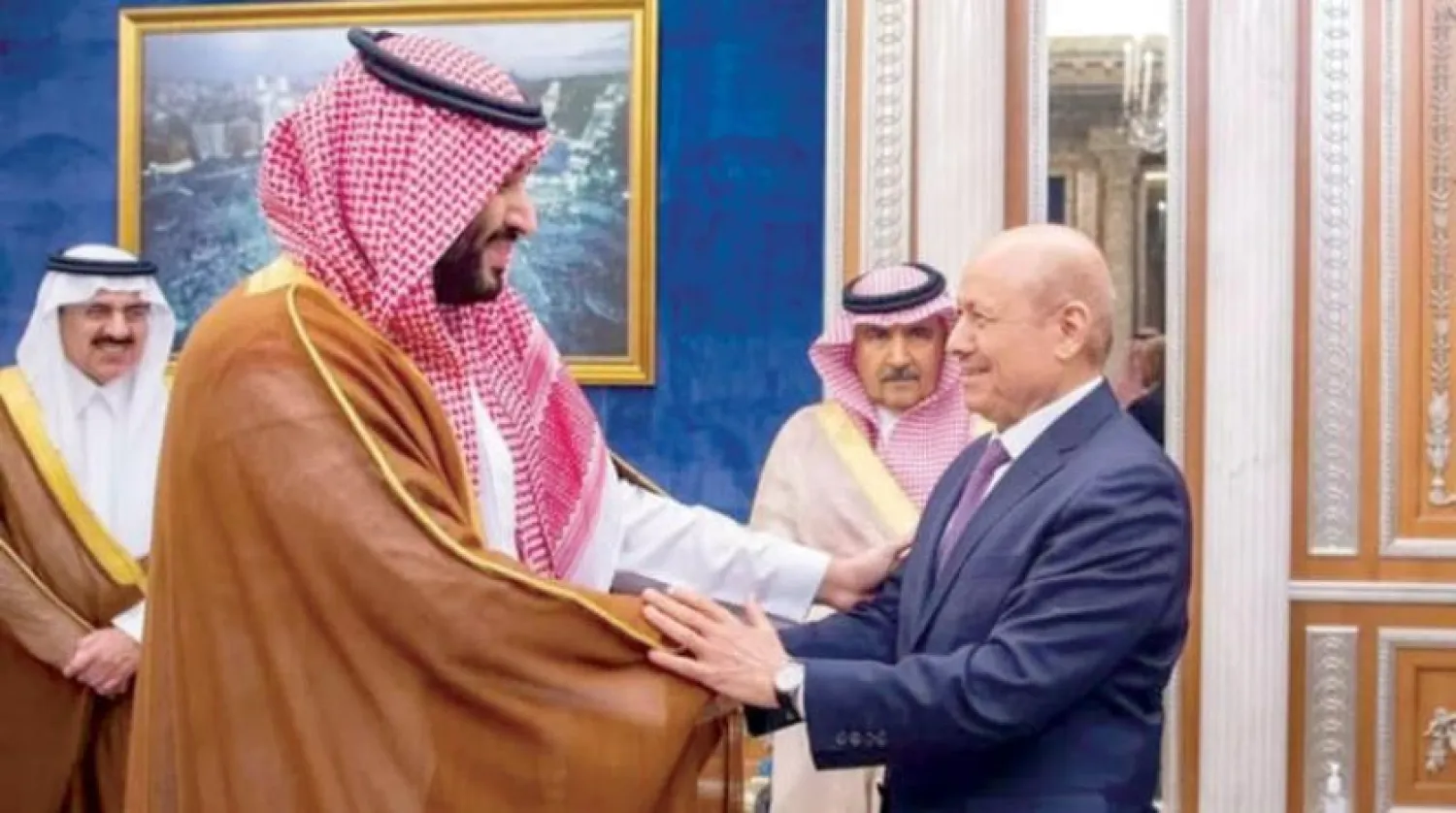
PLC President Rashad al-Alimi assumed his duties alongside seven deputies that represent Yemen’s various political and military forces.
Some independents criticized the PLC even before it held its first session, and many supported it, seeing it as the best of the few and narrow solutions in the Yemeni complex equation.
Despite contradictions, the PLC provided a good model that was lacking in Yemen.
Yemenis dreamed that there would be another model for services within the liberated areas. This became the focus of Prime Minister Maeen Abdul Malik, who devoted himself entirely to the economy, services, governance and advancing the development wheel with all the government’s might and capabilities.
The UN armistice lasted from April till October 2. It was extended a few times. Despite the truce coming to an end, the internationally recognized government continued to allow flights at Sanaa airport and the flow of oil derivatives to Hodeidah. Most importantly, the government pressed on with the ceasefire on its part.
Houthis, who were only supposed to lift their siege off Taiz’s crossings, did not fulfill their pledges.
“Taiz citizens have no more wishes than to stop the sniping and shelling, and to open that main road that connects Taiz to the eastern part of the area,” said Taiz-based activist Sarah Al Areeqi.
“The aspirations are no longer great,” Areeqi told Asharq Al-Awsat, adding that people are demotivated by the years passing without any of their wishes coming true.
The Houthis did not commit to opening the crossings, and they disappointed the UN envoy who sought to renew the armistice.
The militias, addicted to wasting opportunities, refused the extension because it contained new provisions that would usher in a peace process for Yemen.
Counter-Escalation Diplomacy
The Yemeni government did not respond to Houthi escalation by targeting oil exporting ports.
The Yemeni Defense Council chose to respond by classifying the Houthis as a terrorist group, a step that the government does not consider just a soft move. The blacklisting of Houthis was followed by an action program that the Yemeni Cabinet translated into several decisions, with assurances that relief work would not be affected.
“A number of measures have been approved,” affirmed Yemeni Foreign Minister Ahmad bin Awad bin Mubarak in a November interview with Asharq Al-Awsat.
The measures listed by Mubarak included updating blacklists for Houthi political and field leaders to include persons dealing with the terrorist group. Moreover, those who impersonate official positions in the leadership levels of ministries and heads of institutions and government agencies were also blacklisted.
Criminals involved in human rights violations and Houthi accomplices targeting economic facilities and threatening shipping companies will also be added to the list.
The government also said it would also ban entities and companies involved in financing terrorist Houthi militias. It said it will take legal measures to track networks dealing with the terrorist militia operating outside Yemen.
The government vowed to communicate through official, legal and security channels, “to ensure the circulation of the lists of outlawed individuals and entities. This is so that all terrorists are pursued and to call on countries to freeze their funds,” according to Mubarak.
It should be noted that the UN Security Council and Western countries used the term “terrorist attacks” to describe Houthi attacks against infrastructure, such as the port of Al-Dhaba in eastern Yemen.
This is a precedent that Al-Alimi considered as good, but insufficient.
“The international community should not provide incentives to the Houthi militia, because that encourages them,” Al-Alimi told Al-Arabiya news channel.


