
No Sign of Casualties at Site of Strikes Russia Says Killed Hundreds of Ukrainian Soldiers

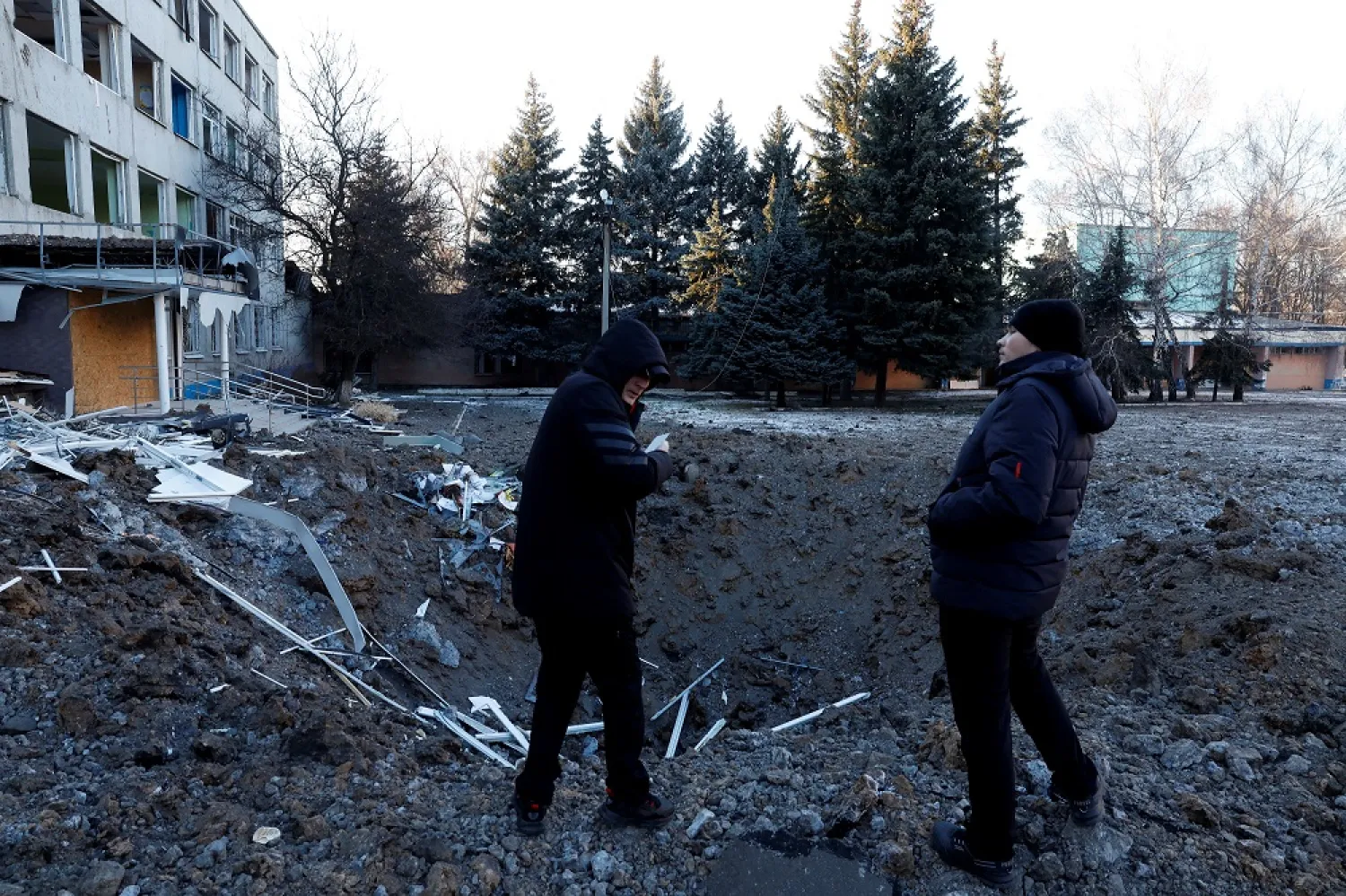
People look at the site of a missile strike that occurred during the night, as Russia's attack on Ukraine continues, in Kramatorsk, Ukraine, January 8, 2023. (Reuters)
TT

No Sign of Casualties at Site of Strikes Russia Says Killed Hundreds of Ukrainian Soldiers

People look at the site of a missile strike that occurred during the night, as Russia's attack on Ukraine continues, in Kramatorsk, Ukraine, January 8, 2023. (Reuters)

A Russian rocket strike on the Ukrainian city of Kramatorsk caused damage but did not destroy buildings and there were no obvious signs of casualties, a Reuters witness said on Sunday, after Russia said the attack killed 600 Ukrainian soldiers. 

Reuters reporters visited the two college dormitories Russia's defense ministry said had been temporarily housing Ukrainian servicemen close to the front line of the war at the time of the overnight strike. Neither appeared to have been directly hit by missiles or seriously damaged. There were no obvious signs that soldiers had been living there and no sign of bodies or traces of blood. 

Some of the windows were broken at Hostel No. 47, which stood by a courtyard that had a big crater in it. 

The other building named by Russia's defense ministry, Hostel No. 28, was entirely intact. A crater lay about 50 meters away closer to some garages. 

Authorities in Kyiv did not immediately comment on the strike or on Russia's claim of hundreds of casualties. Kramatorsk's mayor earlier said there had been no casualties. 

Russia's defense ministry, in a statement, said the strike on the buildings in Kramatorsk was a revenge operation for a deadly Ukrainian attack last week on a Russian barracks in Makiivka, in part of the Donetsk region controlled by Moscow's forces, in which at least 89 servicemen were killed. 

It said Moscow had used what it called reliable intelligence to target the Ukrainian troops. More than 700 Ukrainian troops had been housed in one hostel and more than 600 in another, it said. 

"As a result of a massive missile strike on these temporary deployment points of Ukrainian army units, more than 600 Ukrainian servicemen were destroyed," the defense ministry said. 

If true, it would be the single largest loss of Ukrainian troops since Russia invaded on Feb. 24 last year. Neither side in the grinding war, now in its eleventh month, usually disclose losses. 

Pavlo Kyrylenko, Ukraine's governor of Donetsk, had said earlier that Russia had launched seven missile strikes on Kramatorsk. 

And Oleksandr Honcharenko, Kramatorsk's mayor, said earlier on Sunday that the attack had damaged two educational facilities and eight apartment buildings and garages but that there had been no casualties. 

Ukraine was believed to have stopped housing troops close together in single facilities after a deadly Russian missile strike on a base in western Ukraine in March which killed dozens. 

The practice of housing soldiers all together came into focus too after the Ukrainian strike on Makiivka this month with Russian military commanders subject to fierce criticism inside Russia for not dispersing their forces. 

Russia has repeatedly shelled Kramatorsk, which is also in the Donetsk region, one of four regions Moscow claims to have formally incorporated into Russia, something Ukraine and most countries in the world do not recognize. 

Kramatorsk lies a few miles northwest of Bakhmut, a small city which Russia has been trying to take for more than five months in a brutal battle which has become the scene of some of the fiercest fighting in recent weeks. 

Ukrainian officials earlier said at least two people had been killed elsewhere in Russian overnight bombing after a unilateral Russian Orthodox Christmas ceasefire had expired. 

A 50-year-old man had been killed in the northeastern region of Kharkiv, Oleh Synehubov, the governor of the region, said on the Telegram messaging app. 

Another person had been killed in overnight attack on Soledar, close to Bakhmut in the Donetsk region, local officials said. 

Reuters could not immediately verify those claims. 


Israel Army Confirms Struck Two Nuclear Sites in Iran

Emergency responders inspect the site of a residential building damaged by a strike, amid the US-Israeli conflict with Iran, in Tehran, Iran, March 27, 2026. Majid Asgaripour/WANA (West Asia News Agency) via Reuters
TT

Israel Army Confirms Struck Two Nuclear Sites in Iran

Emergency responders inspect the site of a residential building damaged by a strike, amid the US-Israeli conflict with Iran, in Tehran, Iran, March 27, 2026. Majid Asgaripour/WANA (West Asia News Agency) via Reuters

The Israeli military confirmed it struck a heavy water reactor and a uranium processing plant in central Iran on Friday, as it targeted nuclear sites in the country.

"A short while ago, the Israeli Air Force... struck the heavy water plant in Arak, central Iran," the military said in a statement, describing the site as a "key plutonium production site for nuclear weapons".

Iranian media had earlier reported that US-Israeli strikes hit the Khondab heavy water complex, saying they caused no casualties or radiation leak from the site.

Work on the reactor on the outskirts of the village of Khondab began in the 2000s, but was halted under the terms of a now-abandoned 2015 nuclear deal struck between Iran and world powers.

The core of the reactor was removed and concrete was poured into it, rendering it inoperative.

The research reactor was officially intended to produce plutonium for medical research and the site includes a production plant for heavy water.

The Israeli military also confirmed it struck a uranium processing site in central Iran's Yazd on Friday, after the country’s atomic energy organization said US-Israeli strikes hit the facility.

"A short while ago, the Israeli Air Force... struck a uranium extraction plant located in Yazd, central Iran," the military said in a statement, describing the site as a "unique facility in Iran used for the production of raw materials required for the uranium enrichment process".

Iran's atomic energy organization said the strike on the plant "did not result in the release of any radioactive material."

Israel and the US accuse Iran of seeking to acquire nuclear weapons, while Tehran maintains that its program is for civilian purposes.

The heavy water plant in Arak was targeted by Israeli strikes during the 12-day war between Iran and Israel last June, during which the US also carried out bombings.

The International Atomic Energy Agency (IAEA) says the site was "damaged" during the attacks and "is assessed not to have been fully operational since that time."

But the agency said it has not had access to the site since May 2025.

The Middle East was plunged into war on February 28 when the US and Israel launched joint strikes on Iran, triggering retaliatory missile and drone attacks targeting Israel and several countries in the region.


US, Israel Unlikely to Achieve ‘Regime Change’ in Iran, Says Merz

 27 March 2026, Hesse, Frankfurt/Main: Germany's Chancellor Friedrich Merz speaks at the "FAZ" Congress. (dpa)
27 March 2026, Hesse, Frankfurt/Main: Germany's Chancellor Friedrich Merz speaks at the "FAZ" Congress. (dpa)
TT

US, Israel Unlikely to Achieve ‘Regime Change’ in Iran, Says Merz

 27 March 2026, Hesse, Frankfurt/Main: Germany's Chancellor Friedrich Merz speaks at the "FAZ" Congress. (dpa)
27 March 2026, Hesse, Frankfurt/Main: Germany's Chancellor Friedrich Merz speaks at the "FAZ" Congress. (dpa)

The US-Israeli war against Iran is unlikely to lead to "regime change", German Chancellor Friedrich Merz said Friday, as the month-long conflict showed no signs of abating.

"Is regime change really the goal?" he said at a forum in Frankfurt organized by the FAZ newspaper.

"If that's the goal, I don't think you'll achieve it. It's mostly gone wrong" in past conflicts, he said, pointing to the Afghanistan war.

"I have serious doubts as to whether there is a strategy and whether that strategy is being successfully implemented," he added. "In that respect, it could take even longer."

Germany has pushed back at US President Donald Trump's criticisms of NATO members for failing to join the attacks on Iran, insisting that it is not their war.

Merz however said Friday he believed that Trump had accepted this stance.

He also said Germany would be open to helping provide military protection in the Strait of Hormuz, a key route for oil and gas, which has been nearly totally blocked, in the event of a ceasefire.

"This requires an international mandate, it requires approval from the German parliament and, prior to that, a cabinet decision. And we are far from that."


More Than 300 US Troops Injured Since Start of Iran War

US Navy sailors taxi an F/A-18F Super Hornet on the flight deck aboard Nimitz-class aircraft carrier USS Abraham Lincoln in support of the Operation Epic Fury attack on Iran from an undisclosed location March 17, 2026. (US Navy/Handout via Reuters)
TT

More Than 300 US Troops Injured Since Start of Iran War

US Navy sailors taxi an F/A-18F Super Hornet on the flight deck aboard Nimitz-class aircraft carrier USS Abraham Lincoln in support of the Operation Epic Fury attack on Iran from an undisclosed location March 17, 2026. (US Navy/Handout via Reuters)

More than 300 US troops have been wounded since the start of the Iran war on February 28, US Central Command said on Friday.

"Since the start of Operation Epic Fury, approximately 303 US service members have been wounded. The vast majority of these injuries have been minor, and 273 troops have returned to duty," US Navy Captain Tim Hawkins said.

A US official who asked not to be identified told AFP that 10 troops remain seriously wounded.

A further 13 troops have been killed in the war, according to the latest figures, with seven killed in the Gulf and six in Iraq.

In a separate development Friday, Iran's military said that hotels housing US soldiers in the region would be considered targets.

"When all the Americans (forces) go into a hotel, then from our perspective that hotel becomes American," armed forces spokesman Abolfazl Shekarchi told state television on Thursday.

Iran's government has not released an updated casualty toll, but a US-based activist group said on March 23 that some 1,167 Iranian troops had been killed and 658 troops' status is unknown. AFP is not able to independently verify tolls in Iran due to reporting restrictions.

The war began on February 28 when the United States and Israel launched strikes on Iran, killing its supreme leader Ali Khamenei.

Since then, the conflict has spread across the Middle East. Iran has fired drone and missiles at Gulf states home to American military bases and other interests.

US President Donald Trump insisted on Thursday that talks to end the conflict were "ongoing" and "going very well".