Qatar to Build Biggest Ethane Cracker Worth $6 Bln
Qatar's traders look at share prices on an electronic display at the Doha Stock Exchange in Doha, Qatar January 8, 2020. REUTERS/Naseem Zeitoon
QatarEnergy announced on Sunday the final investment decision on the $6 billion Ras Laffan Petrochemicals Complex with partner Chevron Pillips Chemical which is expected to be the largest of its kind in the Middle East.
The complex, expected to begin production in 2026, includes an ethane cracker with a capacity of 2.1 million tons of ethylene per year.
The integrated complex will also include two high-density polyethylene derivative units with a total production capacity of 1.7 million tons per year, QatarEnergy chief Saad al-Kaabi Kaabi said.
State-run QatarEnergy will hold a 70 percent stake in the venture with Chevron Phillips Chemicals holding 30 percent under the agreement signed on Sunday.
"This marks QatarEnergy's largest investment ever in Qatar's petrochemical sector," Kaabi said.
The complex, located in Ras Laffan industrial city, is an "important milestone" in Qatar's downstream expansion strategy, he said.
Qatar, one of the world's top producers of liquified natural gas (LNG), will see its ethylene production capacity double on the back of the new complex. Local polymer production will also increase from 2.6 million to 4 million tons per annum.
In another context, Qatari IT services firm MEEZA will be the first company in the country to use book-building to carry out an initial public offering, it said in a statement on Sunday, as Qatar aligns itself with international practices.
The company, part-owned by telecom operator Ooredoo, said it was selling 50 percent of its share capital in a public-share sale with a planned listing on the Qatar Stock Exchange.
The IPO process, which begins this month, will allow the company to offer a price range to test investor appetite and determine the IPO price.
The offering's price range is between 2.61 riyals ($0.71) to 2.81 riyals per share, potentially raising between 846 million and 911 million riyals.
Qatar introduced regulations for book-building in February 2021 to help attract foreign investors and elevate its status towards a developed market.
Until now, the standard practice in Qatar has been for a company to set a price based on feedback from two independent valuation reports.
In its statement, MEEZA said the book building would follow the regulator Qatar Financial Markets Authority's offering and listing regulations, including "a set of new procedures that would provide additional options for companies wishing to offer and list in the financial market".
Visa, Mastercard Launch International Card Payments in Syria after US Lifts Terrorism Designationhttps://english.aawsat.com/business/5311766-visa-mastercard-launch-international-card-payments-syria-after-us-lifts-terrorism
Visa, Mastercard Launch International Card Payments in Syria after US Lifts Terrorism Designation
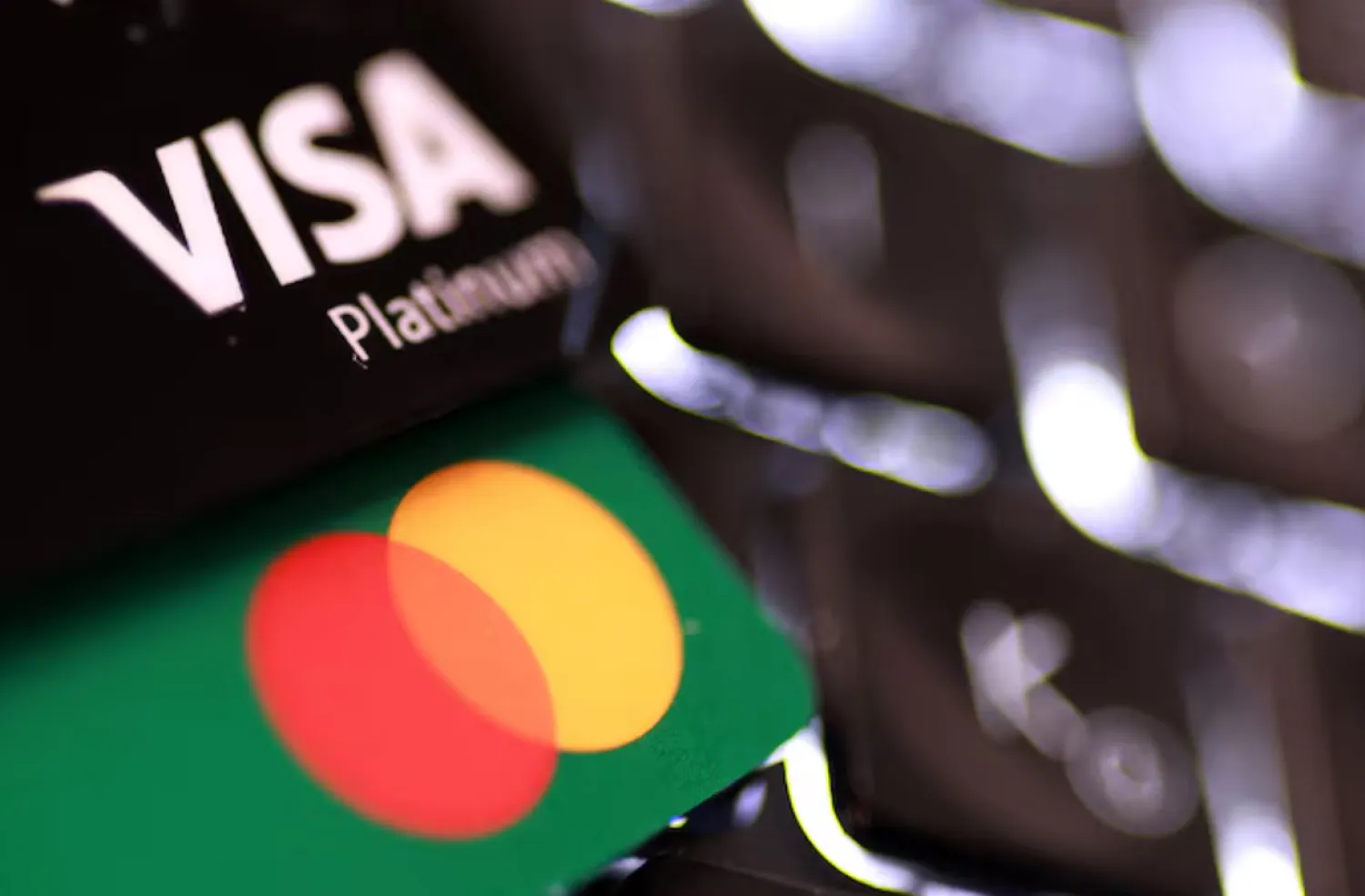
Visa and Mastercard credit cards are seen in this illustration taken February 3, 2026. REUTERS/Dado Ruvic/Illustration
Visa and Mastercard carried out their first international card transactions in Syria on Wednesday, a major step in reconnecting the country with global payment networks days after Washington removed it from its state sponsors of terrorism list.
The near-simultaneous moves by two of the world's largest payment networks offer one of the clearest signs yet of Syria's accelerating reintegration into the global financial system after decades of sanctions and isolation.
Qatar's QNB Group said it and Mastercard had completed what it described as the world's first end-to-end international card payment in Syria, while Visa said separately it had tested its first live international transaction in the country with Lebanon-based Fransabank.
Syrian President Ahmed al-Sharaa took part in the Visa test, making a card payment at a restaurant in Damascus's historic Old City, according to a video published by Syria’s state-run Syrian Response. Central Bank Governor Mohammed Safwat Raslan was seated alongside him.
The transactions came just two days after the US formally removed Syria from its list of state sponsors of terrorism.
The designation, imposed in 1979, had remained a major deterrent to international banks and investors even after Washington dismantled its broader sanctions program against the country.
Washington terminated comprehensive sanctions on Syria in December last year while retaining targeted measures against former President Bashar al-Assad and his associates, rights abusers, drug traffickers, ISIS and al-Qaeda affiliates and Iranian proxies.
But Syria's continued designation as a state sponsor of terrorism carried restrictions on financial transactions and remained a source of legal and compliance risk for banks considering doing business there. The US formally removed Syria from the list on Monday.
Syrian Foreign Minister Asaad al-Shaibani told Reuters before the removal that Damascus hoped lifting what he called the "last obstacle" would reconnect Syria with the global financial and economic system and boost investment.
"There is no longer any obstacle to investment, doing business and rebuilding economic life in Syria," he said.
Sharaa's government has made restoring access to global finance and attracting foreign investment a central part of its economic strategy since rebels led by him toppled Assad in December 2024.
STEP TOWARDS WIDER ACCEPTANCE
Visa said it planned to enable international visitors to use their cards while in Syria, and described the test as a step towards wider international card acceptance in the country.
QNB said its system now allows Syrian merchants including hotels, restaurants and government entities to accept international Mastercard credit cards through its point-of-sale terminals. It will gradually add eligible merchants as part of a phased rollout, subject to regulatory approvals.
Visa's transaction was carried out in cooperation with Fransabank Lebanon as the acquiring financial institution and Paymera, a Syrian payments technology company owned by the state's sovereign fund.
Saudi Arabia Closes Loophole in White Land Fees: Develop or Payhttps://english.aawsat.com/business/5311753-saudi-arabia-closes-loophole-white-land-fees-develop-or-pay
Saudi Arabia Closes Loophole in White Land Fees: Develop or Pay
Construction work at the Shams Al-Diyar project, part of the Housing Program in Riyadh (SPA).
Saudi Arabia is moving to make white land fees more closely tied to the actual behavior of landowners, closing one avenue through which ownership of land could previously be transferred before outstanding fees were settled. The new decision gives owners of fee-subject land clearer options: pay the fees, develop the land, or sell it after settling their obligations, strengthening the system's effectiveness in increasing supply and bringing undeveloped land onto the market.
The Saudi Cabinet approved this week a decision not to document any real estate transaction transferring ownership of land subject to the White Land and Vacant Real Estate Fees Law until payment of the fees due on the land has been verified.
Minister of Municipalities and Housing Majid Al Hogail said the Cabinet's approval to regulate the documentation of real estate transactions involving land subject to the fees, by verifying payment of outstanding amounts before documenting any ownership transfer, aims to safeguard the state's rights, encourage landowners to develop their properties and increase real estate supply, thereby improving market efficiency and supporting market balance.
Evolution of the Fees
White land fees in Saudi Arabia have gone through several stages aimed at meeting the country's development targets and injecting more supply into the local market. In 2015, the fees were approved at a fixed rate of 2.5 percent. This was followed by the modern billing system introduced this year, under which annual fees can reach as much as 10 percent of the land's value, in implementation of directives from Crown Prince and Prime Minister Mohammed bin Salman.
The decision puts landowners before a clearer equation: develop the land, pay the fees, or sell after settling their obligations, closing one avenue for avoiding the fees by transferring ownership.
The significance of the move extends beyond the procedural collection of outstanding amounts, as it seeks to influence landowners' behavior, raise the cost of holding undeveloped land, and push more of it toward development or sale.
The modern fee system has expanded to include both white land and vacant real estate, tightening the pressure on vacant properties in the Kingdom to develop them and offer them for rent or sale, increasing market activity and achieving the real estate balance targeted by the government.
Rising Cost of Land
Khaled Al-Mubayyed, CEO of real estate company Manasat, told Asharq Al-Awsat that the Cabinet's approval prevents land from being transferred to a new owner while outstanding fees remain unpaid, or attempts to shed the obligation through a change in ownership. As a result, the fees become effectively tied to the land and transactions involving it, preventing attempts to circumvent the system.
Al-Mubayyed said the measure strengthens the collection of government dues by linking documentation to payment, making collection more effective because a sale and transfer of ownership are among the key pressure points that are difficult to bypass.
The CEO of Manasat added that the significance of the Cabinet's approval lies in putting the owner before two options: either develop the land or pay the fees if they wish to retain or sell it. This increases the cost of keeping land undeveloped and strengthens the incentive to bring it onto the market.
Monitoring the Property's Status
Real estate specialist and developer Ahmed Omar Basoudan told Asharq Al-Awsat that the new measure eliminates attempts to circumvent or evade development or payment of the fees, increases supply, and curbs speculative behavior and land hoarding.
He added that holding undeveloped land has become costly, forcing some owners to sell or develop rather than wait for prices to rise. This could therefore expand the pool of land available for development, which is the primary objective of the fee system.
Basoudan said increased supply of developed land would help ease bottlenecks in the land market, particularly in cities with high demand, and could gradually affect land prices as well as development and housing costs.
He added that the decision comes amid the expansion of the system to include white land and vacant real estate, with implementing regulations allowing fees to be calculated and the status of properties monitored, while reinforcing collection procedures and preventing evasion.
World Gold Council to Asharq Al-Awsat: Saudi Arabia Strengthens Its Position as a Key Market in the Regionhttps://english.aawsat.com/business/5311746-world-gold-council-asharq-al-awsat-saudi-arabia-strengthens-its-position-key
World Gold Council to Asharq Al-Awsat: Saudi Arabia Strengthens Its Position as a Key Market in the Region
A customer looks at gold bracelets at a local store in Saudi Arabia (SPA)
As gold prices climbed to record levels in 2026 and its role as a tool for hedging and portfolio diversification grew amid rising global debt and continued economic and geopolitical uncertainty, Saudi Arabia has emerged as one of the markets undergoing rapid transformation in the gold sector. This has been driven by growth in investment and consumer spending, as well as the expansion of tourism and financial activity.
Andrew Naylor, the World Gold Council's Head of Middle East and Public Policy, believes these shifts are strengthening the Kingdom's position among the region's major gold markets and creating new opportunities for sector growth in the coming years.
In an interview with Asharq Al-Awsat, Naylor said gold has entered a phase in which its role extends beyond its association with immediate crises, as its importance as a strategic asset in investment portfolios continues to grow. Global gold demand, including over-the-counter trading, reached about 1,269 tons in the second quarter of 2026, while demand in the first half of the year rose 2 percent year on year to 2,522 tons. The value of demand reached a record level of about $380 billion.
Andrew Naylor, the World Gold Council's Head of Middle East and Public Policy (World Gold Council)
These levels come amid strong gains in gold prices during the year. The metal's average price under the London benchmark reached $4,506 per ounce in the second quarter, a significant increase from its level in the same period last year, despite falling from the record level recorded in the first quarter. The price movement reflects continued investor demand for gold as geopolitical risks intersect with interest rate expectations, currency fluctuations, and elevated debt levels.
Gold received an additional boost in August amid growing concerns about US debt levels, particularly after the US Treasury Department announced that it would double buyback operations for longer-term bonds to at least $4 billion per operation. The announcement on August 19 coincided with declines in Treasury yields and the dollar, while gold jumped more than 3 percent in a single session, signaling continued investor sensitivity to developments in the US debt market and fiscal policy.
Global Economic Risks
Naylor explained that gold's importance has increased amid continued geopolitical and economic uncertainty worldwide, noting that investors are not reacting only to individual events, but to an environment characterized by growing and persistent risks, from geopolitical tensions to uncertainty over inflation and interest rates and volatility in currency markets.
He added that gold continues to play a role in diversifying portfolios, preserving value, and strengthening their ability to withstand volatility, pointing out that concerns over rising global debt levels and their sustainability have become factors supporting interest in gold.
These factors come as recent US inflation data showed that price pressures persist, with annual inflation, as measured by the Personal Consumption Expenditures index, holding at 3.7 percent in July, slightly above market expectations. The persistence of inflation above the Federal Reserve's 2 percent target increases the importance of the path of interest rates and the dollar for gold's performance, as markets await new signals on US monetary policy.
Naylor noted that gold's appeal does not rest on a single factor, explaining that geopolitical developments are one of the drivers, but interact with a broader set of economic, financial, and investment factors.
Investment Maintains Its Momentum
Despite some moderation in investment demand following a strong start to the year, global demand for gold bars and coins remained at elevated levels, while over-the-counter demand, particularly in Asian markets, continued to support the market.
Naylor said investment may remain one of the main drivers of demand in the coming period, as investors seek to diversify their portfolios and hedge against a broader range of risks.
He added that continued geopolitical tensions could provide additional support for demand, but their impact will depend on how they interact with the broader economic and financial environment, including trends in inflation, interest rates, and currencies.
Asia Leads Demand
Asked which regions are best positioned to drive global demand, Naylor said Asia will remain a key market driver, with China and India, along with Middle Eastern markets, continuing to play an important role in investment and jewelry demand.
Demand for gold bars and coins in China reached about 107 tons in the second quarter, compared with 50 tons in India, indicating continued investment interest despite the impact of higher prices on some consumer segments.
He explained that rising prices can alter the composition of demand across different categories, with investment products tending to show greater resilience than jewelry during periods of rising prices.
The Gulf Strengthens Its Role
At the Middle East level, Naylor said geopolitical developments have contributed to increased interest in gold, but investor behavior in the region also reflects a broader trend toward portfolio diversification and hedging against economic and financial volatility and currency risks.
He added that Saudi Arabia and the UAE continue to strengthen their positions as financial and wealth management centers in the region, supporting long-term demand for gold.
He stressed that the Gulf plays a vital role in the global gold market, benefiting from its geographic location, trade networks, and advanced infrastructure in refining, logistics, and trade.
He noted that the development of financial markets and economic growth in the region are creating scope for this role to expand further in the coming years, as the region has moved beyond its traditional role as a consumer market for gold to assume a larger role in global trade and flows.
Saudi Arabia... An Expanding Market
Regarding the Saudi market specifically, Naylor said the Kingdom is attracting growing attention amid ongoing economic transformations, the expansion of investment activity, and higher levels of consumer and tourism spending. These factors are supporting its position as one of the important gold markets in the region.
He added that initiatives linked to Vision 2030, particularly the development of the tourism, retail, and entertainment sectors, along with population growth and evolving spending patterns, are providing a supportive environment for the long-term development of the gold and jewelry sector.
He believes that the growth of tourism and consumer activity in the Kingdom could open new opportunities for the jewelry sector, while the development of financial markets and private wealth supports the investment side of demand.
Central Banks
Regarding central banks, Naylor noted that official demand has become one of the structural factors supporting the market, with central banks adding 289 tons to their reserves in the second quarter, bringing total purchases to 345 tons in the first half of the year.
Although these levels are below the exceptional rates recorded during some earlier periods, they remain strong by historical standards and reflect the continued preference of central banks for gold as a strategic reserve asset.
This comes as discussions intensify around diversifying global reserves, currency risks, and monetary policies, giving official demand for gold a long-term dimension that extends beyond short-term price movements.
The continuation of this demand, alongside growing investment and consumer demand, gives the Saudi market an opportunity to benefit from these shifts, particularly as tourism grows, the retail sector develops, and the investor base expands.
This does not mean that the Kingdom is competing with the world's major centers for gold trading or refining. Rather, domestic economic transformations are enabling it to strengthen its role as an important regional center for gold demand, investment, and related services.
Thus, the story of gold in Saudi Arabia is not only about rising global prices, but also about a broader shift in the nature of demand, where investment intersects with tourism, consumption, and the development of financial markets, at a time when investors globally are seeking assets capable of diversifying portfolios and preserving value amid a more volatile economic environment.
لم تشترك بعد
انشئ حساباً خاصاً بك لتحصل على أخبار مخصصة لك ولتتمتع بخاصية حفظ المقالات وتتلقى نشراتنا البريدية المتنوعة