Ukraine’s Leader Wants to Visit UN on Invasion Anniversary 

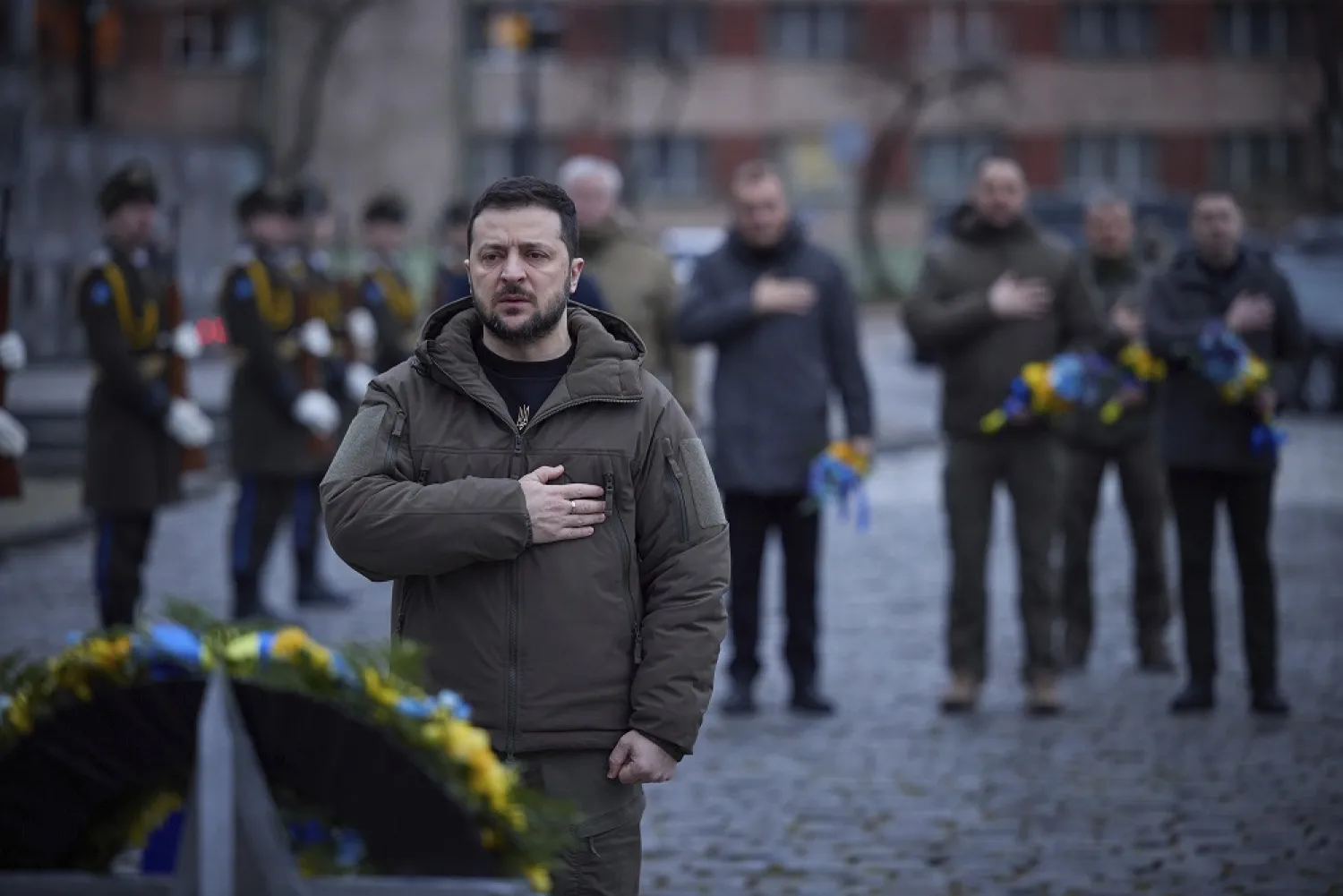
Ukrainian President Volodymyr Zelenskyy, pays tribute at a monument to Fallen Defenders of Ukraine in the Russian-Ukrainian War in Lviv, Ukraine, Wednesday, Jan. 11, 2023.(Ukrainian Presidential Press Office via AP)
TT

Ukraine’s Leader Wants to Visit UN on Invasion Anniversary 

Ukrainian President Volodymyr Zelenskyy, pays tribute at a monument to Fallen Defenders of Ukraine in the Russian-Ukrainian War in Lviv, Ukraine, Wednesday, Jan. 11, 2023.(Ukrainian Presidential Press Office via AP)

Ukraine’s President Volodymyr Zelenskyy wants to visit the United Nations to address a high-level meeting of the 193-member General Assembly on the eve of the first anniversary of Russia’s Feb. 24 invasion of his country if the security situation permits, a senior Foreign Ministry official said Friday. 

First Deputy Foreign Minister Emine Dzhaparova cautioned in an interview with The Associated Press that many factors need to be in place for him to come, citing first and foremost the military situation on the ground and a warning from Ukraine’s intelligence service that Russia is planning “a very serious offensive in February.” 

“Our president would want to come, he has a will or intention to come,” she said, “but it’s still a question if there will be a security situation that will allow him to come.” 

If Zelenskyy does come to the UN, it would be only his second trip outside Ukraine since the invasion. He made a surprise visit to Washington on Dec. 21 to meet his most important backers in the war against Russia — President Joe Biden and members of Congress whom he thanked for their support and told that “against all odds” Ukraine still stands. 

Ukraine’s UN Ambassador Sergiy Kyslytsya said the General Assembly has already scheduled a high-level debate on the war on Feb. 23, which will be followed by a ministerial meeting of the Security Council on Feb. 24. 

Dzhaparova said Ukraine would like to see the assembly adopt one of the two resolutions that Zelenskyy wants to see approved on the eve of the anniversary of the invasion. 

She said Ukraine is consulting with its partners on the two measures, one that would support the president’s 10-point peace formula that includes the restoration of Ukraine’s territorial integrity and the withdrawal of Russian forces and the other that would establish a tribunal to prosecute crimes of aggression, which would enable Russia to be held accountable for its unprovoked invasion. 

“We have to act step by step,” Dzhaparova said. “It’s still a question what will be the first. … I believe that this is something that we will know very soon, in the nearest week or two.” 

In late December, Ukraine’s Foreign Minister Dmytro Kuleba told AP the government wanted a “peace” summit by the end of February at the UN, with Secretary-General Antonio Guterres as mediator, but he didn’t anticipate Russia taking part. That would make it difficult to foresee mediation or an end to the devastating war. 

Kyslytsya, the Ukrainian ambassador, said he doesn't think Russian President Vladimir Putin would allow anyone to attend a summit because it doesn't go along with his plan that Russian territorial gains are non-negotiable. 

Dzhaparova said a summit is still under discussion and stressed that “it’s not a negotiation.” 

Dzhaparova said the summit would be a platform to discuss things that Ukraine considers important on top of the 10-point peace proposal, which also includes the release of all prisoners, a tribunal for those responsible for the Russian aggression, and security guarantees for Ukraine. 

“It’s about shaping the discourse,” she explained. 

It doesn't mean that by adopting a resolution or holding a summit Ukraine is ready to sign up to a peace agreement or ceasefire, Dzhaparova said. It means that only after a resolution or summit “negotiation about peace, or the agreement on peace, might be started.” 

The former journalist and TV anchor, a Crimean Tatar whose parents left Crimea after Russia’s 2014 takeover and annexation of the strategic peninsula, said Ukraine needs political, economic and military support. 

Politically, Dzhaparova said, Russia has discredited the UN Charter, which opposes the use of force against another country, and flouted international law and should be isolated by the international community. 

She said it’s crucial to provide financial support to Ukraine because its economy has suffered much more than Russia’s, and to provide weapons “to fight for peace.” 

Dzhaparova said the Ukrainian armed forces are highly motivated and are fighting to protect their land and people, “but the Russian army doesn’t understand what they’re fighting for.” 

“We are doing our best to win, but then at the end of the day, it’s still a question of what will be the end,” she said. 

If Ukraine were to lose, Dzhaparova said, Putin won’t be satisfied “and I’m sure that Russia would attack other countries in the nearest future.” 

“This is not about Ukraine solely, it’s about a common goal to avoid further aggression,” she stressed. “If the war is not contained in Ukraine, the war will become bigger.” 


UN to Debate Rules for ‘Killer Robots’

Activists from the Campaign to Stop Killer Robots, a coalition of non-governmental organizations opposing lethal autonomous weapons or so-called "killer robots", stage a protest at Brandenburg Gate in Berlin, Germany, March, 21, 2019. (Reuters)
TT

UN to Debate Rules for ‘Killer Robots’

Activists from the Campaign to Stop Killer Robots, a coalition of non-governmental organizations opposing lethal autonomous weapons or so-called "killer robots", stage a protest at Brandenburg Gate in Berlin, Germany, March, 21, 2019. (Reuters)

Countries will debate whether to start talks on binding rules for autonomous weapons systems -- dubbed "killer robots" by critics -- at the UN from Monday, as concerns grow about their increasing use on the battlefield.

Warfare is undergoing a radical transformation as armies seek to capitalize on the boom in artificial intelligence to boost their fighting abilities by identifying and striking targets more quickly and more accurately.

But a chorus of voices, from campaigners to UN chief Antonio Guterres and Pope Leo XIV, have warned against the dangers of handing the power of life and death to fully autonomous machines.

"The need to regulate autonomous weapons has taken on new urgency" with developments in artificial intelligence, said Laurent Gisel, head of the Weapons and Conduct of Hostilities Unit at the International Committee of the Red Cross (ICRC).

Russia has reportedly used fully autonomous drones to deadly effect in its war on Ukraine, while Ukraine's own defense industry is pushing to develop autonomous "drone swarms".

Human Rights Watch said the meeting in Geneva this week of the UN's Review Conference of the Convention on Conventional Weapons (CCW) would leave civilians "dangerously exposed" if it failed to act decisively.

The meeting will bring together 128 countries to decide whether to open negotiations on legally binding rules.

- 'Carefully cultivated ambiguity' -

But while many states are in favor of tighter rules, as with other advanced military capabilities such as nuclear weapons, countries that have acquired the technology are reluctant to have their hands tied.

At the UN General Assembly last month, 163 states adopted a resolution calling for negotiations on rules governing autonomous weapons.

Five countries voted against -- the United States, Russia, Belarus, Israel and North Korea, which last week boasted of a new AI-enabled torpedo system.

Nine abstained, including Iran and China, which has maintained a "carefully cultivated ambiguity", said Laure de Roucy-Rochegonde of the French Institute of International Relations.

Washington has proposed a five-year process to develop a non-binding instrument, while NGOs and the ICRC are advocating for a one-year timeline.

In 2023, Guterres and ICRC President Mirjana Spoljaric Egger called on states to ban autonomous weapons before 2026.

The ICRC is calling for a ban on two categories of autonomous weapons: so-called "unpredictable autonomous weapons" and those designed or used to directly target humans.

Given the opposition from leading international powers, observers say it looks unlikely agreement will be reached this week to start talks on binding rules.


2 Planes Collide on the Ground in Miami, Only Minor Injuries Reported

FILE - Vehicles drive past the entrance to Miami International Airport in Miami May 12, 2020, (AP Photo/Wilfredo Lee, File)
TT

2 Planes Collide on the Ground in Miami, Only Minor Injuries Reported

FILE - Vehicles drive past the entrance to Miami International Airport in Miami May 12, 2020, (AP Photo/Wilfredo Lee, File)

Federal aviation safety officials on Sunday were investigating a minor collision between two planes at a taxiway intersection at Miami International Airport, where one aircraft's wingtip struck the nose of another, authorities said. Two people reported minor injuries.

The accident happened at about 9 p.m. Saturday and involved a Copa Airlines Boeing 737 passenger aircraft with 172 people aboard and a UPS Boeing 767 cargo plane, according to the National Transportation Safety Board and Copa Airlines. The wing of the Copa flight and the nose of the UPS plane collided, the NTSB said.

Photos taken at the scene show the UPS plane nose with a horizontal gash on one side and a larger hole in the middle, The Associated Press reported.

On audio recorded by ATC.com, a pilot on the UPS plane told air traffic control that he went too far at the intersection and his plane was clipped by the Copa flight. Air traffic control told the UPS pilot that he was supposed to yield to the Copa aircraft.

The NTSB said it was gathering information and may provide an update on Sunday.

The Copa plane had just arrived from Panama City and the UPS plane was headed to Bogota, Colombia, officials said.

In a statement on social media, Copa called the collision minor and said two of its passengers were treated at the scene for minor injuries.

UPS said it was working with authorities to determine what happened.

“We cannot speculate on the details of the incident,” UPS said in a statement.

“The National Transportation Safety Board is responsible for investigating incidents like this and will control the flow of information.”

The mishap came two months after an Amazon cargo plane careened off a runway at Miami International and smashed into a van carrying workers for a company that cleans airplanes, killing five people.


Nearly 1,500 Migrants Arrive in Canary Islands in One Day

Rescued migrants disembark from a Spanish Maritime Rescue Service vessel with assistance from emergency workers and Civil Guard officers at the port of La Restinga in El Pinar on the island of El Hierro, Canary Islands, Spain, 14 November 2026. EPA/GELMERT FINOL
TT

Nearly 1,500 Migrants Arrive in Canary Islands in One Day

Rescued migrants disembark from a Spanish Maritime Rescue Service vessel with assistance from emergency workers and Civil Guard officers at the port of La Restinga in El Pinar on the island of El Hierro, Canary Islands, Spain, 14 November 2026. EPA/GELMERT FINOL

Almost 1,500 migrants arrived in Spain's Canary Islands on Saturday, the highest number in a single day since 2020, the EFE news agency reported on Sunday, citing the maritime rescue service.

A total of 1,488 people in 14 boats were rescued by the Spanish coastguard, EFE reported, continuing a surge of arrivals from West African countries to the Spanish archipelago since October.

The previous one-day record was the 1,461 people rescued in waters off the Canary Islands on November 7, 2020, maritime rescue services said ⁠on Sunday, according to Reuters.

While migrant ⁠arrivals have declined so far this year compared with the same period last year, the sharp increase last month placed additional pressure on reception and emergency services on some of the Canary Islands, particularly the smaller and less densely populated ones.

One boat on ⁠Saturday was carrying 240 people, including 12 women and 36 children, authorities said. The rescued migrants were taken to El Hierro, one of the smallest Canary Islands. Most of the people were from Senegal, Gambia and Guinea Conakry.

Twelve boats arrived in El Hierro, plus one in Gran Canaria and another in Tenerife.

Spain's Territorial Policy Minister Angel Victor Torres will visit El Hierro on Sunday to discuss the surge in migrant arrivals.

The Atlantic ⁠route ⁠from West Africa to the Canary Islands is one of the world's deadliest migration crossings. Thousands of migrants attempt the journey each year in overcrowded boats, seeking to reach Spanish territory despite rough seas, strong currents and long distances.

Arrivals tend to pick up in the autumn months, when sea conditions along the route are generally calmer and more favorable for crossings.

Migrant arrivals to the Canary Islands between January and October 31 were down 5.5% from the same period last year, government data show.