
Syrian FM: No Normal Ties with Türkiye without End to Occupation 

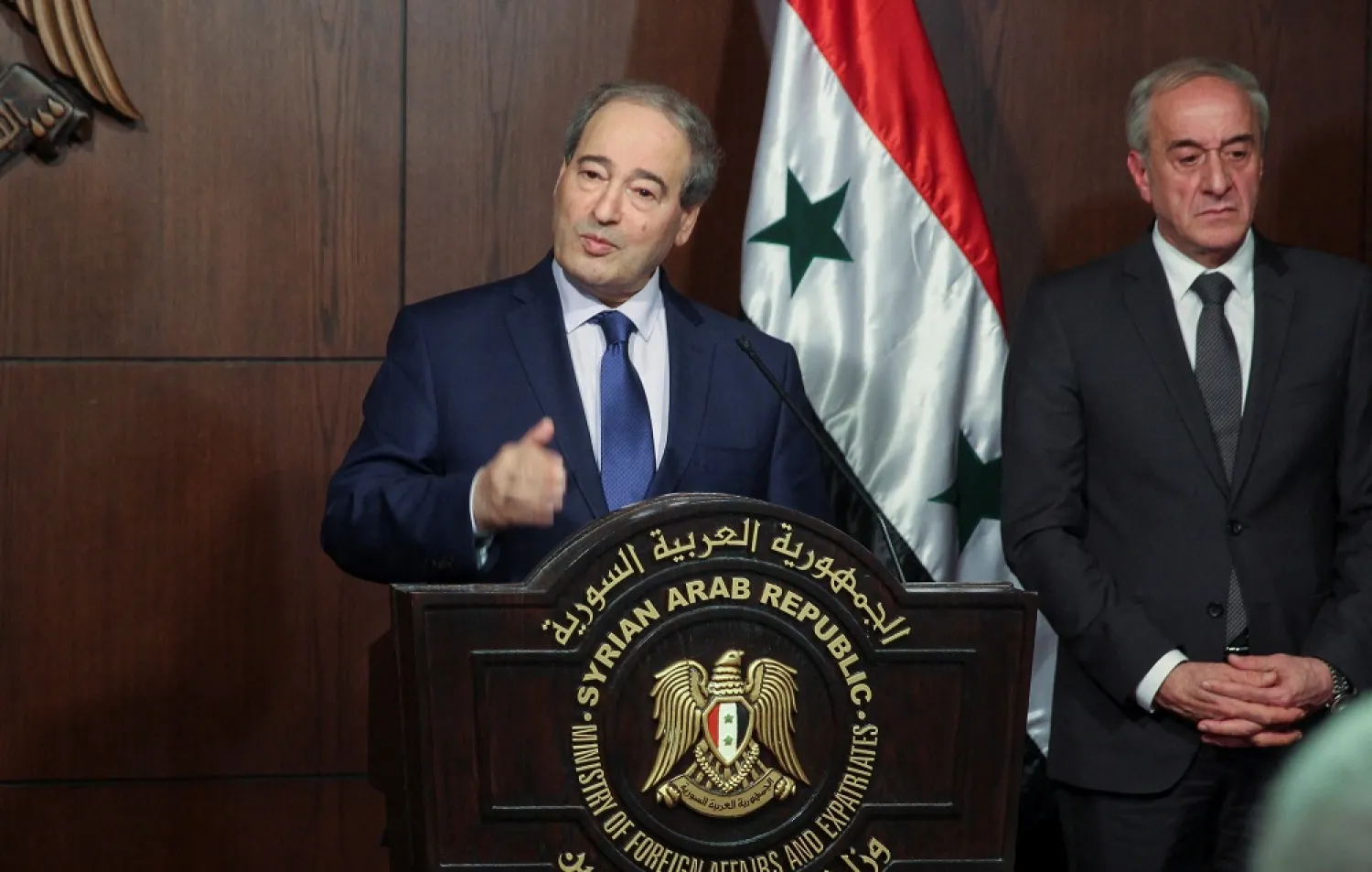
Syrian Foreign Minister Faisal Mikdad speaks during a joint news conference with Iranian foreign minister Hossein Amirabdollahian in Damascus, Syria January 14, 2023. (Reuters)
TT

Syrian FM: No Normal Ties with Türkiye without End to Occupation 

Syrian Foreign Minister Faisal Mikdad speaks during a joint news conference with Iranian foreign minister Hossein Amirabdollahian in Damascus, Syria January 14, 2023. (Reuters)

Syrian Foreign Minister Faisal Mikdad said on Saturday that Türkiye would have to end its military presence in his country to achieve a full rapprochement. 

"We cannot talk about resuming normal ties with Türkiye without removing the occupation," he said after meeting his Iranian counterpart in Damascus. 

Türkiye has been a major backer of the political and armed opposition to Syrian President Bashar al-Assad during the 12-year conflict in Syria, and has sent its own troops into swathes of the country's north. 

Russia, a key ally of Assad, is supporting a rapprochement between Damascus and Ankara, hosting talks between their defense ministers last month and aiming for meetings between the foreign ministers and eventually presidents. 

Mikdad said on Saturday "a meeting between Assad and the Turkish leadership depends on removing the reasons for the dispute," without providing more details or mentioning Turkish President Recep Tayyip Erdogan by name. 

Mekdad was speaking after meeting in Damascus with Hossein Amirabdollahian, the foreign minister of Assad’s other main ally, Iran. 

Amirabdollahian, who also met Assad on Saturday, said on Friday that Iran was "happy with the dialogue taking place between Syria and Türkiye". 

Assad said on Friday the results should be based on the principle of ending the occupation and support for terrorism, a term that Syrian authorities use to refer to all opposition armed groups. 

A source with close knowledge of the negotiations said Syria wanted Türkiye to pull its troops from swathes of the north and to halt support to three main opposition factions. 

The source said Syria was keen to see progress on those demands through follow-up committees before agreeing to a foreign ministers' meeting. 

Turkish Foreign Minister Mevlut Cavusoglu said on Thursday he could meet Mikdad early in February, rejecting reports the two could meet next week. 

Syria has made no official comment on the timing of any such meeting, which would mark the highest-level talks between Ankara and Damascus since the Syrian war began in 2011. 


Iraq Seizes More Cash and Gold in Oil Ministry Corruption Probe

Bundles of cash newly seized from the Deputy Oil Minister (Iraqi News Agency) 
TT

Iraq Seizes More Cash and Gold in Oil Ministry Corruption Probe

Bundles of cash newly seized from the Deputy Oil Minister (Iraqi News Agency) 

Iraqi authorities announced Monday the seizure of an additional 25 billion Iraqi dinars, $1 million in cash, and about five kilograms of gold in the corruption case involving detained Deputy Oil Minister for Refining Affairs Adnan Al-Jumaili and other suspects linked to the investigation.

Diaa Jaafar, the investigating judge at Iraq’s Central Anti-Corruption Criminal Court, said in a statement that total assets seized so far have risen to 127 billion Iraqi dinars and $24 million, in addition to real estate, vehicles, and gold jewelry confiscated during the investigation.

He said inquiries and efforts to track down other suspects were continuing until all legal procedures are completed.

Sources at Iraq’s Integrity Commission told Asharq Al-Awsat that the total value of assets seized from Al-Jumaili so far — including cash and 70 properties — exceeds 250 billion Iraqi dinars (about $191 million).

The Interior Ministry also announced Monday the arrest of another suspect connected to Al-Jumaili’s alleged corruption network in Salahuddin province. According to the ministry, intelligence officers seized more than $3 million, over 750 million Iraqi dinars, a cache of light weapons, modern vehicles, and government contracts from the suspect’s residence.

Iraqi authorities last week arrested 15 people, including lawmakers, heads of political blocs, and former governors, on corruption charges based on confessions allegedly made by Al-Jumaili. Security sources said the latest detainee serves as contracts director at the Baiji Refinery, where authorities discovered the cash during a raid on his home.

Despite broad public support for the government’s anti-corruption campaign, skepticism remains over whether Prime Minister Ali Al-Zaidi’s administration will sustain the drive rather than limiting it to a single wave of arrests. Public doubts have been fueled by Al-Zaidi’s earlier remarks suggesting the possibility of settlements under which suspects could regain their freedom after returning embezzled public funds.

Sources familiar with deliberations inside the ruling Shiite Coordination Framework told Asharq Al-Awsat that some coalition leaders have grown increasingly dissatisfied with the recent crackdown, with some urging the prime minister to halt the campaign for fear that arrests could reach figures affiliated with their factions. Although most Framework parties have publicly endorsed the anti-corruption drive, the sources said their private positions differ from their public statements.

Ghalib Al-Daami of the Iraqi Academy for Combating Corruption said investigations were proceeding on parallel domestic and international tracks, targeting suspects inside Iraq as well as fugitives abroad. He added that authorities are preparing action against businessmen accused of defaulting on billions of dollars in loans from Iraqi banks.

Al-Daami ruled out the prospect of releasing current detainees through financial settlements and said judicial and oversight authorities are pursuing 954 cases involving the recovery of assets smuggled abroad, in addition to 262 legal requests related to recovering funds transferred overseas by imprisoned corruption suspects.


US Keen to Form Alliance with Iraq, Syria Away from Iran’s Influence

Iraqi Prime Minister Ali al-Zaidi meets with US Envoy Tom Barrack in Baghdad on June 16, 2026. (Iraqi government press office)
TT

US Keen to Form Alliance with Iraq, Syria Away from Iran’s Influence

Iraqi Prime Minister Ali al-Zaidi meets with US Envoy Tom Barrack in Baghdad on June 16, 2026. (Iraqi government press office)

Three Syrian, Western, and Iraqi sources said Monday that Iraq and Syria are preparing to sign an economic agreement under US sponsorship during Iraqi Prime Minister Ali al-Zaidi’s visit to Washington in mid-July, in a move that could pave the way for a new alliance in the region that “moves away from the region’s anti-US camp.”

A Syrian source told Asharq Al-Awsat that Syrian Foreign Minister Asaad al-Shaibani is expected to travel to Washington in mid-July, where he is scheduled to meet with al-Zaidi or Iraqi officials accompanying him on the sidelines of the PMs visit.

A Western source said the talks would follow an anticipated meeting between al-Zaidi and US President Donald Trump at the White House.

According to the Syrian source, US Special Envoy Tom Barrack will sponsor the agreement between Baghdad and Damascus, with the possibility of other Arab countries joining at a later stage if ongoing technical and political understandings are finalized.

An Iraqi source neither confirmed nor denied whether al-Zaidi would meet Syrian officials in Washington. However, a political adviser in the previous Iraqi government said that “al-Zaidi’s team is making special preparations to sign a regional economic agreement that includes Syria.”

Another Iraqi source said al-Zaidi’s visit to Washington, scheduled to begin on July 15 and last about four days, will include meetings with the US president, Republican and Democratic congressional leaders, and representatives of American oil companies. He is then expected to travel to Texas for additional meetings with major energy firms.

A government official told Asharq Al-Awsat that “the prime minister will travel to Washington at the invitation of the US president, and the meeting with Trump tops the agenda,” while declining to disclose whether meetings with officials from other countries were also planned.

Syrian President Ahmed al-Sharaa meets with Iraqi Foreign Minister Fuad Hussein in Damascus. (Syrian Presidency)

‘Core alliance’

For weeks, the Iraqi government has focused on advancing two parallel tracks: bringing armed factions’ weapons under state control and integrating them into the security institutions, while pursuing individuals suspected of corruption, including figures believed to have ties to Iran’s Revolutionary Guard Corps (IRGC).

Baghdad has also shown an increasing tilt toward Washington as the US administration continues to press Iraq to reduce its dependence on Iranian influence.

Observers describe al-Zaidi’s government as “a promising opportunity” to reshape the regional balance of power as part of a new regional framework that could redefine relations between Baghdad, Washington, and Tehran.

These developments come as Iraq seeks to diversify its oil export routes and reduce reliance on traditional maritime shipping lanes, while Syria is betting on its geographic location to restore its role as a regional corridor for energy and trade.

The Western source said Barrack is working to translate his approach toward Iraq and Syria into concrete projects by establishing the “core of a new alliance of interests” linking Iraq, Syria, and regional partners through a shorter route to the Mediterranean, thereby reducing dependence on the Strait of Hormuz.

If concluded in its proposed form, the agreement would reflect a shift in the US approach toward the region, emphasizing cross-border infrastructure projects linking Iraq to the Mediterranean coast while giving Syria a greater role in reshaping regional energy flows.

A drone view of vessels anchored in the Strait of Hormuz as seen from Musandam, Oman, June 8, 2026. (Reuters)

Leaving Iran’s influence

An Iraqi researcher believes al-Zaidi’s visit could mark a transitional moment in Iraq’s regional realignment, similar to the shift that followed Syrian President Ahmed al-Sharaa’s visit to the White House in November 2025, which was widely viewed as a turning point in Syria’s move from the Iranian camp to the Western camp led by the United States.

Akeel Abbas, an expert on US affairs, told Asharq Al-Awsat that “the significance of al-Zaidi’s visit to Washington closely resembles al-Sharaa’s.”

Abbas, who is based in Washington, said the essence of al-Sharaa’s visit was Syria’s repositioning from a country opposed to the United States to a partner in the US-led international coalition against terrorism.

Washington wants to see Iraq follow a similar path through clear, measurable, and verifiable steps, including projects linking regional energy pipelines, he added.

“Washington wants this Baghdad-Damascus alliance to reduce the strategic importance of the Strait of Hormuz and limit its impact in the event of a second round of war with Iran,” he explained.


Al-Alimi: Iran Guards’ Flight out of Sanaa Is a Violation of Yemen’s Sovereignty

Chairman of Yemen’s Presidential Leadership Council Dr. Rashad Al-Alimi meets with the ambassadors on Monday. (SABA)
TT

Al-Alimi: Iran Guards’ Flight out of Sanaa Is a Violation of Yemen’s Sovereignty

Chairman of Yemen’s Presidential Leadership Council Dr. Rashad Al-Alimi meets with the ambassadors on Monday. (SABA)

Chairman of Yemen’s Presidential Leadership Council Dr. Rashad Al-Alimi slammed on Monday Iran’s Revolutionary Guards Corps (IRGC) for operating a flight out of Sanaa airport.

Meeting with ambassadors of countries that are sponsoring the political process in Yemen, he said the flight was a violation of Yemen’s sovereignty and an act of “defiance of international laws and relevant United Nations Security Council resolutions.”

The Iran-backed Houthis, who control Sanaa, claimed that the flight had a humanitarian purpose. Al-Alimi revealed, however, that reports indicate that military and security personnel, as well as experts in developing drones and rocket systems, were onboard.

He told the ambassadors that repeated cuts in aircraft tracing signals as the plane flew over Yemen contradict the Houthi claim that this was a humanitarian flight.

He urged an independent international probe to verify the purpose of the flight.

Moreover, he said the Mahan Air, which operated the flight, has been under international sanctions for years for providing logistic support to the IRGC.

Al-Alimi called for firmer international stances against “Iran’s flagrant meddling in Yemeni affairs and a strict implementation of Security Council resolutions and sanctions.”

He stressed that civilian flights and ports must not be used to transport military personnel and equipment.

Al-Alimi said that the stricter implementation of sanctions against the Houthi militias was a peaceful way to implement international resolutions. He also called for greater support to the legitimate Yemeni government, saying it was a “trusted partner in reviving state institutions, achieving peace, protecting waterways and combating terrorism and organized crimes.”

“Yemen is only asking that the international community defend the principles on which the international system is built on,” he went on to say.

“The threat will not stop at Yemeni borders should the armed factions get away with defying Security Council resolutions, violate sanctions, use civilian aircraft as cover for military operations, and threaten energy security and the global economy,” he warned.

“The issue in Yemen is today no longer an internal conflict, but a direct challenge to the international order and global economy that has become a hostage to the Iran’s militias in the region,” he stressed.

“The latest Iranian violation is a grave development and a deliberate attempt to test the international community’s ability to implement its decisions,” he added.

He accused Iran of seeking to shirk sanctions and impose a “new status quo by force”.

“As Iran continues to invest in militias and undermine the state, Saudi Arabia continues to invest in state institutions and development, improve Yemeni livelihoods and prepare the right conditions to achieve peace and stability in Yemen,” Al-Alimi said.

“The Yemeni republic harbors no animosity towards the Iranian people; it only seeks friendly relations between peoples. It, however, rejects the Iranian regime’s policies that are based on supporting militias and interfering in the internal affairs of nations,” he remarked.