



Young Egyptians Battle Plastic Plague

Environmental volunteers stand atop a pyramid of compressed plastic waste collected from the Nile, in Giza near the capital on "World Cleanup Day", September 17, 2022 © Ahmed HASAN / AFP/File
TT

Young Egyptians Battle Plastic Plague

Environmental volunteers stand atop a pyramid of compressed plastic waste collected from the Nile, in Giza near the capital on "World Cleanup Day", September 17, 2022 © Ahmed HASAN / AFP/File

Entrepreneurial young Egyptians are helping combat their country's huge plastic waste problem by recycling junk-food wrappers, water bottles and similar garbage that usually ends up in landfills or the Nile.

At a factory on the outskirts of Cairo, run by their startup TileGreen, noisy machines gobble up huge amounts of plastic scraps of all colours, shred them and turn them into a thick liquid.

The sludge -- made from all kinds of plastic, even single-use shopping bags -- is then moulded into dark, compact bricks that are used as outdoor pavers for walkways and garages.

"They're twice as strong as concrete," boasts co-founder Khaled Raafat, 24, slamming one onto the floor for emphasis.

Each tile takes about "125 plastic bags out of the environment", says his business partner Amr Shalan, 26, raising his voice above the din of the machines.

Raafat said the company uses even low-grade plastics and products "made of many different layers of plastic and aluminium that are nearly impossible to separate and recycle sustainably".

Microplastics in the water concentrate in marine life, threatening the health of people who consume seafood and fish caught in Africa's mighty waterway -- mirroring what has become a worldwide environmental scourge.

TileGreen, launched in 2021, aims to "recycle three billion to five billion plastic bags by 2025", said Shalan, AFP reported.

The start-up last year started selling its outdoor tiles, of which it has produced some 40,000 so far, and plans to expand into other products usually made from cement.

Egypt, a country of 104 million, has pledged to more than halve its annual consumption of single-use plastics by 2030 and to build multiple new waste management plants.

Low-quality plastics such as food wrappers are incinerated to power a cement factory which, Fawzy said, keeps "the environment clean with air filters and a sensitive monitoring system."

"We can't clean up the environment in one spot just to pollute elsewhere," he said.

The Egyptian programs are part of a battle against a global scourge.

Less than 10 percent of the world's plastic is recycled, according to the Organization for Economic Cooperation and Development.

The OECD said last year that annual production of fossil-fuel-based plastics is set to top 1.2 billion tonnes by 2060, with waste exceeding one billion tonnes.

In Egypt, activists have hailed what they see as a youth-led push for sustainability that has created demand for environmentally-minded solutions and products.

But while the change is welcome, they say it remains insufficient.

"What these initiatives have done is find a way to create a value chain, and there's clearly demand," said Mohamed Kamal, co-director of environmental group Greenish.



Back on Earth, Artemis II Crew Still Finding their Footing

HOUSTON, TEXAS - APRIL 16: Artemis II Commander Reid Wiseman, Pilot Victor Glover, Mission Specialist Christina Koch, and Mission Specialist Jeremy Hansen speak during a press conference at the NASA Johnson Space Center on April 16, 2026 in Houston, Texas. Danielle Villasana/Getty Images/AFP
TT

Back on Earth, Artemis II Crew Still Finding their Footing

HOUSTON, TEXAS - APRIL 16: Artemis II Commander Reid Wiseman, Pilot Victor Glover, Mission Specialist Christina Koch, and Mission Specialist Jeremy Hansen speak during a press conference at the NASA Johnson Space Center on April 16, 2026 in Houston, Texas. Danielle Villasana/Getty Images/AFP

Nearly a week after their Pacific splashdown, the astronauts who crewed the Artemis II mission that flew around the Moon told reporters Thursday they have yet to fully grasp the magnitude of the moment.

"It's been a week of medical testing, physical testing, doctors, science objectives," mission commander Reid Wiseman said during a press conference at NASA's Johnson Space Center in Houston.

"We have not had that decompression," he added.

The 50-year-old led fellow Americans Victor Glover and Christina Koch, and Canadian crewmate Jeremy Hansen, on a mission that took them farther into space than anyone has ever gone before.

Adjusting to life on Earth is taking a beat, AFP reported.

"Tomorrow will be one week, and I just was trying to live in a little hole for one week, been off social media, not on the news. So, no, I don't know," Glover, who piloted the mission, told reporters.

Nonetheless, he said his children and neighbors have clued him in to the excitement.

Artemis II was the first crewed mission to venture to the Moon's orbit since 1972, and the only one in history to include a woman, or a Black astronaut, or a non-American. Their voyage was broadcast live by US space agency NASA, and the media coverage of the launch and return to Earth was watched by millions of people.

For Koch, waking up to the reality means remembering gravity has taken hold.

"In the first few days, I thought I was floating. I truly thought I was floating, and I had to convince myself I wasn't," Koch said.

Their mission lasted almost 10 days, but NASA has ambitions to return to the Moon for longer visits to establish a base in preparation for future missions to Mars.

The United States is targeting a lunar landing in 2028, before the end of President Donald Trump's term and a deadline set by rivals in China.


Hidden Cave, Hippo Bones Under Welsh Castle May Rewrite History

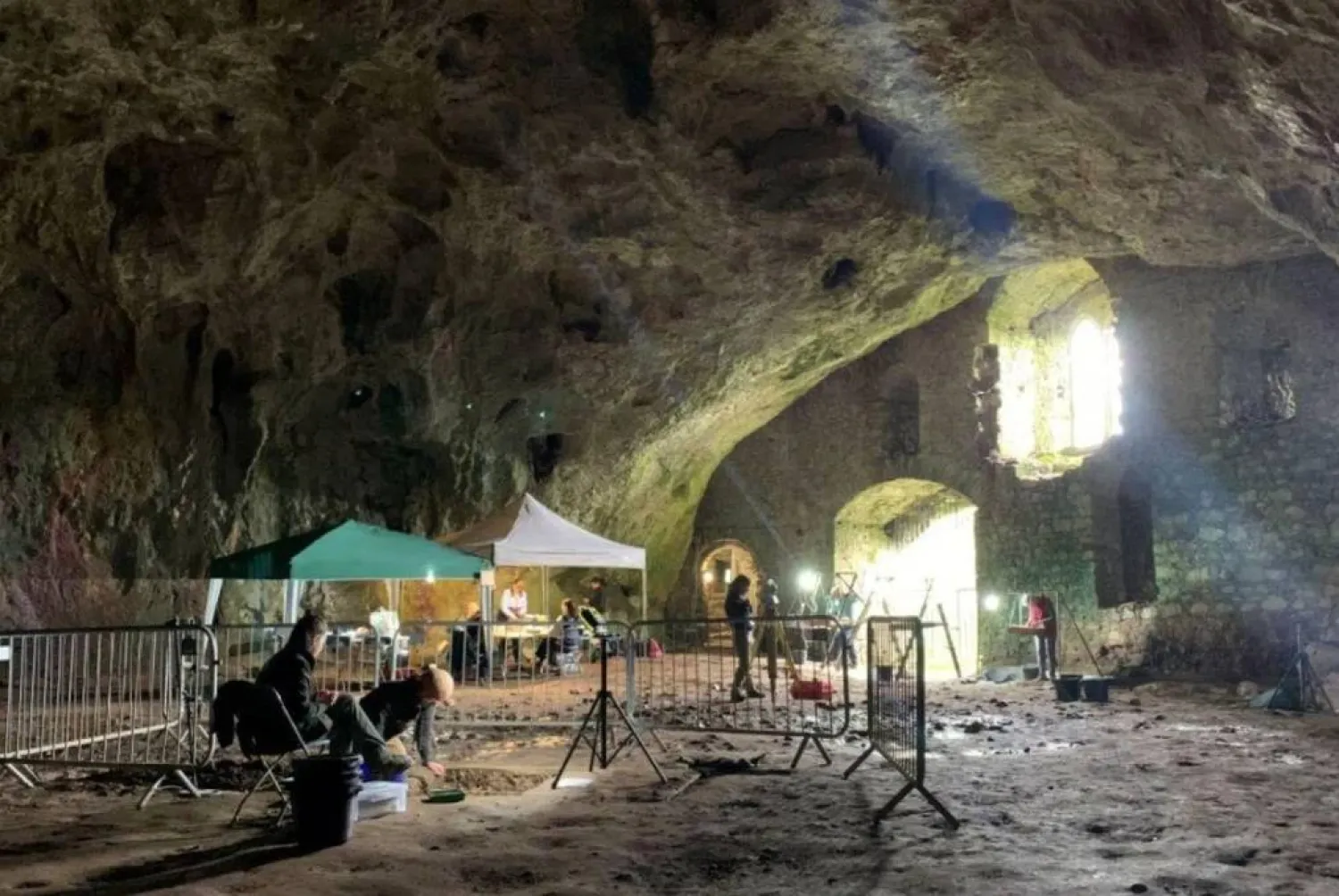
Previous small-scale excavations at Pembroke Castle have already uncovered evidence of early humans and animals. PHOTO: UNIVERSITY OF ABERDEEN
TT

Hidden Cave, Hippo Bones Under Welsh Castle May Rewrite History

Previous small-scale excavations at Pembroke Castle have already uncovered evidence of early humans and animals. PHOTO: UNIVERSITY OF ABERDEEN

A prehistoric hidden cave and hippo bones found beneath a Welsh castle could transform understanding of ancient life in Britain, researchers said Thursday, calling the site a "once-in-a-lifetime discovery".

Previous small-scale excavations at Pembroke Castle have already uncovered evidence of early humans and animals, including a now extinct hippopotamus that roamed Wales 120,000 years ago.

A major five-year archaeological project led by the University of Aberdeen will investigate the "enormous" cave, accessed via a spiral staircase from the 11th Century castle, AFP reported.

"There is no other site like it in Britain -- it is a once-in-a-lifetime discovery," said Rob Dinnis, who will lead the project.

The cave, previously thought to have been emptied by the Victorians, is now described as "one of the most important prehistoric archives in Britain".

"Despite the limited work done so far, we can already say that Wogan Cavern is a truly remarkable site," Dinnis said in a statement.

"Not only is there extremely rare evidence for early Homo sapiens, there are also hints at even earlier human occupation, probably by Neanderthals."

"We have also found hippo bones, which probably date to the last interglacial period, around 120,000 years ago," he added.

Earlier finds have revealed bones of mammoth, woolly rhinoceros, reindeer and wild horse, alongside stone tools and evidence of human occupation across multiple periods.

With larger-scale excavation due to resume in May, the researchers hope to gain "insights into past climate change, extinct species, and the multiple periods when humans called the cave their home".

They said the site could chart a long sequence of human activity, from hunter-gatherers after the last Ice Age around 11,500 years ago to some of Britain's earliest Homo sapiens between 45,000 and 35,000 years ago, and possibly even earlier Neanderthal presence.

"Wogan Cavern provides a unique chance to use all the scientific techniques now available to archaeologists," said professor Kate Britton of the University of Aberdeen.

"Because the bones are well preserved, we can learn a lot about past environments and ecosystems," she added.

At Pembroke Castle, staff say the discovery adds a new dimension to the site's long history as a medieval fortress and birthplace of Henry VII in 1457.

"This is incredibly exciting news for everyone at the castle," said castle manager Jon Williams.

"We are thrilled that work on this wonderful cave will continue."


Massive Asteroid Set to Pass ‘Close’ to Earth

The rare asteroid is expected to “safely pass” within 20,000 miles of Earth in 2029 (Shutterstock)
TT

Massive Asteroid Set to Pass ‘Close’ to Earth

The rare asteroid is expected to “safely pass” within 20,000 miles of Earth in 2029 (Shutterstock)

An asteroid named after a god of chaos is heading toward Earth — but there is no need to panic just yet, according to The Independent.

The massive rock is arriving for a historic flyby rather than a disaster, according to NASA. The encounter is still a few years away, but when it finally arrives, it will be so close that spotting it won’t even require a telescope.

Known as 99942 Apophis, the rare asteroid is expected to “safely pass” within 20,000 miles of Earth in 2029, representing one of the closest approaches ever recorded for a celestial object of this size.

“Even though Apophis does not pose any immediate risk to Earth, an asteroid of its size passing so close to our planet is a very rare event,” NASA astronomers stated. “Scientists across the globe are excited to use this opportunity to study Apophis in detail.”

At roughly 1,115 feet wide, the asteroid will pass closer to Earth than the satellites orbiting in geosynchronous altitude, according to NASA.

It will be the closest approach of an asteroid of this size that humans have ever been aware of in advance, according to the European Space Agency.

The rare timing of the flyby — falling on Friday, April 13, in many parts of the world, has already sparked a mix of excitement and superstition across social media.

The asteroid was named after the ancient Egyptian god of evil and destruction. The name was proposed by its discoverers — astronomers Roy Tucker, David Tholen and Fabrizio Bernardi of the Kitt Peak National Observatory near Tucson, Arizona — because Apophis is the Greek name for the Egyptian god known as Apep.

NASA reports that an asteroid of this scale passes this close to Earth only once every few thousand years on average, making it a potentially unprecedented event in recorded human history.