


Russian Embassy Says North Korea Lifted Lockdown in Capital

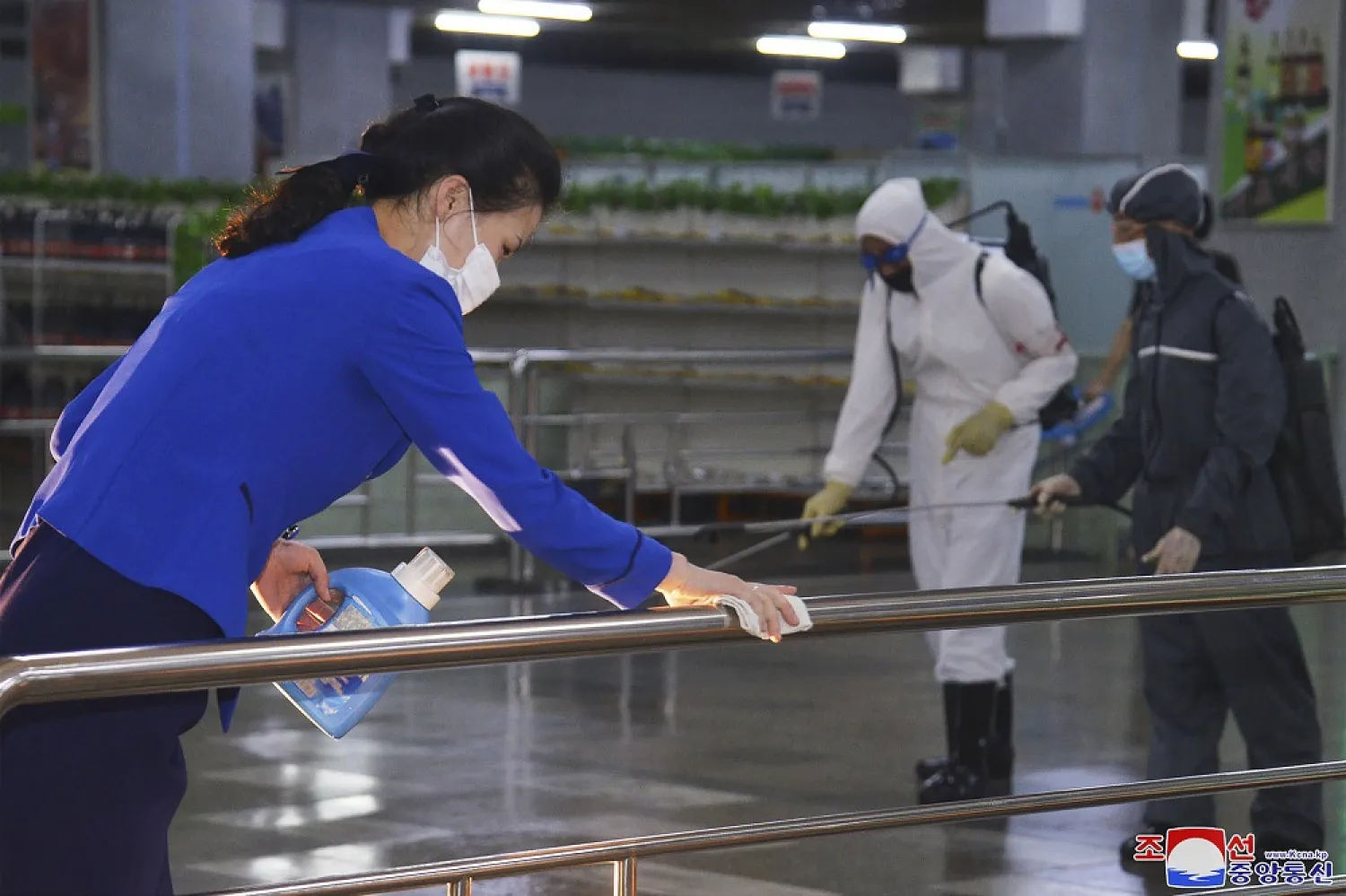
In this photo published on June 28, 2022 by the North Korean government, North Korean employees disinfect a facility at an underground store in Pyongyang, North Korea. (Korean Central News Agency/Korea News Service via AP, File)
TT

Russian Embassy Says North Korea Lifted Lockdown in Capital

In this photo published on June 28, 2022 by the North Korean government, North Korean employees disinfect a facility at an underground store in Pyongyang, North Korea. (Korean Central News Agency/Korea News Service via AP, File)

Russia’s embassy in North Korea says the country has eased stringent epidemic controls in capital Pyongyang that were placed during the past five days to slow the spread of respiratory illnesses.

North Korea has not officially acknowledged a lockdown in Pyongyang or a re-emergence of COVID-19 after leader Kim Jong Un declared a widely disputed victory over the coronavirus in August, but the Russian embassy’s Facebook posts have provided rare glimpses into the secretive country’s infectious disease controls.

The embassy posted a notice Monday issued by North Korea’s Foreign Ministry informing foreign diplomats that the “special anti-epidemic period” imposed in Pyongyang since Wednesday was lifted as of Monday.

Last week, the embassy said that North Korean health authorities required diplomatic missions to keep their employees indoors and also measure their temperatures four times a day and report the results to a hospital in Pyongyang. It said the North Korean measures were in response to an increase in “flu and other respiratory diseases,” but it didn’t mention the spread of COVID-19 or restrictions imposed on regular citizens.

Shortly before that post, NK News, a North Korea-focused news website, cited a North Korean government notice to report that health officials had imposed a five-day lockdown in Pyongyang in an effort to stem the spread of respiratory illnesses.

North Korean state media in recent weeks have stressed vigilance against a possible re-emergence of COVID-19. The official Rodong Sinmun newspaper, which previously described the anti-virus campaign as the “No. 1 priority” in national affairs, called for North Koreans to maintain a “sense of high crisis” Monday as COVID-19 continues to spread in neighboring countries.

North Korea maintains it has had no confirmed COVID-19 cases since Aug. 10, when Kim used a major political conference to declare the country has eradicated the coronavirus, just three months after the country acknowledged an omicron outbreak.

While Kim claimed that the country’s purported success against the virus would be recognized as a global health miracle, experts believe North Korea has manipulated disclosures on its outbreak to help him maintain absolute control.

From May to August, North Korea reported about 4.8 million “fever cases” across its population of 26 million but only identified a fraction of them as COVID-19. Experts say the country’s official death toll of 74 is abnormally small, considering the country’s lack of public health tools.

North Korea has dubiously insisted that rival South Korea was responsible for its COVID-19 outbreak, saying that the virus was transported by anti-Pyongyang propaganda leaflets and other materials flown across the border by balloons launched by South Korean civilian activists. South Korea has dismissed such claims as unscientific and “ridiculous.”



Iranian Traders and Shopkeepers Protest as Currency Hits Record Low

 People shop at Tajrish Bazaar in the Iranian capital Tehran on December 29, 2025. (AFP)
People shop at Tajrish Bazaar in the Iranian capital Tehran on December 29, 2025. (AFP)
TT

Iranian Traders and Shopkeepers Protest as Currency Hits Record Low

 People shop at Tajrish Bazaar in the Iranian capital Tehran on December 29, 2025. (AFP)
People shop at Tajrish Bazaar in the Iranian capital Tehran on December 29, 2025. (AFP)

Iranian traders and shopkeepers staged a second day of protests Monday after the country’s currency plummeted to a new record low against the US dollar.

Videos on social media showed hundreds taking part in rallies in Saadi Street in downtown Tehran, as well as in the Shush neighborhood near Tehran's main Grand Bazaar, which played a crucial role in the 1979 revolution that ousted the monarchy and brought clerics to power.

Witnesses told The Associated Press that traders shut their shops and asked others to do the same. The semiofficial ILNA news agency said many businesses and merchants stopped trading even though some kept their shops open.

There was no reports of police raids though security was tight at the protests, according to witnesses.

On Sunday, protest gatherings were limited to two major mobile market in downtown Tehran, where the demonstrators chanted anti-government slogans.

Iran's rial on Sunday plunged to 1.42 million to the dollar. On Monday, it traded at 1.38 million rials to the dollar.

The rapid depreciation is compounding inflationary pressure, pushing up prices of food and other daily necessities and further straining household budgets, a trend that could worsen by a gasoline price change introduced in recent days.

According to the state statistics center, inflation rate in December rose to 42.2% from the same period last year, and is 1.8% higher than in November. Foodstuff prices rose 72% and health and medical items were up 50% from December last year, according to the statistics center. Many critics see the rate a sign of an approaching hyperinflation.

Reports in official Iranian media said that the government plans to increase taxes in the Iranian new year that begins March 21 have caused more concern.

Iran’s currency was trading at 32,000 rials to the dollar at the time of the 2015 nuclear accord that lifted international sanctions in exchange for tight controls on Iran’s nuclear program. That deal unraveled after US President Donald Trump unilaterally withdrew the United States from it in 2018.

There is also uncertainty over the risk of renewed conflict following June’s 12-day war involving Iran and Israel. Many Iranians also fear the possibility of a broader confrontation that could draw in the United States, adding to market anxiety.

In September, the United Nations reimposed nuclear-related sanctions on Iran through what diplomats described as the “snapback” mechanism. Those measures once again froze Iranian assets abroad, halted arms transactions with Tehran and imposed penalties tied to Iran’s ballistic missile program.


Israel’s Supreme Court Suspends Govt Move to Shut Army Radio

Israeli troops during a military operation in the Palestinian village of Qabatiya, near the West Bank city of Jenin, 27 December 2025. (EPA)
TT

Israel’s Supreme Court Suspends Govt Move to Shut Army Radio

Israeli troops during a military operation in the Palestinian village of Qabatiya, near the West Bank city of Jenin, 27 December 2025. (EPA)

Israel's Supreme Court has issued an interim order suspending a government decision to shut down Galei Tsahal, the country's decades-old and widely listened-to military radio station.

In a ruling issued late Sunday, Supreme Court President Isaac Amit said the suspension was partly because the government "did not provide a clear commitment not to take irreversible steps before the court reaches a final decision".

He added that Attorney General Gali Baharav-Miara supported the suspension.

The cabinet last week approved the closure of Galei Tsahal, with the shutdown scheduled to take effect before March 1, 2026.

Founded in 1950, Galei Tsahal is widely known for its flagship news programs and has long been followed by both domestic and foreign correspondents.

A government audience survey ranks it as Israel's third most listened-to radio station, with a market share of 17.7 percent.

Prime Minister Benjamin Netanyahu had urged ministers to back the closure, saying there had been repeated proposals over the years to remove the station from the military, abolish it or privatize it.

But Baharav-Miara, who also serves as the government's legal adviser and is facing dismissal proceedings initiated by the premier, has warned that closing the station raised "concerns about possible political interference in public broadcasting".

She added that it "poses questions regarding an infringement on freedom of expression and of the press".

Defense Minister Israel Katz said last week that Galei Tsahal broadcasts "political and divisive content" that does not align with military values.

He said soldiers, civilians and bereaved families had complained that the station did not represent them and undermined morale and the war effort.

Katz also argued that a military-run radio station serving the general public is an anomaly in democratic countries.

Opposition leader Yair Lapid had condemned the closure decision, calling it part of the government's effort to suppress freedom of expression ahead of elections.

Israel is due to hold parliamentary elections in 2026, and Netanyahu has said he will seek another term as prime minister.


Thai Army Accuses Cambodia of Violating Truce with over 250 Drones

Displaced residents rest in a bunker in Thailand's Surin province on December 11, 2025, amid clashes along the Thai-Cambodia border. (AFP)
TT

Thai Army Accuses Cambodia of Violating Truce with over 250 Drones

Displaced residents rest in a bunker in Thailand's Surin province on December 11, 2025, amid clashes along the Thai-Cambodia border. (AFP)

Thailand's army on Monday accused Cambodia of violating a newly signed ceasefire agreement, reached after weeks of deadly border clashes, by flying more than 250 drones over its territory.

The Thai army said "more than 250 unmanned aerial vehicles (UAVs) were detected flying from the Cambodian side, intruding into Thailand's sovereign territory" on Sunday night, according to a statement.

"Such actions constitute provocation and a violation of measures aimed at reducing tensions, which are inconsistent with the Joint Statement agreed" during a bilateral border committee meeting on Saturday, it added.

Cambodian Foreign Minister Prak Sokhonn said in remarks aired on state television on Monday that the two sides had discussed the incident and agreed to investigate and "resolve it immediately".

Prak Sokhonn described it as "a small issue related to flying drones seen by both sides along the border line".

Thailand and Cambodia agreed to the "immediate" ceasefire on Saturday, pledging to end renewed border clashes that killed dozens of people and displaced more than a million this month.

The reignited fighting spread to nearly every border province on both sides, shattering an earlier truce for which US President Donald Trump took credit.

Under the agreement signed on Saturday, the Southeast Asian neighbors agreed to cease fire, freeze troop movements and cooperate on demining efforts and combatting cybercrime.