NATO's Chief Urges South Korea to Step up Military Support for Ukraine

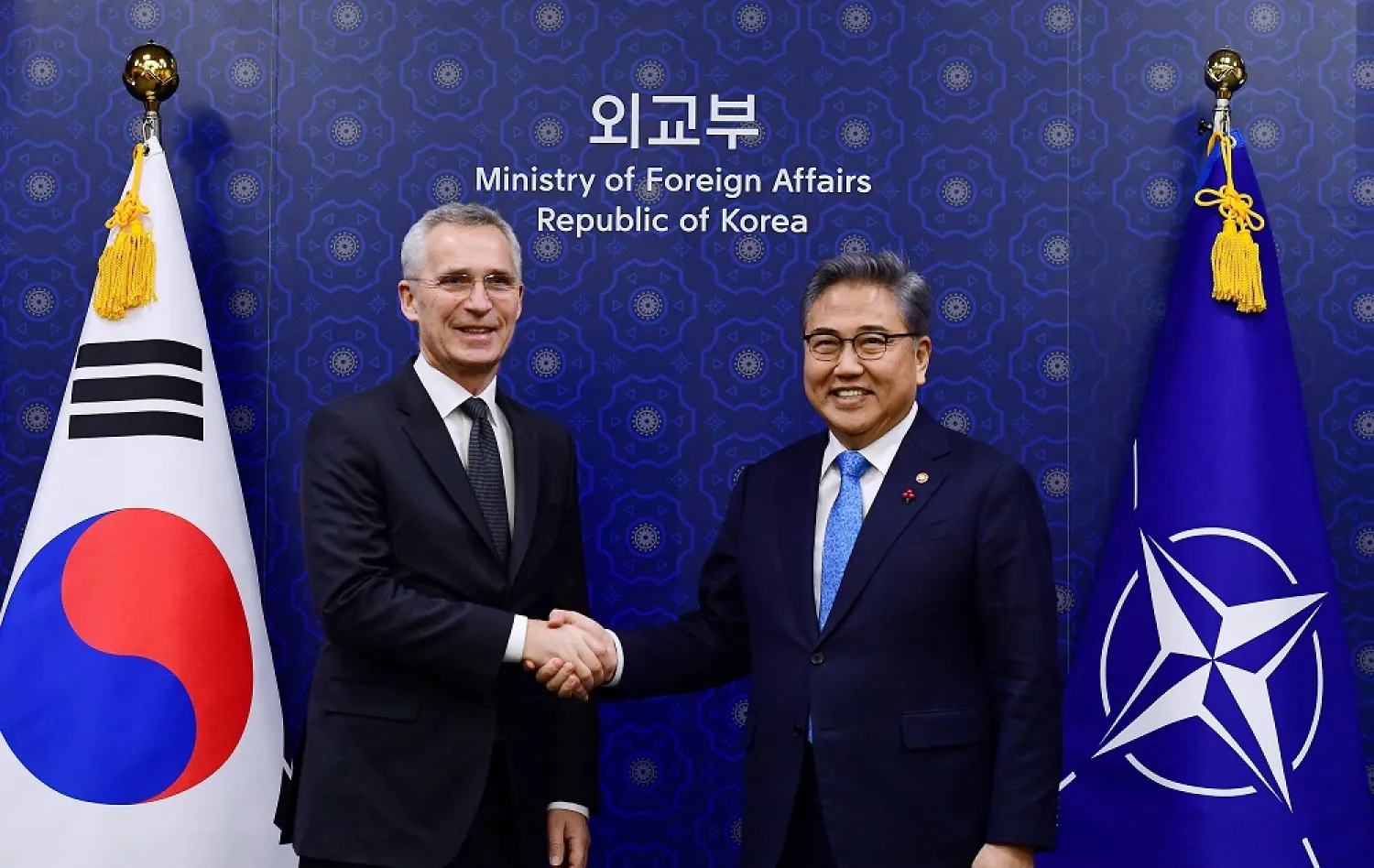
NATO Secretary General Jens Stoltenberg shakes hands with South Korean Foreign Minister Park Jin during their meeting at the Foreign Ministry in Seoul, South Korea January 29, 2023. (Reuters)
TT

NATO's Chief Urges South Korea to Step up Military Support for Ukraine

NATO Secretary General Jens Stoltenberg shakes hands with South Korean Foreign Minister Park Jin during their meeting at the Foreign Ministry in Seoul, South Korea January 29, 2023. (Reuters)

NATO Secretary-General Jens Stoltenberg urged South Korea on Monday to increase military support to Ukraine, citing other countries that have changed their policy of not providing weapons to countries in conflict after Russia's invasion.

Stoltenberg is in Seoul, the first stop on a trip that will include Japan and is aimed at strengthening ties with US allies in the face of the war in Ukraine and rising competition with China.

Speaking at the Chey Institute for Advanced Studies in Seoul, he thanked South Korea for its non-lethal aid to Ukraine, but urged it to do more, adding there is an "urgent need" for ammunition. Russia calls the invasion a "special operation".

"I urge the Republic of Korea to continue and to step up on the specific issue of military support," he said. "At the end of the day, it's a decision for you to make, but I'll say that several NATO allies who have had as a policy to never export weapons to countries in a conflict have changed that policy now."

In meetings with senior South Korean officials, Stoltenberg argued that events in Europe and North America are interconnected with other regions, and that the alliance wants to help manage global threats by increasing partnerships in Asia.

South Korea has signed major deals providing hundreds of tanks, aircraft and other weapons to NATO member Poland since the war began, but South Korean President Yoon Suk-yeol has said that his country's law against providing arms to countries in conflicts makes providing weapons to Ukraine difficult.

Stoltenberg noted that countries such as Germany, Sweden, and Norway had similar policies but changed them.

"If we don't want autocracy and tyranny to win, then they need weapons, that's the reality," he said, referring to Ukraine.

The NATO chief said it was "extremely important" that Russia doesn't win this war, not only for the Ukrainians but also to avoid sending a wrong message to authoritarian leaders, including in Beijing, that they can get what they want by force.

Although China is not NATO's adversary, it has become "much higher" on NATO's agenda, Stoltenberg said, citing Beijing's rising military capabilities and coercive behavior in the region.

"We believe that we should engage with China on issues like arms control, climate change and other issues," he said. "But at the same time, we are very clear that China poses a challenge to our values, to our interests, and to our security."

In a statement carried by state media on Monday, North Korea called Stoltenberg's visit a "prelude to confrontation and war as it brings the dark clouds of a 'new Cold War' to the Asia-Pacific region."

Last year South Korea opened its first diplomatic mission to NATO, vowing to deepen cooperation on non-proliferation, cyber defense, counter-terrorism, disaster response and other security areas.

The NATO chief's visit also comes as US Defense Secretary Lloyd Austin was due to arrive in Seoul on Monday for talks with his South Korean counterpart Lee Jong-sup.


Thai Army Accuses Cambodia of Violating Truce with over 250 Drones

Displaced residents rest in a bunker in Thailand's Surin province on December 11, 2025, amid clashes along the Thai-Cambodia border. (AFP)
TT

Thai Army Accuses Cambodia of Violating Truce with over 250 Drones

Displaced residents rest in a bunker in Thailand's Surin province on December 11, 2025, amid clashes along the Thai-Cambodia border. (AFP)

Thailand's army on Monday accused Cambodia of violating a newly signed ceasefire agreement, reached after weeks of deadly border clashes, by flying more than 250 drones over its territory.

The Thai army said "more than 250 unmanned aerial vehicles (UAVs) were detected flying from the Cambodian side, intruding into Thailand's sovereign territory" on Sunday night, according to a statement.

"Such actions constitute provocation and a violation of measures aimed at reducing tensions, which are inconsistent with the Joint Statement agreed" during a bilateral border committee meeting on Saturday, it added.

Cambodian Foreign Minister Prak Sokhonn said in remarks aired on state television on Monday that the two sides had discussed the incident and agreed to investigate and "resolve it immediately".

Prak Sokhonn described it as "a small issue related to flying drones seen by both sides along the border line".

Thailand and Cambodia agreed to the "immediate" ceasefire on Saturday, pledging to end renewed border clashes that killed dozens of people and displaced more than a million this month.

The reignited fighting spread to nearly every border province on both sides, shattering an earlier truce for which US President Donald Trump took credit.

Under the agreement signed on Saturday, the Southeast Asian neighbors agreed to cease fire, freeze troop movements and cooperate on demining efforts and combatting cybercrime.


Mexican Train Derailment Kills at Least 13 People, 98 Injured

Authorities work at the site of train derailment on the Interoceanic Corridor of the Isthmus of Tehuantepec, a railway line connecting Mexico's Pacific and Gulf coasts, where several passengers were killed and injured near Nizanda, Oaxaca state, Mexico, December, 28, 2025. (Reuters)
TT

Mexican Train Derailment Kills at Least 13 People, 98 Injured

Authorities work at the site of train derailment on the Interoceanic Corridor of the Isthmus of Tehuantepec, a railway line connecting Mexico's Pacific and Gulf coasts, where several passengers were killed and injured near Nizanda, Oaxaca state, Mexico, December, 28, 2025. (Reuters)

Mexican authorities said on Sunday that at least 13 people ​were killed after an Interoceanic Train carrying 250 people derailed in the southern state of Oaxaca.

The Mexican Navy said the train, which derailed near the town of Nizanda, was carrying nine crew members and 241 passengers.

Of those on board, 139 were reported to be out of ‌danger, while 98 ‌were injured, including 36 ‌who ⁠were ​receiving medical assistance.

President ‌Claudia Sheinbaum said on X that five of the injured were in critical condition, adding that senior officials had been dispatched to the site to assist the families of those killed.

The governor of Oaxaca, Salomon Jara Cruz, expressed condolences to the families ⁠of those killed in the accident and said state authorities ‌were coordinating with federal agencies to ‍assist those affected.

Mexico's Attorney ‍General's Office has already opened an investigation into ‍the incident, Attorney General Ernestina Godoy Ramos said in a social media post.

The Interoceanic Train, inaugurated in 2023 under former President Andres Manuel Lopez Obrador, forms ​part of the broader Interoceanic Corridor project.

The initiative was designed to modernize the rail link across ⁠the Isthmus of Tehuantepec, connecting Mexico's Pacific port of Salina Cruz with Coatzacoalcos on the Gulf Coast.

The Mexican government has sought to develop the isthmus into a strategic trade corridor, expanding ports, railways and industrial infrastructure with the goal of creating a route that could compete with the Panama Canal.

The train service is also part of a broader push to expand passenger and freight rail ‌in southern Mexico and stimulate economic development in the region.


North Korea Says It Tested Long-Range Cruise Missiles

A person watches a TV news report at Seoul Station in Seoul, South Korea, 29 December 2025. According to South Korea's Joint Chiefs of Staff (JCS), North Korea launched several long-range strategic cruise missiles on 28 December. (EPA)
TT

North Korea Says It Tested Long-Range Cruise Missiles

A person watches a TV news report at Seoul Station in Seoul, South Korea, 29 December 2025. According to South Korea's Joint Chiefs of Staff (JCS), North Korea launched several long-range strategic cruise missiles on 28 December. (EPA)

North Korea said Monday it fired long-range strategic cruise missiles into the sea to test the country’s nuclear deterrence, days after it showed apparent progress in the construction of its first nuclear-powered submarine.

Sunday’s launches were the latest weapons display by North Korea ahead of its planned ruling Workers’ Party congress early next year. Keen outside attention on the congress, the first of its kind in five years, will be on whether North Korean leader Kim Jong Un will establish new priorities in relations with the US and respond to Washington's calls to resume long-dormant talks.

The official Korean Central News Agency reported that Kim expressed “great satisfaction” over Sunday's launches, which occurred off the country’s west coast. It said Kim noted that testing the reliability of North Korea's nuclear deterrence and demonstrating its might are “just a responsible exercise of the right to self-defense and war deterrence” in the face of external security threats.

South Korea’s Joint Chiefs of Staff said it was aware of several cruise missile launches made from North Korea’s capital region on Sunday morning. It said South Korea maintains a readiness to repel any potential North Korean provocations through its alliance with the United States.

UN Security Council resolutions prohibit North Korea from launches involving its huge stockpile of ballistic missiles. Its cruise missile tests aren’t banned, but they still pose a threat to the US and South Korea because they are highly maneuverable and fly at low altitudes to avoid radar detection. Analysts say North Korea would aim to use cruise missiles to strike US warships and aircraft carriers in the event of conflict.

Last week, North Korea test-launched new anti-air missiles off its east coast and displayed photos showing a largely completed hull of a developmental nuclear-powered submarine. North Korea implied it would arm the submarine with nuclear missiles.

A nuclear-powered submarine is among a slew of sophisticated weapons systems that Kim has vowed to introduce to cope with what he describes as US-led security threats. Some experts say North Korea’s recent alignment with Russia — including sending thousands of troops and military equipment to support President Vladimir Putin’s war in Ukraine — may have helped it to receive crucial technologies in return.

North Korea has focused on weapons-testing activities to expand its nuclear arsenal since Kim's high-stakes nuclear diplomacy with US President Donald Trump collapsed in 2019.

But in an apparent response to Trump’s repeated outreach, Kim suggested in September that he could return to talks if the US drops “its delusional obsession with denuclearization” of North Korea. Experts say Kim might think his enlarged nuclear arsenal would give him greater leverage to wrest concessions in potential talks with Trump.