


Israel Probes Legality of US Giving Artifact to Palestinians

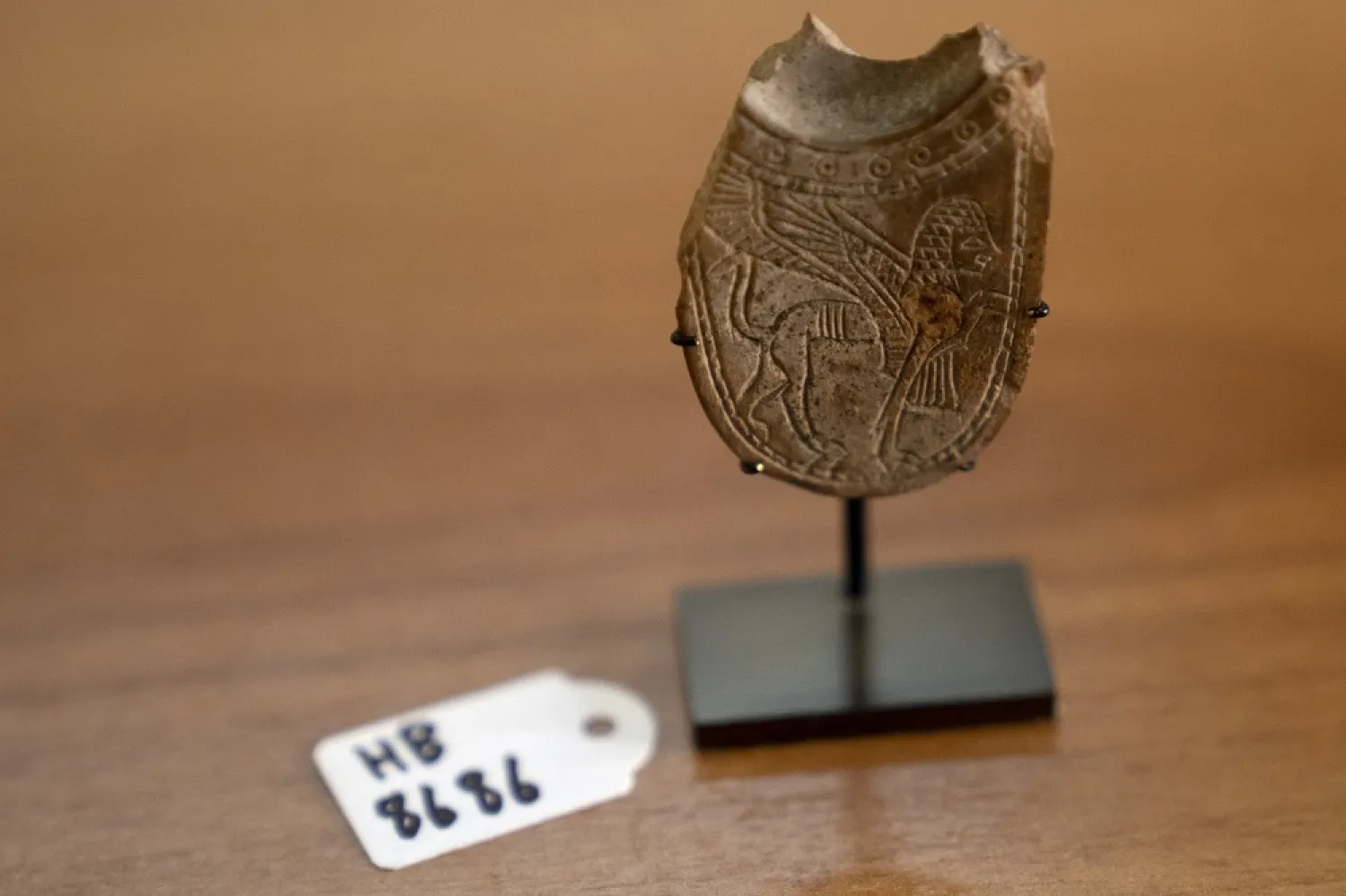
A 2,700-year-old ivory incense spoon plundered from a site in the occupied West Bank — seized in late 2021 by the Manhattan District Attorney's office as part of a plea deal with billionaire hedge fund manager Michael Steinhardt, displayed at the Palestinian Ministry of Tourism and Antiquities in the West Bank city of Bethlehem, Thursday, Jan. 19, 2023. (AP)
TT

Israel Probes Legality of US Giving Artifact to Palestinians

A 2,700-year-old ivory incense spoon plundered from a site in the occupied West Bank — seized in late 2021 by the Manhattan District Attorney's office as part of a plea deal with billionaire hedge fund manager Michael Steinhardt, displayed at the Palestinian Ministry of Tourism and Antiquities in the West Bank city of Bethlehem, Thursday, Jan. 19, 2023. (AP)

An ivory spoon dating back 2,700 years that was recently repatriated to the Palestinian Authority from the United States has sparked a dispute with Israel's new far-right government over the cultural heritage in the occupied West Bank.

The clash brings into focus the political sensitivities surrounding archaeology in the Middle East, where Israelis and Palestinians each use ancient artifacts to support their claims over the land.

Israel's ultranationalist heritage minister has ordered officials to examine the legality of the US government's historic repatriation of the artifact to the Palestinians earlier this month, and is calling for annexing archaeology in the occupied West Bank.

The artifact — a cosmetic spoon made of ivory and believed to have been plundered from a site in the West Bank — was seized in late 2021 by the Manhattan District Attorney's office as part of a deal with the New York billionaire hedge fund manager Michael Steinhardt.

It was one of 180 artifacts illegally looted and purchased by Steinhardt that he surrendered as part of an agreement to avoid prosecution.

American officials handed an artifact over to the Palestinian Ministry of Tourism and Antiquities on Jan. 5 in what the US State Department’s Office of Palestinian Affairs said was "the first event of such repatriation" by the US to the Palestinians.

Dozens of Steinhardt’s surrendered artifacts have already been repatriated to Italy, Bulgaria, Greece, Türkiye, Jordan, Libya and Israel. This spoon was the first and only item ever to be repatriated to the Palestinians.

The repatriation coincided with the first weeks of Israel's new government, which is composed of ultranationalists who see the West Bank as the biblical heartland of the Jewish people and inextricably linked to the state of Israel.

Heritage Minister Amihai Eliyahu’s office said last week that the legality of the repatriation "is being examined by the archaeology staff officer with the legal counsel, which will examine all aspects of the matter, including the Oslo Accords that the US has signed."

The case underscores how archaeology and cultural heritage are intertwined with the competing claims of the Israelis and Palestinians in the decades-long conflict.

"Any artifact that we know that it comes out illegally from Palestine, we have the right to have it back," said Jihad Yassin, director general of excavations and museums in the Palestinian Tourism and Antiquities Ministry. "Each artifact says a story from the history of this land."

The ministry is part of the Palestinian Authority, the government established as part of the Oslo Accords in the 1990s that exercises limited autonomy in parts of the Israeli-occupied West Bank.

Those agreements between Israel and the Palestinians were supposed to include coordination on a raft of issues, including archaeology and cultural heritage.

But the agreements have largely unraveled. Yassin said that the archaeology committee has not met in around two decades, and that there is virtually zero coordination between Israel and the Palestinians concerning antiquities theft prevention in the West Bank.

"We try to do our best to protect these archaeological sites, but we face difficulties," he said.

Yassin said that around 60% of the West Bank's archaeological sites are in territory under complete Israeli military control, and that his ministry's theft prevention workers "manage to control in a high percentage the looting" in areas under Palestinian Authority control.

Nonetheless, many of the illicit artifacts that have made their way to Israel's legal antiquities market were looted from the West Bank, he said.

According to court documents, Steinhardt bought the ivory cosmetic spoon in 2003 from Israeli antiquities dealer Gil Chaya for $6,000. The artifact had no provenance — paperwork detailing where it came from and how it had entered the dealer's inventory — but Chaya said the object was from the West Bank town of El-Koum, which is under Palestinian Authority control.

Another artifact believed to have been looted from the same town, a "Red Carnelian Sun Fish amulet (that) dates to circa 600 B.C.E.," remains missing, according to the DA's office. Steinhardt has yet to locate the item, but if it is found, it will be repatriated to the Palestinians, the office said.

American authorities returned 28 objects to Israel last year, not including three that were seized in place at the Israel Museum of Jerusalem. Seven others meant to be returned to Israel have yet to be found. Several of the items returned to Israel are believed to have been looted from the West Bank.

The Israel Antiquities Authority declined comment on the artifact’s repatriation to the Palestinians.

Heritage Minister Eliyahu, a religious ultranationalist in Netanyahu's government now in charge of the country’s Antiquities Authority, denies the existence of a Palestinian people.

Since taking office, he has accused the Palestinian Authority of committing "national terrorism" and "erasing heritage" at an archaeological site in a Palestinian-controlled area near the West Bank city of Nablus.

It remains unclear what impact, if any, a review by the ministry's legal counsel could have. It appears unlikely Israel could confiscate the artifact from the Palestinians, but a legal opinion against the move could potentially complicate future repatriations.

Earlier this week, Eliyahu said he would be giving the Israel Antiquities Authority full control over archaeological sites, cultural heritage and theft prevention throughout the West Bank — a move that critics say would in effect apply Israeli law over occupied territory in breach of international law.

Currently, archaeological excavations and antiquities in the West Bank are managed by the Civil Administration's archaeology staff officer, which is part of the Defense Ministry. Israel has not formally annexed the West Bank, and the territory is treated as occupied and is governed under military law.

"All heritage on both sides of the green line will earn full protection, at an international and scientific standard," Eliyahu wrote in a Facebook post on Sunday. He said the state of Israel would "act in a uniform and professional manner from the (Mediterranean) sea to the Jordan."

Alon Arad, director of Israeli cultural heritage non-governmental organization Emek Shaveh, said that putting the Israel Antiquities Authority in charge of archaeology in the occupied territory was "activating Israeli law in the West Bank, which means annexation."

Eliyahu’s office declined repeated interview requests.

Yassin said that for the time being, the artifact will remain at the ministry, where it will be studied by one of its archaeologists. Then, he said, it will be displayed at one of the West Bank's museums.

"It's not the only one," Yassin said. "It is the beginning."


Olympic Tourists in Cortina Can Explore the Dolomites with the New ‘Uber Snowmobile’ Service

 The peaks of the Dolomites are seen from the Cortina Sliding Centre during the Milano Cortina 2026 Winter Olympic Games in Cortina d'Ampezzo on February 5, 2026. (AFP)
The peaks of the Dolomites are seen from the Cortina Sliding Centre during the Milano Cortina 2026 Winter Olympic Games in Cortina d'Ampezzo on February 5, 2026. (AFP)
TT

Olympic Tourists in Cortina Can Explore the Dolomites with the New ‘Uber Snowmobile’ Service

 The peaks of the Dolomites are seen from the Cortina Sliding Centre during the Milano Cortina 2026 Winter Olympic Games in Cortina d'Ampezzo on February 5, 2026. (AFP)
The peaks of the Dolomites are seen from the Cortina Sliding Centre during the Milano Cortina 2026 Winter Olympic Games in Cortina d'Ampezzo on February 5, 2026. (AFP)

The peaks of the Dolomites are seen from the Cortina Sliding Centre during the Milano Cortina 2026 Winter Olympic Games in Cortina d'Ampezzo on February 5, 2026. (AFP)

For one month starting on Saturday, Olympic spectators keen for a side trip to a UNESCO World Heritage Site can use Uber to reserve a ride on a snowmobile along the snow-covered road to the base of the Three Peaks of Lavaredo.

The dramatic, jagged limestone pinnacles stand just 23 kilometers (14.3 miles) from the Cortina venues where athletes are competing in the 2026 Winter Olympics and Paralympics.

One of the Olympic torchbearers, Giulia Baffetti, runs snowmobiling tours through Cortina-based winter activities outfit Snowdreamers. The company partnered with Uber, the official ride-hailing sponsor for the Games, to offer free tours on the weekends in February to people in town.

"Uber Snowmobile" tours, which can only be booked through Uber, include a ride in an Uber transfer bus for up to eight people from Cortina to the spot where riders mount their snowmobiles for departure. Tourgoers then follow the instructor, who leads the line of snowmobiles.

The first slots offered went fast, but Uber spokesperson Caspar Nixon said Friday that it planned to add more.

The three peaks are a magical place, Baffetti said, and this is a way for more people to experience it. Hikers and climbers flock there in the warmer months. In the winter, it’s a prime spot for cross-country skiing, snowshoeing and sledding. Snowmobiling is allowed in a limited area in order to protect the environment.

"We want to give an experience to the tourists, so they can feel the mountains in a different way," she said.

The Associated Press took the one-hour tour on Thursday, ahead of the Saturday launch, along with one other person. Helmets are essential, while heated handgrips are a most welcome feature. And that red button? Passengers can push it to stop the snowmobile if it veers off course or they feel unsafe.

The adrenaline-filled ride reaches speeds up to 40 kph (25 mph) when zooming past snow-covered trees, and drivers are instructed to slow when coming upon cross-country skiers and sledders. Deer and wolves are sometimes seen along the 7-kilometer (4.3-mile) route up to the base of the peaks.

Also visible on Thursday was the southernmost of the three Lavaredo peaks, rising sharply out of the fog. While the Dolomites are breathtaking from Cortina — and on Friday, the sun shone and the view was clear from town — they are even more impressive up close.

The route back includes a short loop around Lake Antorno. Before traversing all the ups and downs, the snowmobile instructor leading the tour offers a reminder about that red button.

Saher Deeb, an Israeli tourist, was along for the ride Thursday, one day after his 29th birthday. It was his first time on a snowmobile, and he was all smiles as he climbed off at the end.

"It was perfect," he said.


French Duo Finish Walking from France to Shanghai After 1.5 Years

 Performers throw molten iron to create sparks during a performance on the Bund promenade along the Huangpu river, ahead of the upcoming Lunar New Year of the Horse in Shanghai on February 2, 2026. (AFP)
Performers throw molten iron to create sparks during a performance on the Bund promenade along the Huangpu river, ahead of the upcoming Lunar New Year of the Horse in Shanghai on February 2, 2026. (AFP)
TT

French Duo Finish Walking from France to Shanghai After 1.5 Years

 Performers throw molten iron to create sparks during a performance on the Bund promenade along the Huangpu river, ahead of the upcoming Lunar New Year of the Horse in Shanghai on February 2, 2026. (AFP)
Performers throw molten iron to create sparks during a performance on the Bund promenade along the Huangpu river, ahead of the upcoming Lunar New Year of the Horse in Shanghai on February 2, 2026. (AFP)

Two French adventurers reached the end of an epic walk from France to Shanghai on Saturday, after nearly a year and a half crossing 16 countries almost entirely on foot.

Loic Voisot and Benjamin Humblot embraced as they stood by the river on the Bund promenade, the financial hub's distinctive skyline glittering in the background.

Voisot and Humblot set off from Annecy in September 2024.

"We were thinking about this moment almost every day for more than a year now, so it's a really strong feeling," Humblot said of reaching their destination.

Hanging out after work one day, the two friends realized they both yearned for a "great adventure".

They wanted to visit China -- but without flying, which they believe is too harmful to the environment.

A plan to set out on foot was hatched, and except for a stretch in Russia which was done by bus for safety reasons, 518 days and around 12,850 kilometers (7,980 miles) later they took the last steps to completing it.

Around 50 people gathered at the start point for the last 10km stretch of their odyssey, many local people who have been following them on social media.

Along the way their numbers swelled, as media, French residents of Shanghai and others joined.

"If your dreams are crazy, just take it step by step and sometimes you will not succeed, but sometimes you will," said Voisot.

Asked what he would do first now the walk was over, he joked: "Sleep a lot!"


Annual Orchids Show Brings Vivid Color to Chicago Winter

Orchids adorn a Volkswagen Beetle as finishing touches are placed on the 12th annual Chicago Botanic Garden Orchid Show, Friday, Feb. 6, 2026, in Glencoe, Ill. (AP)
TT

Annual Orchids Show Brings Vivid Color to Chicago Winter

Orchids adorn a Volkswagen Beetle as finishing touches are placed on the 12th annual Chicago Botanic Garden Orchid Show, Friday, Feb. 6, 2026, in Glencoe, Ill. (AP)

A soft layer of white snow blankets the grounds of the Chicago Botanic Garden. The air is chilly, the sky gray.

Inside, however, the air is warm and lights illuminate more than 10,000 vividly colored orchids. Staff members move in and out of greenhouses, preparing to open the garden’s 12th annual Orchid Show on Saturday.

This year’s theme is “Feelin’ Groovy" with several installations calling back to the 1970s, including a yellow Volkswagen Beetle filled with orchids.

“It’s just a really great way to get out of the winter cold and come into our greenhouses,” said Jodi Zombolo, associate vice president of visitor events and programs. “I think people are really looking for something to kind of bring happiness and something that they will enjoy and find whimsy in.”

The orchid family is one of the largest in the plant world and some of the species in the show are rare, exhibits horticulturist Jason Toth said. One example is the Angraecum sesquipedale, also known as Darwin’s orchid, on display in the west gallery.

Toth said the orchid led Darwin to correctly conclude that pollinators have adapted in order to reach down the flower's very long end.

"It has a great story and it’s quite remarkable-looking,” said Toth.

Elsewhere, massive, gnarly roots dangle from purple, pink and yellow Vanda orchids in the south greenhouse. These epiphytic orchids grow on the surface of trees instead of in soil.

“I think everyone’s tired of the winter,” said Toth. “So having some kind of flower show at this point is what we’re all craving. And 'Orchids' fits the bill.”

The show is expected to draw 85,000 visitors this year.
