

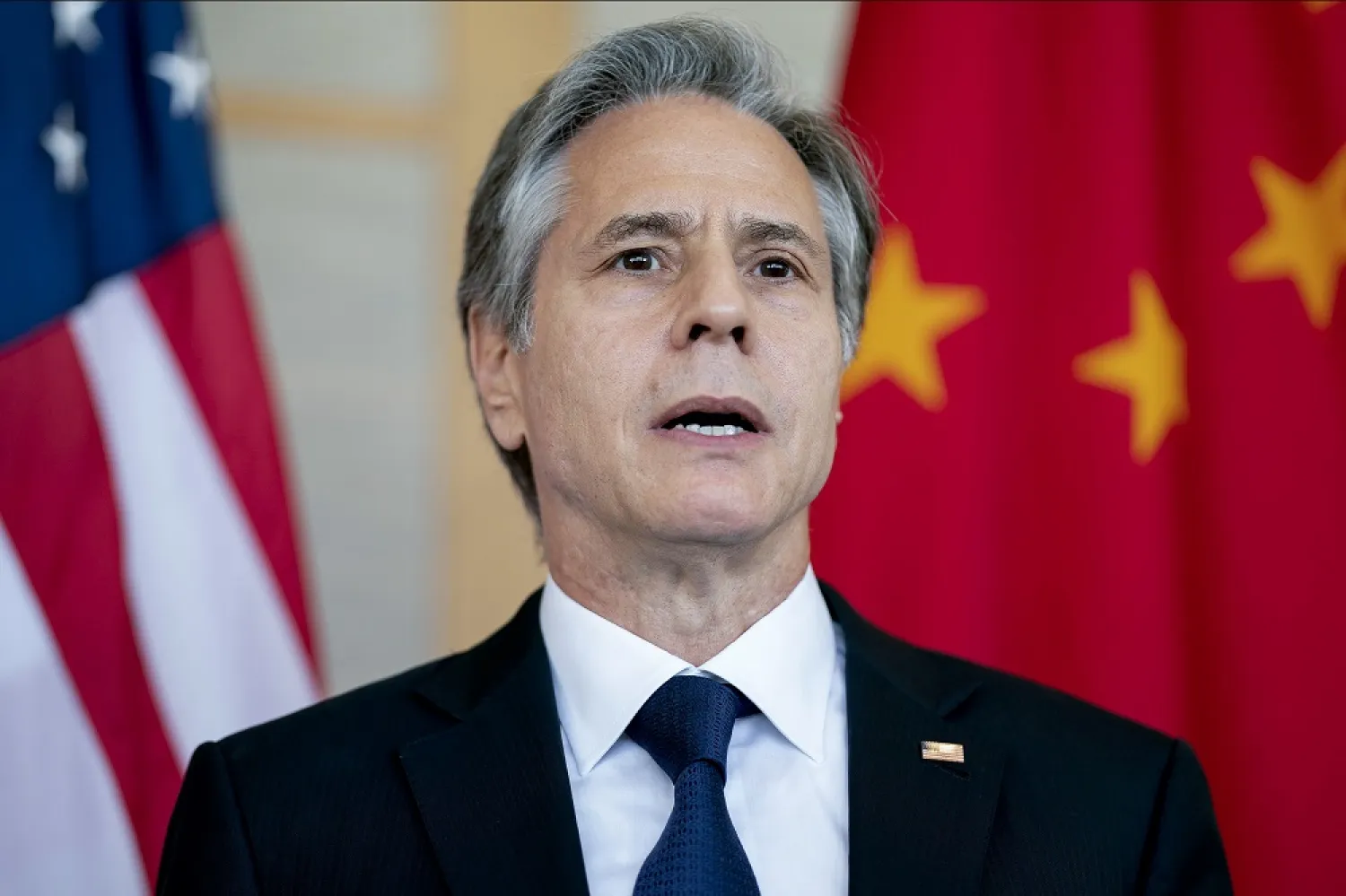

Blinken Scraps Rare Beijing Trip over Alleged China Spy Balloon

US Secretary of State Antony Blinken attends a meeting with China's Foreign Minister Wang Yi in Nusa Dua on the Indonesian resort island of Bali, July 9, 2022. (AP)
TT

Blinken Scraps Rare Beijing Trip over Alleged China Spy Balloon

US Secretary of State Antony Blinken attends a meeting with China's Foreign Minister Wang Yi in Nusa Dua on the Indonesian resort island of Bali, July 9, 2022. (AP)

US Secretary of State Antony Blinken on Friday scrapped a rare Beijing trip aimed at easing escalating tensions between the two global powers, after the Pentagon said that China sent a spy balloon over the United States.

Moments before the decision, China issued a rare statement of regret and blamed winds for blowing over what it called a civilian airship.

But President Joe Biden's administration was not impressed and, with the rival Republican Party already on the offensive, Blinken postponed his two-day visit that would have started Sunday.

"We have noted the PRC statement of regret but the presence of this balloon in our airspace is a clear violation of our sovereignty as well as international law and it is unacceptable," said a senior US official, referring to the People's Republic of China.

The official said Blinken personally conveyed the decision and would still go ahead with his visit to Beijing once "conditions are right," although no date was set.

The official voiced confidence that the delay would not set back communication between the two powers, a top goal of the trip.

"Candidly speaking in this current environment, I think it would have significantly narrowed the agenda that we would have been able to address," he told reporters.

Blinken would have been the first top US diplomat to visit China since October 2018, signaling a thaw following intense friction under former president Donald Trump.

Last month, Blinken said he would use the trip to help establish "guardrails" to prevent the relationship from escalating into all-out conflict.

Republican lawmakers quickly pounced on the balloon incident, casting Biden -- who has largely preserved and at times expanded Trump's hawkish policies on China -- as weak.

"President Biden should stop coddling and appeasing the Chinese communists. Bring the balloon down now and exploit its tech package, which could be an intelligence bonanza," tweeted Senator Tom Cotton, a prominent hardliner who had urged Blinken to call off his trip.

China voices regret

The Pentagon said Thursday it was tracking the balloon which flew far above the western state of Montana and decided for safety reasons not to shoot it down.

After initial hesitation, Beijing admitted ownership of the "airship" and said it veered off course due to the winds.

"The airship is from China. It is a civilian airship used for research, mainly meteorological, purposes," said the statement attributed to a foreign ministry spokesperson.

"The Chinese side regrets the unintended entry of the airship into US airspace due to force majeure," it said, using the legal term for an act outside of human control.

"The Chinese side will continue communicating with the US side and properly handle this unexpected situation."

The senior official who announced Blinken's trip delay said the United States has not changed its assessment that it was a spy balloon.

A US defense official said earlier that Biden had asked for military options but that the Pentagon believed shooting the object down would put people on the ground at risk from debris.

The balloon has "limited additive value from an intelligence collection perspective," the defense official told reporters on condition of anonymity.

The United States is also widely believed to spy on China, although generally with more advanced technology than balloons.

The northwestern United States is home to sensitive airbases and nuclear weapons in underground silos.

Pentagon spokesman Pat Ryder said that, as of Thursday, the balloon was "traveling at an altitude well above commercial air traffic."

"It does not present a military or physical threat to people on the ground," Ryder said in a statement.

Bracing for worst

Defense Secretary Lloyd Austin, who was visiting the Philippines, held discussions Wednesday with top Pentagon officials after Biden asked for options.

In the Philippines, Austin agreed to expand the US military presence, weeks after a separate troop deal with another regional ally, Japan.

The US military moves show that the United States is preparing for potential conflict over Taiwan, the self-governing democracy China claims as its own, despite diplomatic efforts.

Biden held a surprisingly cordial meeting in November with Chinese President Xi Jinping on the sidelines of a summit in Bali, where they agreed to send Blinken to Beijing.

A US military officer recently told his forces to be ready for war with China.

"I hope I am wrong. My gut tells me we will fight in 2025," Air Mobility Command chief General Mike Minihan wrote in a memo, saying that US elections in 2024 would also "offer Xi a distracted America."



Trump Hints at Land Strike as Venezuela Pressure Mounts

A US Air Force C-130J Super Hercules aircraft approaches for landing at Rafael Hernandez Airport, amid tensions between US President Donald Trump's administration and the government of Venezuelan President Nicolas Maduro, in Aguadilla, Puerto Rico, December 28, 2025. (Reuters)
TT

Trump Hints at Land Strike as Venezuela Pressure Mounts

A US Air Force C-130J Super Hercules aircraft approaches for landing at Rafael Hernandez Airport, amid tensions between US President Donald Trump's administration and the government of Venezuelan President Nicolas Maduro, in Aguadilla, Puerto Rico, December 28, 2025. (Reuters)

A throwaway remark last week by President Donald Trump has raised questions about whether US forces may have carried their first land strike against drug cartels in Venezuela.

Trump said the US knocked out a "big facility" for producing trafficking boats, as he was discussing his pressure campaign against Venezuelan President Nicolas Maduro in an interview broadcast Friday.

"They have a big plant or a big facility where they send, you know, where the ships come from," Trump said in an interview with billionaire supporter John Catsimatidis on the WABC radio station in New York.

"Two nights ago we knocked that out. So we hit them very hard."

Trump did not say where the facility was located or give any other details. US forces have carried out numerous strikes in both the Caribbean Sea and eastern Pacific Ocean since September, killing more than 100 people.

The Pentagon referred questions about Trump's remarks to the White House. The White House did not respond to requests for comment from AFP.

There has been no official comment from the Venezuelan government.

Trump has been saying for weeks that the United States will "soon" start carrying out land strikes targeting drug cartels in Latin America, but there have been no confirmed attacks to date.

The Trump administration has been ramping up pressure on Maduro, accusing the Venezuelan leader of running a drug cartel himself and imposing an oil tanker blockade.

Maduro has accused Washington of attempting regime change.


UN Chief Says ‘Get Serious’ in Grim New Year Message

 UN Secretary-General Antonio Guterres. (AFP)
UN Secretary-General Antonio Guterres. (AFP)
TT

UN Chief Says ‘Get Serious’ in Grim New Year Message

 UN Secretary-General Antonio Guterres. (AFP)
UN Secretary-General Antonio Guterres. (AFP)

The United Nations urged global leaders Monday to focus on people and the planet in a New Year's message depicting the world in chaos.

"As we enter the new year, the world stands at a crossroads. Chaos and uncertainty surround us. Division. Violence. Climate breakdown. And systemic violations of international law," UN Secretary-General Antonio Guterres said in a video message.

In 2026, as war rages in Ukraine and elsewhere, world leaders must work to ease human suffering and fight climate change, he added.

"I call on leaders everywhere: Get serious. Choose people and planet over pain," said Guterres, criticizing the global imbalance between military spending and financing for the poorest countries.

Military spending is up nearly 10 percent this year to $2.7 trillion, which is 13 times total world spending on development aid and equivalent to the entire gross domestic product of Africa, he said.

Wars are raging at levels unseen since World War II, he added.

"In this New Year, let's resolve to get our priorities straight. A safer world begins by investing more in fighting poverty and less in fighting wars. Peace must prevail," said Guterres, who will be serving his last year as secretary general.


Türkiye and Armenia Agree to Simplify Visa Procedures to Normalize Ties

Türkiye’s President Recep Tayyip Erdogan, right, and Armenia's Prime Minister Nikol Pashinyan shake hands before a meeting at Prague Castle in Prague, Czech Republic, Thursday, Oct. 6, 2022. (Turkish Presidency via AP, File)
TT

Türkiye and Armenia Agree to Simplify Visa Procedures to Normalize Ties

Türkiye’s President Recep Tayyip Erdogan, right, and Armenia's Prime Minister Nikol Pashinyan shake hands before a meeting at Prague Castle in Prague, Czech Republic, Thursday, Oct. 6, 2022. (Turkish Presidency via AP, File)

Türkiye and Armenia have agreed to simplify visa procedures as part of efforts to normalize ties, Türkiye’s Foreign Ministry announced Monday, making it easier for their citizens to travel between the two countries.

Relations between Türkiye and Armenia have long been strained by historic grievances and Türkiye’s alliance with Azerbaijan. The two neighboring countries have no formal diplomatic ties and their joint border has remained closed since the 1990s.

The two countries, however, agreed to work toward normalization in 2021, appointing special envoys to explore steps toward reconciliation and reopening the frontier. Those talks have progressed in parallel with efforts to ease tensions between Armenia and Azerbaijan.

Türkiye supported Azerbaijan during its 2020 conflict with Armenia for control of the Karabakh region, known internationally as Nagorno-Karabakh, a territorial dispute that had lasted nearly four decades.

The Turkish Foreign Ministry said in a statement posted on social platform X that Ankara and Yerevan agreed that holders of diplomatic, special and service passports from both countries would be able to obtain electronic visas free of charge as of Jan. 1.

“On this occasion, Türkiye and Armenia reaffirm once again their commitment to continue the normalization process between the two countries with the goal of achieving full normalization without any preconditions,” the ministry said.

Türkiye and Armenia also have a more than century-old dispute over the deaths of an estimated 1.5 million Armenians in massacres, deportations and forced marches that began in 1915 in Ottoman Türkiye. Historians widely view the event as genocide.

Türkiye denies the deaths constituted genocide, saying the toll has been inflated and those killed were victims of civil war and unrest. It has lobbied to prevent countries from officially recognizing the massacres as genocide.