


Former Israeli PM: Putin Promised Not to Kill Zelenskyy

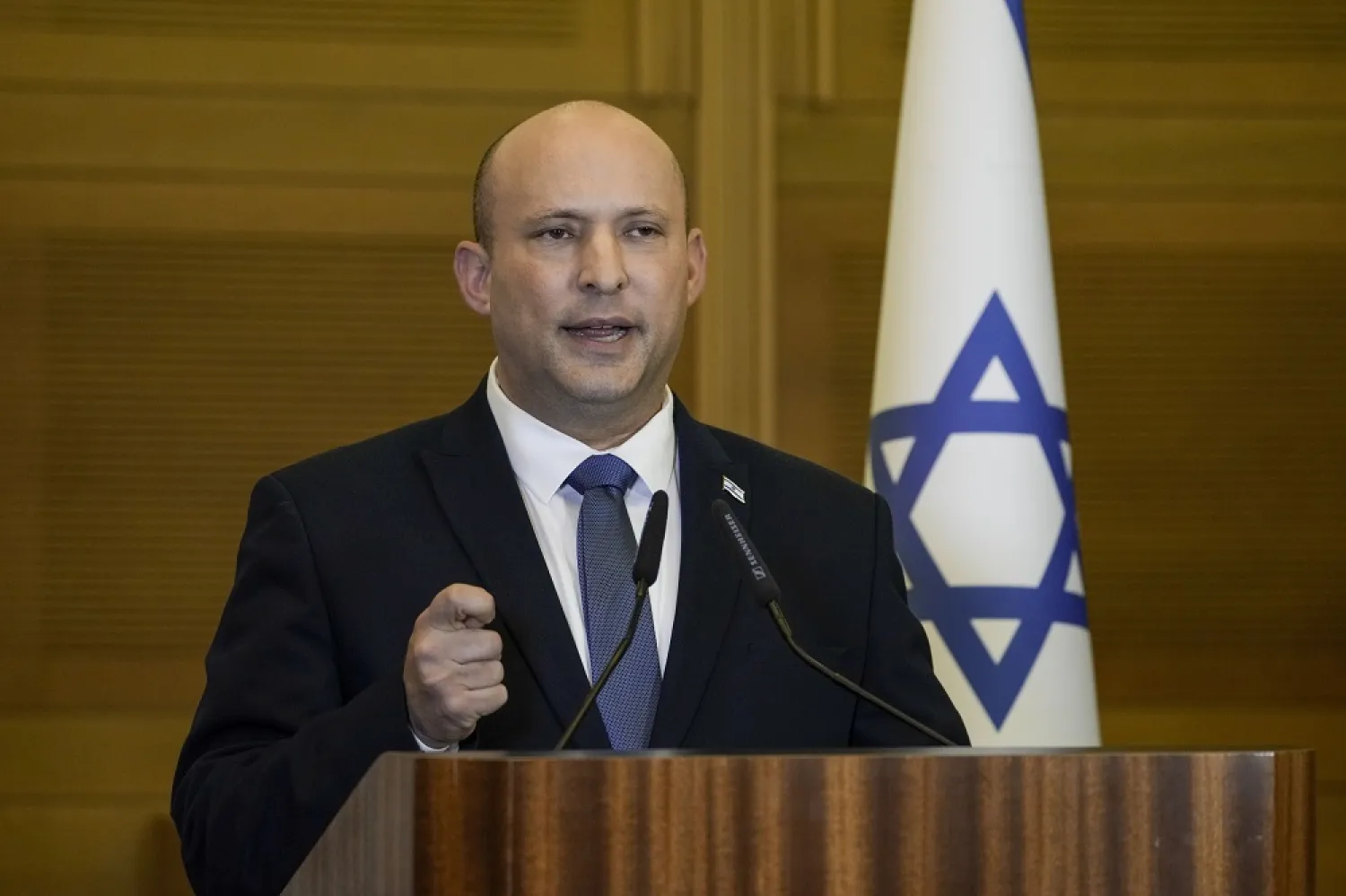
Israeli Prime Minister Naftali Bennett delivers a statement at the Knesset, Israel's parliament, in Jerusalem on June 29, 2022. (AP)
TT

Former Israeli PM: Putin Promised Not to Kill Zelenskyy

Israeli Prime Minister Naftali Bennett delivers a statement at the Knesset, Israel's parliament, in Jerusalem on June 29, 2022. (AP)

A former Israeli prime minister who served briefly as a mediator at the start of Russia's war with Ukraine says he drew a promise from the Russian president not to kill his Ukrainian counterpart.

Former Prime Minister Naftali Bennett became an unlikely intermediary in the war's first weeks, becoming one of the few Western leaders to meet President Vladimir Putin during the war in a snap trip to Moscow last March.

While Bennett's mediation efforts appear to have done little to end the bloodshed that continues until today, his remarks, in an interview posted online late Saturday, shed light on the backroom diplomacy and urgent efforts that were underway to try to bring the conflict to a speedy conclusion in its early days.

In the five-hour interview, which touched on numerous other subjects, Bennett says he asked Putin about whether he intended to kill Ukrainian President Volodymyr Zelenskyy.

“I asked ‘what’s up with this? Are you planning to kill Zelenskyy?’ He said ‘I won’t kill Zelenskyy.’ I then said to him ‘I have to understand that you’re giving me your word that you won’t kill Zelenskyy.’ He said ‘I’m not going to kill Zelenskyy.’”

Bennett said he then called Zelenskyy to inform him of Putin's pledge.

“'Listen, I came out of a meeting, he’s not going to kill you.’ He asks, ‘are you sure?’ I said ’100% he won’t kill you.’”

Bennett said that during his mediation, Putin dropped his vow to seek Ukraine's disarmament and Zelenskyy promised not to join NATO.

Bennett, a largely untested leader who had served as prime minister for just over six months when the war broke out, unexpectedly thrust himself into international diplomacy after he had positioned Israel into an uncomfortable middle ground between Russia and Ukraine.

Israel views its good ties with the Kremlin as strategic in the face of threats from Iran but it aligns itself with Western nations and also seeks to show support for Ukraine.

An observant Jew and little known internationally, he flew to Moscow for his meeting with Putin during the Jewish Sabbath, breaking his religious commitments and putting himself at the forefront of global efforts to halt the war.

But his peacemaking efforts did not appear to take off and his time in power was short-lived. Bennett's government, an ideologically diverse union that sent current Prime Minister Benjamin Netanyahu into a brief political exile, collapsed in the summer over infighting. Bennett stepped away from politics and is now a private citizen.



Türkiye and Armenia Agree to Simplify Visa Procedures to Normalize Ties

Türkiye’s President Recep Tayyip Erdogan, right, and Armenia's Prime Minister Nikol Pashinyan shake hands before a meeting at Prague Castle in Prague, Czech Republic, Thursday, Oct. 6, 2022. (Turkish Presidency via AP, File)
TT

Türkiye and Armenia Agree to Simplify Visa Procedures to Normalize Ties

Türkiye’s President Recep Tayyip Erdogan, right, and Armenia's Prime Minister Nikol Pashinyan shake hands before a meeting at Prague Castle in Prague, Czech Republic, Thursday, Oct. 6, 2022. (Turkish Presidency via AP, File)

Türkiye and Armenia have agreed to simplify visa procedures as part of efforts to normalize ties, Türkiye’s Foreign Ministry announced Monday, making it easier for their citizens to travel between the two countries.

Relations between Türkiye and Armenia have long been strained by historic grievances and Türkiye’s alliance with Azerbaijan. The two neighboring countries have no formal diplomatic ties and their joint border has remained closed since the 1990s.

The two countries, however, agreed to work toward normalization in 2021, appointing special envoys to explore steps toward reconciliation and reopening the frontier. Those talks have progressed in parallel with efforts to ease tensions between Armenia and Azerbaijan.

Türkiye supported Azerbaijan during its 2020 conflict with Armenia for control of the Karabakh region, known internationally as Nagorno-Karabakh, a territorial dispute that had lasted nearly four decades.

The Turkish Foreign Ministry said in a statement posted on social platform X that Ankara and Yerevan agreed that holders of diplomatic, special and service passports from both countries would be able to obtain electronic visas free of charge as of Jan. 1.

“On this occasion, Türkiye and Armenia reaffirm once again their commitment to continue the normalization process between the two countries with the goal of achieving full normalization without any preconditions,” the ministry said.

Türkiye and Armenia also have a more than century-old dispute over the deaths of an estimated 1.5 million Armenians in massacres, deportations and forced marches that began in 1915 in Ottoman Türkiye. Historians widely view the event as genocide.

Türkiye denies the deaths constituted genocide, saying the toll has been inflated and those killed were victims of civil war and unrest. It has lobbied to prevent countries from officially recognizing the massacres as genocide.


Russia Says Ukraine Tried to Attack Putin's Residence so Moscow's Negotiating Stance under Review

Russian President Vladimir Putin chairs a meeting on the "special military operation" amid the ongoing Russia-Ukraine conflict in Moscow, Russia, December 29, 2025. Sputnik/Mikhail Metzel/Pool via REUTERS
TT

Russia Says Ukraine Tried to Attack Putin's Residence so Moscow's Negotiating Stance under Review

Russian President Vladimir Putin chairs a meeting on the "special military operation" amid the ongoing Russia-Ukraine conflict in Moscow, Russia, December 29, 2025. Sputnik/Mikhail Metzel/Pool via REUTERS

Russian Foreign Minister Sergei Lavrov said on Monday that Ukraine had tried to attack President Vladimir Putin's residence ‌in the Novgorod ‌region and so ‌Moscow's ⁠negotiating ​position ‌would be reviewed.

Lavrov said that on Dec. 28-29, Ukraine had attacked the Russian president's state residence in the Novgorod region with 91 long-range drones which were all ⁠destroyed by Russian air defenses.

"Such reckless actions will ‌not go unanswered," ‍Lavrov said, adding ‍that the attack amounted to "state ‍terrorism."

He said that targets had already been selected for retaliatory strikes by Russia's armed forces, Reuters reported.

Lavrov noted that the ​attack took place during negotiations about a possible Ukrainian peace ⁠deal and that while Russia would not leave the negotiations, Moscow's position will be reviewed.

Ukrainian President Volodymyr Zelenskiy said the accusation was a lie, adding that Moscow was preparing the ground to strike government buildings in Kyiv.

It was not immediately clear if Putin ‌was in the residence at the time.


Paris Metro Stabbing Suspect is French, Says Ministry

The attacks happened on a central line of Paris's metro, seen here in a file picture © JULIEN DE ROSA / AFP/File
TT

Paris Metro Stabbing Suspect is French, Says Ministry

The attacks happened on a central line of Paris's metro, seen here in a file picture © JULIEN DE ROSA / AFP/File

The suspect in the stabbing of three women in the Paris metro last week is French, the interior ministry said Monday, after previously saying he was an undocumented Malian ordered to leave the country.

A source with knowledge of the case, requesting anonymity because not allowed to speak to the press, said he had held a French passport since 2018, AFP reported.

The 25-year-old man was arrested on suspicion of having stabbed and injured three women along the Paris metro's Line 3 on Friday, then admitted to a psychiatric hospital the next day.

"The investigation uncovered a French passport belonging to the suspect," the ministry said, adding that he had not once mentioned his French nationality during previous run-ins with police.

The ministry said on Friday the man was a Malian citizen imprisoned in January last year for aggravated theft and sexual assault, and required to leave France after being released in July.

The man had been placed in an administrative detention centre, but failure to obtain a consular travel document required for his deportation meant he was released after 90 days as required by law, it said.

Interior Minister Laurent Nunez last week called for "maximum vigilance" during the festive season in France.