

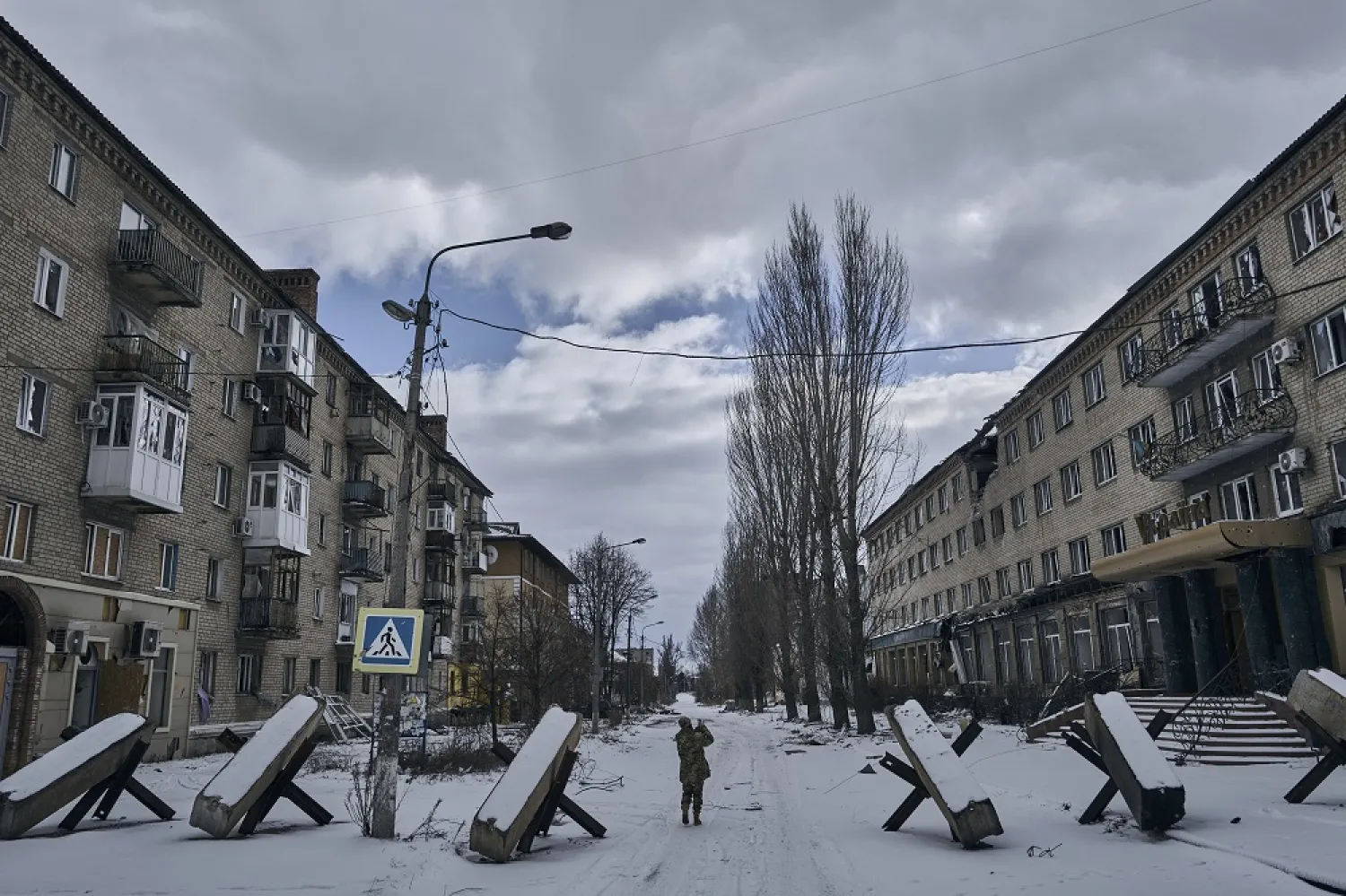

Russian Forces Bombard Ukraine’s Bakhmut in What NATO Sees as Start of New Offensive

A Ukrainian soldier walks along a street in Bakhmut, Donetsk region, Ukraine, Sunday, Feb. 12, 2023. (AP)
TT

Russian Forces Bombard Ukraine’s Bakhmut in What NATO Sees as Start of New Offensive

A Ukrainian soldier walks along a street in Bakhmut, Donetsk region, Ukraine, Sunday, Feb. 12, 2023. (AP)

The eastern Ukrainian city of Bakhmut endured heavy artillery fire on Monday in what the NATO chief said appeared to be the start of a major new Russian offensive as the first anniversary of the war neared.

Ukrainian defenders, who have already held out there for months, were braced for new ground attacks, Ukrainian military officials said.

Positions in Bakhmut have been fortified and only people with a military role were being allowed in, a deputy battalion commander said. Any civilians who still wanted to leave the city would have to brave the incoming fire, he said.

Bakhmut is a prime objective for Russian President Vladimir Putin and its capture would give Russia a new foothold in the Donetsk region and a rare victory after several months of setbacks. Donetsk and Luhansk regions make up the Donbas, Ukraine's industrial heartland now partially occupied by Russia which wants full control.

"... The reality is we have seen the start (of a Russian offensive) already because we see now what Russia does now - President Putin does now - is to send thousands and thousands more troops, accepting a very high rate of casualty," NATO Secretary-General Jens Stoltenberg told reporters in Brussels.

The Russian assault on Bakhmut has been spearheaded by mercenaries of the Wagner group, who have made small but steady gains. The renewed Russian bombardments made the situation there even more acute.

"The city, the city's suburbs, the entire perimeter, and essentially the entire Bakhmut direction and Kostyantynivka are under crazy, chaotic shelling," said Volodymyr Nazarenko, deputy commander of Ukraine's Svoboda battalion.

Nazarenko said that although no fighting was taking place in the city center right now, the defenders were prepared to meet any assault.

"The city is a fortress, every position and every street there, almost every building, is a fortress," he said.

The Russian defense ministry said its troops had pushed forward a few kilometers along the frontlines, without specifying exactly where.

The Ukrainian military reported Russian shelling all along the frontline and said 16 settlements had been bombarded near Bakhmut. It said that over the past day, its forces had repelled a number of attacks near Bakhmut as well as assaults in Kharkiv, Luhansk and Zaporizhzhia regions.

Luhansk Governor Serhiy Haidai said Russian forces had attacked Bilogorivka from all sides before dawn on Monday.

Regarding the Russian offensive, he said: "Preparations for this offensive are already under way, the amount of shelling, air strikes and attacks by small groups has already increased. We are waiting for them to start massive round-the-clock attacks."

Reuters was not able to independently verify the battlefield reports.

Village under fire

The frontline village of Chasiv Yar has been shelled heavily in recent days as Russian troops work to cut off routes to Bakhmut city.

One family told Reuters they had decided to leave the village after a projectile landed in their yard, damaging the roof and windows of their home.

Grandmother Raiisa Akusova, 75, suffered a heart attack shortly after setting off for the evacuation center in Dnipro and died, they said.

The United Nations' human rights office said on Monday that it had recorded 7,199 civilian deaths and 11,756 injured since the Feb. 24 invasion, mostly from shelling and missile and air strikes. However, it believed the actual figure was far higher.

With Ukraine desperate for more weapons and munitions to turn the tide of the war, defense ministers from several NATO countries allied to Kyiv will meet in Brussels on Tuesday to discuss possible further military aid.

Ukraine says it needs fighter jets and long-range missiles to counter the offensive and recapture lost territory.

NATO's Stoltenberg said he expected the issue of aircraft to be discussed at the meeting, but that Ukraine needed urgent support on the ground now.

NATO said on Monday it would increase targets for the stockpiling of ammunition as Kyiv is burning through shells much faster than Western countries can produce. A year of war in Ukraine has left allied stocks badly depleted.

"The current rate of Ukraine's ammunition expenditure is many times higher than our current rate of production," Stoltenberg told reporters.

A European diplomat told Reuters: "If Europe were to fight Russia, some countries would run out of ammunition in days."

Russia invaded Ukraine last Feb. 24 saying its neighbor posed a security threat. Kyiv and the West say the action was nothing more than a land grab.

Putin's forces failed in an early bid to capture the capital and the conflict has since become a war of attrition that has killed thousands of soldiers and civilians and left whole cities in ruins.



Russia's Lavrov Meets German Foreign Minister at UN

Russian Foreign Minister Sergei Lavrov attends a meeting with Tanzanian Minister of Foreign Affairs and East African Cooperation Mahmoud Thabit Kombo (not pictured), in Moscow, Russia, 09 February 2026.  EPA/RAMIL SITDIKOV / POOL
Russian Foreign Minister Sergei Lavrov attends a meeting with Tanzanian Minister of Foreign Affairs and East African Cooperation Mahmoud Thabit Kombo (not pictured), in Moscow, Russia, 09 February 2026. EPA/RAMIL SITDIKOV / POOL
TT

Russia's Lavrov Meets German Foreign Minister at UN

Russian Foreign Minister Sergei Lavrov attends a meeting with Tanzanian Minister of Foreign Affairs and East African Cooperation Mahmoud Thabit Kombo (not pictured), in Moscow, Russia, 09 February 2026.  EPA/RAMIL SITDIKOV / POOL
Russian Foreign Minister Sergei Lavrov attends a meeting with Tanzanian Minister of Foreign Affairs and East African Cooperation Mahmoud Thabit Kombo (not pictured), in Moscow, Russia, 09 February 2026. EPA/RAMIL SITDIKOV / POOL

Russia's Foreign Minister Sergei Lavrov met his German counterpart Johann Wadephul at the UN on Saturday -- the first such meeting since Moscow launched its full-scale invasion of Ukraine more than four years ago.

The talks took place as tensions between Berlin and Moscow spiralled in recent weeks, with Germany accusing Russia of orchestrating an attempted drone attack on Leipzig airport and each country ordering the closure of the other's consulate, AFP reported.

Lavrov, who will address the UN's gathering of world leaders in New York later in the day, last met with a German foreign minister, Annalena Baerbock, in January 2022, less than a month before Russian forces invaded Ukraine.

Direct flights between Russia and Germany have been suspended since the invasion.

The meeting Saturday was closed to media, but Ukraine will likely have been top of the agenda.

Before the meeting with Lavrov, the German side demanded that media access be restricted and that the opening remarks not be recorded, Moscow's foreign ministry spokeswoman Maria Zakharova said, according to the Russian TASS news agency.

She said Saturday's meeting was initiated by Berlin.


Europe and the Dilemma of Preparing for a '2030 War'

French and Lithuanian soldiers operate a Caesar Mk-I wheeled self-propelled howitzer during a live fire exercise of Lithuanian and French troops along with NATO allies at the General Silvestras Zukauskas Training Area in Pabrade, Lithuania, on September 16, 2026.  (Photo by Petras Malukas / AFP)
French and Lithuanian soldiers operate a Caesar Mk-I wheeled self-propelled howitzer during a live fire exercise of Lithuanian and French troops along with NATO allies at the General Silvestras Zukauskas Training Area in Pabrade, Lithuania, on September 16, 2026. (Photo by Petras Malukas / AFP)
TT

Europe and the Dilemma of Preparing for a '2030 War'

French and Lithuanian soldiers operate a Caesar Mk-I wheeled self-propelled howitzer during a live fire exercise of Lithuanian and French troops along with NATO allies at the General Silvestras Zukauskas Training Area in Pabrade, Lithuania, on September 16, 2026.  (Photo by Petras Malukas / AFP)
French and Lithuanian soldiers operate a Caesar Mk-I wheeled self-propelled howitzer during a live fire exercise of Lithuanian and French troops along with NATO allies at the General Silvestras Zukauskas Training Area in Pabrade, Lithuania, on September 16, 2026. (Photo by Petras Malukas / AFP)

The possibility of the war in Europe expanding is no longer being discussed as a distant scenario or a theoretical assumption. Since the outbreak of the war in Ukraine, the continent has entered a new security phase in which military confrontation overlaps with cyberattacks, sabotage, airspace violations, disinformation campaigns, and pressure on infrastructure. What is concerning is that Europe is increasingly talking about preparing for a possible war with Russia toward the end of the decade, even as NATO continues to emphasize that there are no indications of an imminent attack.

Europe's current situation therefore carries two parallel messages. The first is that the risk of a broader confrontation has become more serious than at any time since the end of the Cold War. The second is that a full-scale war is not, at present, a scenario expected to break out tomorrow or the day after. Current concerns are primarily linked to the accumulation of "hybrid warfare" incidents and the possibility that Moscow could use limited or covert operations to test the alliance's readiness to respond.

Evidence of this is mounting. In recent months, there have been airspace-related incidents, including the interception and downing by NATO fighter jets of a Russian drone over Lithuania, as well as other incidents involving a Russian military aircraft, a Russian vessel, and a Danish military helicopter. In Germany, an attempted drone attack at Leipzig Airport was linked to a person suspected of having ties to Russia. At the same time, European governments have been warning of an increase in acts of sabotage, cyberattacks, and attacks targeting infrastructure.

Field Preparations

The issue is no longer limited to political warnings. Germany is preparing for the possibility of receiving large numbers of casualties in its hospitals, while Lithuania has updated its civilian evacuation plans, and military exercises have intensified across the Baltic region and the Nordic countries. German and Swedish forces have conducted joint exercises near the strategically important island of Gotland, while NATO forces have held other exercises near Russia's Kaliningrad exclave, located between Poland and Lithuania and about 360 kilometers from Russia's main territory.

But the most contentious question concerns not only what is happening now, but also the date for a war that is increasingly being discussed, both privately and publicly, in Europe: 2029 to 2030.

Why the End of the Decade?

The official European and NATO explanation is not that war will break out by 2030. Rather, assessments refer to a period in which Russia could have rebuilt its military capabilities following the war in Ukraine and re-equipped its forces sufficiently to threaten NATO's eastern flank. General Carsten Breuer, Germany's Inspector General of the Bundeswehr and the country's highest-ranking military officer, explains that referring to a specific date is not a prophecy, but a timeframe for assessing the Russian military's potential ability to recover its strength. According to assessments attributed to NATO, Moscow could, by the end of the decade, have accumulated the resources and capabilities needed to launch a potential attack.

This is where Europe's political dilemma emerges. The more frequently warnings are issued about a possible war in 2029 or 2030, the more the dates themselves become part of public consciousness. More importantly, European officials are calling for increased defense spending, governments are rebuilding their military capabilities, and NATO is intensifying its exercises, while the idea of preparing for a future war is becoming a permanent policy.

NATO Secretary General Mark Rutte has articulated this logic by saying that Europe is "safe now," but may not be so in three to five years, using this timeframe to argue for increased defense spending. At the same time, European officials have spoken about the need to prepare to respond to "Russian aggression," rather than about a European decision to go to war with Russia.

Between Prevention and Response

Against this backdrop, one of the most interesting aspects of the situation becomes clearer: Is Europe working to prevent war, or has it begun treating war as a possible outcome for which it must prepare?

The distinction is not merely semantic. Military preparedness can serve as a deterrent, with the aim of convincing an adversary that the cost of an attack would be high. At the same time, however, the intensity of the rhetoric surrounding war can make a scenario that seemed unlikely only a few years ago part of the daily political debate.

In this context, some European voices have also begun calling for a return to dialogue with Moscow. Finnish President Alexander Stubb said it was time for the European Union to begin opening channels of communication with Russia, while European Council President António Costa spoke of Europe's readiness for possible negotiations concerning Ukraine. The European Union is discussing designating a point of contact for such talks.

This tension between military preparedness and the need for dialogue reflects Europe's underlying dilemma. On one hand, public pressure is growing to end the war and reduce the amount of money being spent on weapons. On the other hand, European governments believe that ending the war on certain terms could allow Russia to rapidly rebuild its military strength, while Europe itself is still in a transitional phase of rebuilding its armed forces.

Ukraine finds itself at the center of this equation. Continued European military support means a continued flow of weapons to Kyiv, but it also means the war continues. Military support thus becomes both a means of assisting Ukraine and a means of maintaining military pressure on Russia while Europe waits to restore its own defense capabilities.

A Psychological Campaign?

None of these calculations means that a war between Russia and NATO has become inevitable. On the contrary, NATO sources have confirmed that there is currently no imminent threat of an attack. The alliance's official assessment has not changed, nor have the allies received a formal briefing on new intelligence indicating an imminent attack.

It was notable that Lithuanian Foreign Minister Kęstutis Budrys said political statements could be part of a coordinated campaign to warn Moscow against testing NATO's collective-defense provision under Article 5.

At the same time, the figures illustrate why there is concern. Between January and August 2026, 100 officially recorded hybrid warfare incidents were documented in Europe, compared with 60 during the same period the previous year, according to Ukraine's Sahajdachny Security Center. A NATO source said the actual number could exceed 200 incidents if cyberattacks were excluded, adding that NATO institutions face thousands of cyberattacks each month.

Perhaps the clearest indication of the scale of European concern came on September 18, when French President Emmanuel Macron brought together party leaders and candidates for the upcoming presidential election at the Élysée Palace for a confidential security meeting. Participants received a briefing from senior intelligence officials on the evolving threat. Macron said the nature of the Russian threat in Europe was changing and that sabotage, which had previously targeted primarily government or military facilities, could shift toward targets capable of causing civilian casualties.

Europe therefore appears caught between two wars: an ongoing war in Ukraine and a potential war for which preparations are being made toward the end of the decade. Between them lies a broad space of deterrence, sabotage, cyberwarfare, military exercises, and warnings.

Talk of 2029 or 2030 may simply be a planning framework for rebuilding Europe's military capabilities, or it may form part of a deterrence strategy specifically intended to prevent Moscow from considering a test of NATO. But the risk lies in allowing preparation for war to become a permanent state, and in allowing the scenario of war itself to become more familiar than the prospect of peace.

Ultimately, the current evidence does not indicate that Europe is inevitably heading toward war with Russia. It does, however, indicate something more complex: Europe has begun acting on the assumption that it must be prepared for such a war, while at the same time continuing to search for a path that could prevent it. The latter is a responsibility shared by both sides.


France Working on UN Resolution to Restore Freedom of Navigation in Strait of Hormuz

Vessels at the Strait of Hormuz, as seen from Musandam, Oman, September 23, 2026. Picture taken through a window. REUTERS/Stringer
TT

France Working on UN Resolution to Restore Freedom of Navigation in Strait of Hormuz

Vessels at the Strait of Hormuz, as seen from Musandam, Oman, September 23, 2026. Picture taken through a window. REUTERS/Stringer

France is working on a draft United Nations Security Council resolution backing freedom of navigation in the Strait of Hormuz, a UN diplomat said on Friday.

The resolution would reaffirm the need to respect freedom of navigation in the strait, a flashpoint in the war in Iran, citing its importance for global shipments critical for food and energy security, the diplomat said, speaking on condition of anonymity because discussions on the measure have been private.

The proposed UN resolution would recall the need to respect the Law of the Sea and support peaceful initiatives aimed at ensuring safe passage in the strait, the UN diplomat added.

Iran’s disruption of the strait, through which a fifth of the world’s traded oil and gas transited before the war, has emerged as its main point of leverage.

The effects have been felt far beyond the Middle East and pose political problems for US President Donald Trump and his Republican Party ahead of November’s midterm congressional elections.

Paris has unsuccessfully attempted in the past to put a resolution together on the subject, but the latest move follows talks between France's President Emmanuel Macron on Monday evening and Trump on the sidelines of the UN General Assembly.

“Trump and Macron discussed the topic on the sidelines of this week’s annual UN gathering of global leaders,” the diplomat said. It also was discussed with Arab nations and Iran.

After his meeting the ⁠US president at Trump Tower in New York, Macron said: “Several options were discussed. We will be working on diplomatic solutions over the coming hours, which could make it possible, even without a comprehensive agreement, to find ways of allowing more container ships and oil tankers to transit.”