

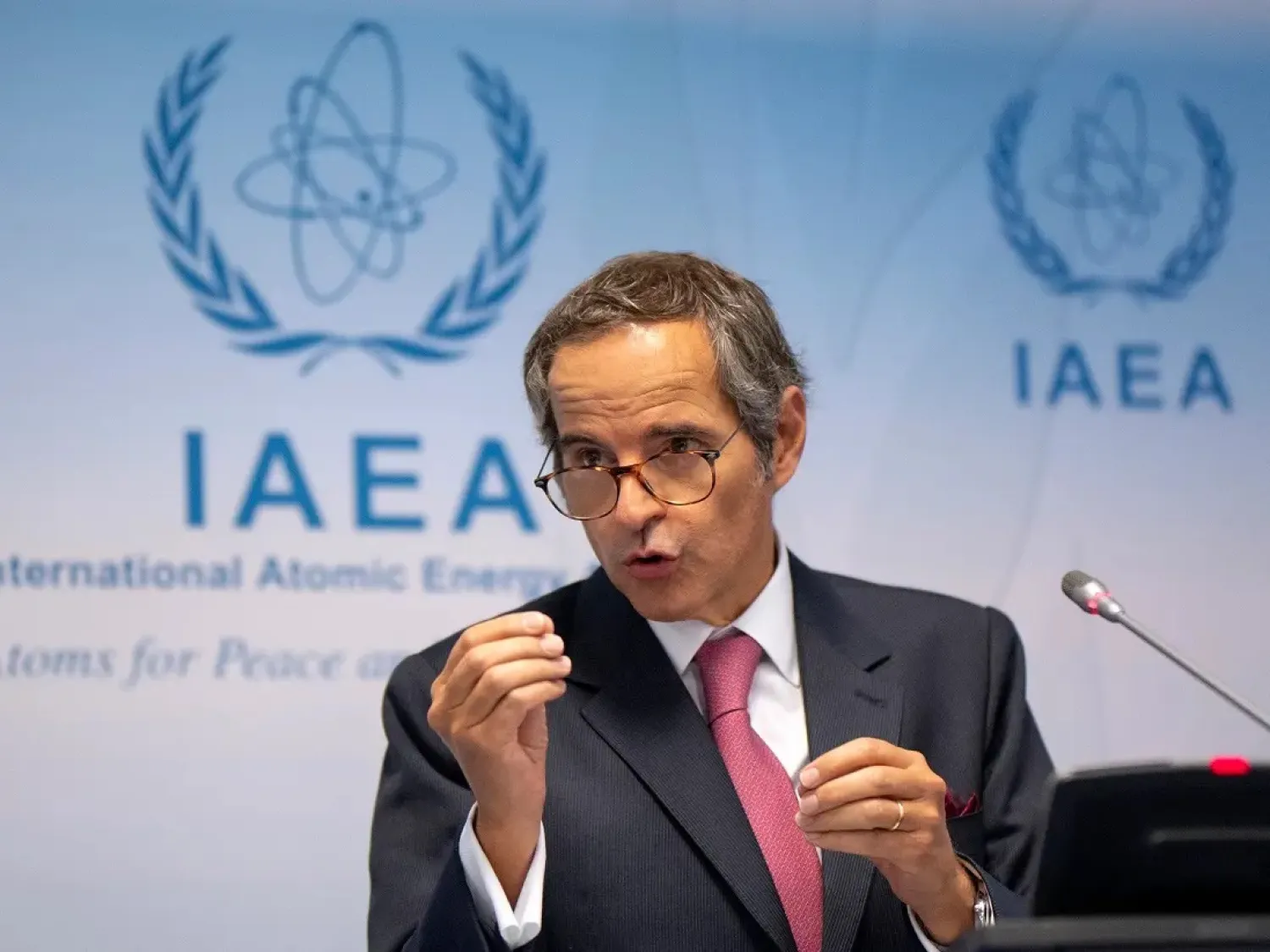

Iran Says Nuclear Watchdog Chief to Visit in ‘Coming Days’

A file photo shows Rafael Grossi, IAEA’s chief speaks during a press conference at the agency’s headquarters in Vienna, Austria on September 14, 2020. (AFP)
TT

Iran Says Nuclear Watchdog Chief to Visit in ‘Coming Days’

A file photo shows Rafael Grossi, IAEA’s chief speaks during a press conference at the agency’s headquarters in Vienna, Austria on September 14, 2020. (AFP)

Iran said Monday the head of the UN’s nuclear watchdog, Rafael Grossi, will visit Tehran “in the coming days,” amid a row over uranium enrichment levels in the country.

The Vienna-based International Atomic Energy Agency (IAEA) said earlier this month it was in discussions with Tehran after Bloomberg News reported that the watchdog’s inspectors in Iran had found uranium enriched to 84 percent purity.

Iran denied the report, insisting it had not made any attempt to enrich uranium beyond 60 percent, well beyond the 3.67 percent threshold set out in a landmark agreement reached with world powers in 2015.

On Monday, the Atomic Energy Organization of Iran said Grossi would travel to Iran “in the coming days” following an official invitation from its director, Mohammad Eslami.

“In recent days, we have had constructive and promising discussions” with the IAEA delegation that was already in Iran to clear up any doubts about its nuclear program, AEOI spokesman Behrouz Kamalvandi said.

“It is hoped that this trip will form the basis for greater cooperation and a clearer horizon between Iran and the IAEA,” he added.

The latest visit by the IAEA inspectors comes amid deadlock in negotiations on reviving the 2015 deal that promised Iran relief from crippling economic sanctions in exchange for curbs on its nuclear activities.

The restrictions were intended to prevent Iran developing a nuclear weapons capability, an ambition it has always denied.

The US unilaterally withdrew from the deal in 2018 and reimposed sanctions, prompting Iran to suspend the implementation of its own commitments under the accord known formally as the Joint Comprehensive Plan of Action, or JCPOA.



Iran: Any US Attack Including Limited Strikes Would be 'Act of Aggression'

Vehicles move along a highway near Tehran's landmark Azadi (Freedom) Tower in Tehran on February 23, 2026. (Photo by ATTA KENARE / AFP)
TT

Iran: Any US Attack Including Limited Strikes Would be 'Act of Aggression'

Vehicles move along a highway near Tehran's landmark Azadi (Freedom) Tower in Tehran on February 23, 2026. (Photo by ATTA KENARE / AFP)

Iran said Monday that any US attack, including limited strikes, would be an "act of aggression" that would precipitate a response, after President Donald Trump said he was considering a limited strike on Iran.

"With respect to your first question concerning the limited strike, I think there is no limited strike," foreign ministry spokesman Esmaeil Baqaei said at a briefing in Tehran attended by an AFP journalist.

"An act of aggression would be regarded as an act of aggression. Period. And any state would react to an act of aggression as part of its inherent right of self-defense ferociously so that's what we would do."

Trump said Friday he was considering a limited strike if Tehran did not reach a deal with the United States.

"I guess I can say I am considering that," he replied following a question from reporters.

The two countries concluded a second round of indirect talks in Switzerland on Tuesday under Omani mediation, against the backdrop of a major US military build-up in the region.

Further talks, confirmed by Iran and Oman but not by the United States, are scheduled for Thursday.

Foreign Minister Abbas Araghchi is leading the negotiations for Iran, while the United States is represented by envoy Steve Witkoff and Trump's son-in-law Jared Kushner.

Trump is wondering why Iran has not "capitulated" in the face of Washington's military deployment, Witkoff said in an interview with Fox News broadcast on Sunday.

Baqaei responded Monday by saying that Iranians had never capitulated at any point in their history.


India Tells Citizens to Leave Iran

An elderly Iranian man rides a bicycle next to an anti-US mural in Tehran, Iran, 23 February 2026. EPA/ABEDIN TAHERKENAREH
TT

India Tells Citizens to Leave Iran

An elderly Iranian man rides a bicycle next to an anti-US mural in Tehran, Iran, 23 February 2026. EPA/ABEDIN TAHERKENAREH

India's foreign ministry urged its citizens Monday to leave Iran, against a backdrop of fears of a possible US strike on Tehran.

"In view of the evolving situation in Iran, Indian nationals who are currently in Iran... are advised to leave Iran by available means of transport, including commercial flights," the Indian Embassy in Tehran said in a post on social media.

India's foreign ministry estimates there are usually around 10,000 citizens in Iran.

Iran said Monday that any US attack, including limited strikes, would be an "act of aggression" that would precipitate a response, after President Donald Trump said he was considering a limited strike on Iran.

The two countries concluded a second round of indirect talks on Iran’s nuclear program in Switzerland on Tuesday under Omani mediation, against the backdrop of a major US military build-up in the region.

Further talks, confirmed by Iran and Oman but not by the United States, are scheduled for Thursday.

Iran has indicated ‌it is prepared to make concessions on its nuclear program if the US met certain demands.


ICC Opens Hearings Into Former Philippine President Rodrigo Duterte

Protestors, rallying in support of the detention of former Philippine's president Rodrigo Duterte, hold a placard which reads as "hold Duterte accountable now" outside of the International Criminal Court (ICC), in The Hague on February 23, 2026. (Photo by Simon Wohlfahrt / AFP)
TT

ICC Opens Hearings Into Former Philippine President Rodrigo Duterte

Protestors, rallying in support of the detention of former Philippine's president Rodrigo Duterte, hold a placard which reads as "hold Duterte accountable now" outside of the International Criminal Court (ICC), in The Hague on February 23, 2026. (Photo by Simon Wohlfahrt / AFP)

The International Criminal Court began pre-trial hearings on Monday for former Philippine President Rodrigo Duterte, who is facing three counts of crimes against humanity for deadly anti-drugs crackdowns he oversaw while in office.

Duterte, 80, was not in The Hague courtroom, having waived his right to appear as prosecutors began presenting evidence to support their charges of his alleged involvement in dozens of killings as part of his so-called war on drugs.

The charges date from Duterte’s time as mayor of the southern Philippine city of Davao and later as president, and include dozens of killings as part of his so-called war on drugs.

Duterte has described the charges against him an “outrageous lie.”

The Hague hearing is not a trial, but allows prosecutors to outline their case in court, The Associated Press reported. After weighing the evidence, judges have 60 days to decide whether or not to confirm the charges.

Last month, judges found the octogenarian was fit to stand trial, after postponing an earlier hearing over concerns about his health.

Rights groups and families of victims hailed Duterte’s arrest in March, saying it was a step forward for justice.

“We have waited for this for so long, for years we have waited, but we did not relent,” Llore Pasco told reporters at a news conference ahead of the hearing. She said both of her sons left for work in May 2017 and never returned. Their bodies were later found riddled with bullets.

Supporters of Duterte criticized the administration of current Philippine President Ferdinand Marcos Jr., Duterte’s political rival, for arresting and surrendering the former leader to a court whose jurisdiction they dispute. Detractors include his daughter, current Philippine Vice President Sara Duterte who announced last week that she would seek the presidency in the 2028 elections.

ICC prosecutors announced in February 2018 that they would open a preliminary investigation into the violent drug crackdowns. In a move that human rights activists say was aimed at escaping accountability, Duterte, who was president at the time, announced a month later that the Philippines would leave the court.

Judges rejected a request from Duterte’s legal team to throw out the case on the grounds that the court did not have jurisdiction because of the Philippine withdrawal.

Countries can’t “abuse” their right to withdraw from the court's foundational Rome Statute “by shielding persons from justice in relation to alleged crimes that are already under consideration,” the September decision says.

An appeal of that decision is still pending.

Estimates of the death toll during Duterte’s presidential term vary, from the more than 6,000 that the national police have reported to up to 30,000 claimed by human rights groups.