UAE Approves Developing the Circular Economy Policy 2031

Prime Minister and Vice-President of the UAE and Ruler of Dubai Sheikh Mohammed bin Rashid Al Maktoum chairs the cabinet meeting on Monday. (WAM)
TT

UAE Approves Developing the Circular Economy Policy 2031

Prime Minister and Vice-President of the UAE and Ruler of Dubai Sheikh Mohammed bin Rashid Al Maktoum chairs the cabinet meeting on Monday. (WAM)

The Emirati Cabinet approved developing the UAE Circular Economy Policy 2031, as an updated framework to achieve the objectives of the UAE in the circular economy, the UAE's Green Agenda 2030, and the UAE Centennial 2071.

The Agenda includes developing 22 policies in various fields, including sustainable transport, sustainable food production and consumption, sustainable manufacturing, and green infrastructure.

The UAE Governments Net Zero 2050 Charter was approved by the Cabinet, reported the state news agency WAM.

The charter aims to create a unified framework between the Federal government and the local governments of the Emirates, ensuring cooperation in adopting policies and procedures to achieve climate neutrality by 2050.

Prime Minister and Vice-President of the UAE and Ruler of Dubai Sheikh Mohammed bin Rashid Al Maktoum said: “We approved four international agreements and the establishment of an office for the Asian Infrastructure Investment Bank (AIIB) in the country.”

“The bank brings in 57 countries, with a starting capital of $100 billion, and aims at driving investments in infrastructure to promote Asia’s accelerated development.”

Sheikh Mohammed added: “During the meeting, we adopted the UAE Circular Economy Policy 2031. Also, we reviewed the UAE Council for Climate Change and Environment report and its action plan for the upcoming period, to achieve UAE Net Zero by 2050.”

“We approved the ‘Ajyal Schools’ model which includes managing 28 government schools by operators from the private sector for three years to ensure experience transfer and diversification of educational choices for parents.”

The Cabinet also approved the launch of the “UAE Award for Market Leadership” that recognizes distinct practices and honors leading businessmen and employees, and highlight the competitiveness of the UAE labor market.


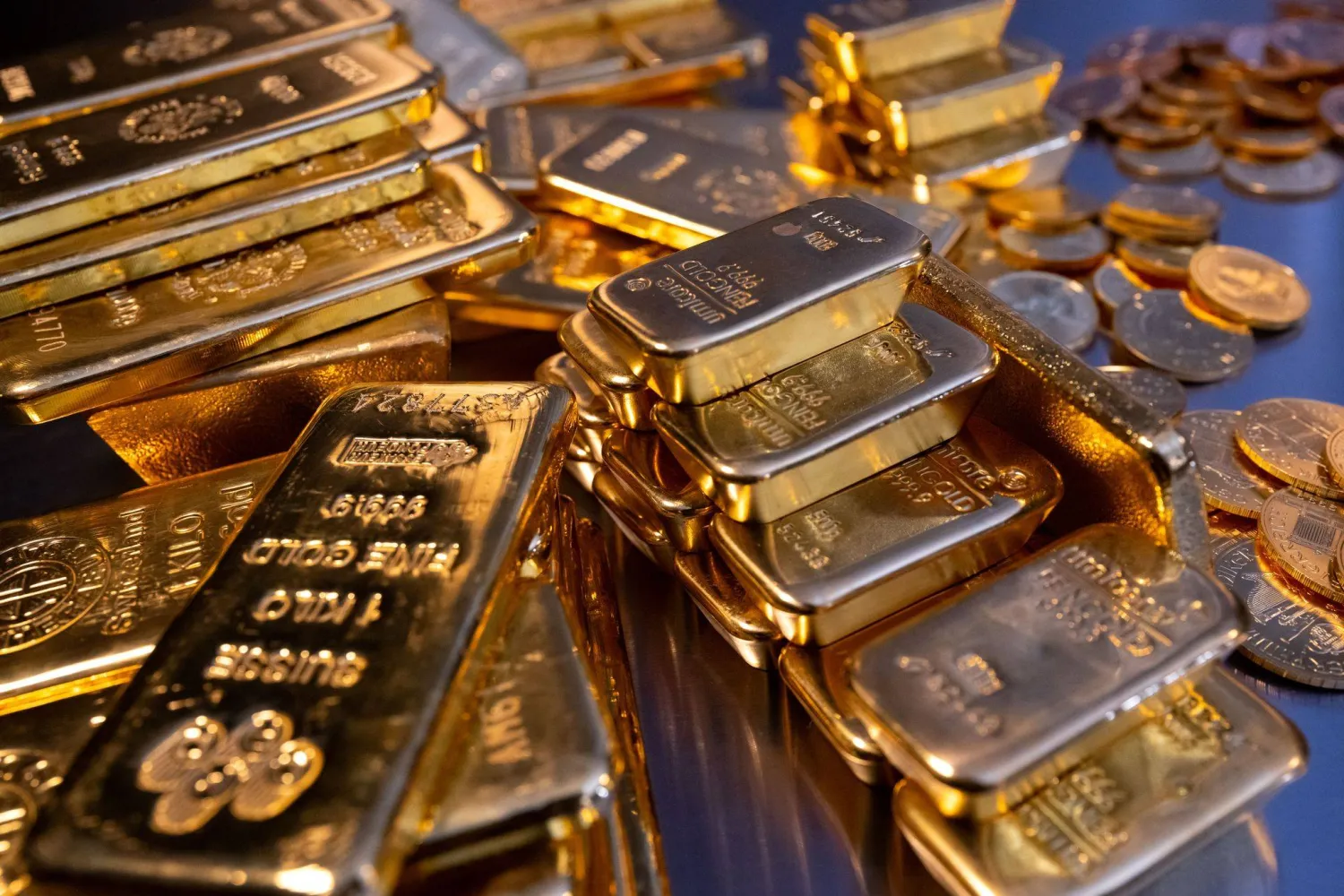
Gold Prices Dip as Markets Brace for 'Hawkish' Fed Tone

UK gold bars and gold Sovereign coins are displayed at Baird & Co in Hatton Garden in London, Britain, October 8, 2025. REUTERS/Hiba Kola
TT

Gold Prices Dip as Markets Brace for 'Hawkish' Fed Tone

UK gold bars and gold Sovereign coins are displayed at Baird & Co in Hatton Garden in London, Britain, October 8, 2025. REUTERS/Hiba Kola

Gold edged down on Tuesday as investors, having mostly priced in a Federal Reserve rate cut, looked ahead for clues that the US central bank might opt for a gentler-than-expected easing cycle when its two-day policy meeting begins later in the day.

Spot gold was down 0.3% to $4,174.91 per ounce, as of 0609 GMT. US gold futures for December delivery slipped 0.4% to $4,202.70 per ounce.

Investors are largely repositioning ahead of the Federal Reserve's policy meeting, OANDA senior market analyst Kelvin Wong said.

"Earlier in the month, Jerome Powell signalled hawkish rate-cut guidance during his press conference. So investors in the US Treasury market are adjusting their positions."

The benchmark US 10-year Treasury yields held near a 2-1/2-month peak hit on Monday, Reuters reported.

Analysts widely expect a "hawkish cut" this week accompanied by guidance and forecasts that signal a high threshold for further easing into next year.

Last week, data showed the US Personal Consumption Expenditures (PCE) Price Index, the Fed's preferred inflation gauge, landed in line with expectations, while consumer sentiment improved in December.

Private payrolls for November recorded their sharpest drop in more than 2-1/2 years, but jobless claims fell to a three-year low for the week ended November 28.

Markets now assign an 89% probability of a quarter-point cut at the Fed's December 9–10 meeting, according to CME's FedWatch Tool.

Lower interest rates tend to favor non-yielding assets such as gold.

Meanwhile, silver fell 0.6% to $57.76 per ounce. The white metal hit a record high of $59.32 on Friday.

"Right now, silver is more of a higher-beta play among precious metals," Wong said, adding that low inventories, strong industrial demand, and expectations of Fed rate cuts are driving its momentum, pushing it into risk-on mode and outperforming gold.

Platinum lost 0.2% to $1,638.35, while palladium shed 0.4% to $1,459.78.


Türkiye Cenbank Net Reserves Rose $5.5 billion Last Week, Bankers Say

Türkiye's Central Bank headquarters is seen in Ankara, Türkiye in this January 24, 2014 file photo. REUTERS/Umit Bektas
TT

Türkiye Cenbank Net Reserves Rose $5.5 billion Last Week, Bankers Say

Türkiye's Central Bank headquarters is seen in Ankara, Türkiye in this January 24, 2014 file photo. REUTERS/Umit Bektas

The Turkish Central Bank's net reserves increased by around $5.5 billion last week, due to foreign currency buying and rising gold prices, according to bankers.

Calculations by four bankers showed that net reserves rose to almost $78 billion in the week ending December 5, with net reserves excluding swaps rising some $4.5 billion to $62.5 billion, Reuters reported.

The bankers said the central bank bought more than $3 billion last week, with more than $1 billion of the increase due to the gold price change.

The bank's total gross reserves increased by $3.3 billion to $186.5 billion last week, the bankers said.

Their calculations were based on the central bank's preliminary data, with official data to be released on Thursday.


Non-Oil Activities Account for Half of Saudi Economic Growth Momentum

Photo of the Saudi capital (SPA) 
TT

Non-Oil Activities Account for Half of Saudi Economic Growth Momentum

Photo of the Saudi capital (SPA) 

The Saudi economy posted real growth of 4.8% in the third quarter of 2025 compared with the same period of the previous year, reflecting the Kingdom’s sustained economic momentum. Non-oil activities were the primary engine of expansion, while seasonally adjusted real GDP rose 1.4% from the second quarter of 2025.

According to the final data released by the General Authority for Statistics (GASTAT), the annual growth figure came in slightly below the flash estimate published last October, which had projected a 5% increase. Even so, it remains the strongest quarterly performance recorded in 2025.

Non-oil activities delivered the largest contribution to overall annual growth, adding 2.4 percentage points, or 50% of the total 4.8% expansion. This outpaced the contribution from oil activities, which added 2.0 percentage points. The Authority revised its estimate for non-oil growth downward to 4.3% (from 4.5% in the flash estimate), while slightly raising its estimate for oil-sector growth to 8.3% (from 8.2%) for the previous quarter.

This improvement coincided with the gradual ramp-up in oil production following the expiration of voluntary cuts by the OPEC+ alliance at the end of August. Saudi Arabia increased its output by approximately 547,000 barrels per day starting in September, followed by an additional 137,000 barrels per day from November onward.

Both government activities and net taxes on products made modest positive contributions of 0.2 percentage points each.

On a quarterly, seasonally adjusted basis, oil and non-oil activities contributed 0.8 and 0.3 percentage points, respectively.

All economic sectors recorded positive annual growth. Oil refining emerged as the fastest-growing activity in the third quarter, rising 11.9% year-on-year and 3.9% quarter-on-quarter. It was followed by crude oil and natural gas activities, which grew 7.3% annually and 3.2% quarterly. Electricity, gas, and water services also posted gains of 6.4% year-on-year and 1.0% quarter-on-quarter.

From the expenditure perspective, performance varied between annual and quarterly comparisons. Final private consumption increased 2.6% year-on-year, but slipped 0.6% from the previous quarter. Conversely, final government consumption declined 3.1% annually, while increasing 1.4% quarter-on-quarter.

Gross fixed capital formation fell 0.7% year-on-year, but rebounded strongly on a quarterly basis with a 6.2% increase, indicating a pickup in investment spending during the third quarter.

Regarding foreign trade, the overall performance was buoyed by a significant surge in exports, which climbed 18.4% year-on-year and 7.5% quarter-on-quarter, reflecting strong external demand for Saudi products. Imports rose 4.3% annually, but edged down 1.2% on a quarterly basis.