

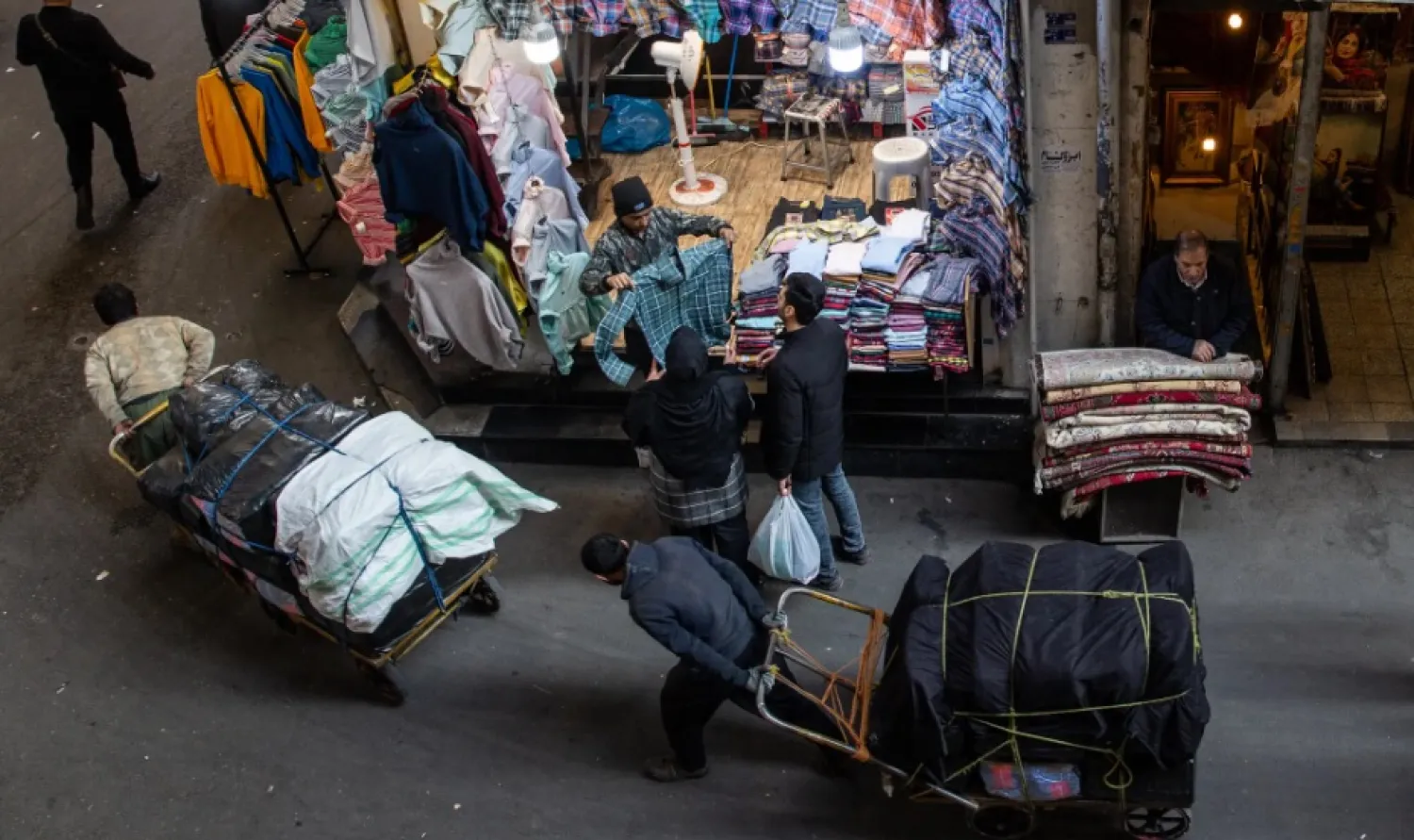

Iran’s Rulers, Shaken by Protests, Now Face Currency Crisis

The Grand Bazaar. Credit: Arash Khamooshi for The New York Times
TT

Iran’s Rulers, Shaken by Protests, Now Face Currency Crisis

The Grand Bazaar. Credit: Arash Khamooshi for The New York Times

As their currency plunged to new lows recently, Iranians did what they had grown all too used to: They crowded exchange shops, hoping to convert their increasingly worthless rials into dollars.

At the grocery store, prices had climbed so high that many people had only enough to buy vegetables. And as the Persian New Year approached, some had little left for holiday meals, shopping and travel.

The rial has lost some 30 percent of its value against the dollar since the beginning of the year, the latest setback for an economy whose outlook has steadily dimmed since 2018, when President Donald J. Trump walked away from an agreement to limit Iran’s nuclear activities in exchange for lifting sanctions. Instead, he imposed even harsher sanctions.

The currency’s recent decline has added to a sense of despair and to Iranians’ grievances against the government. The prospects for economic relief and political change now appear slim: The nuclear deal looks unlikely to be revived, and a violent crackdown by the authorities has largely crushed the mass protests against clerical rule that erupted in September.

For an increasingly vocal number of Iranians, the long lines outside the currency exchanges were the latest evidence that the authoritarian leadership was steering the country off the rails.

Frustration with the theocratic rulers, whether over economic policies or social restrictions, also drove the recent protests, which posed one of the greatest challenges to the Islamic Republic since it was established in 1979.

“As someone who has been studying her whole life, I am full of rage that I can’t have a normal life or afford the minimum that I want,” said Sima, 33, a pharmacologist from the capital, Tehran, whose savings have plummeted in value with the currency. She hopes to emigrate to Canada, but if she makes it, her money will be worth far less than before.

“I have no future in this country,” she said.

Iran, its residents often say, should be rich, with some of the world’s largest oil reserves and a well-educated population. Instead, with inflation routinely topping 50 percent annually, some Iranians can no longer afford meat.

Others pare down middle-class comforts they once took for granted: No more eating out. No more travel or new clothes. No more offering visitors the sour plums and green almonds that are traditional nibbles for guests, or no more hosting at all. Marriages are delayed, babies put off.

Economic frustration over a sudden spike in gasoline prices set off major protests in 2019. But last year’s demonstrations, which began after the death in police custody of 22-year-old Mahsa Amini, who was accused of violating the strict religious dress code for women, first took aim at the mandatory head scarf law and the systemic sexism protesters said it symbolized.

The movement quickly expanded, however, to encompass a broad range of grievances with the ruling establishment, including a lack of political and social freedoms, corruption and economic mismanagement.

Economists say the current crisis can be traced to years of Western sanctions on Iran’s oil industry and financial sector over an Iranian nuclear program that the US and its allies suspect is aimed at producing weapons.

“There is no way for this government, without increasing oil revenues, to find money to help people find jobs or even give them mere income,” said Djavad Salehi-Isfahani, an Iranian-born economist at Virginia Tech. “They’ve gotten themselves into a very bad situation.”

Data shows that Iran’s economy grew and poverty rates fell steadily until 2011, when the West first imposed heavy sanctions. The rial exchange rate is now about 500,000 to the dollar, compared with 32,000 when the original nuclear deal was signed in 2015. Poverty has spread, especially in rural areas.

But the government’s handling of a series of recent crises did little to dispel the widely held belief that mismanagement and corruption are also to blame.

In the last several months, victims of an earthquake in northern Iran denounced a too-little-too-late emergency response, according to social media posts. The authorities responded to protests with water cannons.

Mohamed Ali Kadivar, a Boston College sociologist who studies Iranian protest movements, said that “because of the dominance of the hard liners, the people who take government jobs are loyal, they’re not people with expertise,” which makes the system “incapable of problem-solving.”

Government interventions to stop the currency’s slide over the last week have had minor success. The government has given cash to low-income and some middle-income Iranians and urged the private sector to create jobs. But economists say Iran has failed to use levers it has to hold back poverty.

Much of the economy is controlled by well-connected government loyalists or the powerful Iranian Revolutionary Guard Corps, creating advantages for insiders that, along with the political uncertainty, hinder investment.
Iran’s leaders blame Western sanctions for the economic problems and foreign meddling for the recent unrest.

Some analysts say one way for Iran to gain badly needed cash and investment would be to negotiate a new nuclear deal that would ease sanctions, as President Biden has tried to do. But some of the ruling establishment’s fiercest critics argue that such an agreement would only grant Iran’s leaders revenue and power.

Any hint that negotiations are stalling or picking up can send the rial fluctuating, and the growing belief that sanctions are here to stay was probably a factor in the rial’s decline, analysts said. New restrictions on dollars flowing into neighboring Iraq made the US currency even scarcer in Iran, a major trading partner, according to analysts.

In one supermarket in Amol, a city in northern Iran, the price of shampoo went up by nearly 60 percent in a week, while the price of meat increased tenfold, said Leili, 39, a teacher. To save, she said, she and her husband walked instead of taking taxis, stopped eating meat and dairy and bought more canned goods to use less cooking gas.

The idea of having a child, as she once imagined, no longer seemed realistic.

“This political system is the reason that we work for most of the day, and at the end of the day, we still have nothing. We’re entirely incapable of affording the basics,” said Leili, who, like other Iranians whom The Times interviewed, gave only her first name to avoid government reprisal.

Batoul, a 77-year-old pensioner in a poor area of south Tehran whose rent alone rose this year to more than twice her monthly pension, began asking for a grocery store’s castoff fruit, hoping to find a few edible pieces among the rot.

To be sure, total economic collapse remains a ways away. Iran’s economic output other than oil has managed to grow slightly in recent years. On recent visits to several cities, restaurants and hotels still had some guests, and bazaars and sweet shops had customers.

But with the dizzying swings in the currency’s value, the uncertainty and the lack of opportunities for young people, despair is little surprise, said Mr. Salehi-Isfahani, the economist.

The government has done little to blunt the pain other than to avoid raising gas prices, one of its few means of raising revenue. Such a move could lead to protests, as it did in 2019. This year’s budget did not increase welfare payments to match inflation, according to analysts, or increase subsidies for food staples and gasoline.

The budget did, however, allocate more money to the Revolutionary Guards force and other defense sectors.

“It’s just more money for the defense industry and cuts for the people,” said Henry Rome, a senior fellow at the Washington Institute for Near East Policy who studies Iran, “and I think that kind of speaks for itself.”

The New York Times


Road Accident in Nigeria Kills at Least 30 People

FILE PHOTO: A police vehicle of Operation Fushin Kada (Anger of Crocodile) is parked on Yakowa Road, as schools across northern Nigeria reopen nearly two months after closing due to security concerns, following the mass abductions of school children, in Kaduna, Nigeria, January 12, 2026. REUTERS/Nuhu Gwamna/File Photo
TT

Road Accident in Nigeria Kills at Least 30 People

FILE PHOTO: A police vehicle of Operation Fushin Kada (Anger of Crocodile) is parked on Yakowa Road, as schools across northern Nigeria reopen nearly two months after closing due to security concerns, following the mass abductions of school children, in Kaduna, Nigeria, January 12, 2026. REUTERS/Nuhu Gwamna/File Photo

At least 30 people have been killed and an unspecified number of people injured in a road accident in northwest Nigeria, authorities said.

The accident occurred Sunday in Kwanar Barde in the Gezawa area of Kano state and was caused by “reckless driving” by the driver of a truck-trailer, Gov. Abba Yusuf said in a statement. He did not specify what other vehicles were involved.

Yusuf described the accident as “heartbreaking and a great loss” to the affected families and the state. He did not provide more details of the accident, said The Associated Press.

Africa’s most populous country recorded 5,421 deaths in 9,570 road accidents in 2024, according to data by the country’s Federal Road Safety Corps.

Experts say a combination of factors including a network of bad roads, lax enforcement of traffic laws and indiscipline by some drivers produce the grim statistics.

In December, boxing heavyweight champion Anthony Joshua was in a deadly car crash that injured him and killed Sina Ghami and Latif “Latz” Ayodele, two of his friends, in southwest Nigeria.

Adeniyi Mobolaji Kayode, Joshua’s driver, was charged with dangerous and reckless driving and his trial is scheduled to begin later this month.


US Vice President Vance Heads to Armenia, Azerbaijan to Push Peace, Trade

US Vice President JD Vance speaks during the Critical Minerals Ministerial at the State Department in Washington, DC, US, February 4, 2026. (Reuters)
TT

US Vice President Vance Heads to Armenia, Azerbaijan to Push Peace, Trade

US Vice President JD Vance speaks during the Critical Minerals Ministerial at the State Department in Washington, DC, US, February 4, 2026. (Reuters)

US Vice President JD Vance will visit Armenia and Azerbaijan this week to push a Washington-brokered peace agreement that could transform energy and trade routes in the strategic South Caucasus region.

His two-day trip to Armenia, which begins later on Monday, comes just six months after the Armenian and Azerbaijani leaders signed an agreement at the White House seen as the first step towards peace after nearly 40 years of war.

Vance, the first US vice president to visit Armenia, is seeking to advance the Trump Route for International Peace and Prosperity (TRIPP), a proposed 43-kilometre (27-mile) corridor that would run across southern Armenia and give Azerbaijan a direct route to its exclave ‌of Nakhchivan ‌and in turn to Türkiye, Baku's close ally.

"Vance's visit should ‌serve ⁠to reaffirm the ‌US's commitment to seeing the Trump Route through," said Joshua Kucera, a senior South Caucasus analyst at Crisis Group.

"In a region like the Caucasus, even a small amount of attention from the US can make a significant impact."

The Armenian government said on Monday that Vance would hold talks with Prime Minister Nikol Pashinyan and that both men would then make statements, without elaborating.

Vance will then visit Azerbaijan on Wednesday and Thursday, the White House has said.

Under the agreement signed last year, ⁠a private US firm, the TRIPP Development Company, has been granted exclusive rights to develop the proposed corridor, with Yerevan ‌retaining full sovereignty over its borders, customs, taxation and security.

The ‍route would better connect Asia to Europe ‍while - crucially for Washington - bypassing Russia and Iran at a time when Western countries are ‍keen on diversifying energy and trade routes away from Russia due to its war in Ukraine.

Russia has traditionally viewed the South Caucasus as part of its sphere of influence but has seen its clout there diminish as it is distracted by the war in Ukraine.

Securing US access to supplies of critical minerals is also likely to be a key focus of Vance's visit.

TRIPP could prove a key transit corridor for the vast mineral wealth of ⁠Central Asia - including uranium, copper, gold and rare earths - to Western markets.

CLOSED BORDERS, BITTER RIVALS

In Soviet times the South Caucasus was criss-crossed by railways and oil pipelines until a series of wars beginning in the 1980s disrupted energy routes and shuttered the border between Armenia and Türkiye, Azerbaijan's key regional ally.

Armenia and Azerbaijan were locked in bitter conflict for nearly four decades, primarily over the mountainous region of Nagorno-Karabakh, an internationally recognized part of Azerbaijan that broke away from Baku's control as the Soviet Union fell apart in 1991.

Azerbaijan and Armenia fought two wars over Karabakh before Baku finally took it back in 2023. Karabakh's entire ethnic Armenian population of around 100,000 people fled to Armenia. The two neighbors have made progress in recent months on normalizing relations, including restarting ‌some energy shipments.

But major hurdles remain to full and lasting peace, including a demand by Azerbaijan that Armenia change its constitution to remove what Baku says contains implicit claims on Azerbaijani territory.


Adviser to Iran's Supreme Leader to Visit Oman on Tuesday

FILED - 06 February 2009, Bavaria, Munich: Ali Larijani, then chairman of the Iranian parliament, speaks at the 45th Munich Security Conference in Munich. Photo: Andreas Gebert/dpa
TT

Adviser to Iran's Supreme Leader to Visit Oman on Tuesday

FILED - 06 February 2009, Bavaria, Munich: Ali Larijani, then chairman of the Iranian parliament, speaks at the 45th Munich Security Conference in Munich. Photo: Andreas Gebert/dpa

Ali Larijani, an adviser to Iran's Supreme Leader Ali Khamenei, will visit Oman accompanied by a delegation on Tuesday, the ‌semi-official Tasnim news ‌agency reported ‌on ⁠Monday.

American and ‌Iranian diplomats held indirect talks in Oman last week, aimed at reviving diplomacy amid a US ⁠naval buildup near Iran and ‌Tehran's vows ‍of a ‍harsh response if ‍attacked.

"During this trip, (Larijani) will meet with high-ranking officials of the Sultanate of Oman and discuss the latest regional ⁠and international developments and bilateral cooperation at various levels," Tasnim said.

The date and venue of the next round of talks are yet to be announced.
