

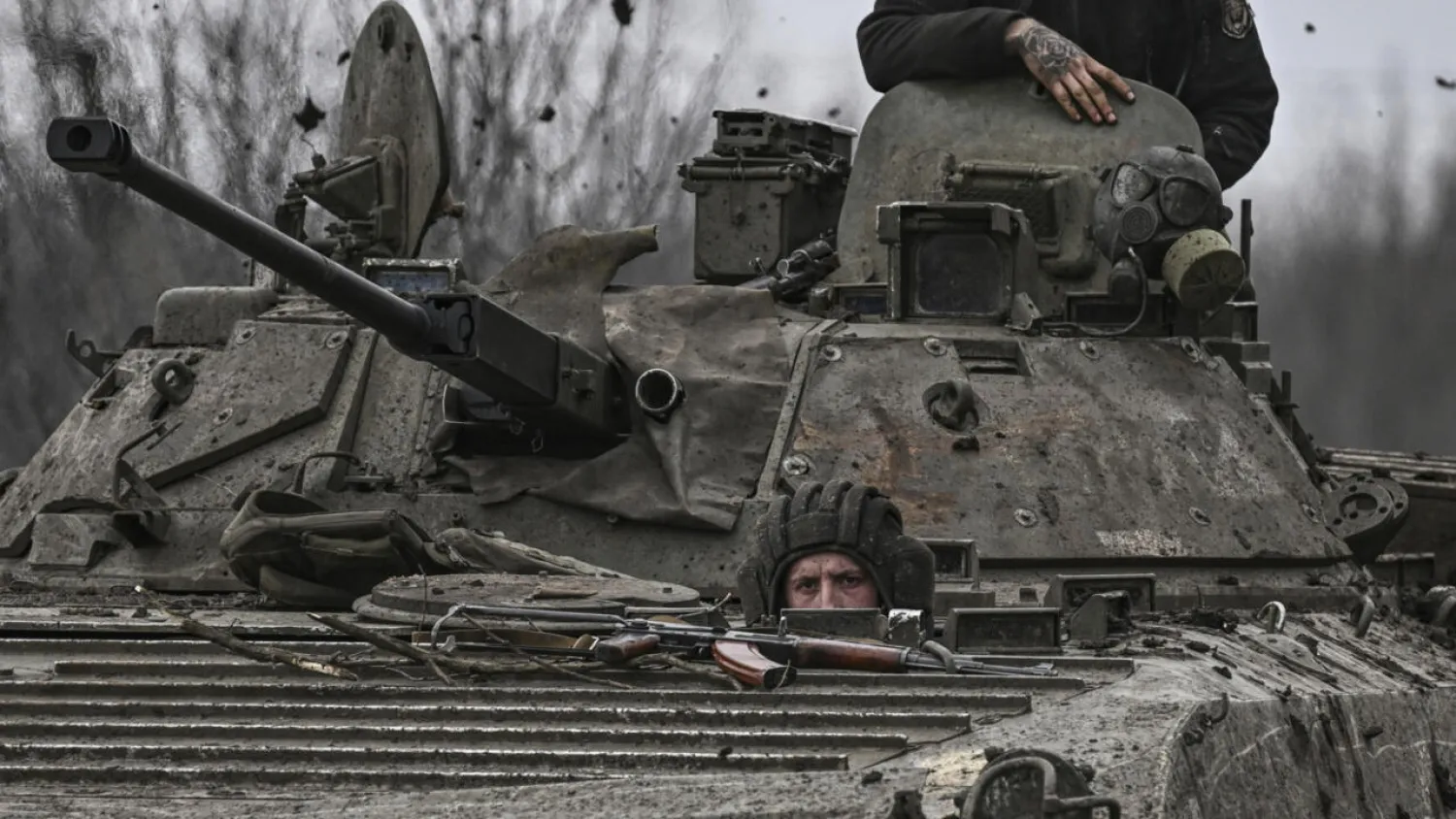

Ukraine Readies Counteroffensive as Russia Inches Forward in Bakhmut

Some military experts have questioned the sense of the continued fight for Bakhmut. Aris Messinis / AFP
TT

Ukraine Readies Counteroffensive as Russia Inches Forward in Bakhmut

Some military experts have questioned the sense of the continued fight for Bakhmut. Aris Messinis / AFP

The Ukrainian military was preparing Sunday for an upcoming counteroffensive, with a top commander saying his forces' ongoing defense of Bakhmut in the face of fierce and sustained Russian attacks was necessary to "buy time" for that push.

The remarks came as British intelligence said the frontline had shifted in the fight for Bakhmut -- the longest and bloodiest battle of Moscow's year-long invasion -- but that any further Russian advance in the devastated town would be "highly challenging".

Some military experts have questioned the sense of continuing to hold the city, but the commander of Ukraine's ground forces, Oleksandr Syrsky, said that it helped win time in preparation for the coming counteroffensive, said AFP.

"The real heroes now are the defenders who are holding the eastern front on their shoulders, and inflicting the heaviest possible losses, sparing neither themselves nor the enemy," Syrsky was quoted as saying in a statement on Saturday.

"It is necessary to buy time to build reserves and launch a counteroffensive, which is not far off."

In a video released on Saturday, Yevgeny Prigozhin, chief of Russian mercenary group Wagner, said that his forces were close to the administrative center of the city.

Standing on the rooftop of a high-rise building in what is said to be Bakhmut, Prigozhin is seen pointing towards a building in the distance.

"This is the building of the town administration, this is the center of the town," he said, clad in full military gear.

"It is one kilometer and two hundred meters away."

Speaking as artillery boomed in the background, Prigozhin said the most important thing now was to receive more ammunition from the army and "move forward".

Wagner has been spearheading offensives against cities in eastern Ukraine including Bakhmut. Both sides have suffered heavy losses.

The Ukrainian defense ministry on Saturday reported that its forces had repelled "more than 100 enemy attacks" over the last day along the eastern front.

'A killing zone'
In an interview with the French newspaper Journal du Dimanche, Ukrainian Deputy Prime Minister Olga Stefanishyna underscored the human cost of Russia's assault on Bakhmut.

"Thousands of Russian soldiers died at a considerable rate in this battle," she said. "The human mass of its infantry is a formidable weapon, it seems inexhaustible in volume and in time."

But even if it did capture the "small town", she added, "it will not impact the strategic corridors we still control in the region".

British military intelligence said that the Bakhmutka River in the center of the city now marked the front line.

"Ukrainian forces hold the west of the town and have demolished key bridges over the river, which runs north-south through a strip of open ground 200 meters-800 meters wide," the British defense ministry said.

"This area has become a killing zone, likely making it highly challenging for Wagner forces attempting to continue their frontal assault westwards."

Wagner chief Prigozhin, an ally of President Vladimir Putin, has been entangled in a power struggle with the defense ministry.

He has several times claimed battlefield victories ahead of Russia's army, criticized the country's top brass and accused the military of not sharing ammunition with Wagner forces.

On Saturday he said he was ready to ask Russia's top commanders for forgiveness but at the same time appeared to mock Russian Defence Minister Sergei Shoigu and Chief of the General Staff Valery Gerasimov.

He said they were "outstanding military commanders" and added that Russia's greatest military leaders including Georgy Zhukov and Alexander Suvorov "could have learnt" from them.

"I absolutely -- totally -- support all their initiatives," Prigozhin added.

Shelling of Kherson
Since Russia's retreat from the city of Kherson late last year, it has been regularly pounded by Moscow's troops.

The Russian army has kept shelling the southern city, killing three people and wounding another two, Ukrainian officials said Saturday.

"Russian terrorists are shelling Kherson again," said Andriy Yermak, the head of Ukraine's presidential office, posting a picture of firefighters next to a charred car.

Galyna Kolisnyk, 53, said the Russians struck when she was in a store.

"When we entered, literally five minutes later this tragedy happened," she told AFP.

"Explosions began, our car got hit," she said. "This is horrible."

Kherson is the capital of one of the four regions -- along with Donetsk, Lugansk and Zaporizhzhia -- that Russia claims to have annexed but does not fully control.

Donetsk's separatist mayor Alexei Kulemzin said Saturday that Ukrainian shelling had killed two people including a young boy.



Search Teams in Türkiye Recover Recorders after Plane Crash that Killed Libyan Military Officials

Turkish army soldiers stand guard as rescue teams search for the remains of a private jet carrying Libya's military chief and four others that crashed after taking off from Ankara, killing everyone on board, in Ankara, Turkey, early Wednesday, Dec. 24, 2025. (AP Photo/Efekan Akyuz)
TT

Search Teams in Türkiye Recover Recorders after Plane Crash that Killed Libyan Military Officials

Turkish army soldiers stand guard as rescue teams search for the remains of a private jet carrying Libya's military chief and four others that crashed after taking off from Ankara, killing everyone on board, in Ankara, Turkey, early Wednesday, Dec. 24, 2025. (AP Photo/Efekan Akyuz)

Search teams in Türkiye on Wednesday recovered the cockpit voice and flight data recorders from a jet crash that killed eight people, including western Libya’s military chief, while efforts to retrieve the victims' remains were still underway, Türkiye's interior minister said.

The private jet carrying Gen. Muhammad Ali Ahmad al-Haddad, four other military officials and three crew members crashed on Tuesday, after taking off from Türkiye's capital, Ankara, killing everyone on board. Libyan officials said that the cause of the crash was a technical malfunction on the plane.

The high-level Libyan delegation was on its way back to Tripoli after holding defense talks in Ankara aimed at boosting military cooperation between the two countries.

Turkish Interior Minister Ali Yerlikaya told journalists at the site of the crash that wreckage was scattered across an area covering three square kilometers (more than a square mile), complicating recovery efforts. Authorities from the Turkish forensic medicine authority were working to recover and identify the remains, he said.

A 22-person delegation — including five family members — arrived from Libya early on Wednesday to assist in the investigation, he said.

Tripoli-based Libyan Prime Minister Abdul-Hamid Dbeibah confirmed the deaths on Tuesday, describing the crash on Facebook as a “tragic accident” and a “great loss” for Libya.

Turkish President Recep Tayyip Erdogan held a telephone call with Dbeibah, during which he conveyed his condolences and expressed his sorrow over the deaths, his office said.

The Turkish leader later also offered his condolences during a televised speech, voicing solidarity with Libya.

"An investigation has been launched into this tragic incident that has deeply saddened us, and our ministries will provide information about its progress,” Erdogan said.

Al-Hadad was the top military commander in western Libya and played a crucial role in the ongoing, UN-brokered efforts to unify Libya’s military, which has split, much like the nation's other institutions.

The four other military officials who died in the crash were Gen. Al-Fitouri Ghraibil, the head of Libya’s ground forces, Brig. Gen. Mahmoud Al-Qatawi, who led the military manufacturing authority, Mohammed Al-Asawi Diab, adviser to the chief of staff, and Mohammed Omar Ahmed Mahjoub, a military photographer with the chief of staff’s office.

The identities of the three crew members weren't immediately released.

Turkish officials said that the Falcon 50-type business jet took off from Ankara’s Esenboga airport at 8:30 p.m. and that contact was lost around 40 minutes later. The plane notified air traffic control of an electrical fault and requested an emergency landing. The aircraft was redirected back to Esenboga, where preparations for its landing began.

The plane, however, disappeared from radar while descending for the emergency landing, the Turkish presidential communications office said.

The Libyan government declared a three-day period of national mourning. Flags would be flown half-staff at all state institutions, according to the government’s announcement on Facebook.

The wreckage was found near the village of Kesikkavak, in Haymana, a district about 70 kilometers (45 miles) south of Ankara.

At the crash site, search and recovery teams intensified their operations on Wednesday after a night of heavy rain and fog, the state-run Anadolu Agency reported. Gendarmerie police sealed off the area while the Turkish disaster management agency, AFAD, set up a mobile coordination center. Specialized vehicles, such as tracked ambulances, were deployed because of the muddy terrain.

Türkiye has assigned four prosecutors to lead the investigation, and Yerlikaya that said the Turkish search and recovery teams included 408 personnel.

While in Ankara, al-Haddad had met with Turkish Defense Minister Yasar Guler and other officials.


Netanyahu: Israel to Spend $110 billion to Develop Independent Arms Industry in Next Decade

Two Israeli soldiers inside Gaza (AFP)
TT

Netanyahu: Israel to Spend $110 billion to Develop Independent Arms Industry in Next Decade

Two Israeli soldiers inside Gaza (AFP)

Israeli Prime Minister Benjamin Netanyahu said ​on Wednesday Israel would spend 350 billion shekels ($110 billion) on developing an independent arms to reduce ‌dependency on other ‌countries, AFP reported.

"We ‌will ⁠continue ​to ‌acquire essential supplies while independently arming ourselves," Netanyahu said at a ceremony for new pilots.

"I ⁠don't know if ‌a country can ‍be ‍completely independent but we ‍will strive ... to ensure our arms are produced as ​much as possible in Israel," he said.

"Our ⁠goal is to build an independent arms industry for the State of Israel and reduce the dependency on any party, including allies."


EU, France, Germany Slam US Visa Bans as 'Censorship' Dispute Deepens

European Commissioner for Internal Market Thierry Breton holds a press conference in Brussels, Belgium March 25, 2024. REUTERS/Yves Herman/File Photo
TT

EU, France, Germany Slam US Visa Bans as 'Censorship' Dispute Deepens

European Commissioner for Internal Market Thierry Breton holds a press conference in Brussels, Belgium March 25, 2024. REUTERS/Yves Herman/File Photo

The European Union, France and Germany condemned US visa bans on European citizens combating online hate and ​disinformation, with Brussels saying on Wednesday it could "respond swiftly and decisively" against the "unjustified measures".

US President Donald Trump's administration imposed visa bans on Tuesday on five European citizens, including French former EU commissioner Thierry Breton, who it accuses of working to censor freedom of speech or unfairly target US tech giants with overly burdensome regulation.

A European Commission spokesperson said it "strongly condemns the US decision", adding: "Freedom of expression is a fundamental right in Europe and a shared core value with the United States across the democratic world."

EU FINED ELON MUSK'S X THIS MONTH

The visa bans are likely to exacerbate growing divergences between Washington and some European capitals over issues including free speech, defense, immigration, far-right politics, trade and the Russia-Ukraine war.

They come just weeks after a US National Security ‌Strategy document warned Europe ‌faced "civilizational erasure" and must change course if it is to remain a reliable ‌US ⁠ally.

Breton ​was one ‌of the architects of the EU's Digital Services Act, a landmark piece of legislation aimed at making the internet safer that has irritated US officials.

They were particularly riled by Brussels' sanction earlier this month against Elon Musk's X platform, which was fined 120 million euros for breaching online content rules. Musk and Breton have often sparred online over EU tech regulation, with Musk referring to him as the "tyrant of Europe".

The bans also targeted Imran Ahmed, the British CEO of the US-based Center for Countering Digital Hate; Anna-Lena von Hodenberg and Josephine Ballon of the German non-profit HateAid; and Clare Melford, co-founder of the Global Disinformation Index, according to US Under Secretary for Public ⁠Diplomacy Sarah Rogers.

EU LAW AIMS TO MAKE ONLINE WORLD SAFER

The EU's DSA is meant to make the online environment safer, in part by compelling tech giants to do ‌more to tackle illegal content, including hate speech and child sexual abuse material.

Washington ‍has said the EU was pursuing "undue" restrictions on freedom of ‍expression in its efforts to combat hateful speech, misinformation and disinformation, and that the DSA unfairly targets US tech giants ‍and US citizens.

The European Commission spokesperson said the EU had the right to regulate economic activity, and had requested more information from Washington about the measures.

"If needed, we will respond swiftly and decisively to defend our regulatory autonomy against unjustified measures," they said.

French President Emmanuel Macron said: "These measures amount to intimidation and coercion aimed at undermining European digital sovereignty."

On X, he said the DSA was approved in a democratic process, and existed "to ​ensure fair competition among platforms, without targeting any third country, and to ensure that what is illegal offline is also illegal online."

Breton, a former French finance minister and the European commissioner for the internal ⁠market from 2019 to 2024, was the most high-profile individual targeted.

"Is McCarthy's witch hunt back?" he wrote on X.

"As a reminder: 90% of the European Parliament - our democratically elected body - and all 27 Member States unanimously voted the DSA. To our American friends: Censorship isn't where you think it is."

GERMANY SAYS BANS ON ACTIVISTS 'UNACCEPTABLE'

Germany's justice ministry said the two German activists had the government's "support and solidarity" and the visa bans on them were unacceptable, adding that HateAid supported people affected by unlawful digital hate speech.

"Anyone who describes this as censorship is misrepresenting our constitutional system," it said in a statement. "The rules by which we want to live in the digital space in Germany and in Europe are not decided in Washington."

A Global Disinformation Index spokesperson called the visa bans "an authoritarian attack on free speech and an egregious act of government censorship."

"The Trump Administration is, once again, using the full weight of the federal government to intimidate, censor, and silence voices they disagree with," they said. "Their actions today are immoral, unlawful, and un-American."

Breton is not the first French person to ‌be sanctioned by the Trump administration.

In August, Washington sanctioned French judge Nicolas Yann Guillou, who sits on the International Criminal Court, for the tribunal's targeting of Israeli leaders and a past decision to investigate US officials.