


Armenia Raises Peacekeeper 'Problems' with Putin, Fears Escalation

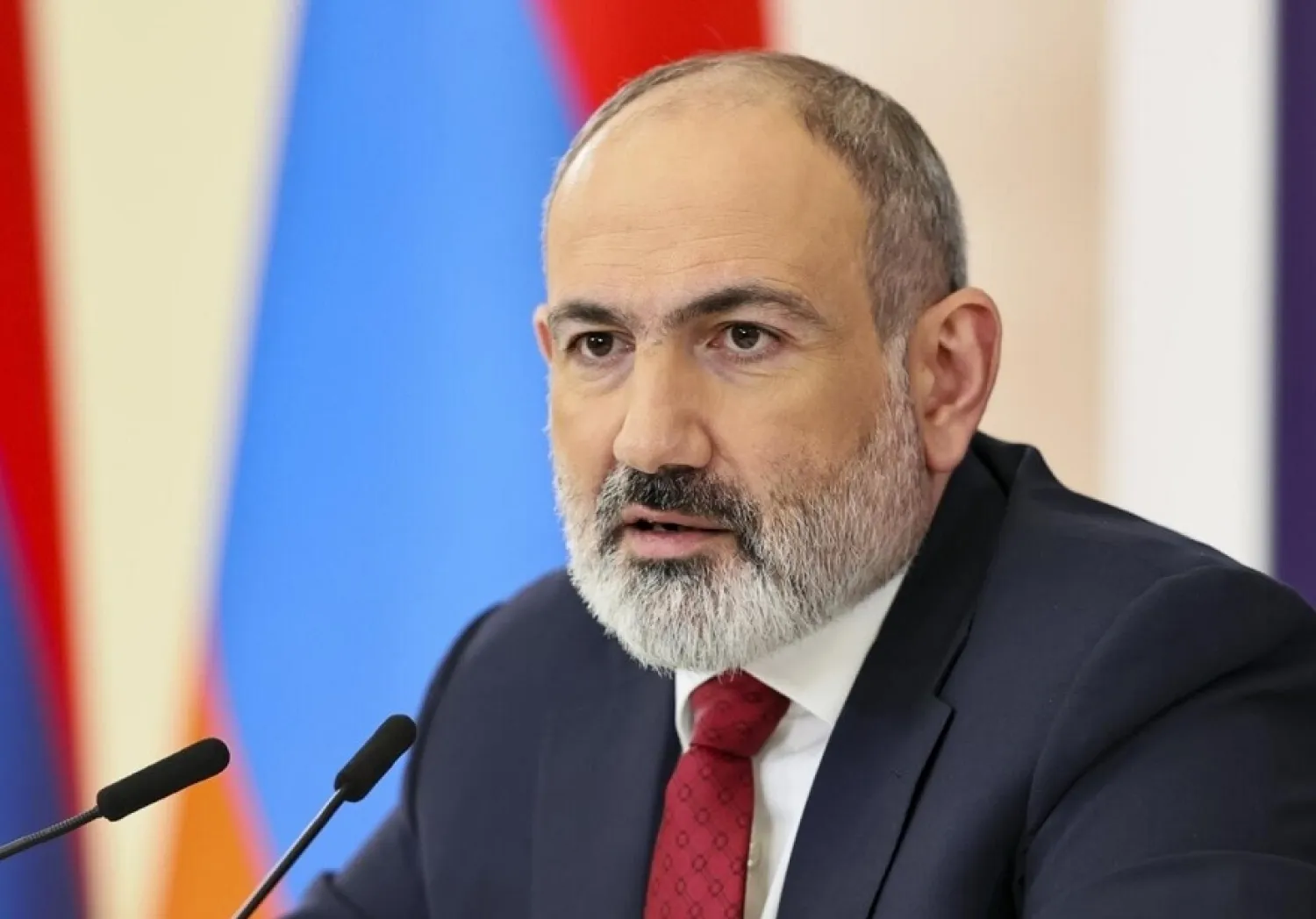
Armenian Prime Minister Nikol Pashinyan gestures during a news conference in Yerevan, Armenia, Tuesday, March 14, 2023. Tigran Mehrabyan, AP
TT

Armenia Raises Peacekeeper 'Problems' with Putin, Fears Escalation

Armenian Prime Minister Nikol Pashinyan gestures during a news conference in Yerevan, Armenia, Tuesday, March 14, 2023. Tigran Mehrabyan, AP

Armenian Prime Minister Nikol Pashinyan said Tuesday he had complained to President Vladimir Putin about "problems" with Russian peacekeepers in Nagorno-Karabakh, warning of an escalation in the restive Caucasus region.

Armenia and Azerbaijan have fought two wars for control of the Armenian-majority region and the latest conflict in 2020 ended with the deployment of Moscow's forces, said AFP.

Pashinyan's comments are the latest sign that Armenia, which relies on Russia as a security guarantor, is growing frustrated with the Kremlin whose attention is focused on Ukraine and confrontation with the West.

"In a phone conversation with Putin yesterday, I spoke of a possible escalation in Nagorno-Karabakh and said that there are problems in the zone where Russian peacekeepers are responsible," Pashinyan said during a press conference.

"Azerbaijan's rhetoric is becoming more and more aggressive every day," he said, denouncing a blockade of the so-called Lachin corridor, which is Karabakh's sole land link with Armenia.

Since mid-December, a group of self-styled Azerbaijani environmental activists has barred traffic in the Lachin corridor to protest what they say is illegal mining.

Pashinyan on Tuesday described the disruptions along the route as "preparation for ethnic cleansing of Armenians."

- Waning influence -

Yerevan has claimed that the blockade has led to a humanitarian crisis and was aimed at driving Armenians from Karabakh, which Baku has denied.

Armenia, which hosts a permanent Russian military base on its territory, is a member of the Collective Security Treaty Organisation (CSTO) that includes several pro-Moscow ex-Soviet republics -- but not Azerbaijan.

Last week Yerevan refused to assume the rotating top post in the security bloc -- partly in a show of frustration over the peacekeepers' failure to prevent Karabakh's blockade.

"It is not that Armenia is leaving the CSTO, the CSTO is leaving Armenia, which is of great concern to us, Pashinyan said.

Yerevan's distancing from the bloc marked another sign of Russia's waning authority in its traditional sphere of influence.

At least three Armenians died in the latest border clashes at the beginning of March.

"I want to underline that this happened in the zone of responsibility of Russian peacekeeping forces. This worries us," Pashinyan said Tuesday.

- Progress, problems, red lines -

Pashinyan also said that Armenia recently received Baku's response to proposals for a full peace treaty, which Yerevan submitted in mid-February.

He noted some progress in the peace process, but said "fundamental problems" remain because "Azerbaijan is trying to put forward territorial claims, which is a red line to Armenia."

Yerevan has accused Baku forces of occupying -- after the 2020 war -- some 150 square kilometers in Armenia, along the countries' shared border.

On February 20, the European Union deployed an expanded monitoring mission to Armenia's volatile border area as Western engagement grows in the region seen by the Kremlin as its geopolitical backyard.

When the Soviet Union collapsed in 1991, ethnic Armenian separatists in Karabakh broke away from Azerbaijan. The ensuing conflict claimed around 30,000 lives.

Another flare-up in violence in 2020 left more than 6,500 dead and ended with a Russian-brokered truce.

Under the deal Armenia ceded territories it had controlled for decades and Russia deployed its peacekeeping contingent to oversee the fragile ceasefire.



Thousands of Somalis Protest Israeli Recognition of Somaliland

This picture taken on November 7, 2024 shows a general view of the city of Hargeisa, capital and largest city of the self-proclaimed Republic of Somaliland. (Photo by LUIS TATO / AFP)
TT

Thousands of Somalis Protest Israeli Recognition of Somaliland

This picture taken on November 7, 2024 shows a general view of the city of Hargeisa, capital and largest city of the self-proclaimed Republic of Somaliland. (Photo by LUIS TATO / AFP)

Large protests broke out in several towns and cities across Somalia on Tuesday in opposition to Israel's recognition of the breakaway region of Somaliland.

Israel announced on Friday that it viewed Somaliland -- which declared independence in 1991 but has never been recognized by any other country -- as an "independent and sovereign state".

Somali President Hassan Sheikh Mohamud has condemned the move as a threat to stability in the Horn of Africa. He travelled Tuesday to Türkiye, a close ally, to discuss the situation, AFP reported.

Thousands of protesters marched through the streets of Somali capital Mogadishu and gathered at a stadium, waving placards with anti-Israeli slogans alongside Somali and Palestinian flags.

"We will never allow anyone to violate our sovereignty," one attendee, Adan Muhidin, told AFP, adding that Israel's move was "a blatant violation of international law".

Demonstrations also took place in Lascanod in the northeast, Guriceel in central Somalia, and Baidoa in the southwest.

"There is nothing we have in common with Israel. We say to the people of Somaliland, don't bring them close to you," said Sheikh Ahmed Moalim, a local religious leader, in Guriceel.

Somaliland has long been a haven of stability and democracy in the conflict-scarred country, with its own money, passport and army.

It also has a strategic position on the Gulf of Aden that makes it an attractive trade and military partner for regional and international allies.

But Israel's decision to recognize its statehood has brought rebukes from across the Muslim and African world, with many fearing it will stoke conflict and division.

There have been celebrations in Somaliland's capital Hargeisa, with the rare sight of Israeli flags being waved in a Muslim-majority nation.


Iranian Students Protest in Tehran and Isfahan, Says Local Media

Shopkeepers and traders walk over a bridge during a protest against the economic conditions and Iran's embattled currency in Tehran on December 29, 2025. (Handout / Fars News Agency / AFP)
TT

Iranian Students Protest in Tehran and Isfahan, Says Local Media

Shopkeepers and traders walk over a bridge during a protest against the economic conditions and Iran's embattled currency in Tehran on December 29, 2025. (Handout / Fars News Agency / AFP)

Student protests erupted on Tuesday at universities in the capital Tehran and the central city of Isfahan, decrying declining living standards following demonstrations by shopkeepers, local media reported.

"Demonstrations took place in Tehran at the universities of Beheshti, Khajeh Nasir, Sharif, Amir Kabir, Science and Culture, and Science and Technology, as well as the Isfahan University of Technology," reported Ilna, a news agency affiliated with the labor movement.


Iran Designates Royal Canadian Navy a Terrorist Organization

Iranians drive past a huge banner of former Iranian Revolutionary Guard Corps (IRGC) Quds Force commander Qassem Soleimani ahead of the sixth anniversary of his assassination at Valiasr Square in Tehran, Iran, 30 December 2025. (EPA)
TT

Iran Designates Royal Canadian Navy a Terrorist Organization

Iranians drive past a huge banner of former Iranian Revolutionary Guard Corps (IRGC) Quds Force commander Qassem Soleimani ahead of the sixth anniversary of his assassination at Valiasr Square in Tehran, Iran, 30 December 2025. (EPA)

The Iranian foreign ministry designated the Royal Canadian Navy a terrorist organization on Tuesday in what it said was retaliation for Canada's 2024 blacklisting of Iran's Revolutionary Guards.

In a statement, the ministry said that the move was in reaction to Ottawa declaring the Guards, the ideological arm of Iran's military, a terror group "contrary to the fundamental principles of international law".

Iran "within the framework of reciprocity, identifies and declares the Royal Canadian Navy as a terrorist organization," the statement added, without specifying what ramifications if any the force will face.

On June 19, 2024, Canada declared the IRGC a terror group. This bars its members from entering the country and Canadians from having any dealings with individual members or the group.

Additionally, any assets the Guards or its members hold in Canada could also be seized.
Canada accused the Guards of "having consistently displayed disregard for human rights both inside and outside of Iran, as well as a willingness to destabilize the international rules-based order."

One of the reasons behind Ottawa's decision to designate the force as a terror group was the Flight PS752 incident.

The flight was show down shortly after takeoff from Tehran in January 2020, killing all 176 passengers and crew, including 85 Canadian citizens and permanent residents.

The IRGC admitted its forces downed the jet, but claimed their controllers had mistaken it for a hostile target.

Ottawa broke off diplomatic ties with Tehran in 2012, calling Iran "the most significant threat to global peace".

Iran's archenemy, the United States, listed the Guards as a foreign terrorist organization in April 2019 while Australia did the same last month, accusing the force of being behind attacks on Australian soil.