


Pentagon Video Shows Damage to Downed US Drone After Russia Jet Flyby

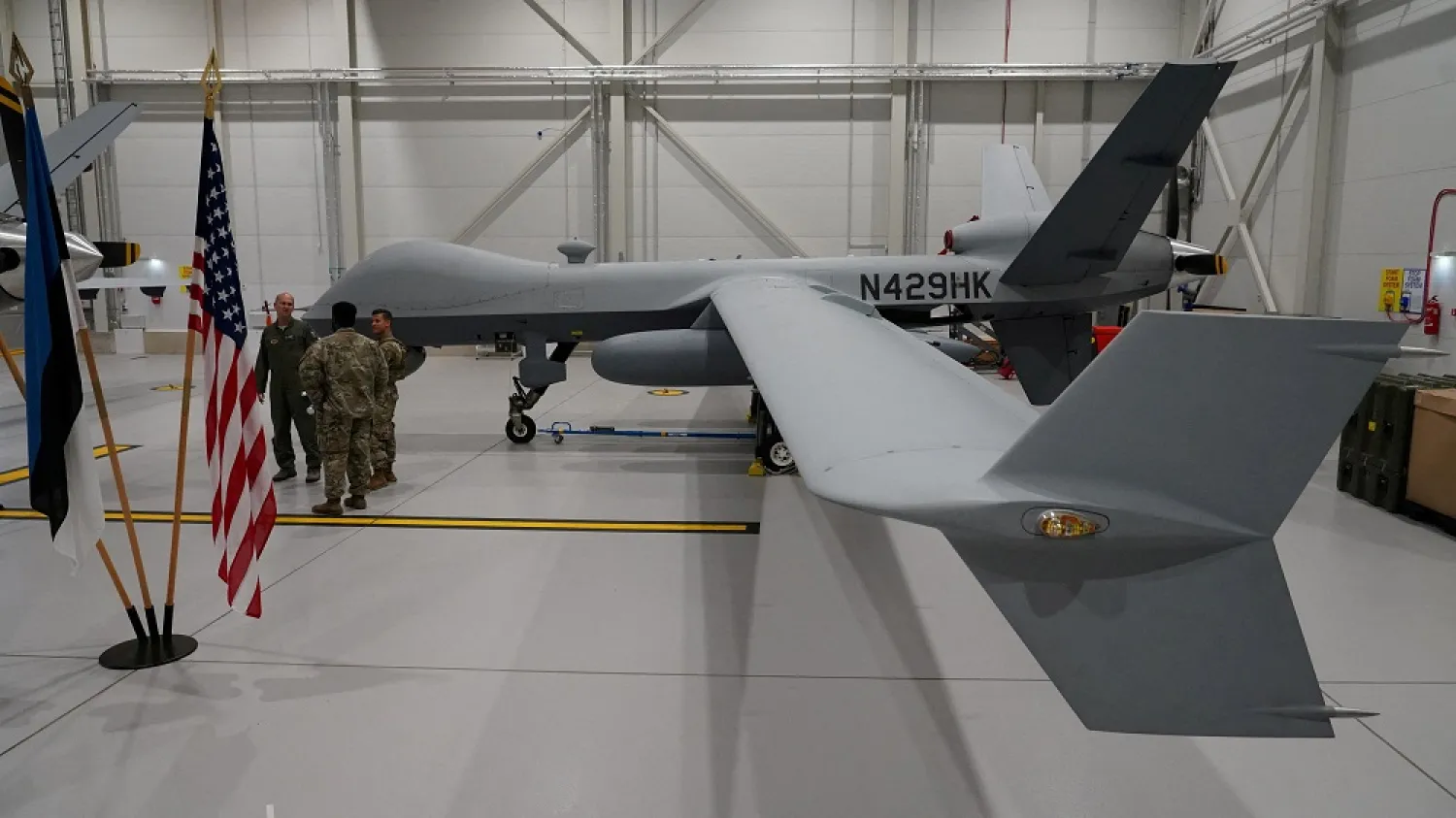
A US Air Force MQ-9 Reaper drone sits in a hanger at Amari Air Base, Estonia, July 1, 2020. (Reuters)
TT

Pentagon Video Shows Damage to Downed US Drone After Russia Jet Flyby

A US Air Force MQ-9 Reaper drone sits in a hanger at Amari Air Base, Estonia, July 1, 2020. (Reuters)

The Pentagon released on Thursday a video showing a Russian military jet intercept a US drone downed over the Black Sea two days ago, in what was the first direct encounter between the world's leading nuclear powers since the Ukraine war began.

The rare Pentagon move came a day after US and Russian defense ministers and military chiefs held phone conversations over the incident that saw the MQ-9 Reaper drone crash into the sea while on a reconnaissance mission in international airspace.

In the declassified, roughly 40-second video, a Russian Su-27 fighter jet comes very close to the drone and dumps what US officials say was jet fuel near it in an apparent effort to damage the American aircraft as it flew over the Black Sea.

It also shows the loss of the video feed after a second pass by a Russian jet, which the Pentagon says resulted from its collision with the drone. The video ends with images of the drone's damaged propeller, which the Pentagon says resulted from the collision, making the aircraft inoperable.

Russia has denied any collision and said the drone crashed after making "sharp maneuvers", having "provocatively" flown close to Russian air space near Crimea, which Moscow forcibly annexed from Ukraine in 2014.

"There is a pattern of behavior recently where there is a little bit more aggressive actions being conducted by the Russians," General Mark Milley, chairman of the US Joint Chiefs of Staff said on Wednesday.

Milley said it was clear that the intercept and harassment of the drone by Russian jets was intentional, but it was unclear whether the Russian pilots meant to slam their aircraft into the drone - a move that could also put them at risk.

‘Escalation’

Russian Defense Minister Sergei Shoigu told his US counterpart that US drone flights near Crimea's coast "were provocative in nature" and could lead to "an escalation ... in the Black Sea zone," a ministry statement said.

Russia, the statement said, has "no interest" in escalation "but will in future react in due proportion" and the two countries should "act with a maximum of responsibility", including by having military lines of communication in a crisis.

US Defense Secretary Lloyd Austin declined to offer details about his conversation with Shoigu, but said the United States would continue "to operate wherever international law allows. And it is incumbent on Russia to operate its military aircraft in a safe and professional manner".

Russia has said the episode showed Washington was directly participating in the Ukraine war, something the West has taken pains to avoid.

"The Americans keep saying they're not taking part in military operations. This is the latest confirmation that they are directly participating in these activities - in the war," Kremlin Security Council Secretary Nikolai Patrushev said.

The United States has supported Ukraine with tens of billions of dollars in military aid but says its troops have not become directly engaged in the war, which Moscow portrays as a conflict against the combined might of the West.

‘Complex’ Bakhmut battle

The drone incident came as Russia kept up a months-long drive to capture the small eastern Ukrainian city of Bakhmut, in what would be its first substantial victory in more than half a year.

The Russian-installed leader of Ukraine's eastern Donetsk region said on Thursday the situation around the now-ruined city remained "complex and difficult" as Kyiv refused to withdraw its forces.

"That is, we do not see that there is any premise that the enemy is going to simply withdraw units," Denis Pushilin said in an interview on state TV.

Ukraine's President Volodymyr Zelenskiy said this week his military top brass had advised reinforcing Bakhmut.

Kyiv had appeared last month to be preparing to pull out of the city but has since decided to defend it, saying it is exhausting Russia's attacking force there to pave the way for its own counter-attack.

In its daily intelligence update on the Ukraine war, Britain's defense ministry said on Thursday Russian attempts to capture the town of Vuhledar, about 150 km (93 miles) southwest of Bakhmut, had "almost certainly slowed" after repeated, very costly failed attacks over the last three months.

To the north of Bakhmut, Ukrainian troops in a bombed out village near the city of Kreminna battled to counter what they said was an attempt by Russia to undertake a giant pincer move.

"The Russians try to adapt in real time," said a member of a drone unit call-signed "Zara". "This makes great problems for us, because we have to think a couple of steps ahead - how do successfully complete the mission and not let the enemy know how we did it."

The war has resulted in the destruction of Ukrainian towns and cities, the deaths of tens of thousands of people and the flight of millions from their homes. It has also rocked the global economy, pushing up energy and food prices.

President Vladimir Putin, meeting members of Russia's business elite on Thursday for the first time since the invasion, urged them to invest in their country to help it weather what he called the West's "sanctions war".

Many of those attending the meeting are themselves under Western sanctions because of what Putin calls Russia's "special military operation" in Ukraine.



China Launches Military Drills Simulating Blockade of Taiwan Ports

A Taiwan Air Force Mirage 2000 fighter jet takes off at Hsinchu Air Base in Hsinchu on December 29, 2025. (AFP)
TT

China Launches Military Drills Simulating Blockade of Taiwan Ports

A Taiwan Air Force Mirage 2000 fighter jet takes off at Hsinchu Air Base in Hsinchu on December 29, 2025. (AFP)

China launched live-fire drills around Taiwan on Monday that it said would simulate a blockade of the self-ruled island's key ports, prompting Taipei to condemn Beijing's "military intimidation".

Beijing claims Taiwan as part of its sovereign territory and has refused to rule out using military action to seize the island democracy.

The latest show of force follows a bumper round of arms sales to Taipei by the United States, Taiwan's main security backer.

Beijing warned on Monday that "external forces" arming Taipei would "push the Taiwan Strait into a perilous situation of imminent war", but did not mention any countries by name.

Any attempts to stop China's unification with Taiwan were "doomed to fail", foreign ministry spokesman Lin Jian said.

China said earlier it was conducting "live-fire training on maritime targets to the north and southwest of Taiwan" in large-scale exercises involving destroyers, frigates, fighters, bombers and drones.

A military spokesman said Beijing would send army, navy, air force and rocket force troops for "major military drills" code-named "Justice Mission 2025".

The activities will focus on "sea-air combat readiness patrol, joint seizure of comprehensive superiority, blockade on key ports and areas, as well as all-dimensional deterrence outside the island chain", said Senior Colonel Shi Yi of the People's Liberation Army's Eastern Theater Command.

Chinese authorities also published a map of five large zones around Taiwan where further live-fire activities would take place from 8:00 am to 6:00 pm (0000 to 1000 GMT) on Tuesday.

"For the sake of safety, any irrelevant vessel or aircraft is advised not to enter the afore-mentioned waters and airspace," the statement said.

- 'Rapid response' -

Taiwan condemned China's "disregard for international norms and the use of military intimidation to threaten neighboring countries", Presidential Office spokeswoman Karen Kuo said.

Taipei said Monday it had detected four Chinese coastguard ships sailing off its northern and eastern coasts.

Its coastguard said it "immediately deployed large vessels to pre-position responses in relevant areas" and "sent additional support units".

Taiwan's military said it had established a response center, deployed "appropriate forces" and "carried out a rapid response exercise".

The drills by China's ruling Communist Party "further confirm its nature as an aggressor, making it the greatest destroyer of peace", Taipei's defense ministry said.

- 'Stern warning' -

Shi, the Chinese military spokesman, said the drills were "a stern warning against 'Taiwan Independence' separatist forces, and... a legitimate and necessary action to safeguard China's sovereignty and national unity".

Beijing's military released a poster about the drills showing "arrows of justice" -- one engulfed in flames -- raining down on what appeared to be green worms on a geographical outline of Taiwan.

Chinese state broadcaster CCTV reported that a core theme of the exercises was a "blockade" of key Taiwanese ports including Keelung in the north and Kaohsiung in the south.

China's military last held large-scale drills involving live firing around Taiwan in April -- surprise maneuvers condemned by Taipei.

China said this month it would take "resolute and forceful measures" to safeguard its territory after Taiwan said the United States had approved a major $11 billion arms sale.

Beijing announced fresh sanctions on 20 American defense companies last week, though they appeared to have little or no business in China.

Last month, Japan's Prime Minister Sanae Takaichi triggered a backlash from Beijing when she said the use of force against Taiwan could warrant a military response from Tokyo.


Top Diplomats of China, Cambodia and Thailand Meet as Beijing Seeks to Strengthen Role in Dispute

This handout photo taken and released by Agence Kampuchea Press (AKP) on December 29, 2025 shows China's Foreign Minister Wang Yi (C), Cambodia's Deputy Prime Minister Prak Sokhonn (L), who is also the country's Foreign Minister, and Thailand's Foreign Minister Sihasak Phuangketkeow (R) linking arms during a meeting in China's Yunnan province. (Handout / Agence Kampuchea Press (AKP) / AFP)
TT

Top Diplomats of China, Cambodia and Thailand Meet as Beijing Seeks to Strengthen Role in Dispute

This handout photo taken and released by Agence Kampuchea Press (AKP) on December 29, 2025 shows China's Foreign Minister Wang Yi (C), Cambodia's Deputy Prime Minister Prak Sokhonn (L), who is also the country's Foreign Minister, and Thailand's Foreign Minister Sihasak Phuangketkeow (R) linking arms during a meeting in China's Yunnan province. (Handout / Agence Kampuchea Press (AKP) / AFP)

Foreign ministers from Cambodia and Thailand convened with their Chinese counterpart on Monday as the Beijing government, building on its expanding presence in the world diplomatic arena, sought to play a stronger mediating role in the violent border dispute between the two Southeast Asian countries.

The trilateral meeting, held in a southwestern Chinese province north of the contested border, came two days after Thailand and Cambodia signed a fresh ceasefire agreement to end weeks of fighting that killed more than 100 people and forced hundreds of thousands to be evacuated on both sides of the border.

Chinese Foreign Minister Wang Yi called for joint efforts to promote regional peace, stability and development, which is language typical for China in such situations.

“Allowing the flames of war to be reignited is absolutely not what the people of the two countries want, and not what China, as your friend, wants to see. Therefore, we should resolutely look ahead and move forward,” Wang said during the meeting Monday in Yunnan province.

It was noteworthy that the meeting was held there, nearer to the dispute and to Southeast Asia, rather than in Beijing, the Chinese capital and seat of government about 1,300 miles (2,500 kilometers) northeast.

Cambodian Foreign Minister Prak Sokhonn said he believed the latest ceasefire would last and would create an environment for both countries to work on their relations and resume the previously agreed-upon ways to settle their differences, according to a Chinese interpreter.

Thai Foreign Minister Sihasak Phuangketkeow also expressed hopes for peace with neighboring countries, the interpreter said.

The Thai Foreign Ministry later said in a statement that China volunteered to be a platform to support peace between the two countries and Thailand reiterated that adjustments of ties should be conducted “on a step-by-step basis.”

“The Thai side will consider the release of 18 soldiers after the 72 hours ceasefire observation period and requests that Cambodia facilitate the return of Thais along the border,” the ministry said.

A day after the fresh pact was signed, Sihasak and Prak Sokhonn held separate meetings with Wang on Sunday, the first day of the two-day gathering.

The meetings represented China's latest efforts to strengthen its role as an international mediator and, in particular, its influence in Asian regional crises. As China grows and becomes more of an economic and political force regionally and globally, Beijing has spent the past decade and more working in various ways to increase its voice as a third party in diplomatic matters.

Disputes continue

The two Southeast Asian countries originally reached a ceasefire in July. It was brokered by Malaysia and pushed through under pressure from US President Donald Trump, who threatened to withhold trade privileges unless Thailand and Cambodia agreed. The preliminary pact was followed by a more detailed October agreement.

But Thailand and Cambodia carried on a bitter propaganda war, with minor, cross-border violence continuing. The tensions erupted into heavy fighting in early December.

The Saturday agreement calls for Thailand, after the ceasefire has held for 72 hours, to repatriate 18 Cambodian soldiers who have been held prisoner since the earlier fighting in July. Their release has been a major demand of the Cambodian side.

The agreement also calls on both sides to adhere to international agreements against deploying land mines, a major concern of Thailand.

Cambodian Prime Minister Hun Manet on Monday issued a statement to all Cambodian combatants along the border with Thailand.

“Even though we can still fight," he said, “as a small country we still have nothing to gain from prolonging the fighting for a long time.”


US Pledges $2B for UN Humanitarian Aid as Trump Slashes Funding, Warns Agencies to 'Adapt or Die'

This photograph taken on December 20, 2025 shows Rohingya refugee men carrying bricks at the Kutupalong refugee camp in Cox's Bazar. (AFP)
TT

US Pledges $2B for UN Humanitarian Aid as Trump Slashes Funding, Warns Agencies to 'Adapt or Die'

This photograph taken on December 20, 2025 shows Rohingya refugee men carrying bricks at the Kutupalong refugee camp in Cox's Bazar. (AFP)

The United States on Monday announced a $2 billion pledge for UN humanitarian aid as President Donald Trump’s administration continues to slash US foreign assistance and warns United Nations agencies to “adapt, shrink or die” in a time of new financial realities.

The money is a small fraction of what the US has contributed in the past but reflects what the administration believes is a generous amount that will maintain the United States’ status as the world’s largest humanitarian donor.

The pledge creates an umbrella fund from which money will be doled out to individual agencies and priorities, a key part of US demands for drastic changes across the world body that have alarmed many humanitarian workers and led to severe reductions in programs and services.

The $2 billion is only a sliver of traditional US humanitarian funding for UN-backed programs, which has run as high as $17 billion annually in recent years, according to UN data. US officials say only $8-$10 billion of that has been in voluntary contributions. The United States also pays billions in annual dues related to its UN Membership.

Critics say the Western aid cutbacks have been shortsighted, driven millions toward hunger, displacement or disease, and harmed US soft power around the world.

A year of crisis in aid

The move caps a crisis year for many UN organizations like its refugee, migration and food aid agencies. The Trump administration has already cut billions in US foreign aid, prompting them to slash spending, aid projects and thousands of jobs. Other traditional Western donors have reduced outlays, too.

The announced US pledge for aid programs of the United Nations — the world’s top provider of humanitarian assistance and biggest recipient of US humanitarian aid money — takes shape in a preliminary deal with the UN Office for the Coordination of Humanitarian Affairs, or OCHA, run by Tom Fletcher, a former British diplomat and government official.

Even as the US pulls back its aid, needs have ballooned across the world: Famine has been recorded this year in parts of conflict-ridden Sudan and Gaza, and floods, drought and natural disasters that many scientists attribute to climate change have taken many lives or driven thousands from their homes.

The cuts will have major implications for UN affiliates like the International Organization for Migration, the World Food Program and refugee agency UNHCR. They have already received billions less from the US this year than under annual allocations from the previous Biden administration — or even during Trump’s first term.

Now, the idea is that Fletcher’s office — which last year set in motion a “humanitarian reset” to improve efficiency, accountability and effectiveness of money spent — will become a funnel for US and other aid money that can be then redirected to those agencies, rather than scattered US contributions to a variety of individual appeals for aid.

US seeks aid consolidation

The United States wants to see “more consolidated leadership authority” in UN aid delivery systems, said a senior State Department official, speaking on condition of anonymity to provide details before the announcement at the US diplomatic mission in Geneva.

Under the plan, Fletcher and his coordination office “are going to control the spigot” on how money is distributed to agencies, the official said.

“This humanitarian reset at the United Nations should deliver more aid with fewer tax dollars — providing more focused, results-driven assistance aligned with US foreign policy,” said US Ambassador to the United Nations Michael Waltz.

US officials say the $2 billion is just a first outlay to help fund OCHA’s annual appeal for money, announced earlier this month. Fletcher, noting the upended aid landscape, already slashed the request this year. Other traditional UN donors like Britain, France, Germany and Japan have reduced aid allocations and sought reforms this year.

“The agreement requires the UN to consolidate humanitarian functions to reduce bureaucratic overhead, unnecessary duplication, and ideological creep,” the State Department said in a statement. “Individual UN agencies will need to adapt, shrink, or die.”

“Nowhere is reform more important than the humanitarian agencies, which perform some of the UN’s most critical work,” the department added.

“Today’s agreement is a critical step in those reform efforts, balancing President Trump’s commitment to remaining the world’s most generous nation, with the imperative to bring reform to the way we fund, oversee, and integrate with UN humanitarian efforts.”

At its core, the reform project will help establish pools of funding that can be directed either to specific crises or countries in need. A total of 17 countries will be targeted initially, including Bangladesh, Congo, Haiti, Syria and Ukraine.

One of the world’s most desperate countries, Afghanistan, is not included, nor are the Palestinian territories, which officials say will be covered by money stemming from Trump’s as-yet-incomplete Gaza peace plan.

The project, months in the making, stems from Trump’s longtime view that the world body has great promise, but has failed to live up to it, and has — in his eyes — drifted too far from its original mandate to save lives while undermining American interests, promoting radical ideologies and encouraging wasteful, unaccountable spending.

Fletcher praised the deal, saying in a statement: “At a moment of immense global strain, the United States is demonstrating that it is a humanitarian superpower, offering hope to people who have lost everything.”