

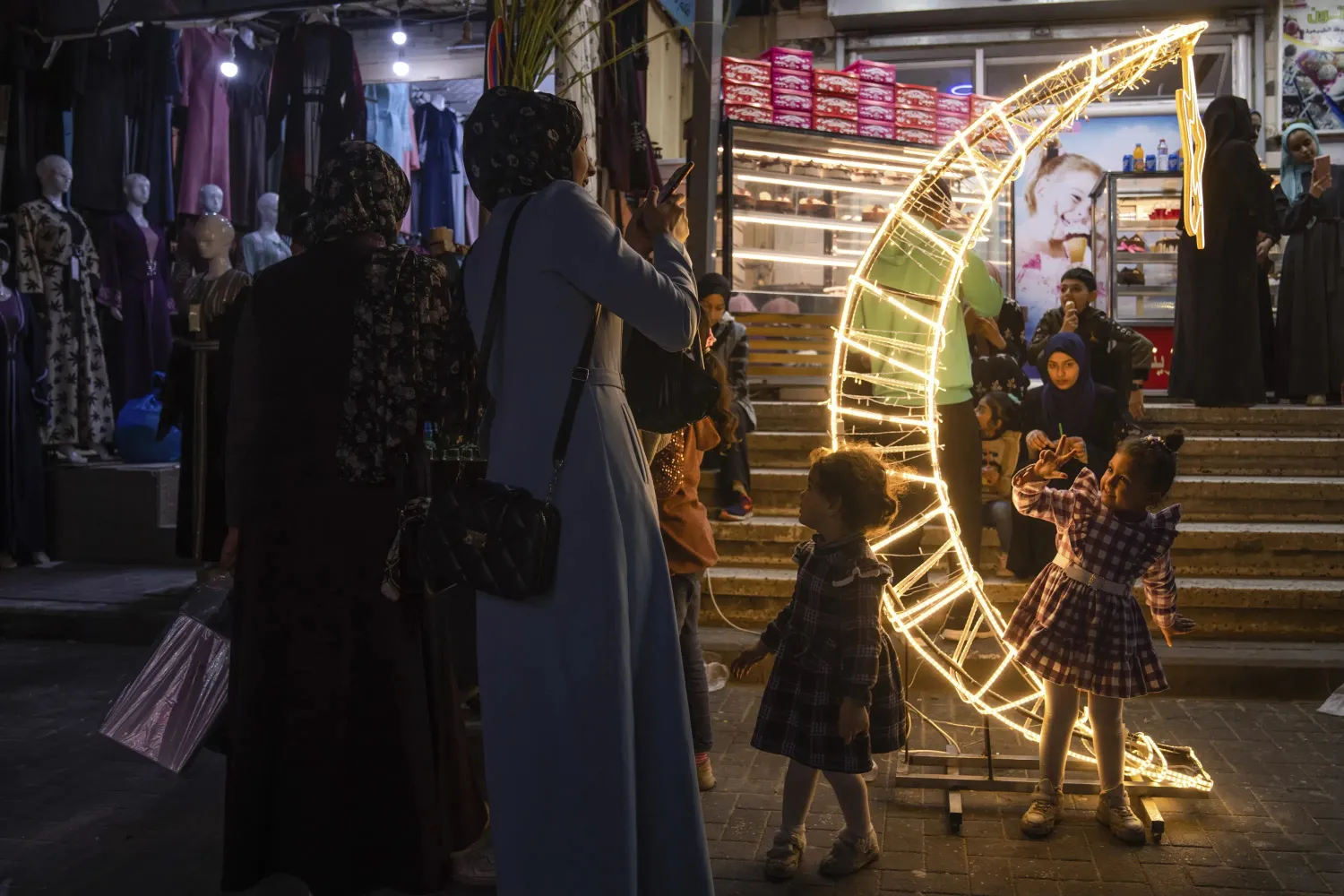

Ramadan Begins in Mideast amid High Costs, Hopes for Peace

A Palestinian woman takes photos of her daughter next to a crescent moon-shaped decoration in a market, at the beginning of the Muslim holy month of Ramadan in Jebaliya refugee camp, northern Gaza Strip, Wednesday, March 22, 2023. (AP Photo/Fatima Shbair)
TT

Ramadan Begins in Mideast amid High Costs, Hopes for Peace

A Palestinian woman takes photos of her daughter next to a crescent moon-shaped decoration in a market, at the beginning of the Muslim holy month of Ramadan in Jebaliya refugee camp, northern Gaza Strip, Wednesday, March 22, 2023. (AP Photo/Fatima Shbair)

The first daily fast of the Islamic holy month of Ramadan began Thursday, as hundreds of millions of Muslims worldwide enter a four-week period of worship.

The observance comes at a time when numerous countries and governments across the Middle East are taking tentative steps towards calming enduring conflicts and crises made more acute by the costly war in Ukraine and a devastating earthquake in Türkiye and Syria that killed over 52,000 people, The Associated Press said.

During the coming four weeks, hundreds of millions of Muslims will abstain from food and water from dawn to dusk, before gathering with family and friends for indulgent nighttime meals.
According to Islam, fasting draws the faithful closer to God and reminds them of the suffering of the poor.

In Sudan’s capital, families prepare and sell culinary delights weeks in advance to mark the break of the fast each evening, a meal known as Iftar.

The food and drink of choice for nighttime feasts across households in the Islamic African nation include assida, a semolina-based flour dish, and a sugary fermented drink called, “sweet bitter.” Both are recipes that date back generations.

“Those who can’t afford don’t have to pay,” said Fatima Mohammed Hamid, who sells the food items from her small home on Tuti island, just north of the Sudanese capital of Khartoum.

In addition to fasting, charity giving is another of Islam’s five pillars. During Ramadan, mosques and charities regularly provide meals for the poor at long tables that sprawl out onto the street.

For Sudan, the holy season comes as the promise of a new political era approaches. The country has been steeped in political chaos since a coup ousted a western powersharing government in October 2021.

A new transitional government could be formed before the holy month draws to a close, as promised by the country’s ruling military and other political forces earlier this week. However, many prominent Sudanese factions reject the move. Amid the uncertainty, most find common ground in complaining about the rising cost of living.

“Everything (the ingredients) costs double what it did last year,” said Hamid.

Israeli and Palestinian leaders pledged this week to lower tensions as Ramadan begins, following months of deadly violence in the West Bank and east Jerusalem. This year, the fasting period coincides with the Jewish festival of Passover, spurring concern about fresh flare-ups with large numbers of Jewish and Muslim faithful expected to pour into Jerusalem’s Old City.

From Gaza to Khartoum and Tunis to Sanaa, soaring prices are proving a further concern for those set to celebrate the occasion. Arab countries are continuing to suffer from the economic fallout of the war in Ukraine, with many reliant on grain imports from eastern Europe.

In Tunis’ once-bustling Bab al-Fellah market, rising costs have left shoppers unable to splurge on Ramadan food shopping as they might have in past years.

“I have almost used up the 40 dinars (roughly $13) that my husband gave me and I bought only vegetables, a chicken and some spices,’’ said a woman who identified herself only as Fatima B.

In war-torn Sanaa, the picture is bleaker still, with residents struggling to purchase even basic supplies. The country’s ruinous civil war, now entering its ninth year, has killed more than 150,000 people and pushed millions of Yemenis to the brink of famine.

“I am not able to provide daily sustenance for the children,” said Saleh al-Omrani, an unemployed resident from Sanaa. “We had Ramadan in the good old days, but today there is no longer Ramadan.”

In southern Türkiye and northwestern Syria, the destruction caused by last month’s earthquake poses perhaps the steepest challenge of all.

The quake destroyed or damaged hundreds of mosques, Turkish authorities say, leaving tens of thousands to pray in makeshift tents.

In northwestern Idlib province — Syria’s last rebel enclave -- very few families still have the energy or resources to make the necessary preparations for Ramadan this year.

Abdul Qahar Zakou, a cafe owner from the province, said he will decorate his cafe despite the prevailing misery and do his best to create a festive atmosphere.

“Despite all the odds, Ramadan will always have its own atmosphere, with a symbolism and spirituality that makes life easier,” said Zakou.

Fasting is required for all healthy Muslims, with exemptions for those who are sick and for women who are pregnant or breastfeeding. Small children are not expected to fast.

Eating or drinking in public during the day is generally frowned upon in Muslim countries.

Islam follows a lunar calendar, so Ramadan begins around a week and a half earlier each year.

At the end of Ramadan, Muslims celebrate the joyous Eid al-Fitr holiday, when children often receive new clothes and gifts.



Rescue Teams Search for Survivors in Building Collapse that Killed at Least 2 in Northern Lebanon

A Lebanese flag is pictured, in the aftermath of a massive explosion, in Beirut's damaged port area, Lebanon August 17, 2020. REUTERS/Hannah McKay
TT

Rescue Teams Search for Survivors in Building Collapse that Killed at Least 2 in Northern Lebanon

A Lebanese flag is pictured, in the aftermath of a massive explosion, in Beirut's damaged port area, Lebanon August 17, 2020. REUTERS/Hannah McKay

At least two people were killed and four rescued from the rubble of a multistory apartment building that collapsed Sunday in the city of Tripoli in northern Lebanon, state media reported.

Rescue teams were continuing to dig through the rubble. It was not immediately clear how many people were in the building when it fell.

The bodies pulled out were of a child and a woman, the state-run National News Agency reported.

Dozens of people crowded around the site of the crater left by the collapsed building, with some shooting in the air.

The building was in the neighborhood of Bab Tabbaneh, one of the poorest areas in Lebanon’s second largest city, where residents have long complained of government neglect and shoddy infrastructure. Building collapses are not uncommon in Tripoli due to poor building standards, according to The AP news.

Lebanon’s Health Ministry announced that those injured in the collapse would receive treatment at the state’s expense.

The national syndicate for property owners in a statement called the collapse the result of “blatant negligence and shortcomings of the Lebanese state toward the safety of citizens and their housing security,” and said it is “not an isolated incident.”

The syndicate called for the government to launch a comprehensive national survey of buildings at risk of collapse.


Israel to Take More West Bank Powers and Relax Settler Land Buys

A view of Israeli settlement of Maale Adumim, in the West Bank, Sunday, June 18, 2023. (AP)
TT

Israel to Take More West Bank Powers and Relax Settler Land Buys

A view of Israeli settlement of Maale Adumim, in the West Bank, Sunday, June 18, 2023. (AP)

Israel's security cabinet approved a series of steps on Sunday that would make it easier for settlers in the occupied West Bank to buy land while granting Israeli authorities more enforcement powers over Palestinians, Israeli media reported.

The West Bank is among the territories that the Palestinians seek for a future independent state. Much of it is under Israeli military control, with limited Palestinian self-rule in some areas run by the Western-backed Palestinian Authority (PA).

Citing statements by Finance Minister Bezalel Smotrich and Defense Minister Israel Katz, Israeli news sites Ynet and Haaretz said the measures included scrapping decades-old regulations that prevent Jewish private citizens buying land in the West Bank, The AP news reported.

They were also reported to include allowing Israeli authorities to administer some religious sites, and expand supervision and enforcement in areas under PA administration in matters of environmental hazards, water offences and damage to archaeological sites.

Palestinian President Mahmoud Abbas said the new measures were dangerous, illegal and tantamount to de-facto annexation.

The Israeli ministers did not immediately respond to requests for comment.

The new measures come three days before Prime Minister Benjamin Netanyahu is scheduled to meet in Washington with US President Donald Trump.

Trump has ruled out Israeli annexation of the West Bank but his administration has not sought to curb Israel's accelerated settlement building, which the Palestinians say denies them a potential state by eating away at its territory.

Netanyahu, who is facing an election later this year, deems the establishment of any Palestinian state a security threat.

His ruling coalition includes many pro-settler members who want Israel to annex the West Bank, land captured in the 1967 Middle East war to which Israel cites biblical and historical ties.

The United Nations' highest court said in a non-binding advisory opinion in 2024 that Israel's occupation of Palestinian territories and settlements there is illegal and should be ended as soon as possible. Israel disputes this view.


Arab League Condemns Attack on Aid Convoys in Sudan

A general view shows the opening session of the meeting of Arab foreign ministers at the Arab League Headquarters (Reuters)
TT

Arab League Condemns Attack on Aid Convoys in Sudan

A general view shows the opening session of the meeting of Arab foreign ministers at the Arab League Headquarters (Reuters)

Arab League Secretary-General Ahmed Aboul Gheit strongly condemned the attack by the Rapid Support Forces on humanitarian aid convoys and relief workers in North Kordofan State, Sudan.

In a statement reported by SPA, secretary-general's spokesperson Jamal Rushdi quoted Aboul Gheit as saying the attack constitutes a war crime under international humanitarian law, which prohibits the deliberate targeting of civilians and depriving them of their means of survival.

Aboul Gheit stressed the need to hold those responsible accountable, end impunity, and ensure the full protection of civilians, humanitarian workers, and relief facilities in Sudan.