

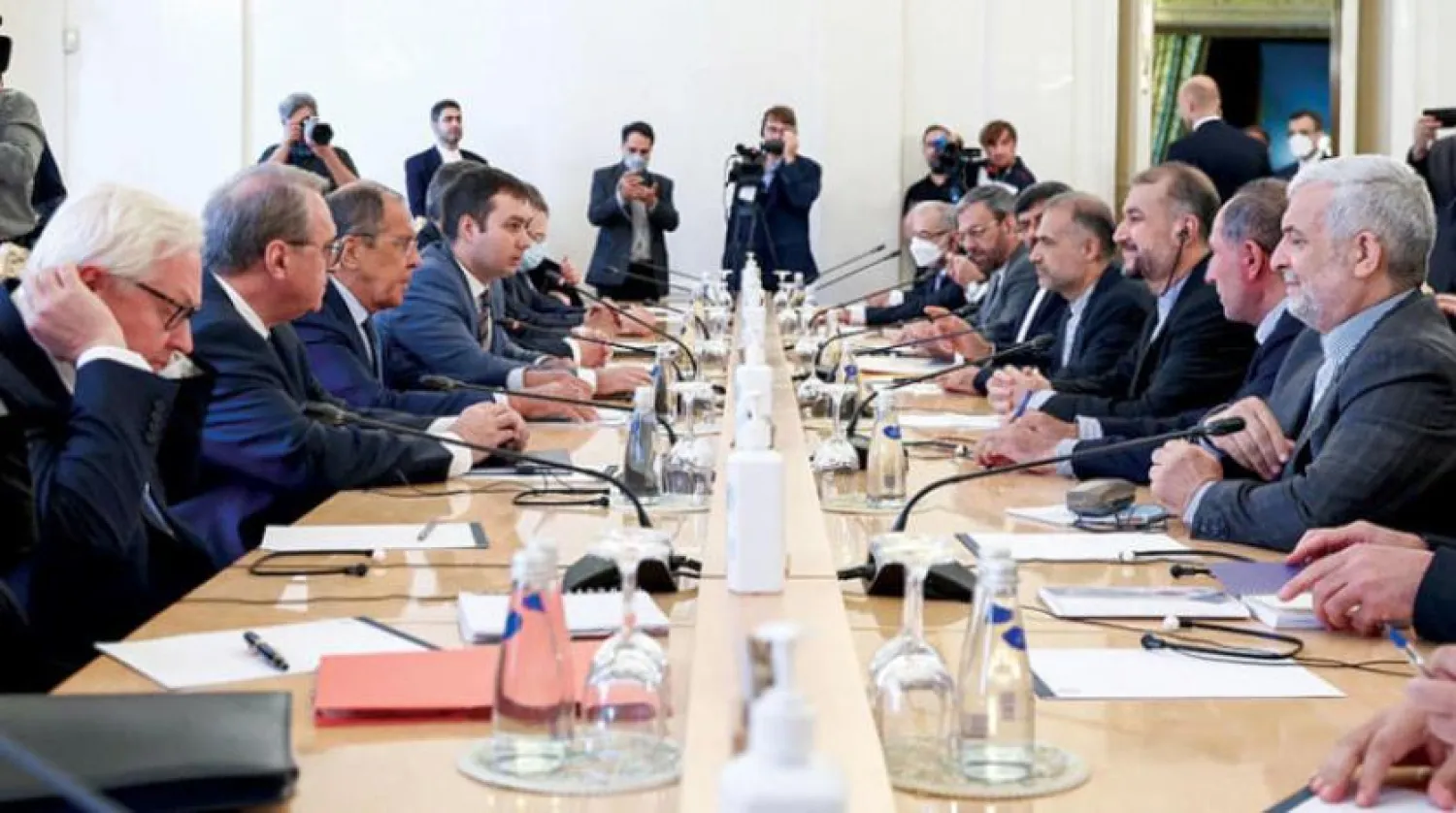

Lavrov, Abdollahian Discuss Opportunities to Revive Nuclear Pact

 Lavrov and Abdollahian held talks in Moscow in August. (Russian Foreign Ministry)
Lavrov and Abdollahian held talks in Moscow in August. (Russian Foreign Ministry)
TT

Lavrov, Abdollahian Discuss Opportunities to Revive Nuclear Pact

 Lavrov and Abdollahian held talks in Moscow in August. (Russian Foreign Ministry)
Lavrov and Abdollahian held talks in Moscow in August. (Russian Foreign Ministry)

Iranian Foreign Minister Hossein Amir-Abdollahian will visit Moscow on Wednesday to hold talks with his Russian counterpart, Sergey Lavrov, on several issues, including faltering efforts to revive the nuclear agreement.

Iranian media quoted the Iranian ambassador to Moscow, Kazem Jalali, as saying that Abdollahian will follow up on the implementation of bilateral agreements, and will review regional developments, and the latest situation in the International North-South Transport Corridor.

The Iranian foreign minister had announced his visit to Moscow, saying in a Tweet on Monday: “Balanced foreign policy and active diplomacy are on the right track.”

Last week, Russian Foreign Ministry spokeswoman Maria Zakharova told reporters at her weekly press briefing that Lavrov will hold consultations with his Iranian counterpart on Wednesday on current international issues, including the Joint Comprehensive Plan of Action (JCPOA).

The two ministers are also expected to discuss the regional situation in light of the agreement between Riyadh and Tehran to resume diplomatic relations, according to the Russian Foreign Ministry spokeswoman.

Abdollahian is currently facing increasing pressure, whether from critics of the current government’s approach to the nuclear negotiations or those questioning his ability to lead the Iranian diplomatic apparatus. In fact, the Secretary-General of the Iranian National Security Council, Ali Shamkhani, stole the limelight in the wake of the Iranian-Saudi agreement, and his visit to both Abu Dhabi and Baghdad, which preceded the meetings held by the head of the Strategic Relations Committee, Kamal Kharazi, in Damascus and Beirut.

Abdollahian, Shamkhani, and Kharazi have all tried to deny the presence of any divisions among the Iranian bodies, stressing coordination on foreign policy.

On the eve of his visit to Moscow, the Iranian foreign minister sent several messages in press statements that were reported by the official media on Tuesday. He warned that the doors of nuclear negotiations “will not remain open,” speaking of a plan that the Iranian parliament intends to discuss to set a ceiling for nuclear talks.

Nonetheless, Abdollahian said that Tehran was “committed” to cooperating with the International Atomic Energy Agency (IAEA), in reference to the recent agreement reached by the director of the UN agency, Rafael Grossi, regarding the investigation of uranium particles recently found at the Fordo facility, with a purity of 83.7 percent, or the thorny investigation of traces of uranium in three undeclared sites.

Meanwhile, the Russian envoy to international organizations in Vienna, Mikhail Ulyanov, said on Monday that the negotiations to revive the nuclear agreement remained at a dead end, adding that the Western parties were “refraining from announcing their death.”

In remarks to the Russian Novosti agency, Ulyanov noted that the chances of completing the negotiation process “still exist today, although they seem to be very limited.”

“The United States opposes the resumption of the negotiation process in the first place, as well as the three European countries (Germany, France and Britain), which seem to have almost lost interest in restoring the nuclear deal,” he added.



Trump Says Tuesday Deadline to Make a Deal with Iran Is Final

US President Donald Trump speaks to members of the media during the annual Easter Egg Roll on the South Lawn of the White House in Washington, DC, USA, 06 April 2026. (EPA)
TT

Trump Says Tuesday Deadline to Make a Deal with Iran Is Final

US President Donald Trump speaks to members of the media during the annual Easter Egg Roll on the South Lawn of the White House in Washington, DC, USA, 06 April 2026. (EPA)

US President Donald Trump said on Monday the Tuesday deadline he has set for Iran to make a deal is final, calling Iran's peace proposal significant but not good enough.

Trump has warned US forces will unleash broad attacks on Iranian infrastructure if his Tuesday night deadline is not met. Iran has rejected Trump's deadline.

"They ‌made a ‌proposal, and it's a ‌significant ⁠proposal. It's a significant step. ⁠It's not good enough," Trump told reporters during an Easter egg event for children on the White House South Lawn.

"It could end very quickly, the war, if they do what they have to do. They ⁠have to do certain things. ‌They know that, they've ‌been negotiating I think in good faith," he ‌said.

Trump's senior aides have been negotiating ‌with Iran indirectly through Pakistan, attempting to get a deal in which Iran will forswear nuclear weapons and reopen the Strait of Hormuz, the oil ‌transit waterway. Iran said it wanted a permanent end to the war, ⁠not ⁠just a temporary ceasefire.

Trump said it appeared the latest team representing the Iranian government is "not as radicalized" as others who have been killed in airstrikes. "We think they're actually smarter," he said.

Trump said if it were up to him, the United States would take control of Iran's oil, but he said the American people would probably not understand such a move.


Red Cross Chief Condemns ‘Deliberate Threats’ Against Civilians in Mideast War

A man walks past the damaged building of the Shahid Beheshti University following a strike, in Tehran on April 4, 2026. (AFP)
TT

Red Cross Chief Condemns ‘Deliberate Threats’ Against Civilians in Mideast War

A man walks past the damaged building of the Shahid Beheshti University following a strike, in Tehran on April 4, 2026. (AFP)

The head of the International Committee of the Red Cross on Monday condemned "deliberate threats" against civilian targets that have marked the widening Middle East war.

Without naming any side, ICRC president Mirjana Spoljaric said there had already been widespread destruction of "essential" infrastructure and that "any war fought without limits is incompatible with the law" and "indefensible".

Spoljaric spoke out as the conflict headed for a new crisis point with US President Donald Trump threatening attacks on Iranian bridges and power stations unless Iran reopens the Strait of Hormuz to international shipping.

The ICRC chief, whose body is considered a key guardian of the Geneva conventions, has already warned over the conduct of the war since it started on February 28 with US-Israeli attacks on Iran. Iran has responded with retaliatory strikes on Gulf states and Israel.

"Deliberate threats, whether in rhetoric or in action, against essential civilian infrastructure and nuclear facilities must not become the new norm in warfare," Spoljaric said in a statement.

"Any war fought without limits is incompatible with the law. It is indefensible, inhumane and devastating for entire populations."

She added: "States must respect and ensure respect for the rules of war in both what they say and what they do. The world cannot succumb to a political culture that prioritizes death over life."

Spoljaric said that, across the Middle East, ICRC "teams are seeing the destruction of infrastructure essential for civilian life. Power plants, water systems, hospitals, roads, bridges, homes, schools and universities have come under fire.

"Most alarming are potential threats to nuclear facilities. Any miscalculation can cause irreversible consequences for generations to come.

"I urgently call on parties to spare civilians and civilian objects in all military operations. It is their obligation under international humanitarian law."


Death Toll From Extreme Weather in Afghanistan Increases to 110

Residents inspect a building that partially collapsed due to heavy flooding in Jalalabad, Afghanistan, Saturday, April 4, 2026. (AP)
TT

Death Toll From Extreme Weather in Afghanistan Increases to 110

Residents inspect a building that partially collapsed due to heavy flooding in Jalalabad, Afghanistan, Saturday, April 4, 2026. (AP)

The death toll from extreme weather that has triggered widespread flooding and landslides in many parts of Afghanistan has increased to at least 110, authorities said Monday, with another seven people missing and more heavy rain forecast.

Storms and heavy rainfall began across Afghanistan about 12 days ago, affecting most of the country’s 34 provinces. Over the past 24 hours alone, 11 people have died and six have been injured, the Disaster Management Authority said. Seven people were reported missing in separate incidents, all believed to have been carried away by floodwater.

Overall, the flooding, landslides and lighting strikes have killed 110 people and injured 160 in the past 12 days, the authority said, while 958 homes have been completely destroyed and another 4,155 have suffered partial damage.

The Defense Ministry said Monday that it had used a helicopter to airlift two people to safety after they became stranded by floodwater in the western province of Herat.

More than 325 kilometers (200 miles) of roads have been destroyed, while businesses, agricultural land, irrigation canals and fresh-water wells have also been damaged, affecting 6,122 families, the authority said. It said the figures are preliminary.

Authorities issued weather warnings for Tuesday for nearly the entire country, warning people to stay away from rivers and areas prone to flooding.

Earlier this year, heavy snowfall and flash floods left dozens of people dead across the country.

Two major highways have been closed for days due to landslides and floods, forcing travelers to take long, circuitous routes to reach their destinations. The Kabul to Jalalabad highway — the main route linking the capital to the Pakistani border and eastern Afghan provinces — has been shut since last Thursday, while the road from Jalalabad, the main city in eastern Afghanistan, heading northeast to Kunar and Nuristan provinces has been closed since Sunday by falling rocks.

Snow and heavy rain often trigger flash floods that kill scores, or even hundreds, of people at a time in Afghanistan. In 2024, more than 300 people died in springtime flash floods.