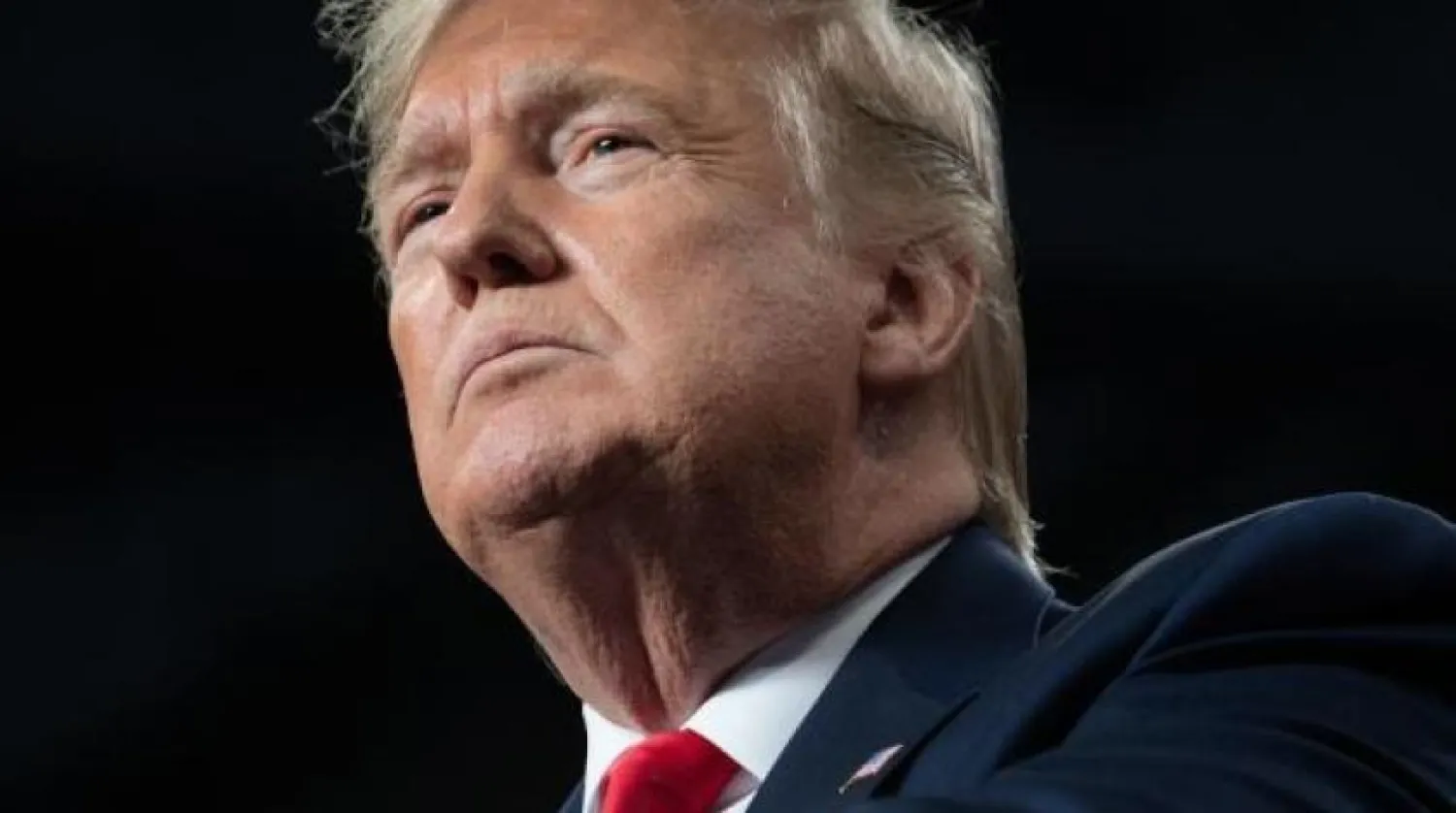
Trump Faces Setbacks in Other Probes as NY Case Proceeds

Former US president Donald Trump
TT

Trump Faces Setbacks in Other Probes as NY Case Proceeds

Former US president Donald Trump

Former President Donald Trump faces the most urgent legal challenge of his life this week in New York, where he’s set to be arraigned Tuesday on charges arising from hush money payments during his 2016 campaign.

But as much of the attention will be on the courthouse in lower Manhattan, investigations from Atlanta to Washington will press forward, underscoring the broad range of peril he confronts as he seeks to reclaim the presidency, The Associated Press said.

The vulnerability Trump faces in Washington alone has become clear over the past month, as judges in a succession of sealed rulings have turned aside the Trump team’s efforts to block grand jury testimony — including from his own lawyer and his former vice president — from witnesses who were, or still are, close to him and who could conceivably offer direct insight into key events.

The rulings directing advisers and aides to testify don't suggest that the Justice Department is close to bringing criminal charges, nor do they guarantee that prosecutors can secure testimony valuable to a potential prosecution. But they're nonetheless a key, closed-door win for the government as it investigates whether classified documents were criminally mishandled at Trump's Florida home and the possible obstruction of that probe, as well as efforts by Trump and his allies to undo the results of the 2020 presidential election.

“I do think when you're talking about an attempted insurrection and the kinds of issues that we're talking about there, there's going to be a lot of arguments on DOJ's side” to get the testimony, said Randall Eliason, a former federal prosecutor and a George Washington University law professor.

Meanwhile, the district attorney in Atlanta is continuing to investigate attempts by Trump and his allies to undo his election loss in Georgia. A special grand jury in February said it believed “one or more witnesses” committed perjury and urged local prosecutors to bring charges.

The former president never testified before the special grand jury, meaning he is not among those who could have perjured themselves. But the report doesn’t foreclose the possibility of other charges, and the case still poses particular challenges for Trump, in part because his actions in Georgia were so public.

Overall, the number of sealed disputes over the scope of grand jury testimony is unusual but perhaps befitting for hugely consequential probes like one concerning a former president. It also stands in contrast to the last special counsel investigation involving Trump, when he was president and when Robert Mueller and his team of prosecutors sought to determine whether Trump's 2016 campaign had colluded with Russia to tip the election.

In that probe, a lawyer inside the White House, Ty Cobb, facilitated voluntary interviews of White House staff — without subpoenas — in hopes that cooperation would hasten the investigation toward conclusion.

“If I could figure out a way to cooperate and still preserve executive privilege, it would speed things up, which in my judgment ... was imperative to the president and to the country,” Cobb said in a recent interview. “We were able to accelerate getting them all of the information.”

Trump in that investigation was protected by the power of his office and by Justice Department legal opinions that say a sitting president cannot be indicted. No longer president, Trump has lost that shield, raising the stakes of his criminal exposure. And as prosecutors have sought to question people close to him — whether to better understand Trump's state of mind and possible defenses, or to gather potentially damaging testimony — Trump's lawyers have repeatedly objected, often in vain.

Perhaps the most vivid example came last month when the then-chief judge of the D.C. federal court ordered that Trump's lawyer, M. Evan Corcoran, had to give more grand jury testimony in the Mar-a-Lago investigation. He had invoked attorney-client privilege in an earlier appearance before the grand jury in declining to answer more questions, but prosecutors pressed for more testimony.

They cited what's known as the crime-fraud exception to attorney client privilege, which allows prosecutors to compel testimony from a lawyer if they can convince a judge that a client was using legal services in furtherance of a crime. US District Judge Beryl Howell ruled that Corcoran had to return before the grand jury, and he was in court a week later.

Another instance came last week when a different federal judge, James Boasberg, ruled that former Vice President Mike Pence had to give some testimony in a Justice Department special counsel probe into efforts to undo the election.

The decision rejected the Trump team's arguments of executive privilege, though Boasberg did give Pence a victory by accepting his lawyers' arguments that, for constitutional reasons, he could not be questioned about his actions on Jan. 6, 2021, when a mob of Trump’s supporters stormed the US Capitol as Republican Pence was presiding over a joint session of Congress to certify Democrat Joe Biden’s victory.

A Trump spokesman did not respond to a request for comment on this story but responded to the ruling in the Pence matter in a statement saying that the Justice Department “is continuously stepping far outside the standard norms in attempting to destroy the long accepted, long held, Constitutionally based standards of attorney-client privilege and executive privilege.”

Other former Trump aides, including Stephen Miller and former national security adviser Robert O'Brien, have also recently been ordered by a judge to offer testimony despite Trump team objections of executive privilege.

The ability of Justice Department prosecutors in multiple instances to convince judges that there's a basis to secure the testimony is significant to the extent that it shows that “there's a there there” with respect to the investigations, Eliason said.

But he cautioned from reading too much into it, given that the threshold for prevailing in a fight over executive privilege or attorney-client is lower than the burden needed to win a criminal case at trial.

“It’s a far cry from being able to prove guilt beyond a reasonable doubt in a contested trial,” Eliason said. “It would be quite a leap to go from there and be able to say that they've got a criminal case locked up.”


2 Planes Collide on the Ground in Miami, Only Minor Injuries Reported

FILE - Vehicles drive past the entrance to Miami International Airport in Miami May 12, 2020, (AP Photo/Wilfredo Lee, File)
TT

2 Planes Collide on the Ground in Miami, Only Minor Injuries Reported

FILE - Vehicles drive past the entrance to Miami International Airport in Miami May 12, 2020, (AP Photo/Wilfredo Lee, File)

Federal aviation safety officials on Sunday were investigating a minor collision between two planes at a taxiway intersection at Miami International Airport, where one aircraft's wingtip struck the nose of another, authorities said. Two people reported minor injuries.

The accident happened at about 9 p.m. Saturday and involved a Copa Airlines Boeing 737 passenger aircraft with 172 people aboard and a UPS Boeing 767 cargo plane, according to the National Transportation Safety Board and Copa Airlines. The wing of the Copa flight and the nose of the UPS plane collided, the NTSB said.

Photos taken at the scene show the UPS plane nose with a horizontal gash on one side and a larger hole in the middle, The Associated Press reported.

On audio recorded by ATC.com, a pilot on the UPS plane told air traffic control that he went too far at the intersection and his plane was clipped by the Copa flight. Air traffic control told the UPS pilot that he was supposed to yield to the Copa aircraft.

The NTSB said it was gathering information and may provide an update on Sunday.

The Copa plane had just arrived from Panama City and the UPS plane was headed to Bogota, Colombia, officials said.

In a statement on social media, Copa called the collision minor and said two of its passengers were treated at the scene for minor injuries.

UPS said it was working with authorities to determine what happened.

“We cannot speculate on the details of the incident,” UPS said in a statement.

“The National Transportation Safety Board is responsible for investigating incidents like this and will control the flow of information.”

The mishap came two months after an Amazon cargo plane careened off a runway at Miami International and smashed into a van carrying workers for a company that cleans airplanes, killing five people.


Nearly 1,500 Migrants Arrive in Canary Islands in One Day

Rescued migrants disembark from a Spanish Maritime Rescue Service vessel with assistance from emergency workers and Civil Guard officers at the port of La Restinga in El Pinar on the island of El Hierro, Canary Islands, Spain, 14 November 2026. EPA/GELMERT FINOL
TT

Nearly 1,500 Migrants Arrive in Canary Islands in One Day

Rescued migrants disembark from a Spanish Maritime Rescue Service vessel with assistance from emergency workers and Civil Guard officers at the port of La Restinga in El Pinar on the island of El Hierro, Canary Islands, Spain, 14 November 2026. EPA/GELMERT FINOL

Almost 1,500 migrants arrived in Spain's Canary Islands on Saturday, the highest number in a single day since 2020, the EFE news agency reported on Sunday, citing the maritime rescue service.

A total of 1,488 people in 14 boats were rescued by the Spanish coastguard, EFE reported, continuing a surge of arrivals from West African countries to the Spanish archipelago since October.

The previous one-day record was the 1,461 people rescued in waters off the Canary Islands on November 7, 2020, maritime rescue services said ⁠on Sunday, according to Reuters.

While migrant ⁠arrivals have declined so far this year compared with the same period last year, the sharp increase last month placed additional pressure on reception and emergency services on some of the Canary Islands, particularly the smaller and less densely populated ones.

One boat on ⁠Saturday was carrying 240 people, including 12 women and 36 children, authorities said. The rescued migrants were taken to El Hierro, one of the smallest Canary Islands. Most of the people were from Senegal, Gambia and Guinea Conakry.

Twelve boats arrived in El Hierro, plus one in Gran Canaria and another in Tenerife.

Spain's Territorial Policy Minister Angel Victor Torres will visit El Hierro on Sunday to discuss the surge in migrant arrivals.

The Atlantic ⁠route ⁠from West Africa to the Canary Islands is one of the world's deadliest migration crossings. Thousands of migrants attempt the journey each year in overcrowded boats, seeking to reach Spanish territory despite rough seas, strong currents and long distances.

Arrivals tend to pick up in the autumn months, when sea conditions along the route are generally calmer and more favorable for crossings.

Migrant arrivals to the Canary Islands between January and October 31 were down 5.5% from the same period last year, government data show.


Iranian Lawmaker: A Nuclear Bomb is a ‘Public Demand’

Satellite imagery from Jun 9th, 2025 via Airbus/Bulletin, shows a truck at Iran’s Isfahan underground complex carrying 18 sealed containers (AP)
TT

Iranian Lawmaker: A Nuclear Bomb is a ‘Public Demand’

Satellite imagery from Jun 9th, 2025 via Airbus/Bulletin, shows a truck at Iran’s Isfahan underground complex carrying 18 sealed containers (AP)

Iranian lawmaker Hosseinali Haji Deligani said on Saturday that building a nuclear bomb has become a public demand, just days before a meeting of the International Atomic Energy Agency’s Board of Governors to discuss Iran.

“Today, one of the people's demands is that Iran, in addition to its faith and missiles, must build and possess a nuclear bomb,” said Haji Deligani, the deputy head of the Article 90 Commission in the Iranian Parliament, according to Fars news agency.

He argued that Tehran should possess nuclear weapons regardless of whether it intends to use them.

“We must have this capability. Whether it is used or not is a separate matter,” the lawmaker noted.

He said, “based on current assessments, the enemy would not launch a nuclear attack on Iran because of the country’s vast size and the significant repercussions of such an attack.”

The Article 90 Commission of Iran's parliament is mandated to receive, investigate, and respond to written complaints regarding the performance of the legislative, executive, and judicial branches.

Iran has made no official decision to change its nuclear doctrine despite growing calls from lawmakers and members of the public to reconsider its position if war resumes.

Iranian Foreign Ministry spokesperson Esmaeil Baghaei said on Monday that Tehran had not suspended its obligations under its safeguards agreement with the International Atomic Energy Agency (IAEA).

Speaking to reporters, Baghaei said Iran remained a party to the Treaty on the Non-Proliferation of Nuclear Weapons (NPT) and continued to uphold both the treaty and its safeguards agreement. He said the country had demonstrated its adherence to those commitments.

Grossi’s Report

Haji Deligani’s statements came one day after the UN’s nuclear watchdog said it cannot confirm that Tehran hasn’t diverted nuclear material away from peaceful purposes.

In a confidential report on Iran seen by media outlets on Friday, the UN’s nuclear watchdog said because of a lack of cooperation from Iran, it “is not able to conclude that there has been no diversion of declared nuclear material from peaceful nuclear activities in Iran.”

IAEA said it is “increasingly concerned” about a uranium-enrichment plant at Isfahan that Iran declared to it last year but has still not let the watchdog inspect.”

“It is more than a year since the Agency lost continuity of knowledge in relation to the previously declared inventories of LEU (low-enriched uranium) and HEU (highly enriched ⁠uranium) enriched up to 60% U-235 at the declared nuclear facilities affected by the attacks of June 2025,” IAEA Director General Rafael Grossi wrote in his last report on Iran.

He added that Iran needs to allow inspectors back in “with the utmost urgency.”

Inspectors have yet to return to nuclear sites the United States and Israel bombed in June 2025.

Until those attacks, the IAEA estimates Iran had 440.9 kg of uranium enriched to up to 60% purity, a short step from the roughly 90% of weapons-grade uranium. That is enough material, if enriched further, for 10 nuclear weapons, according to an IAEA yardstick, and Iran also had material enriched to lower levels.

“The director general encourages Iran to consider technical and gradual measures by which conditions are achieved that allow for the return of agency inspectors to Iran,” the report said.

But Iran told the IAEA that discussions on restarting inspections in the country cannot resume amid “a series of persistent, explicit, and public threats by the President of the United States of America.”

Criticizing legal and technical basis of IAEA’s reports, Iran Mission to UN Office in Vienna said normal execution of safeguards cannot resume under the abnormal condition created by attacks on Iran’s safeguarded nuclear sites.

In a message posted on its X account on Saturday, the Iranian mission also criticized Grossi’s reporting, arguing that the Board’s decisions have been adopted through an abuse of process and that the US-Israeli attacks on Iran have disrupted inspections and forced the withdrawal of the IAEA’s inspectors.

“The United States removed aggression from bias resolutions, but its consequences cannot be erased from reality,” the statement added.

An Unavoidable Necessity

Last Thursday, Iran’s Assembly of Experts called for considering the country’s withdrawal from the Nuclear Non-Proliferation Treaty (NPT), alongside a review of Iran’s defense doctrine and the establishment of what it described as necessary deterrence.

In a statement carried by Iranian media, the Assembly said that reviewing withdrawal from the NPT, revising the country’s defense doctrine and establishing the necessary deterrence had become an “unavoidable necessity” and a “public and national demand.”

Two weeks ago, Mohsen Araki, a member of the Assembly of Experts and the Expediency Discernment Council, said Iran should reconsider its membership in the Nuclear Non-Proliferation Treaty. He also noted that the country had suffered setbacks without gaining comparable benefits.

“The Islamic Republic has suffered considerable harm and setbacks over the years because of its membership in and continued adherence to this treaty, while gaining no commensurate benefit from that membership,” said Araki.